Andrés Iniesta: From Barcelona Legend to Entrepreneur
Inside Andrés Iniesta’s family winery and NSN sports ventures, with verified career milestones, ownership history and a clear view of the business risks.
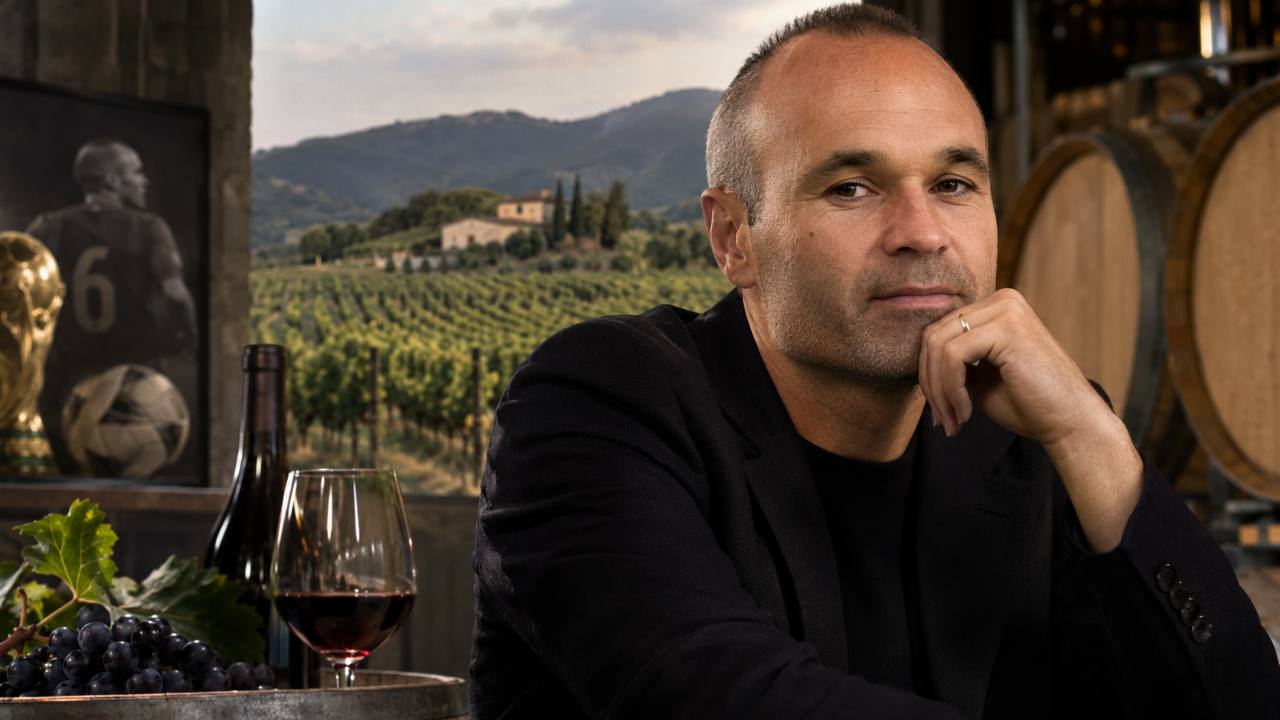
AI-generated editorial illustration supplied for PRESDA. The winery scene is imagined, not an authenticated photograph of Iniesta, the estate, a wine label or a business event.
Andrés Iniesta did not wait for his final match to begin a life in business. The Barcelona and Spain midfielder was already associated with a family winery while still playing at the highest level, and later developed sports ventures through NSN. His story connects Fuentealbilla’s vineyards with football ownership and professional cycling, but it is not a simple catalogue of celebrity riches. Family origins, corporate partners and the commercial risks of each venture matter as much as the famous name on the bottle. Bodega Andrés Iniesta: family and vineyard history NSN: company history and leadership
The strongest way to understand this second career is to follow what each business actually does. Bodega Andrés Iniesta grows and markets wine and offers tourism. NSN works across sport and entertainment and participates in sporting organizations through company structures. A player’s popularity can help both, but it does not make farming predictable, event promotion risk-free or a sports investment immediately profitable.
The football legacy that opened doors
Iniesta joined Barcelona’s youth system in 1996 and made his first-team debut in 2002. Across 674 official appearances, he helped the club win 32 trophies, including nine league titles and four Champions Leagues. These are Barcelona’s own career figures, rather than an estimate assembled from friendly matches. Alongside his technique, his longevity gave him an identity that sponsors, supporters and business partners could recognize across borders. FC Barcelona: Iniesta’s playing record
| Date | Milestone |
|---|---|
| 1996 | Joins Barcelona’s youth system |
| 2002 | First-team debut for Barcelona |
| 1990s to 2010 | Father’s vineyard project develops into a winery open to the public |
| July 11, 2010 | Scores Spain’s World Cup final winner |
| 2018 | Leaves Barcelona for Vissel Kobe |
| 2023 | Reported winery balance-sheet restructuring |
| October 8, 2024 | Announces retirement as a player |
| April 11, 2025 | Helsingør announces approval of NSN ownership structure |
| November 21, 2025 | NSN and Stoneweg announce cycling joint venture for 2026 |
His defining moment for Spain came on July 11, 2010, when his extra-time goal defeated the Netherlands 1–0 in the World Cup final. UEFA records the winner in the 116th minute. It made him a national sporting figure beyond club allegiances, but the goal and the winery opening in the same year should not be confused: the family’s agricultural project had roots well before that night in Johannesburg. UEFA, July 11, 2010: World Cup final winner
Bodega Iniesta began with his father’s vineyards
The winery’s own history traces the project to José Antonio Iniesta’s planting of ten hectares in the 1990s. It says Bodega Andrés Iniesta opened to the public in 2010. The business is based in Fuentealbilla, in Albacete’s Manchuela wine country, and presents itself as a family enterprise. That is a more useful origin story than the assumption that a retired star suddenly bought a fashionable lifestyle asset. Bodega Andrés Iniesta: family and vineyard history
Football fame meets agricultural time
Vines, harvesting and winemaking operate on timescales different from a player’s career or a marketing campaign. Land must be maintained, grapes grown and products brought to market. The connection with Iniesta can make consumers notice a bottle, but the promise has to be supported by what is inside it and by an operation capable of continuing after the initial attention has moved elsewhere.
The winery lists brands including Corazón Loco and Finca El Carril, with different wine styles. Its current history describes almost 300 hectares and fourteen grape varieties. Those are the company’s published descriptions, not independently measured production or audited sales. They show the scope of the operation it presents to customers, while leaving separate questions about annual output, margins and the financial return to its owners. Bodega Andrés Iniesta: family and vineyard history
The family business is more than a label
The official website markets bottles and gift sets, olive oil, guided visits and rural accommodation. That creates several ways for customers to engage with the estate: buying a product, visiting the winery or staying in the surrounding landscape. It also shows how a sporting identity can be incorporated into a place-based business without making every activity a football product. Bodega Andrés Iniesta: products, visits and accommodation
Tourism brings another operating model
Visits and accommodation are services, not simply additional bottles sold. They require organization, bookings and a visitor experience. For a family business associated with a global athlete, they can connect local identity with an international audience. Their existence does not prove how much revenue they produce, and a displayed booking offer should not be converted into an invented occupancy rate or profit figure.
The family element is important because the work is not performed by a famous midfielder alone. The official history credits his father’s initiative and the estate’s own development. Iniesta’s public identity can attract interest, while agricultural, production and hospitality professionals perform different tasks. Recognizing those roles makes the entrepreneurship story more credible than treating every vine, sale and customer experience as the player’s personal accomplishment.
Growth and profitability are different questions
Cinco Días reported a €5.87m debt-to-equity conversion in August 2023 after losses. That was balance-sheet restructuring, not new sales. Cinco Días, August 9, 2023: winery recapitalization
This distinction is essential in celebrity-business reporting. A capital increase can change how a company is financed without representing the same amount of cash arriving from customers. Land, buildings and a recognized brand can coexist with weak operating results. Conversely, a loss in a particular accounting period does not by itself establish that a business has closed or that every other venture owned by the family has failed.
Why no personal fortune estimate is needed
The public information reviewed does not establish the current consolidated value of Iniesta’s holdings or his annual personal income from the winery. Nor should one company’s historical accounts be presented as the 2026 result of an entire portfolio. An honest profile can explain the documented restructuring and the operating model while declining to fill those gaps with a guessed net worth or a claim of uninterrupted commercial success.
The lesson is not that fame is useless. It is that visibility and commercial execution are separate resources. Football can create recognition in markets far from Fuentealbilla. A winery still needs customers who return, distribution that works and financial arrangements that support the business. These requirements make the family’s agricultural venture a real entrepreneurial story, rather than a decorative epilogue to a football career.
NSN took the story into sports and entertainment
NSN, short for Never Say Never, lists Iniesta as a co-founder and connects its story with Barcelona and Kobe. Its November 2025 partner announcement described the company as seven years old, placing its origins around 2018, the year he moved to Vissel Kobe. Its model spans live events, content and representation-related activity. It is therefore not simply a holding company for a former player’s souvenirs, and its development overlapped with years in which Iniesta was still playing professionally. NSN: company history and leadership Stoneweg and NSN, November 21, 2025: cycling joint venture
A sports company is not the same as its co-founder
NSN’s ventures involve partners and operating teams. The name of an investor or co-founder does not establish that person’s exact percentage in every subsidiary, the amount personally contributed to a transaction or the liabilities attached to each venture. A useful account names the relevant corporate entity instead of describing all its assets as if Iniesta had individually bought and managed them himself.
The company’s November 2025 announcement with Stoneweg described activities including sporting events, content, player representation and a majority stake in gravel-bike brand GUAVA. These were corporate descriptions of a portfolio at that date. They should not be turned into a current personal asset valuation, or a guarantee that every line of activity has the same ownership, financial performance or development timetable. Stoneweg and NSN, November 21, 2025: cycling joint venture
What the Helsingør investment actually means
On April 11, 2025, FC Helsingør announced that its ownership structure had been approved by the Danish Business Authority. The club identified NSN as its owner and Iniesta as one of NSN’s owners. This is the crucial distinction: he was involved through a company and a wider ownership group, not described by the club as the sole personal owner of the Danish team. FC Helsingør, April 11, 2025: approved ownership structure
Football knowledge still needs local execution
The club’s statement presented approval as a basis for long-term development. That was its stated intention, not evidence that promotion, improved finances or sporting success had already followed. Ownership in football concerns an institution with its own staff, supporters and commitments. Experience gained at Barcelona is valuable context, but it does not remove the different requirements of managing a club in another country.
The Helsingør example also shows why announcing an investment and recording an approved structure are distinct milestones. Both can appear in a company’s growth narrative, but they answer different questions. Reporting the dated club confirmation gives readers a firmer basis than a headline claiming that Iniesta simply purchased a team, without explaining who owns it or what authority approved the arrangement.
The move into professional cycling
On November 21, 2025, NSN and Stoneweg announced a joint venture to take over the WorldTour and development-team structure ahead of the 2026 season. The new identities were NSN Cycling Team and NSN Development Team. The primary announcement described a Swiss licence and a base in Spain, with Kjell Carlström remaining general manager. This was an investment in an existing sporting structure, not the creation of professional cycling from nothing. Stoneweg and NSN, November 21, 2025: cycling joint venture
A new identity with an existing history
AP’s contemporaneous reporting placed the change in the context of the former Israel-Premier Tech team’s rebranding after protests and disruption during the 2025 season. That background matters when explaining what was acquired. The new name represented a change in ownership and identity around an established organization, rather than a claim that Iniesta personally assembled every rider or originated the team’s sporting record. AP, November 21, 2025: cycling team’s change of identity
Stoneweg’s announcement also said it was becoming a shareholder in NSN. A partnership can therefore operate at more than one level, with investment in the company as well as a joint sporting project. The document does not establish Iniesta’s personal return or justify assigning him the partner’s assets under management. Managed investor capital is not the private bank balance of a footballer associated with the business. Stoneweg and NSN, November 21, 2025: cycling joint venture
Retirement was a transition, not the starting gun
Iniesta announced his retirement as a player on October 8, 2024, following Barcelona, Vissel Kobe and Emirates Club. Barça’s report described the move from Fuentealbilla to La Masia as central to his life. His business activities show another continuity: connections with home, Spain and Japan became part of a wider professional network. Yet the businesses had their own histories and did not all begin on the day he stopped playing. FC Barcelona, October 8, 2024: retirement announcement
Different ventures, different tests of success
For a winery, product quality, sales and financial resilience matter. For an events company, delivery and relationships with clients and partners matter. For a sports investment, governance and competitive development add further tests. These are ways to assess the ventures, not financial results established by the sources. Keeping them separate avoids judging all entrepreneurship through the emotional memory of one famous World Cup goal.
The same care applies to the future. A company’s announced ambition is not an achieved result, and a historical loss is not an eternal verdict. The available records support a portrait of Iniesta participating in family enterprise and increasingly international sports businesses. They do not support a neat story in which every investment has already become a success or his playing intelligence automatically turns into investment performance.
A second career rooted in relationships
Iniesta’s entrepreneurial journey brings together his father’s agricultural project, the recognition built at Barcelona and Spain, and corporate relationships developed across sport. Each connection gave a venture a different starting advantage. None removed the need for people who know winemaking, hospitality, finance, events or the daily operation of a sporting organization. That shared work is the substance behind the public-facing name.
The most interesting continuity is therefore not a supposed fortune. It is the move from participating in one highly specialized team to helping build several different kinds of organization. Iniesta’s football record is settled history. His entrepreneurial record is a sequence of operating businesses, investments and changing structures that deserves to be judged on its own evidence, with both ambition and risk left in the picture.
FAQ
Frequently Asked Questions
What businesses is Andrés Iniesta involved in?
His documented activities include the family’s Bodega Andrés Iniesta and sports and entertainment company NSN. Through corporate partnerships, the NSN portfolio has included FC Helsingør and a professional cycling venture with Stoneweg. These are not all wholly owned personal assets.
Did Iniesta start his winery after retiring?
No. The winery traces its origins to his father’s vineyard planting in the 1990s and says it opened to the public in 2010. Iniesta did not announce his playing retirement until October 8, 2024.
Does Iniesta own FC Helsingør on his own?
The club announced on April 11, 2025 that its NSN ownership structure had been approved. Iniesta was identified as one of NSN’s owners, not as the sole personal owner of the Danish club.
Does the value of NSN or its partners establish Iniesta’s wealth?
No. Company assets, a partner’s assets under management, sales and personal net wealth are different measures. Public announcements reviewed here do not establish a verified current personal fortune or the profit of his entire portfolio.
PRESDA Dispatch
Stay Informed. Stay Aware.
A sharp briefing across AI, gaming, sport, business, world affairs, paparazzi, and lifestyle.