DAVID BECKHAM: THE BUSINESS BEHIND A $1 BILLION FORTUNE ESTIMATE
How David Beckham built a business spanning licensing, production and Inter Miami, and why Forbes’ $1 billion fortune estimate is not annual company revenue.
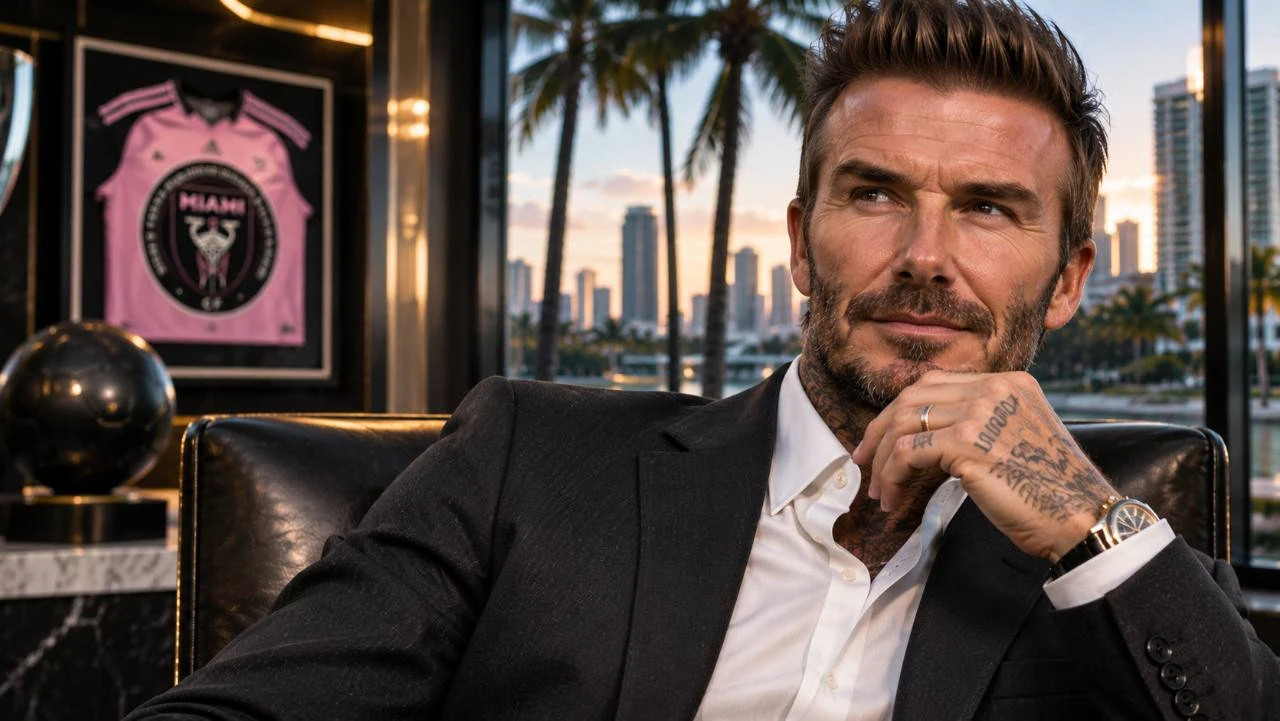
Supplied editorial illustration of David Beckham in a business setting. Not verified office photography or evidence of asset ownership or a particular valuation.
David Beckham’s most valuable move was not simply finding more companies willing to put him in an advertisement. It was building a business in which his name, creative work and football ownership could continue generating value after his playing career ended. The result is a portfolio of different activities, not a single company with one conveniently measurable price.
Forbes estimated his personal fortune at $1 billion in a profile published on May 22, 2026. That is an attributed wealth estimate, not a statement that his companies earn $1 billion annually, that he has that amount in cash or that an independent audit has valued every asset at a readily realisable sale price. Forbes: May 22, 2026 fortune estimate and business profile
| Date | What the record establishes |
|---|---|
| January 29, 2018 | MLS awards Miami an expansion club with Beckham as co-owner |
| February 24, 2022 | Authentic partnership and Beckham shareholding announced |
| May 2, 2024 | Safilo announces a perpetual eyewear licence |
| May 22, 2026 | Forbes estimates personal fortune at $1 billion |
The billion-dollar figure needs the right label
Net worth, revenue and profit answer different questions. A wealth estimate considers the value of interests and assets, allowing for relevant liabilities. Revenue measures sales over a period. Profit is what remains after the applicable costs. Treating those figures as interchangeable makes a business look larger or more liquid than the evidence establishes.
The distinction is particularly important when valuable assets are privately held. A share of a football club or a commercial-rights business can contribute to an estimated fortune without being available as spendable money. Its eventual sale value depends on the transaction, the stake offered, debt and other obligations, rather than a headline alone.
Beckham’s case is therefore best understood by examining the underlying business models. Licensing a name, appearing in a campaign, producing media and owning part of a club involve different responsibilities and sources of value. Their association with the same famous person does not turn them into one homogeneous revenue stream.
The Authentic partnership changed the structure
On February 24, 2022, Beckham and Authentic Brands Group announced a partnership to co-own and manage his global brand. The official release also said that Beckham became an Authentic shareholder. This was a structural relationship with a brand-management organisation, not merely another product endorsement. David Beckham: official February 24, 2022 Authentic partnership
The announcement described plans spanning endorsements, consumer products, digital work and media. A licensing platform can connect a recognisable identity with specialist businesses that already know how to develop, manufacture or distribute particular products. The name provides a commercial connection; the partners contribute capabilities that the celebrity need not build from scratch.
That structure also makes partner selection important. A brand can appear across several industries, but the customer encounters a specific product and service. The commercial challenge is to maintain a coherent identity while relying on different operators. A wide list of partnerships is not, on its own, proof that every relationship performs equally well.
Eyewear shows how licensing actually works
Safilo’s May 2, 2024 announcement offers a concrete example. The eyewear group signed a perpetual licence with Authentic for David Beckham Eyewear, replacing an earlier agreement due to expire in 2030. Safilo said it would oversee the value chain from a design process creatively led by Beckham through production and worldwide distribution. The first collection launched in 2020. Safilo: May 2, 2024 perpetual eyewear licence
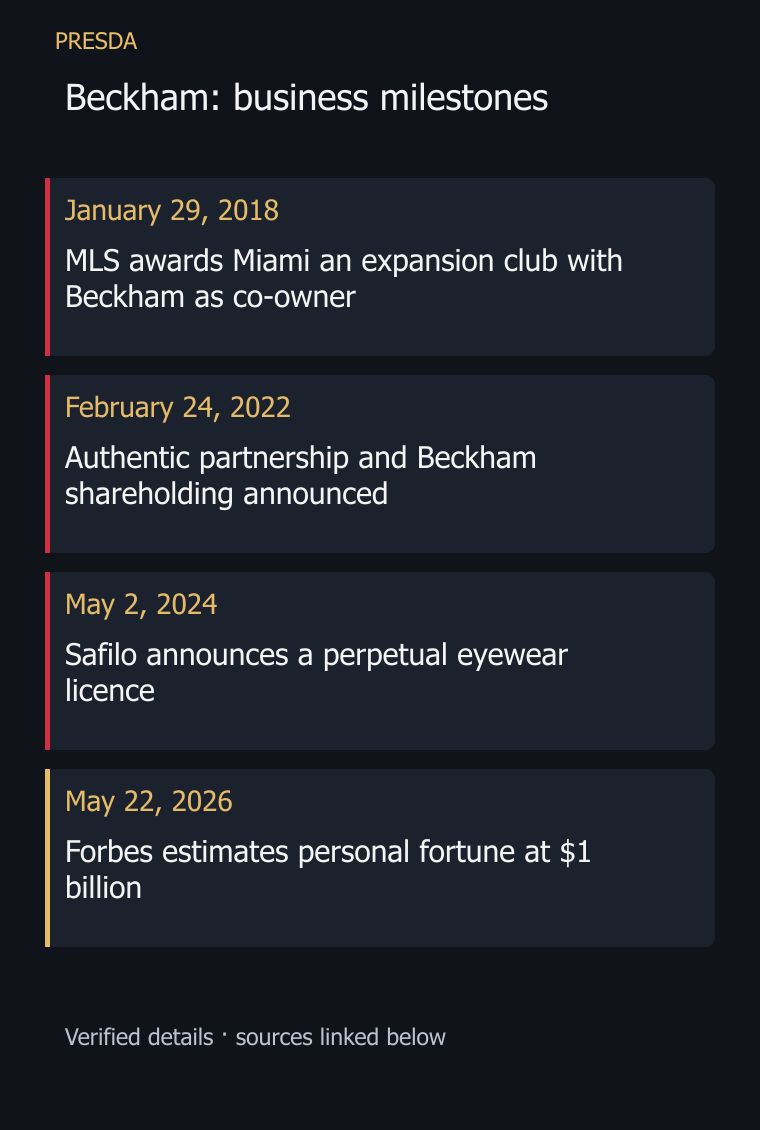
David Beckham’s business: milestones and financial distinctions. Sources: Forbes, Authentic, MLS and Safilo.
This division of work is more informative than describing sunglasses as simply another Beckham business. The creative identity and the industrial operation are connected, but they are not identical. The licence does not mean Beckham personally owns Safilo’s factories, nor does Safilo’s total revenue become his income. The announcement does not disclose the licence’s financial value.
Inter Miami is ownership, not an advertising campaign
Major League Soccer awarded Miami an expansion club on January 29, 2018, identifying Beckham as part of an ownership group. The club’s own history records the milestone. Unlike an endorsement arrangement, a club interest connects its owner to the long-term development and risks of an operating sporting organisation. MLS: Miami expansion award, January 29, 2018 Inter Miami: official club chronology
Forbes’ 2026 profile traced the opportunity to the expansion option negotiated around his move to the LA Galaxy in 2007, with a $25 million entry price. That historical option should not be confused with the total cost of building a club, funding operations or developing a stadium. The initial right and the eventual enterprise are different economic objects. Forbes: May 22, 2026 fortune estimate and business profile
The same profile estimated Inter Miami’s value at $1.35 billion before debt. That is a club-level valuation, not a statement that the full amount belongs to Beckham. Co-ownership and liabilities matter. Multiplying a headline valuation by a casually assumed ownership percentage would not establish his current cash proceeds or an independently verified net asset value.
The significance of the club is not that it eliminates commercial uncertainty. It is that it changes the role: the former player participates in an institution whose value depends on a continuing sporting and business operation. Attention can help a club attract interest, but it does not replace management, infrastructure or the demands of competition.
Studio 99 adds a production business
The Authentic announcement also identified Studio 99, co-founded by Beckham in 2019, as part of the transaction’s wider structure, with Authentic becoming its largest shareholder. It described both documentary work for major platforms and a commercial content operation. That places media production alongside the management of his public image. David Beckham: official February 24, 2022 Authentic partnership
Production introduces another distinction. Being the subject of a documentary and being involved in a company that makes content are different roles, even when they intersect. The operating business includes teams, creative decisions and delivery obligations. A famous face can bring an audience, but the work still has to be commissioned, produced and completed.
Together, licensing, ownership and production explain why the portfolio cannot be reduced to endorsement fees. Some activities generate payments for a defined service; others can create an interest in a continuing enterprise. Reporting needs to distinguish those mechanisms before adding up any supposed empire.
The personal story and the commercial story overlap
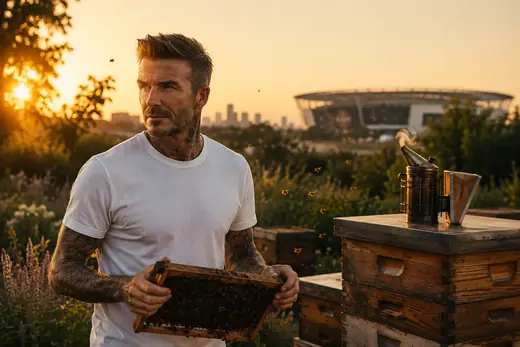
Beckham’s activities outside football also attract readers for reasons unrelated to valuation. PRESDA’s earlier feature on his beekeeping, gardening and countryside interests explores that side of his public life. It is a different subject from the structure of the licensing and ownership businesses examined here.
That distinction prevents hobbies from being treated automatically as revenue lines. An interest can influence a brand’s story without proving that every private activity is a commercial venture. Equally, an apparently relaxed public image can coexist with organised professional work. Neither perspective should erase the other.
What the fortune estimate ultimately tells us
The documented shift is from a celebrated football career to a set of partnerships and ownership interests capable of outlasting it. Forbes’ billion-dollar estimate supplies a dated external assessment of personal wealth. The official partnership, club and licensing announcements explain some of the business architecture behind that assessment.
They do not establish a single audited empire valuation or a billion dollars of annual revenue. The more compelling story is how different assets were assembled and professionally organised. Beckham’s name opened doors; the businesses behind it depend on contracts, specialist partners, creative work and institutions that must keep functioning after the initial attention fades.
FAQ
Frequently Asked Questions
Is David Beckham officially worth exactly $1 billion?
Forbes estimated his personal fortune at $1 billion in May 2026. It is a dated external estimate, not a guarantee of current cash holdings or an audited valuation of every asset.
Does his business generate $1 billion a year?
The fortune estimate does not establish that. Personal net worth, company revenue, profit and cash are different financial measures.
Does Beckham own all of Inter Miami?
No. MLS describes an ownership group. A valuation of the entire club is not the same as the value or sale proceeds of Beckham’s own interest.
What does the Safilo agreement cover?
The 2024 announcement describes a perpetual eyewear licence with Authentic, with Safilo overseeing design collaboration, production and distribution. It does not disclose the licence’s financial value.
PRESDA Dispatch
Stay Informed. Stay Aware.
A sharp briefing across AI, gaming, sport, business, world affairs, paparazzi, and lifestyle.