IBN BATTUTA: THE MOROCCAN WHO TRAVELED ACROSS THREE CONTINENTS
Follow Ibn Battuta’s journeys across Africa, Asia and Europe, and discover how memory, observation and literary editing shaped his famous Rihla.
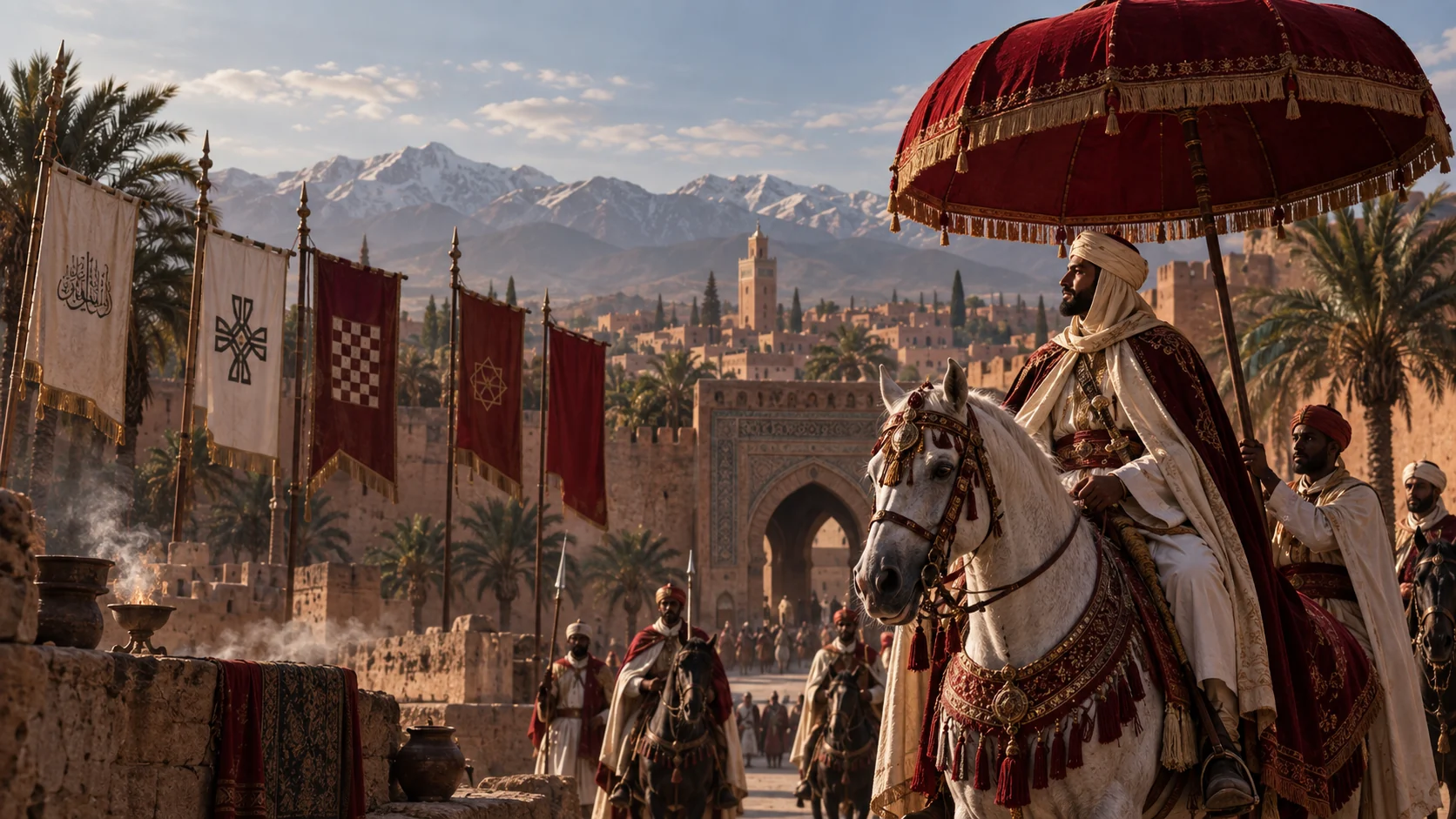
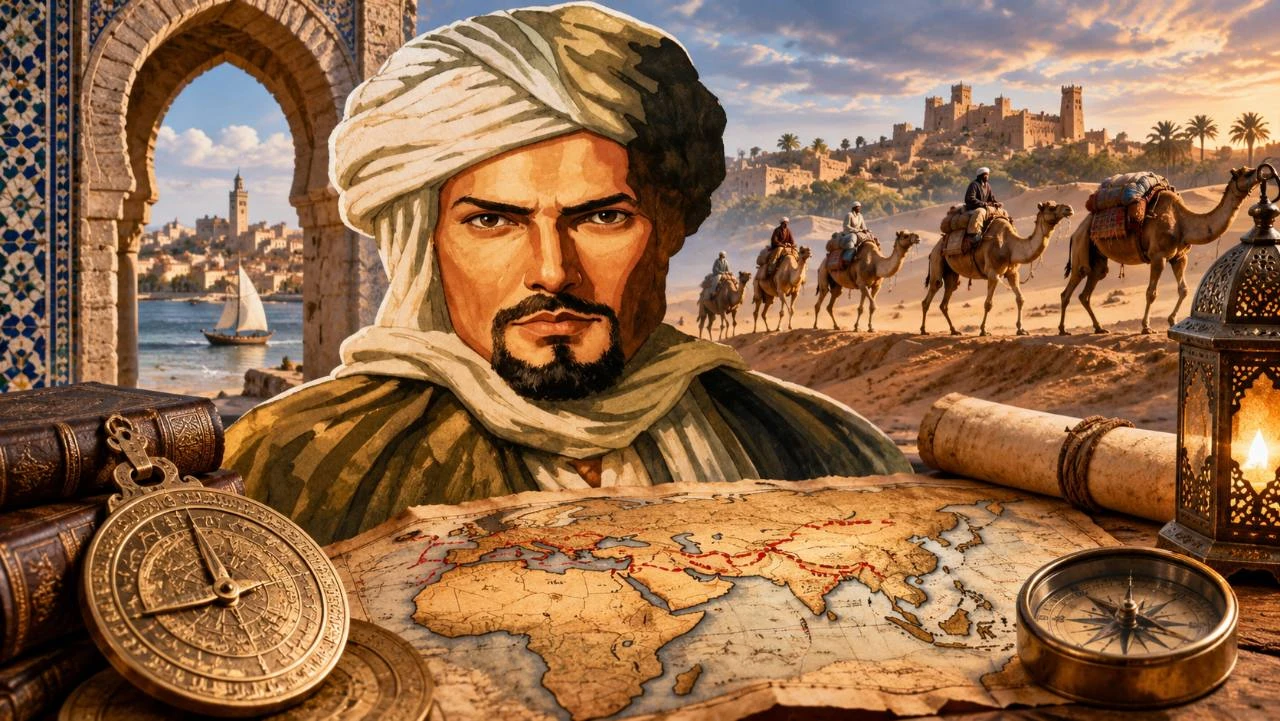
Editorial historical reconstruction. The portrait, map, caravan and instruments are not authenticated records of Ibn Battuta or a surveyed itinerary. Editorial image supplied for PRESDA. Original creator and reuse licence not provided.
Ibn Battuta’s story begins with an intention familiar to many travellers: to reach a meaningful destination. It became something much larger. The Moroccan pilgrim’s journeys would take him through societies spread across Africa, Asia and Europe, and his account would give later readers an extraordinary view of the fourteenth century. His achievement is not best understood as winning a mileage contest. It is the survival of a traveller’s expansive, complicated account of other people’s worlds.
A pilgrimage that opened onto a wider world
Born in Tangier in 1304, Ibn Battuta left Morocco in 1325 with the pilgrimage to Mecca as his initial purpose. Berkeley’s ORIAS teaching resource places his journeys within a much wider geography of Muslim societies and travel routes. That setting is essential. His movements did not occur through an empty map: he travelled among communities already connected by pilgrimage, exchange and learning. The route depended on an existing world of relationships. UC Berkeley ORIAS, departure from Tangier
Africa was not merely a departure point, nor Asia a single destination. The Rihla describes a remarkable variety of places, from North Africa and Arabia to India and the Indian Ocean. A continent-by-continent list can help orient a reader, but it flattens the differences between routes, political settings and encounters. Understanding his travels means attending to those connections rather than projecting modern national borders neatly onto a medieval journey. UC Berkeley ORIAS, travel context
Why three continents includes Europe
His later itinerary included al-Andalus, in the Iberian Peninsula. Berkeley’s account discusses his visits to Málaga and Granada, making Europe part of the geographical story alongside Africa and Asia. This is not a claim that he explored every part of any continent. The distinction matters because modern summaries often turn a wide-ranging journey into an impossible promise of complete coverage. A traveller can connect worlds without seeing everything inside them. UC Berkeley ORIAS, al-Andalus and Morocco
Travel to Mali also forms part of his later story. The account brings the Sahara and West Africa into a narrative too often reduced to a line heading east from Morocco. Remembering that breadth changes the centre of the map. Africa appears as a place of journeys and encounters in its own right. It is not simply a margin around the supposedly more important destinations of a global traveller. UC Berkeley ORIAS, journey to Mali
The Rihla was made after the journey
The book was not simply a diary carried unchanged from campsite to campsite. The Library of Congress describes the travel account’s production under the patronage of Morocco’s ruler Abu Inan Faris, with Ibn Juzayy shaping the narrative. That collaboration explains why authorship and memory belong beside geography in this story. The surviving work is an extraordinary source, but its literary form is part of the evidence, not something to ignore. Library of Congress, Ibn Battuta’s Rihla catalogue
Berkeley’s discussion of the writing process distinguishes personal observation from hearsay and material borrowed from earlier travel accounts. That does not make the Rihla worthless, or prove every disputed journey false. It changes how we should read it: compare claims, recognise a literary convention and avoid treating every passage as an independent eyewitness report. Respect for a historical traveller does not require suspending ordinary questions about sources. UC Berkeley ORIAS, writing the Rihla
A world traveller without a modern GPS trace
For the same reason, exact distance records deserve caution: modern totals depend on reconstructing a long and sometimes debated itinerary. The supplied portrait and map are interpretive artwork, not authenticated evidence of his face, instruments or a precise route. Ibn Battuta remains fascinating without those shortcuts. His lasting invitation is to see a connected medieval world through a particular human perspective, then ask how that perspective became a book.
Related reading: Morocco’s history across dynasties and empires.
FAQ
Frequently Asked Questions
Which three continents did Ibn Battuta travel across?
His journeys and account connect Africa, Asia and Europe, including al-Andalus in the Iberian Peninsula.
Was the Rihla a diary written entirely on the road?
No. The surviving narrative was shaped after his travels in collaboration with Ibn Juzayy under Moroccan royal patronage.
Can every episode be treated as an eyewitness report?
No. The work combines recollection, observation, hearsay and literary material that historians evaluate critically.
PRESDA Dispatch
Stay Informed. Stay Aware.
A sharp briefing across AI, gaming, sport, business, world affairs, paparazzi, and lifestyle.