
MARCO REUS NAMED LA GALAXY PLAYER OF THE YEAR 2026
LA Galaxy names Marco Reus its 2026 Player of the Year. Eight goals, 15 assists, 74 key passes and the distinction from the club Golden Boot and MLS MVP.
Supplied editorial illustration. It is not verified photography of Reus’s Player of the Year presentation.
Marco Reus has been named LA Galaxy’s 2026 Player of the Year after leading the club with 23 regular-season goal contributions. The Galaxy announced the honour on November 18, citing eight goals, 15 assists and 74 key passes across 31 league appearances. It is a club award, distinct from the league-wide MLS Most Valuable Player honour. LA Galaxy: November 18, 2026 team awards and regular-season statistics
The numbers describe a season built on both finishing and creation, with the assists especially prominent. They also explain why Player of the Year need not mean leading scorer. Reus won the club’s overall honour while João Klauss received its Golden Boot for scoring the most regular-season goals.
| Measure | Official figure |
|---|---|
| Appearances and starts | 31 appearances, 24 starts. |
| Goals | 8. |
| Assists | 15; goals plus assists total 23. |
| Key passes | 74; eighth in MLS in the club’s account. |
What exactly did Reus win?
The Galaxy’s announcement identifies Reus as the club’s Player of the Year for 2026. It says the award was determined through a cumulative vote involving fans, season-credentialed media and club leadership. That process gives the honour a defined constituency rather than making it a vote of every MLS club or every player in the league. LA Galaxy: November 18, 2026 team awards and regular-season statistics
The title should therefore retain the words “LA Galaxy”. Removing them can turn a precise achievement into a different claim. A supporter can celebrate the club’s leading performer without suggesting that the announcement also awards him league MVP, the MLS Golden Boot or another competition’s trophy.
The attacking totals in scope
The 23 contributions are the sum of eight goals and 15 assists in the MLS regular season. Reus appeared 31 times and started 24 matches. Those figures should not silently become an all-competitions total or be combined with later matches while still carrying the label attached to the award. LA Galaxy: November 18, 2026 team awards and regular-season statistics
The club also reports 74 key passes, placing him eighth in MLS in that measure, and sixth in the league for assists. Those rankings help locate his creative output beyond the Galaxy squad. They are still specific statistical measures, rather than a complete independent ranking of every aspect of his play.
Why creation matters alongside scoring
A goal is the most visible end of an attack, but reaching that moment depends on decisions before the shot. A creative player can influence where a teammate receives the ball, the speed of the move and the options available when defenders react. An assist recognises one part of that relationship between provider and scorer.
Key passes add another view of chance creation. The term is commonly used for a pass leading to a shot, although exact provider definitions should always be checked. It should not be rewritten as 74 assists, 74 goals created or 74 guaranteed scoring chances. The award announcement lists it separately for a reason.
Why the categories cannot simply be added together
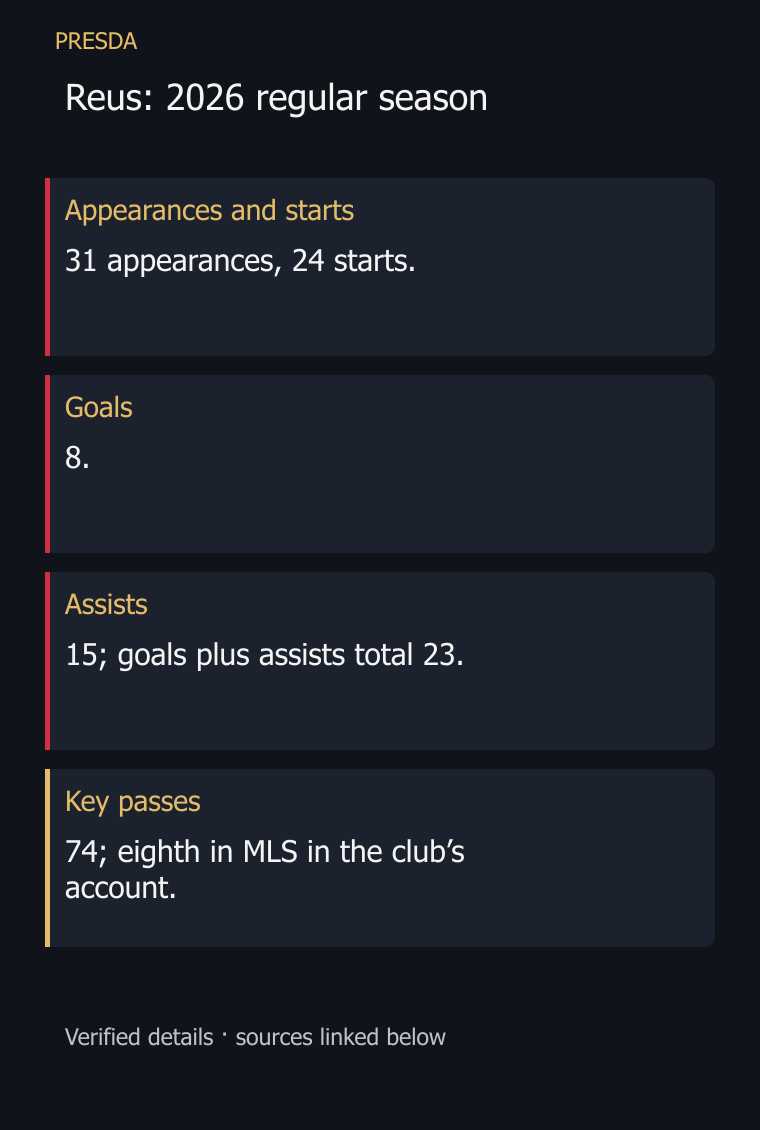
Reus’s 2026 MLS regular season. Source: LA Galaxy’s November 18 team-awards announcement. Key passes are separate from goals plus assists.
Goals and assists combine into the stated 23 direct contributions. Key passes are a different category and may describe related attacking sequences. Adding 74 to 23 and presenting the result as a new official contribution total would invent a metric that the club did not publish.
The same care applies to match counts. An appearance and a start are not interchangeable; substitute outings are part of the first number. A reader assessing availability should keep both figures visible rather than assume that 31 appearances means 31 full matches or that 24 starts accounts for every minute he played.
A strong finish to the campaign
The Galaxy’s account highlights 12 contributions in Reus’s final ten appearances: four goals and eight assists. It also points to a three-assist performance against Austin FC in the club’s penultimate match. These are concrete examples of late-season output, rather than a vague claim that his form improved. LA Galaxy: November 18, 2026 team awards and regular-season statistics
That closing spell represents more than half of his 23 regular-season contributions, using the club’s figures. The comparison is simple arithmetic, not a separate performance model. It shows how strongly the final stretch featured in the season’s attacking account while leaving the earlier matches part of the overall record.
The club also notes five matches with multiple contributions and six MLS Team of the Matchday selections. Such recognition adds context, but it is not interchangeable with the season award. Matchday honours identify particular performances; Player of the Year considers the campaign within the club’s selection process.
From Dortmund to a different chapter in Los Angeles
The Galaxy originally announced Reus’s signing on August 15, 2024, after his long Borussia Dortmund career. Its original release records 429 appearances and 301 goal contributions for Dortmund across 12 seasons from 2012 to 2024. The move was therefore a substantial change of setting for an experienced professional, not the beginning of his football career. LA Galaxy: original August 15, 2024 signing announcement
That history gives the story depth without replacing the 2026 evidence. Reputation can explain why supporters follow an arrival; a later club award needs to be understood through the work done in the new team. Reus’s current recognition is supported by the regular-season record the Galaxy published, not simply by achievements in Germany.
Experience is useful when it becomes contribution
An experienced attacking player may bring an understanding of timing, space and combinations. Those qualities matter when they help a team function, not merely because they appear in a biography. The goals and assists provide measurable examples, while a full evaluation would also require watching the wider work that statistics cannot capture.
The distinction avoids turning a move to MLS into an automatic story of effortless dominance. The league presents its own opponents, schedules and team relationships. The achievement here is specific: Reus’s club selected him after a season in which his output helped define its attack.
The contract context, without confusing the dates
On February 28, 2026, the Galaxy announced a contract extension through December 2027. That is a separately dated commitment, made before the end-of-season award. The November honour did not create that extension, and the existence of a contract does not itself guarantee a particular future lineup or individual result. LA Galaxy: February 28, 2026 extension through December 2027
Keeping the original signing, extension and award separate makes the chronology clearer. Reus joined in 2024, the club extended the agreement in 2026, and it later recognised his 2026 season. Each event has its own source and meaning; there is no need to turn them into an invented new transfer announcement.
Why the Golden Boot went to someone else
The Galaxy awarded its 2026 Golden Boot to João Klauss, whose team-leading regular-season total was ten goals. Reus’s eight goals were combined with a much larger assist tally in the case for the overall player honour. The two awards can therefore recognise different forms of attacking importance without contradicting one another. LA Galaxy: November 18, 2026 team awards and regular-season statistics
The club’s broader awards announcement also named JT Marcinkowski Defender of the Year and Humanitarian of the Year, and Brett Phan Academy Player of the Year. Those distinctions reflect different roles and selection processes. They should not be treated as lesser versions of a single scoring contest.
PRESDA’s report on Griezmann’s MLS Newcomer of the Year award offers a useful comparison of scope. That league honour is restricted to eligible debutants with prior professional experience. Reus’s recognition belongs to the Galaxy’s own season awards, with a different field and electorate.
Reading an award beyond the headline
Supporters often value moments that a final table cannot reproduce: the timing of a pass, a combination that changes a match or the feeling that a player gives an attack direction. An award can bring those impressions together with measurable output, but the published result should still be described accurately.
PRESDA’s exploration of football fandom, identity and rivalry considers that wider attachment. An individual honour is part of a club’s shared memory as well as a statistical story. A careful account can recognise the emotion without inventing reactions from supporters or private statements from the player.
What would need a new announcement?
Any later league award, transfer development or change to the contract would require fresh confirmation. The Player of the Year announcement alone does not establish those events. Nor should an illustration of Reus applauding be presented as documentary proof of an award ceremony that the image’s provenance does not establish.
The confirmed conclusion is substantial: the Galaxy’s voters selected Reus after a regular season featuring eight goals, 15 assists and extensive chance creation. It is recognition of a productive Los Angeles campaign in its own right. His earlier career gives it context; the 2026 record explains the honour.
FAQ
Frequently Asked Questions
Did Marco Reus win LA Galaxy Player of the Year?
Yes. The club announced him as its 2026 winner on November 18.
Is this the same as MLS MVP?
No. It is LA Galaxy’s club award, selected through its own process involving fans, credentialed media and leadership.
What were his regular-season totals?
The club reports eight goals and 15 assists in 31 appearances, with 24 starts and 74 key passes.
Why did he not also win the club Golden Boot?
João Klauss led the Galaxy with ten regular-season goals. Player of the Year is a broader honour and does not have to go to the leading scorer.
How long is Reus’s announced contract extension?
The Galaxy’s February 28, 2026 announcement extends it through December 2027. That agreement is separate from the November award.
PRESDA Dispatch
Stay Informed. Stay Aware.
A sharp briefing across AI, gaming, sport, business, world affairs, paparazzi, and lifestyle.