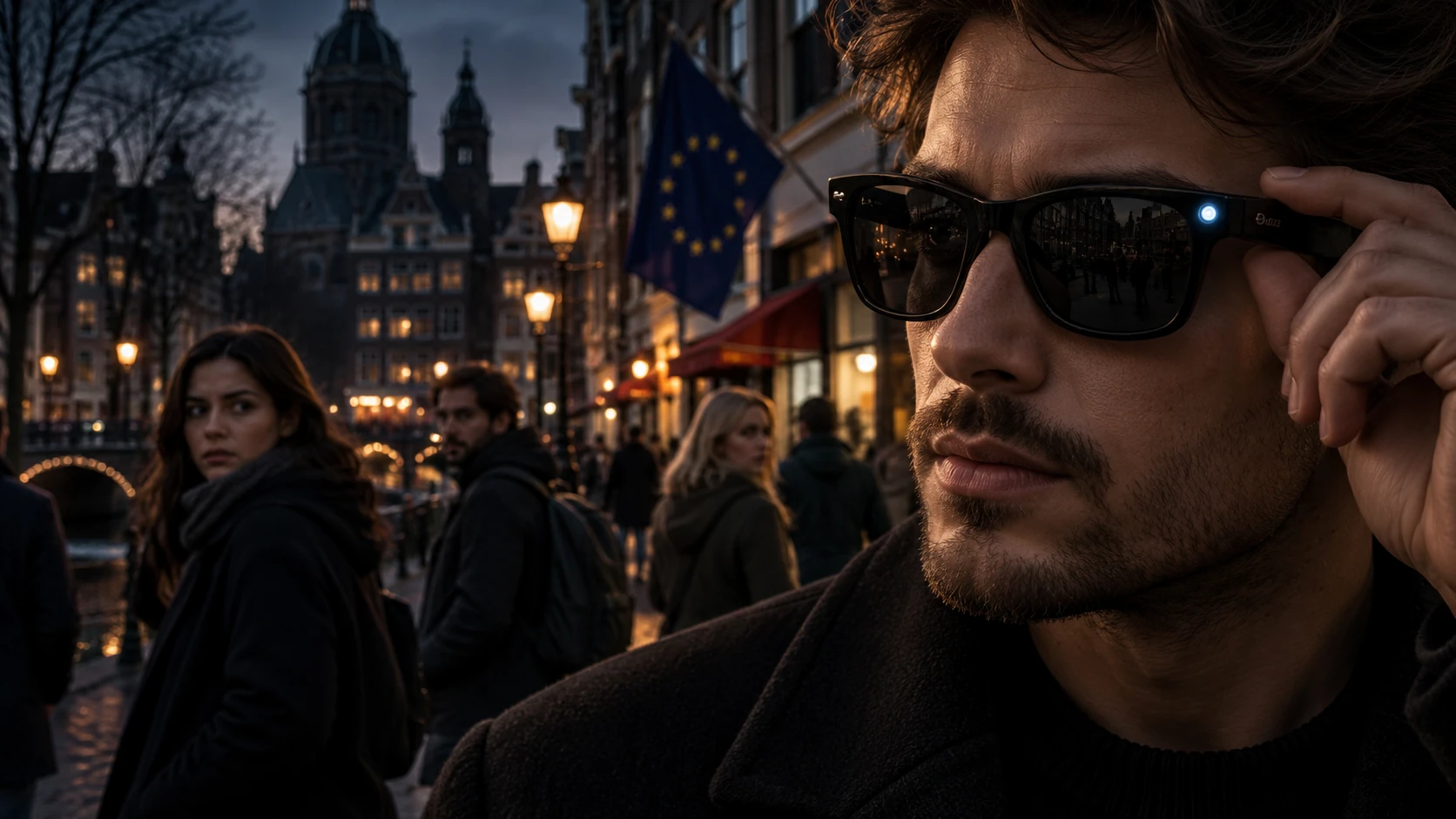
Meta Ray-Ban Smart Glasses Face Privacy Backlash in Europe
Dutch eyewear chain Hans Anders has suspended sales in the Netherlands and Belgium as European scrutiny of camera-equipped smart glasses intensifies.
Hans Anders has suspended sales of Meta’s Ray-Ban smart glasses in the Netherlands and Belgium amid privacy concerns, Reuters reported on October 2. The Dutch eyewear chain’s decision brings a debate about covert recording into the high street, where camera-equipped frames can look much like ordinary glasses. Reuters: Hans Anders suspends sales, October 2, 2026
For the wearer, a camera at eye level offers convenience. For the person opposite, it creates uncertainty: is this a conversation, a recording, or material that will later be shared? That difference in perspective sits at the centre of the backlash. The question is not only what AI wearables can do, but what everyone around them can reasonably understand and control.
A RETAIL PAUSE, NOT A NATIONAL BAN
Hans Anders linked its decision to public and political debate about the conditions under which smart glasses can be used. Its suspension covers the Netherlands and Belgium. This is a retailer’s decision, not evidence that either country has imposed a nationwide sales ban. Reuters: Hans Anders suspends sales, October 2, 2026
That distinction matters for consumers and for the industry. A shop can decide that unresolved concerns justify a pause without waiting for a court judgment. For manufacturers, retail confidence is part of mainstream adoption: technical capability alone does not answer questions a customer, employee or bystander may raise.
WHAT THE DUTCH PRIVACY REGULATOR ACTUALLY SAYS
On September 22, the Dutch data-protection authority, Autoriteit Persoonsgegevens (AP), warned users that identifiable bystanders retain privacy rights. Images cannot simply be used, widely shared or published without a lawful basis; permission is generally required in the situations its warning describes. The AP also advised organisations to consider house rules restricting camera glasses where necessary. Dutch AP: camera-glasses privacy warning, September 22, 2026
The regulator’s general guidance makes an important distinction. Strictly personal or household use can fall outside the GDPR, provided images remain private or are shared only within a very limited circle. Public posting is different: that exception no longer applies, and a lawful basis is needed, usually consent in this context. The circumstances and intended use matter. Dutch AP: photographs, video and personal-use exceptions
A visible light and legal permission are therefore different things. An indicator can help someone notice a camera, but noticing a camera does not automatically mean agreeing to publication. Nor should this guidance be simplified into a claim that every photograph in a public place is unlawful.
CONSUMENTENBOND THREATENS COURT ACTION
On September 29, Dutch consumer organisation Consumentenbond said it had sent Meta a formal demand and given it two weeks to change the glasses. It wants changes to the design and default settings and an end to processing it considers unlawful. It says it will sue if Meta does not comply. Consumentenbond: demand to change the glasses, September 29, 2026
This is the consumer organisation’s allegation and announced legal threat, not a court ruling that the product is unlawful. Its challenge also reaches beyond individual misuse: it asks whether the product itself does enough to protect people who never bought it or accepted its terms.
META’S RESPONSE: A RECORDING LIGHT AND ANTI-TAMPERING PROTECTION
Meta says its glasses use a visible capture LED with no off switch, and that covering or tampering with the indicator disables the camera. Its published explanation describes a white light that signals photographs and video captured for the wearer’s gallery, alongside software intended to detect interference with that light. Meta: AI glasses privacy questions and capture LED
Consumentenbond disputes the effectiveness of the safeguards. In research published September 10, it said it could still record with the light obscured during its September 2 test using software version 127. That is a dated test of the unit and software it examined, not proof about every later update or model. Consumentenbond: recording-light tests, September 10, 2026
The disagreement requires careful wording. Meta’s description explains the intended protection; a test report asks whether that protection works in practice. Even a reliable anti-tampering system leaves another question: can people notice and interpret the indicator quickly enough in ordinary social situations?
RECORDING, SHARING AND AI PROCESSING ARE DIFFERENT STEPS
Meta says photos and videos taken for the gallery remain on the glasses until the user imports them, and users choose whether to share them or use Meta AI. That is different from saying every ordinary recording is automatically published or sent for AI training. Meta: AI glasses privacy questions and capture LED
At the same time, the AP warns that AI functions can process personal data even when no photo or video is saved. The privacy issue is consequently broader than an upload button: capture, AI processing, storage and disclosure each raise questions about purpose, transparency and control. Dutch AP: camera-glasses privacy warning, September 22, 2026
For a bystander, those stages are difficult to observe. Someone may understand that a picture was taken without knowing whether it stayed on a device, entered an AI interaction or reached a public audience. Clear explanations must therefore cover both the hardware and the services connected to it.
A BACKLASH THAT EXTENDS BEYOND THE NETHERLANDS
In the UK, Reuters reports that pub chain Wetherspoon has restricted use over covert-recording concerns. In the US, it reports a lawsuit against Meta and Luxottica alleging that human annotators viewed recordings without the filmed people’s knowledge. Those allegations should not be presented as findings by a court. Reuters: Hans Anders suspends sales, October 2, 2026
France’s privacy regulator CNIL issued a warning and action plan in May. It highlighted how ordinary-looking frames can make recording difficult to recognise and how indicator lights offer limited notice. Its concern includes the social effects of people feeling that everyday encounters could be recorded. CNIL: smart-glasses vigilance and action plan, May 11, 2026
In Germany, Hamburg’s privacy commissioner published a technical and legal review of the Ray-Ban Meta Wayfarer Gen 1 in September. It concluded that recording people outside a close personal circle would generally lack a lawful basis, apart from rare legitimate-interest situations, because informed consent is difficult to obtain transparently. This is a regulator’s assessment of the examined model. Hamburg privacy commissioner: Ray-Ban Meta review, September 10, 2026
These developments are not interchangeable. A pub policy, a consumer lawsuit and a regulator’s analysis have different legal effects. Together, however, they show that the challenge is international: the wearer’s convenience does not settle the position of everyone within camera or microphone range.
CAN AI WEARABLES EARN PUBLIC TRUST?
Smart glasses can offer useful hands-free functions, translation and assistance for people with visual or hearing impairments, benefits CNIL acknowledges. The challenge is to preserve that usefulness while respecting the rights of others. Treating accessibility and privacy as incompatible goals would make the debate less useful. CNIL: smart-glasses vigilance and action plan, May 11, 2026
A credible path forward would combine understandable recording signals, safeguards that withstand real-world testing, restrained data collection and clear information about AI processing. These are criteria for evaluating the technology, not a claim that a particular redesign has already solved the problem. The test should include bystanders, not only satisfied purchasers.
Social rules also matter. People should be able to ask whether recording is taking place and expect a clear answer. Workplaces, shops and venues need policies that address the use of cameras and microphones without assuming every wearer has the same purpose. Public acceptance depends on predictable behaviour as much as a specification sheet.
WHAT TO WATCH NEXT
The next questions are specific: how Meta responds to Consumentenbond’s demand, whether litigation follows, what further regulators conclude, and whether retailers change their position. At publication on October 4, 2026, a sales suspension, regulatory warnings and a threatened Dutch lawsuit are distinct developments. None should be inflated into a universal prohibition.
AI wearables may become ordinary objects. For that to happen without making public life feel like a recording studio, privacy must be understandable to the person facing the glasses as well as to the person wearing them.
FAQ
Frequently Asked Questions
Why did Hans Anders suspend sales of Meta Ray-Ban glasses?
The retailer cited the public and political debate about privacy and the conditions for using smart glasses. The suspension covers the Netherlands and Belgium.
Are Meta Ray-Ban glasses banned across the Netherlands and Belgium?
The reported action is a retailer’s sales suspension. It is not a nationwide sales ban in either country.
Does a recording light count as consent?
No. A light can signal recording, but it does not itself establish consent or another lawful basis for using or publishing identifiable images.
What does Meta say happens if the recording light is covered?
Meta says covering or tampering with the capture LED disables the camera. Consumentenbond has challenged the safeguards based on its own dated testing.
PRESDA Dispatch
Stay Informed. Stay Aware.
A sharp briefing across AI, gaming, sport, business, world affairs, paparazzi, and lifestyle.