15 EXPENSIVE FRUITS: VERIFIED LOT PRICES COMPARED
Compare 15 documented fruit-price examples, from festival durian bids to specialty retail offers, with USD figures, exact units and clear evidence labels.
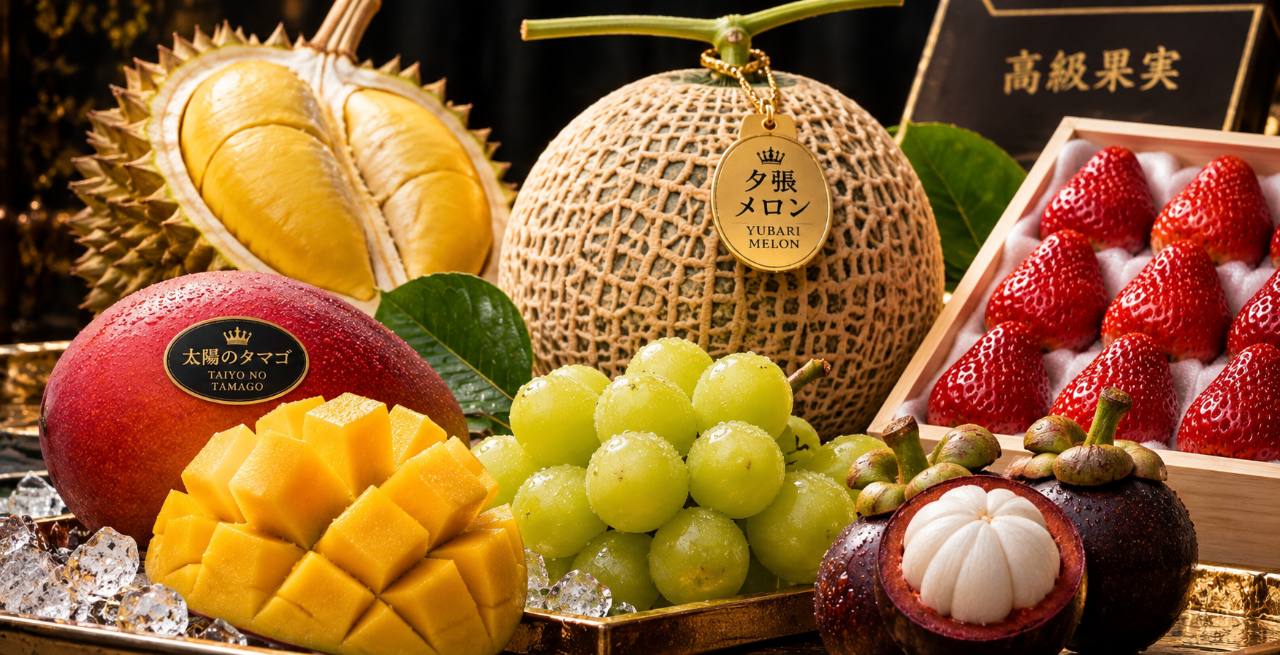
Original supplied fruit illustration, preserved unchanged. It does not depict authenticated auction lots or certify the named premium grades.
A Kanyao durian sold for 1.5 million baht in 2019, approximately $47,784 in Guinness’s explanatory account. That exceptional festival bid leads this countdown of 15 documented fruit-price examples. It does not mean durian is always the most expensive fruit to buy, or that every price in a viral list measures the same thing.
The central issue is the unit. One bunch, a pair of melons, fifteen cherries and a twenty-kilogram crate are different purchases. We preserve those differences and label auctions separately from asking prices. Research and retail offers were checked on November 25, 2026.
Method: compare the actual priced lot
The countdown runs from #15 to #1 by the selected lot or offer’s total nominal USD amount, not by price per kilogram or per individual fruit. These are 15 documented examples across distinct fruit identities, not a verified global top 15 or a measure of ordinary affordability. Retail asks remain asks; historical auction results remain dated transactions. Equal totals follow the English entry name.
Published contemporary USD equivalents are used for auctions. Tenka Fubu is explicitly calculated from its original yen bid using the previous business day’s Federal Reserve rate, ¥154.05 per dollar. We preserve quantities, original currencies and tax qualifications. Production-cost stories, unverified strawberry records and ornamental shapes without a priced documented offer are excluded.
15 prices, with their actual units
The unit is part of the evidence. A larger box can outrank a rarer individual fruit simply because this table compares total lot prices. It is not a per-fruit value league.
| Rank | Fruit identity | USD lot or offer total | Unit and evidence |
|---|---|---|---|
| 15 | White Jewel strawberry | ~$10 | Retail asking price, 1 fruit, 2017 report |
| 14 | Pinkglow pineapple | $29.00 | Retail asking price, 1 pineapple, checked 2026 |
| 13 | Pink guava | $37 | Retail asking price, 1 fruit, checked 2026 |
| 12 | Finger lime | $77 | Retail asking price, 100 g, checked 2026 |
| 11 | Mangosteen | $77 | Retail asking price, 1 fruit, pre-order checked 2026 |
| 10 | Rubyglow pineapple | $395.99 | Retail asking price, listed 1.5 lb pack, pre-order checked 2026 |
| 9 | Juno Heart, Aomori Heartbeat grade | ~$4,440 | 2022 auction: 15 cherries, ¥600,000 |
| 8 | Taiyo no Tamago mangoes | ~$4,500 | 2019 auction: 2 mangoes, ¥500,000 |
| 7 | Densuke watermelon | ~$6,100 | 2008 auction: 1 watermelon, ¥650,000 |
| 6 | Tenka Fubu persimmons | ~$7,205 | 2025 auction: 2 fruits, ¥1,110,000 before tax |
| 5 | Hinomaru satsuma mandarins | ~$9,600 | 2020 auction: 100 fruits, 20 kg, ¥1,000,000 |
| 4 | Sato Nishiki cherries | ~$11,500 | 2026 auction: 1 box, ¥1,800,000 |
| 3 | Ruby Roman grapes | ~$12,700 | 2021 auction: 1 bunch, ¥1,400,000 |
| 2 | Yubari King melons | ~$45,500 | 2019 auction: 2 melons, ¥5,000,000 |
| 1 | Kanyao durian | ~$47,784 | 2019 auction: 1 durian, THB 1,500,000 |
#15. White Jewel strawberry
Price: USD ~$10. Origin: Japan. Basis: Retail asking price, 1 fruit, 2017 report. freshplaza.com
This is a historical retail benchmark for one pale strawberry, not an auction record or a current universal price. White Jewel’s appeal lies in a distinctive appearance and carefully controlled production for the gift market. The reported per-berry sale format matters: multiplying a single presentation price by an imagined kilogram would create a figure nobody in the source actually paid.
#14. Pinkglow pineapple
Price: USD $29.00. Origin: Costa Rica. Basis: Retail asking price, 1 pineapple, checked 2026. melissas.com
Melissa’s lists one Pinkglow pineapple at this asking price. Its pink flesh distinguishes it from an ordinary yellow pineapple, and the seller identifies Costa Rica as the origin. This is a branded retail product, not a first-harvest auction. The premium buys a particular novelty and presentation; it should not be presented as evidence that pink pineapples routinely sell for hundreds of dollars.
#13. Pink guava
Price: USD $37. Origin: Southern Mexico; offer shipped from Florida. Basis: Retail asking price, 1 fruit, checked 2026. miamifruit.org
Miami Fruit’s single-fruit option is a specialty mail-order offer, not the ordinary market price of guava in producing countries. Its own page offers larger boxes too. This example deliberately exposes the commercial unit: individual sampling and shipping logistics can dominate a small order. A luxury price list becomes misleading if it silently calls that retailer’s minimum-format offer the intrinsic value of the species.
#12. Finger lime
Price: USD $77. Origin: Australia; US specialty retail offer. Basis: Retail asking price, 100 g, checked 2026. miamifruit.org
The selected Miami Fruit option contains 100 grams. Finger lime’s separate juice vesicles give it the culinary nickname citrus caviar. Here the unit is a measured weight, not one fruit; other options on the same page have different totals. The distinct texture can interest chefs, but neither the nickname nor the asking price makes it nutritionally equivalent to fish roe.
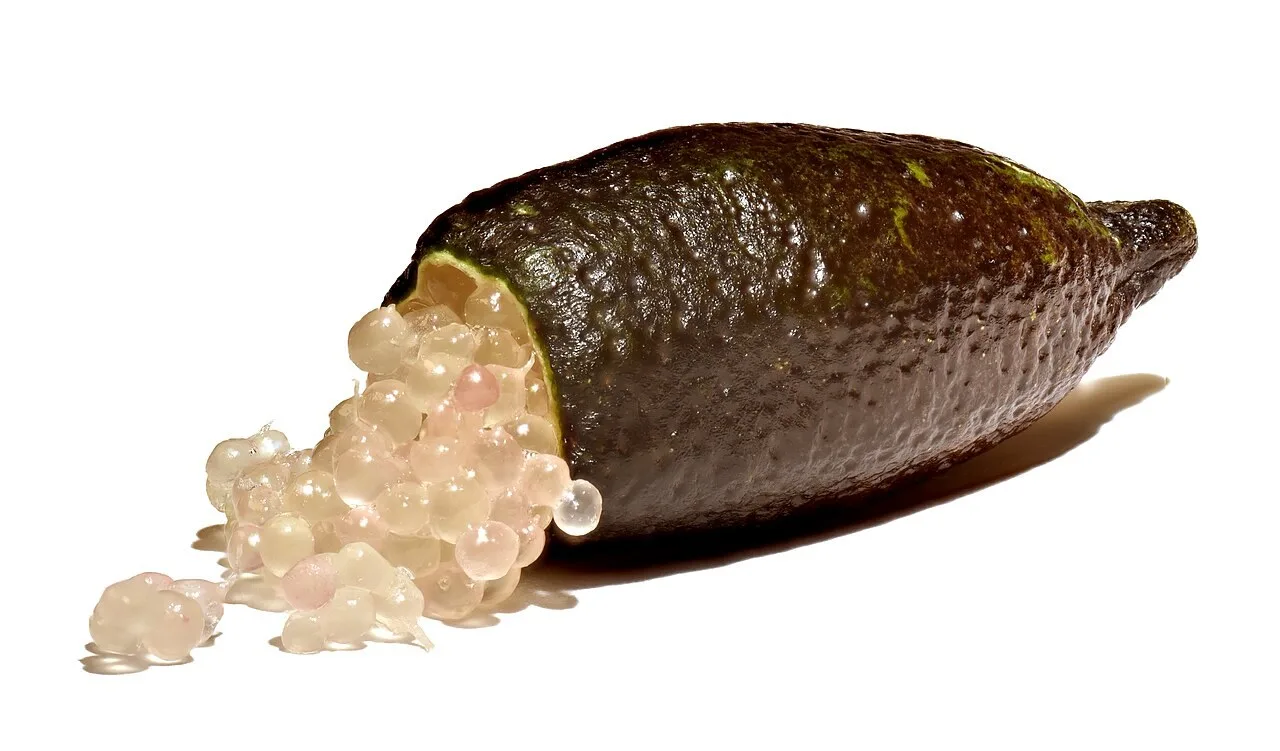
Australian finger lime, Citrus australasica, in a genuine botanical photograph. Species illustration, not the retailer’s priced 100-gram pack.
#11. Mangosteen
Price: USD $77. Origin: Southeast Asia; US specialty retail offer. Basis: Retail asking price, 1 fruit, pre-order checked 2026. miamifruit.org
The retailer explicitly lists one fruit at $77, alongside a small box at $177 and a large box at $297. We retain the single-fruit unit rather than imply that the whole small box costs $77. Mangosteen has a thick purple rind and pale segmented flesh. The pre-order status and highly perishable nature of fresh fruit help explain why availability and delivery terms need checking.
#10. Rubyglow pineapple
Price: USD $395.99. Origin: Costa Rica. Basis: Retail asking price, listed 1.5 lb pack, pre-order checked 2026. melissas.com
Melissa’s identifies the red-skinned, yellow-fleshed Rubyglow as a Costa Rican pineapple developed through traditional crossbreeding. The page lists a 1.5-pound pack and pre-order status. Its $395.99 offer is a retail asking price, not a Guinness-certified sale. Packaging, cultivar identity and restricted distribution are part of the commercial proposition, and should not be confused with a demonstrated resale value.
#9. Juno Heart, Aomori Heartbeat grade
Price: USD ~$4,440. Origin: Japan. Basis: 2022 auction: 15 cherries, ¥600,000. material.human.sankei.co.jp
Aomori Heartbeat is the premium grade associated with the large Juno Heart cherry. The June 2022 result was for a box of 15, not a single cherry at the full box price. The contemporary report gives about $4,440 for that lot. Size selection, presentation and the publicity of a season-opening bid all matter more to understanding this result than a simplistic claim that every cherry of the variety costs hundreds.
#8. Taiyo no Tamago mangoes
Price: USD ~$4,500. Origin: Japan. Basis: 2019 auction: 2 mangoes, ¥500,000. fruitnet.com
A pair of Miyazaki mangoes brought this reported total at the opening auction in April 2019. Taiyo no Tamago, often rendered as Egg of the Sun, is a premium quality identity, not a different botanical species priced uniformly everywhere. The pair format and selected grade explain why the figure must not be used as the supermarket price of a single ordinary mango.
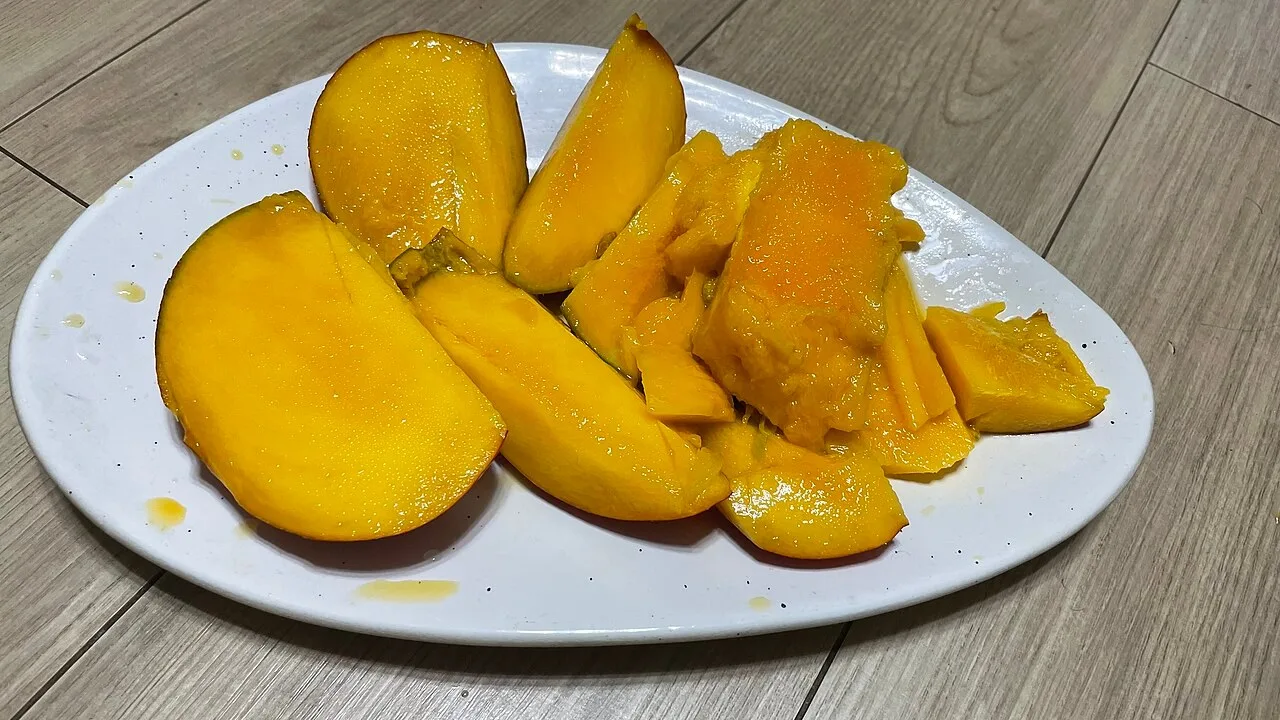
Sliced Miyazaki mango photographed by Sundar. Representative appearance; neither auction-lot identity nor premium grade is certified by this photograph.
#7. Densuke watermelon
Price: USD ~$6,100. Origin: Japan. Basis: 2008 auction: 1 watermelon, ¥650,000. nbcnews.com
The documented 2008 benchmark concerns one black-rinded Hokkaido watermelon. Its placement is a historical transaction example, not a claim that it remains the latest Densuke record. Rind color alone does not authenticate cultivar, grade or origin. A genuine photograph of the variety helps readers recognize its appearance but cannot certify that a pictured melon is the one auctioned.
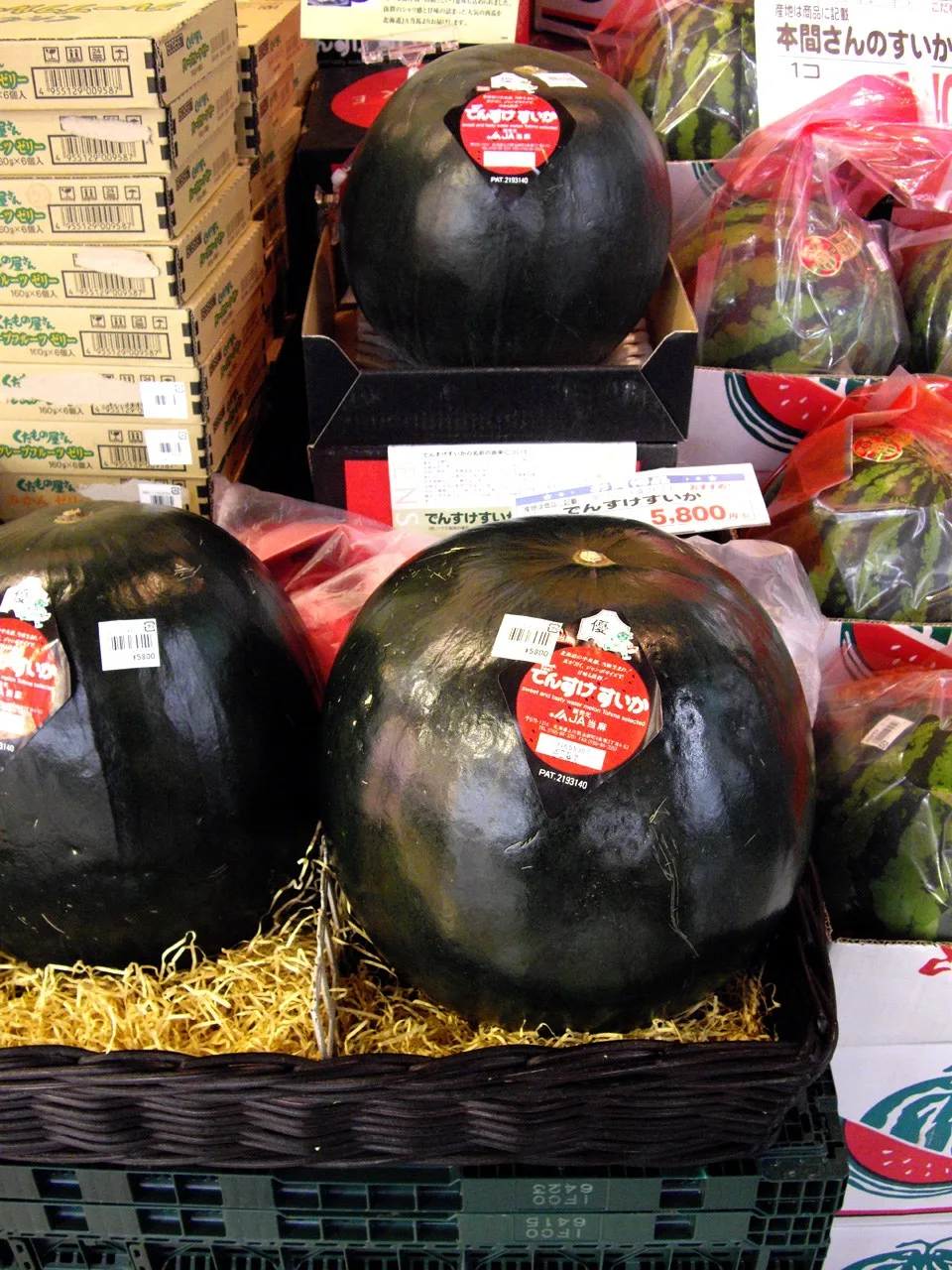
Densuke watermelon in a genuine photograph credited to puamelia. The photograph does not identify the 2008 auction fruit.
#6. Tenka Fubu persimmons
Price: USD ~$7,205. Origin: Japan. Basis: 2025 auction: 2 fruits, ¥1,110,000 before tax. asianews.network
The November 1, 2025 sale concerned a top-grade pair from Gifu’s premium brand, associated with the Neo Sweet cultivar. Our approximate dollar figure is calculated, not quoted by the seller: ¥1,110,000 divided by the Federal Reserve’s October 31 rate of ¥154.05 per USD gives about $7,205. Keeping the pre-tax label avoids silently comparing a tax-exclusive bid with a tax-inclusive retail payment.
#5. Hinomaru satsuma mandarins
Price: USD ~$9,600. Origin: Japan. Basis: 2020 auction: 100 fruits, 20 kg, ¥1,000,000. freshplaza.com
This large lot is the clearest warning against ignoring units: the reported million-yen bid bought a 20-kilogram crate containing 100 mandarins. The Hinomaru produce came from Ehime’s Nishiuwa area, associated with terraced coastal cultivation. The source described a celebratory opening bid and also reported far lower normal prices. It did not describe a $9,600 mandarin.
#4. Sato Nishiki cherries
Price: USD ~$11,500. Origin: Japan. Basis: 2026 auction: 1 box, ¥1,800,000. bernama.com
Bernama’s January 5, 2026 report, carrying Kyodo, identifies this Tokyo box result for premium cherries from Yamagata. The report describes ultra-early forced cultivation, far from the ordinary early-summer harvest. Timing, selected quality and first-auction publicity make this a different economic product from a bag of seasonal cherries. The box total must remain a box total in every language.
#3. Ruby Roman grapes
Price: USD ~$12,700. Origin: Japan. Basis: 2021 auction: 1 bunch, ¥1,400,000. freshplaza.com
The July 19, 2021 report identifies a single bunch from Ishikawa and the Taiwan supermarket buyer who secured it through a wholesaler. Ruby Roman’s conspicuously large red grapes and strict premium identity explain the attention. The stated sum is not for one grape, and its record status in that report refers to 2021 rather than certifying every subsequent season.
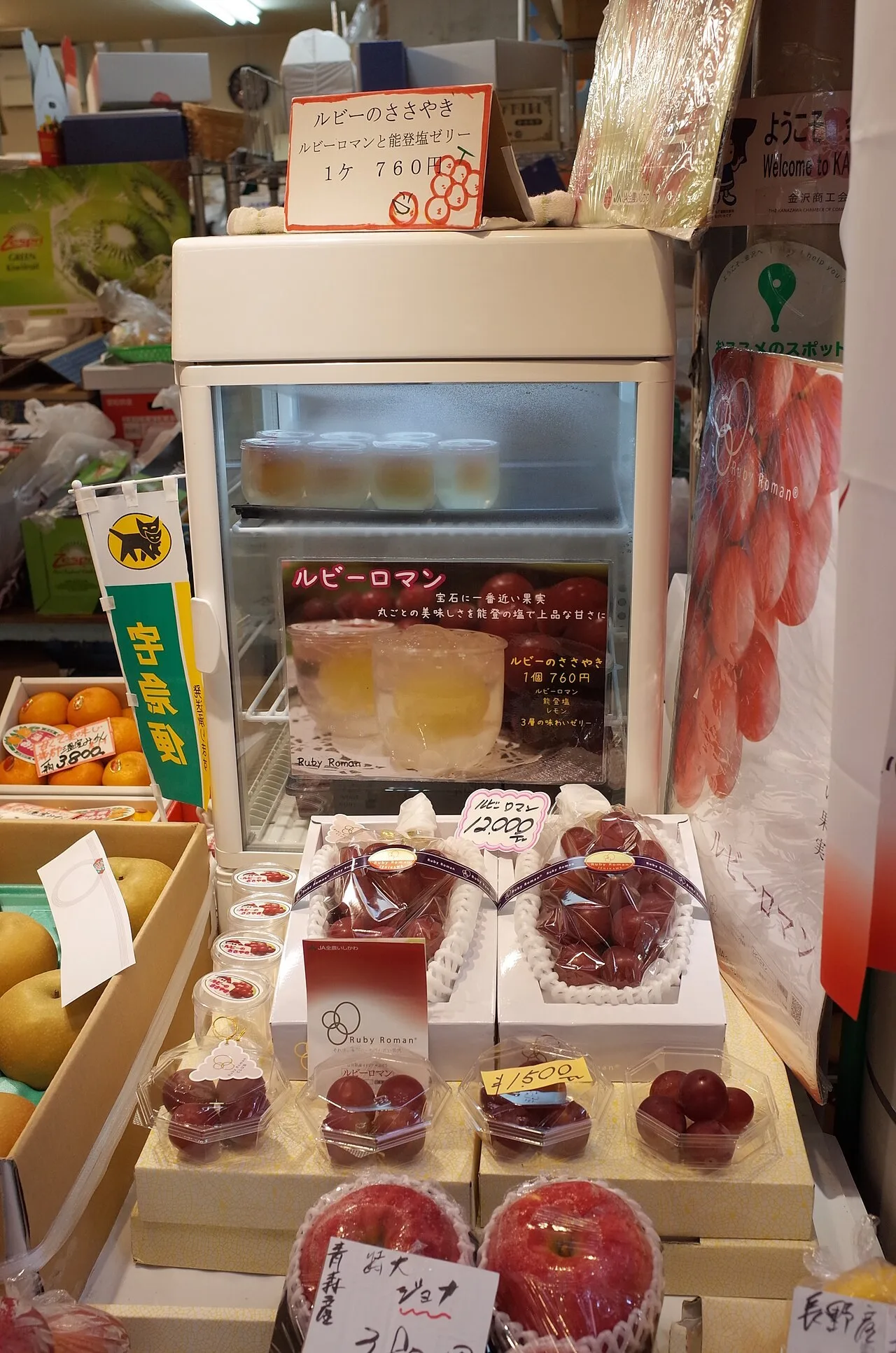
Ruby Roman grapes photographed at Kanazawa’s Omicho market. This is a retail display, not the 2021 auction bunch.
#2. Yubari King melons
Price: USD ~$45,500. Origin: Japan. Basis: 2019 auction: 2 melons, ¥5,000,000. xinhuanet.com
The May 2019 pair sold to Pokka Sapporo, whose purchase was connected with promotion of a melon-flavored drink. This is a historical dollar benchmark, not a claim that ¥5 million remains the newest yen record. Yubari’s orange-fleshed, netted melons are a regional premium product, but a publicity-rich first auction is not a normal wholesale purchase or a retail shelf price.
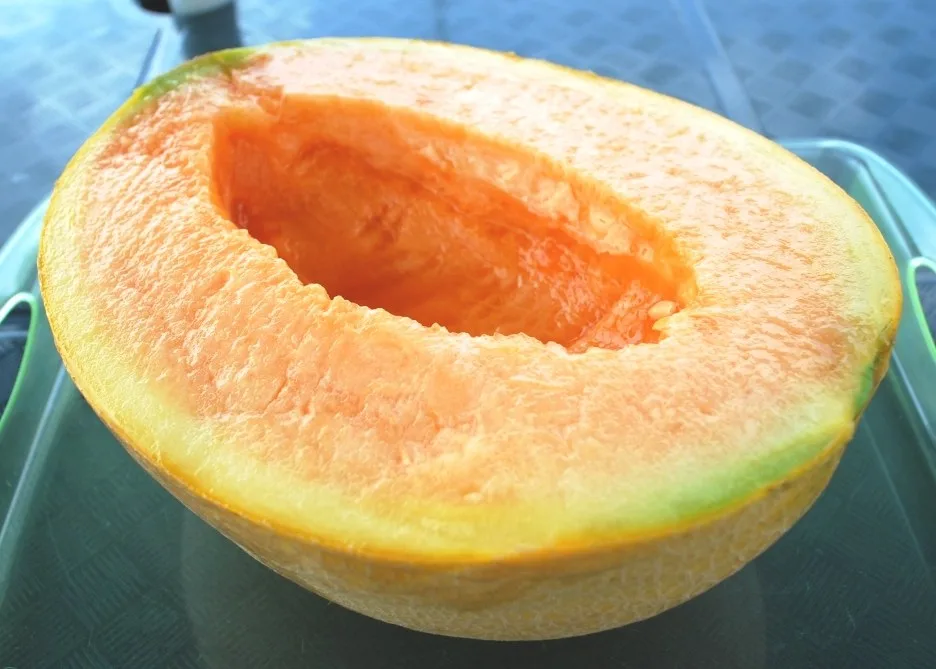
Cut Yubari melon in a genuine photograph. Representative fruit, not the pair sold in the 2019 auction.
#1. Kanyao durian
Price: USD ~$47,784. Origin: Thailand. Basis: 2019 auction: 1 durian, THB 1,500,000. guinnessworldrecords.com
Guinness documents a 1.5-million-baht Kanyao durian auctioned at Nonthaburi’s King of Durian festival on June 7, 2019. Its explanatory text gives $47,784; the page’s separate summary uses a slightly different dollar conversion. We retain the original baht result and the explanatory figure rather than pretending the exchange equivalent is exact. The festival setting separates this exceptional bid from everyday durian trade.
Why first auctions are not supermarket prices
A season-opening auction can purchase visibility as well as food. Buyers may display the fruit, promote a brand or mark a regional harvest. The resulting price is real for that lot, but it does not establish the price of every subsequent crate. Ordinary retail availability is a different question.
For conversion transparency, the Federal Reserve’s November 3, 2025 release lists ¥154.05 per USD for October 31. The Tenka Fubu conversion is ¥1,110,000 ÷ 154.05, rounded to $7,205. This does not include tax or claim that the buyer settled in dollars.
What an evergreen luxury-fruit guide should retain
Preserve cultivar, grade, unit, year and seller or auction setting. A current asking price can expire, while a historical transaction remains a dated fact. The supporting photographs below identify fruit appearances; unless explicitly stated, they are not photographs of the sold lots.
Compare the distinction between estimates and transactions in cat-breed prices, book sale records and car auction results. The common lesson is to understand exactly what was offered or sold before comparing a headline number.
FAQ
Frequently Asked Questions
Is the highest auction bid the normal price of that fruit?
No. Festival and first-season auctions can carry promotional value far above ordinary wholesale or retail prices.
Is every amount for one fruit?
No. The table identifies single fruits, pairs, bunches, boxes and measured-weight offers.
Are all 15 amounts completed sales?
No. Historical auction transactions and current retail asking prices are clearly labeled and should not be treated as the same evidence type.
Does the 2019 Yubari figure claim to be the latest record?
No. It is a dated benchmark selected for comparison, not a current record certification or a complete history of every subsequent auction.
PRESDA Dispatch
Stay Informed. Stay Aware.
A sharp briefing across AI, gaming, sport, business, world affairs, paparazzi, and lifestyle.