THE 1904 OLYMPIC MARATHON: THE STRANGEST RACE EVER
The course, heat and disputed stories behind the 1904 St. Louis Olympic marathon, from Fred Lorz’s car ride to Thomas Hicks’s official victory.
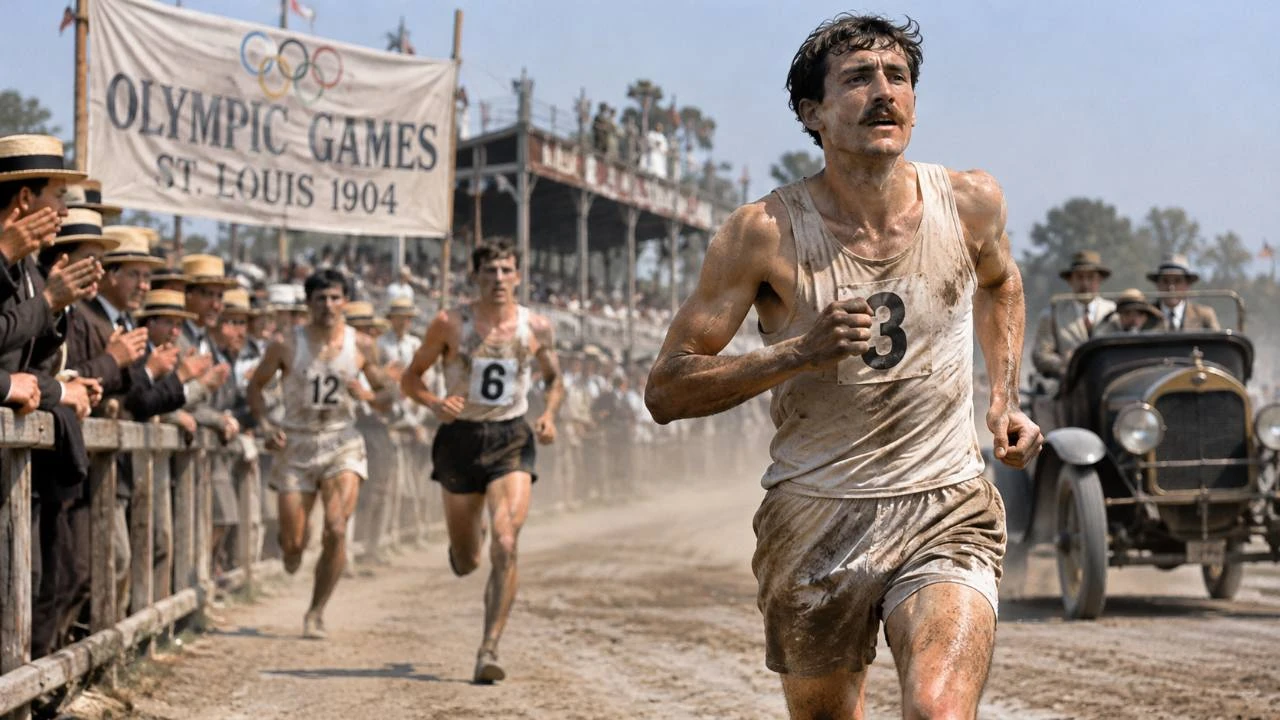
Editorial illustration supplied for PRESDA.
Fred Lorz was the first runner to enter the stadium at the end of the St. Louis Olympic marathon on August 30, 1904. That did not make him the champion. He had covered part of the course in a car and was disqualified. Thomas Hicks became the official winner in 3 hours, 28 minutes and 53 seconds. The course was about 40 kilometres, and only 14 of the 32 people who started finished. The car ride was only one of several episodes shaped by the conditions under which the runners competed. International Olympic Committee Olympedia official results and race history
The 1904 Olympics shared St. Louis with the Louisiana Purchase Exposition. Roads, crowds, vehicles and the physical limits of a summer afternoon surrounded a relatively young international sporting event. Following the runners through that landscape offers a better account of the race than treating every striking detail as a free-standing curiosity. International Olympic Committee Smithsonian magazine historical account
| Place | Runner | Recorded time |
|---|---|---|
| 1 | Thomas Hicks | 3:28:53 |
| 2 | Albert Corey | 3:34:52 |
| 3 | Arthur Newton | 3:47:33 |
| 4 | Félix Carvajal | Time unrecorded in Olympedia |
The course that wore down the field
The race began in the afternoon, with laps around the stadium before the runners went out onto roads. Olympedia describes a hot day, about 32 degrees Celsius, and a 40-kilometre course. The familiar modern marathon distance of 42.195 kilometres would give a misleading impression of what they had agreed to run. Unpaved roads and the vehicles driving nearby stirred up dust, and drinking opportunities were scarce. Heat, effort and the surfaces runners met made the race much harder to sustain than the distance alone suggests. International Olympic Committee Olympedia official results and race history
What “only 14 finished” tells us
Eighteen starters were outside the official finishing list, including Lorz, whose timing did not count after disqualification. Attrition made a difference for the lead throughout the afternoon. A runner catching someone ahead might be going faster, or the other runner might be slowing sharply after overextending earlier. The official result captures the finish order. The changing lead and the circumstances of individual withdrawals are different evidence, preserved with varying detail in contemporary and later accounts. International Olympic Committee Olympedia official results and race history
Fred Lorz and the car ride
The accounts broadly agree that Lorz stopped running partway, rode in a car and later resumed on foot. When he arrived back at the stadium, spectators initially treated him as the winner. His use of a car became known and the result did not stand. The distance he rode and his explanation for reappearing at the finish attract more attention than the central, verifiable point. He completed some of the route using assistance that took the place of running it. The disqualification is in the race record. International Olympic Committee Olympedia official results and race history
What happened after St. Louis
Lorz subsequently won the 1905 Boston Marathon. That later result is part of the reason the episode cannot be explained simply by assuming that he was incapable of running a marathon. A reader can separate the race in which he was disqualified from the race he won the following year. This is a useful distinction in a history often told as a sequence of punch lines. Each result came from a different field, course and event. Olympedia official results and race history Smithsonian magazine historical account
What Thomas Hicks’s team did
Hicks struggled badly as the race went on. Accounts describe his attendants giving him strychnine and later brandy, among other forms of aid, as he continued. Strychnine is a poison. The significance of its appearance here is historical. It shows how early ideas about stimulation, assistance and endurance could create additional danger for a runner. Descriptions vary in some details, but the historical accounts agree he was badly weakened before finishing. His time remains on the official result. International Olympic Committee Olympedia official results and race history Journal of Olympic History historical study
Why the official result and the aid belong side by side
The result answers who was recognised as the winner. The narrative of the assistance answers how he got there. Discussion of the event often applies contemporary sporting expectations retrospectively. A historical account can recognise the difference between past practice and modern expectations without suggesting the aid was safe or changing what is in the record. Photographs and contemporary descriptions can illuminate the assistance, but the official table is still the authority for who was placed first. Olympedia official results and race history Journal of Olympic History historical study 1904 Olympic report archival portrait of Hicks
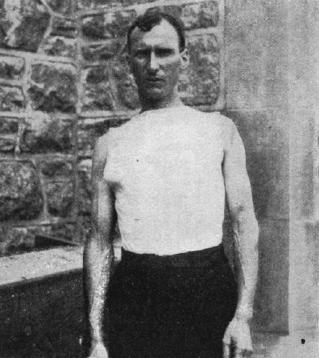
Thomas J. Hicks at the 1904 Olympic Games, reproduced from the contemporary Olympic report.
The runners who complicate the familiar story
Albert Corey was second and Arthur Newton third. Corey’s nationality and how he was represented illustrate a difficulty with historical Olympic records. The athlete was French-born, while the country label in accounts of this individual race can follow the entry under an American affiliation. The safest way to report the result is to preserve the finishing order and specify which record supplies any country label. Newton was already an Olympic marathon runner from the Paris Games in 1900. Olympedia official results and race history
Félix Carvajal and the South African runners
Cuba’s Félix Carvajal placed fourth. Some narratives dwell on clothes, fruit and stomach trouble. His recorded finish is easier to establish than every detail of those anecdotes. Len Taunyane and Jan Mashiani also appear in the results, in ninth and twelfth place. The men’s presence points to a wider fairground context and to participation that was not organised in the way a modern national delegation is. The IOC recounts a dog chase involving Taunyane. It belongs in an attributed account alongside his actual finishing position. International Olympic Committee Olympedia official results and race history Smithsonian magazine historical account
The runners who did not make it back
William Garcia was among those who failed to finish and became dangerously ill. Olympedia records that he spent several days in hospital. His experience deserves space in an account of the event because it shows the human cost behind the high number of non-finishers. The same dust and shortage of drinking opportunities that make the race visually memorable exposed athletes to real harm. The winner’s time alone cannot communicate that cost. Olympedia official results and race history Smithsonian magazine historical account
Why the story survives
The race gives historians a compact example of how results and narratives can diverge. Lorz appears first in the stadium story and nowhere among the official finishers. Hicks appears first in the standings and in historical descriptions of a runner who was in very poor condition. Carvajal and the South Africans appear in popular anecdotes that can overshadow their places. A reader who keeps the sources distinct can appreciate the extraordinary story while seeing which parts are recorded, which are contextual and which require attribution. For another PRESDA feature that reconstructs a famous episode through a timeline and eyewitness accounts, read 72 Days in the Andes. International Olympic Committee Olympedia official results and race history Journal of Olympic History historical study
How a world’s fair shaped who could take part
The exposition placed the Olympics in a busy international exhibition, but access to the race was uneven. Olympedia describes several of the American entrants as experienced distance runners, including past Boston winners. It also records how some runners came to St. Louis in connection with the fair itself. Taunyane and Mashiani were associated with its South African exhibit and had worked as dispatch runners during the South African War. Recognising those circumstances gives their results more context than the dog-chase anecdote alone. It also shows how much the presence of athletes could owe to the location of the fair, the cost of making the trip and the networks that got people to the start. Olympedia official results and race history Smithsonian magazine historical account
Why old photographs need their own captions
An archival image can show a runner’s clothing and the setting in which the camera caught him. Its ability to answer what happened over a whole race is limited. A picture of Hicks reproduced in the official report is evidence of how he was recorded and presented. It cannot establish who led on a particular stretch of road or how much help a runner received before reaching the camera. The same distinction applies to the hero illustration here, which depicts the event without claiming to reproduce an archival photograph. Journal of Olympic History historical study 1904 Olympic report archival portrait of Hicks
FAQ
Frequently Asked Questions
Who won the 1904 Olympic marathon?
Thomas Hicks won in 3:28:53 after Fred Lorz was disqualified.
Why was Fred Lorz disqualified?
He covered part of the route in a car and returned to the course on foot.
How many runners finished the 1904 Olympic marathon?
Fourteen of the 32 starters were official finishers, according to Olympic records.
PRESDA Dispatch
Stay Informed. Stay Aware.
A sharp briefing across AI, gaming, sport, business, world affairs, paparazzi, and lifestyle.