20 Rare Natural Phenomena That Seem Impossible
Discover 20 extraordinary natural phenomena, their science, documented locations and licensed images, from red sprites to Catatumbo lightning.
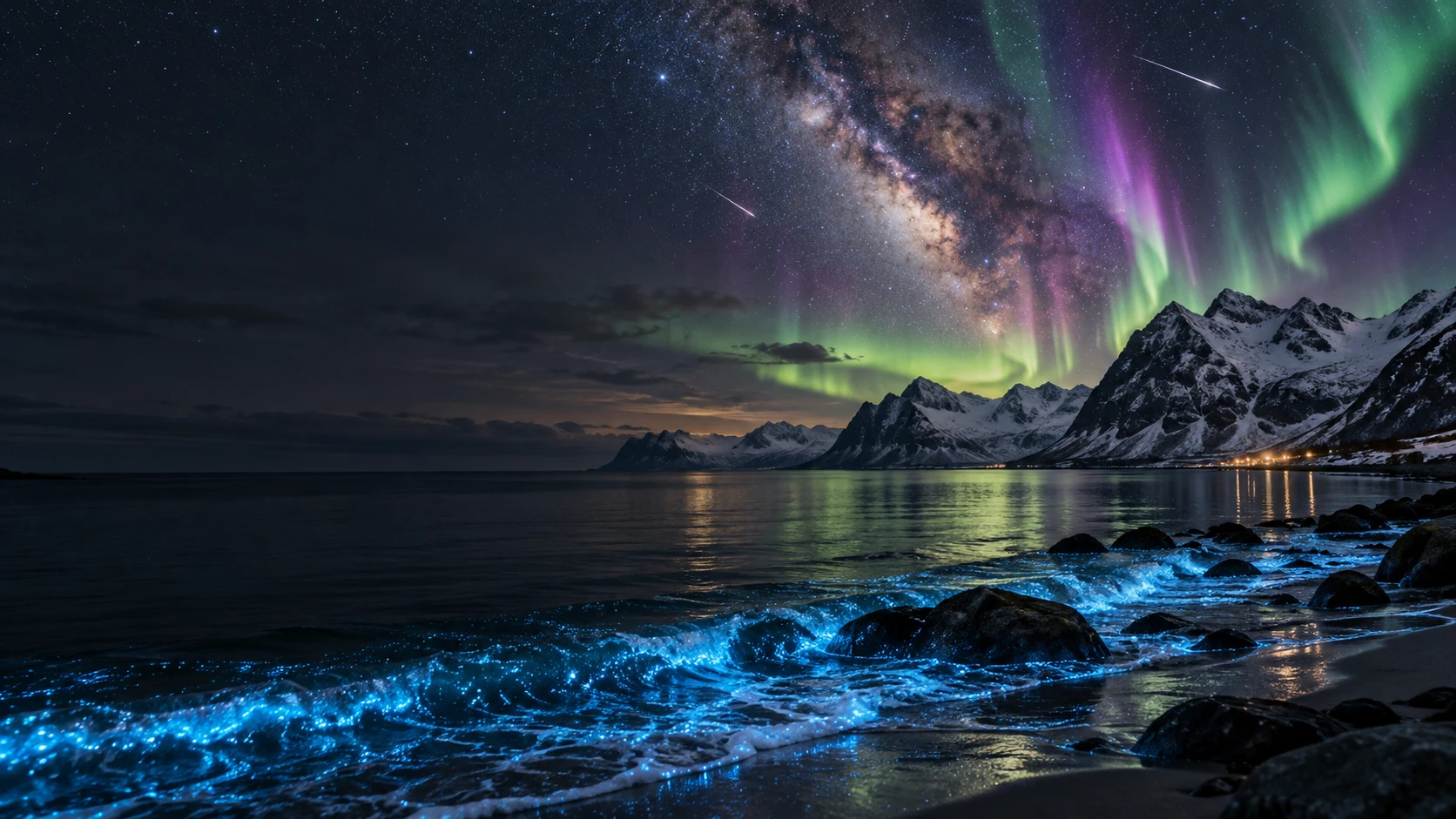
Approved editorial illustration combining luminous surf and auroral scenery. Not a documentary photograph of a verified simultaneous event.
Nature can look impossible when a familiar material behaves under unfamiliar conditions. Ice becomes a prism, a wave holds a cloud in place, and a living cell turns chemical energy into light. These 20 phenomena range from well-understood optics to events whose underlying mechanisms remain debated. “Rare” here means unusual to encounter, not that every entry has a measured global occurrence rate.
The locations below are documented examples, not promises of a sighting. The hero is an editorial illustration combining bioluminescence and auroral scenery, not a documentary photograph of a verified simultaneous event. Individual images distinguish photographs from a historical depiction and an explanatory diagram. Wonder becomes more interesting when we know exactly what the evidence supports.
1. Bioluminescent Beaches
Breaking waves can glow blue when light-producing organisms, often dinoflagellates, respond to mechanical disturbance. Their bioluminescence is a chemical process, rather than stored sunlight or fluorescent sand. Concentrated populations can make a breaking wave briefly reveal its own motion. Water may look ordinary during the day while movement becomes visible as light after dark. NOAA: bioluminescence
Mosquito Bay on Vieques in Puerto Rico and documented New Zealand beaches provide examples of luminous waters. Brightness varies with species, abundance and conditions; not every glowing bloom is harmless. Photographs can also intensify color through exposure settings. Follow local water-quality guidance rather than assuming that a beautiful glow means safe swimming. NOAA: a glowing ocean
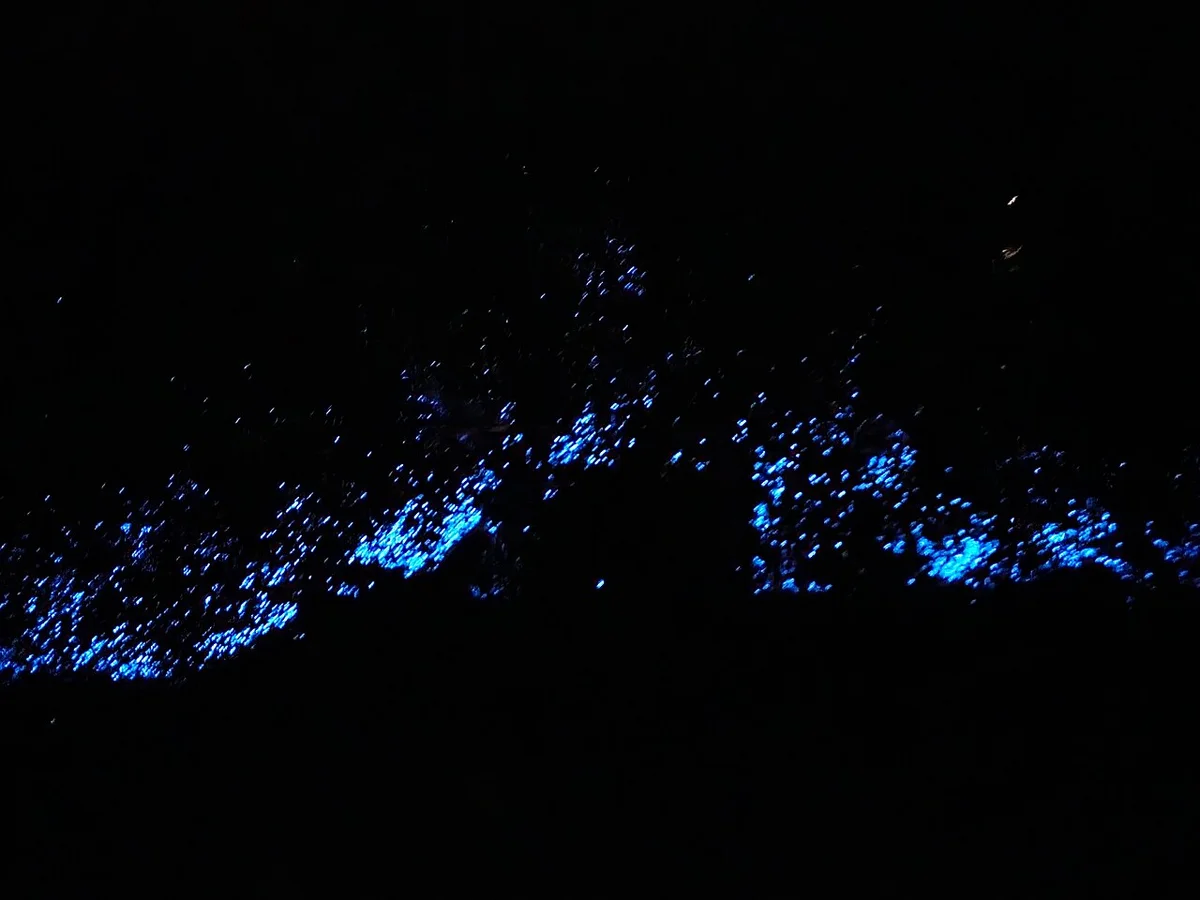
Bioluminescent surf at Paraparaumu Beach, New Zealand
Panamitsu · Source image · License: CC BY-SA 4.0
Responsive WebP conversion by PRESDA. Full composition retained. ShareAlike derivatives retain the stated license.
2. Red Sprites
Sprites are brief electrical light emissions high above thunderstorms. Often red and branching, they belong to transient luminous events and occur far above the storm’s ordinary cloud lightning. A distant observer with a clear horizon and sensitive camera may record structures that last too briefly to inspect comfortably by eye. Their color and form arise from electrical excitation of the upper atmosphere, not a burning object. NASA: sprites and other events
They have been photographed over storms in regions including North America and from the International Space Station. A sprite is not a red lightning bolt descending from a cloud to the ground. Its relationship with a thunderstorm is electrical, but its altitude and discharge environment differ. Documented images resolve what would otherwise sound like a sailor’s fleeting description.
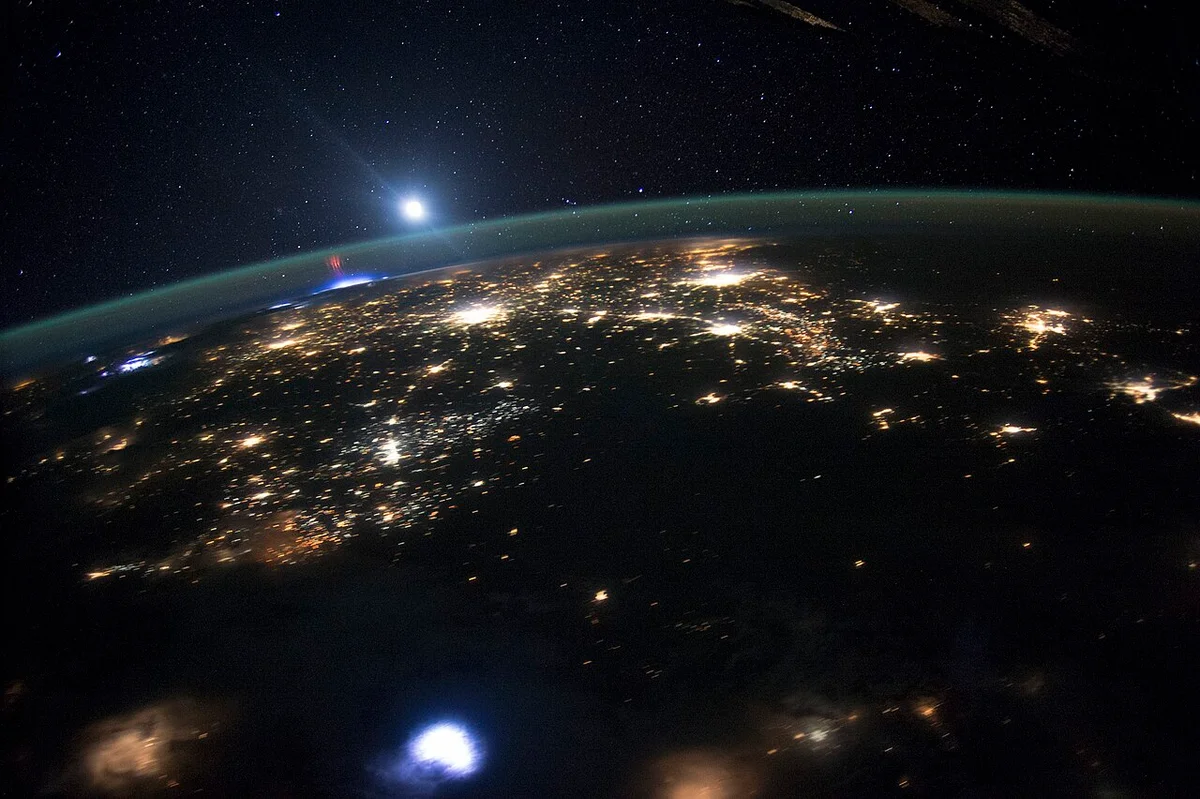
Red sprite above a thunderstorm, photographed from the ISS
NASA · Source image · License: Public domain
Responsive WebP conversion by PRESDA. Full composition retained. ShareAlike derivatives retain the stated license.
3. Lenticular Clouds
Lenticular clouds form when moist air rises and cools within atmospheric waves, often downwind of mountains. Condensation can occur in a stable part of the wave while droplets evaporate beyond it. The result resembles a stationary lens or stacked saucers even though air continues moving through the shape. Apparent stillness therefore does not imply still air. National Weather Service: standing lenticular clouds
They are documented in places such as Hawaii and the mountain regions of the southwestern United States, and occur elsewhere when suitable conditions align. Smooth contours are a sign of organized airflow, not evidence of a solid craft. Mountain waves can involve aviation hazards, so the visual elegance should not be confused with gentle conditions for flying.
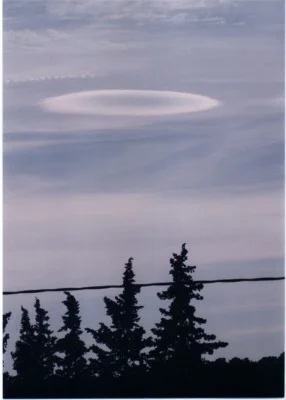
Lenticular cloud photographed near Salernes, France
Pieter Krul (Pkrul) · Source image · License: CC BY-SA 3.0
Responsive WebP conversion by PRESDA. Full composition retained. ShareAlike derivatives retain the stated license.
4. Volcanic Lightning
Explosive eruptions can generate electrical discharges inside or around ash plumes. Fragmentation and collisions help separate charge, while ice-related processes can contribute in tall plumes. Volcanic lightning therefore has more than one relevant charging environment. The flashes illuminate a mixture whose fine ash particles and intense motion differ from the familiar scene of an ordinary rainstorm. USGS: lightning in volcanic ash
Galunggung in Indonesia and Eyjafjallajökull in Iceland provide documented examples. Instrumental detection also helps researchers connect electrical activity with eruptive behavior and ash hazards. The lightning does not mean lava itself has become electricity. It is a discharge created by charge separation within the eruption’s evolving plume.
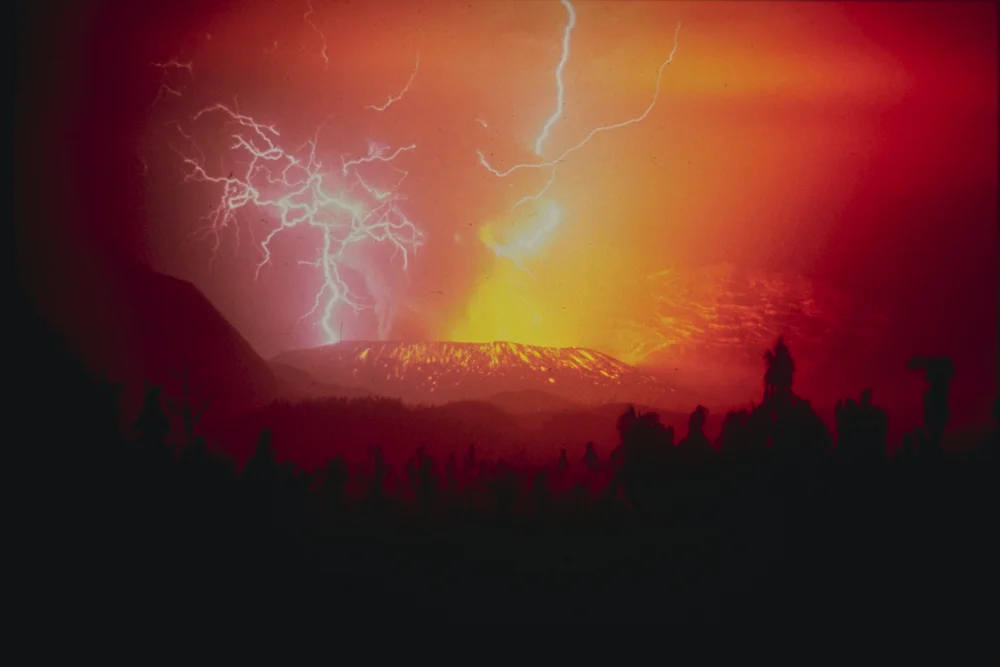
Lightning during the 1982 Galunggung eruption, Indonesia
R. Hadian, U.S. Geological Survey · Source image · License: Public domain
Responsive WebP conversion by PRESDA. Full composition retained. ShareAlike derivatives retain the stated license.
5. Fire Rainbows
The popular name “fire rainbow” usually refers to a circumhorizontal arc. Sunlight passes through suitably oriented ice crystals in high clouds and separates into colors. The Sun must be high enough above the horizon for the geometry to work, approximately 58 degrees or more. There is no fire, and the mechanism differs from a rainbow formed by liquid raindrops. National Weather Service: a circumhorizontal arc
One documented display appeared over the Spokane and Post Falls area in 2006. Similar arcs can occur elsewhere under the right solar altitude and cloud conditions. Do not assume every patch of colorful cloud is this phenomenon: cloud iridescence and other halos have different geometries. A photograph’s position relative to the Sun helps identify the effect.
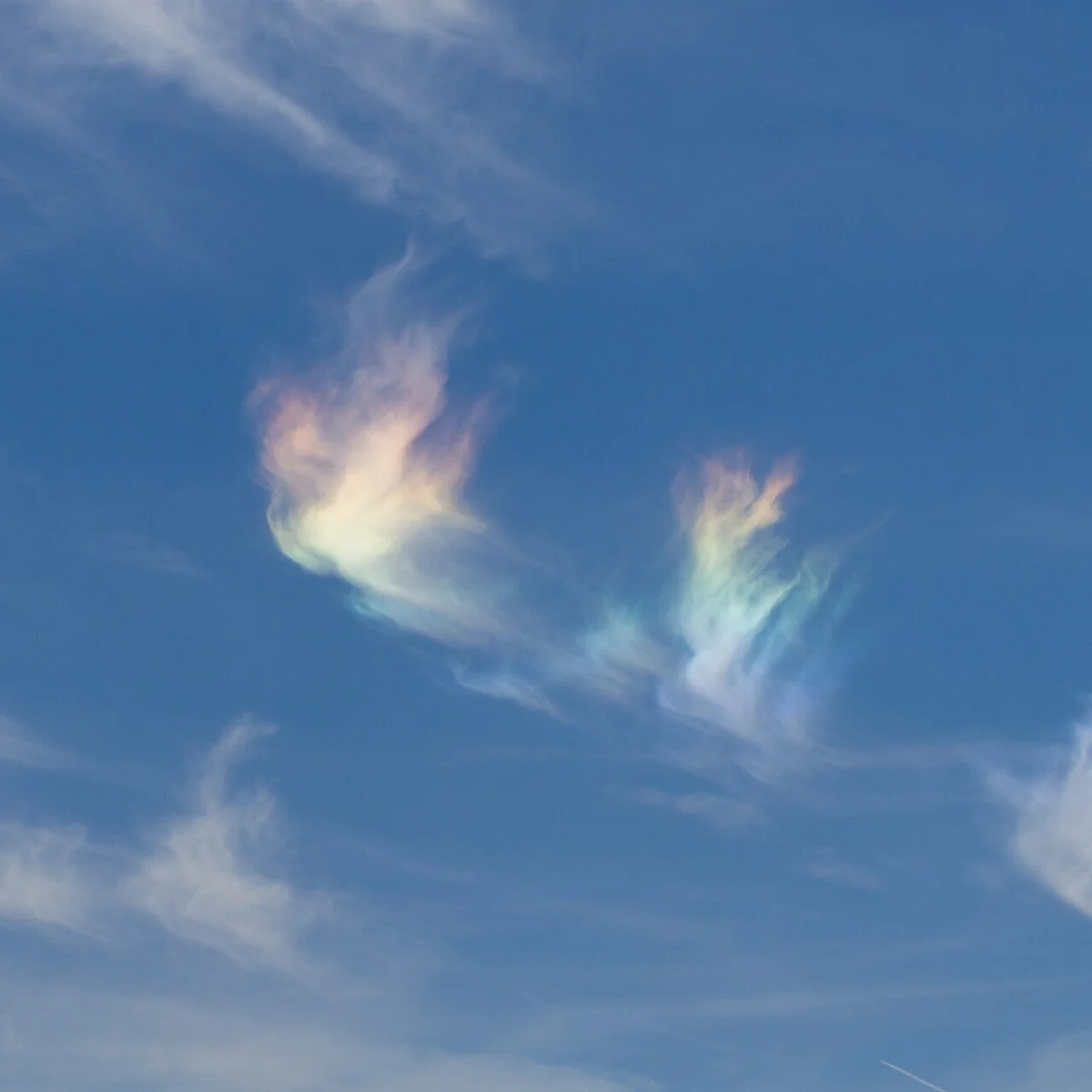
Circumhorizontal arc over Rennes, France
Eusebius · Source image · License: CC BY 3.0
Responsive WebP conversion by PRESDA. Full composition retained. ShareAlike derivatives retain the stated license.
6. Noctilucent Clouds
Noctilucent clouds are extremely high ice clouds near the summer mesopause, roughly 80 to 85 kilometers above Earth. Long after the lower atmosphere has darkened, these clouds can still receive sunlight and shine with silvery blue patterns. Tiny particles, including material associated with meteoric smoke, provide surfaces on which ice can form in that exceptionally cold region. NASA: meteor smoke and clouds
They are associated especially with summer twilight at higher latitudes, with observations in places including northern Europe. Their light is reflected sunlight, unlike an aurora’s emission. Satellite missions such as AIM made it possible to study their large-scale distribution rather than relying only on striking observations from the ground. NASA: noctilucent clouds
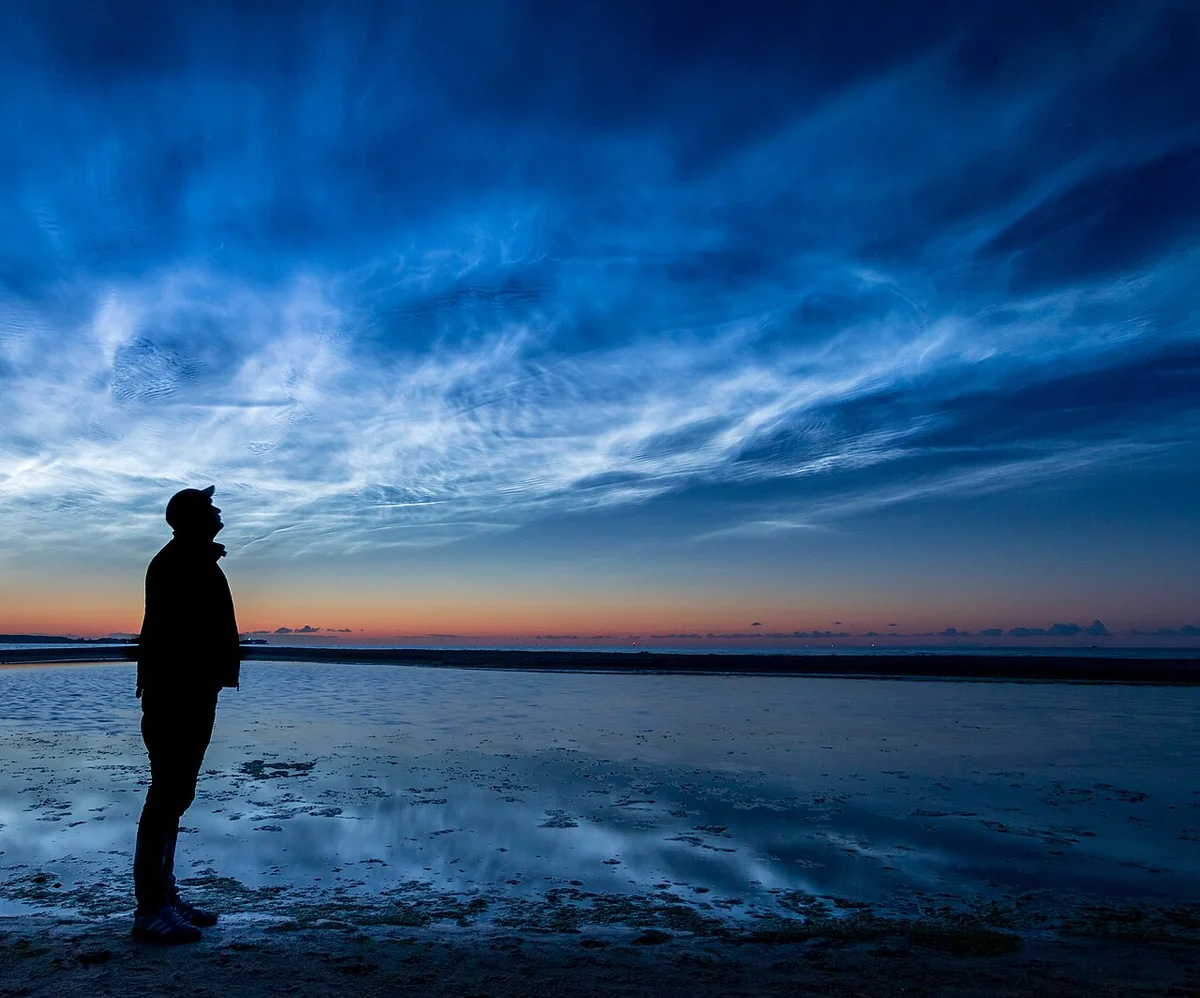
Noctilucent clouds at Laboe, Germany
Matthias Süßen · Source image · License: CC BY-SA 4.0
Responsive WebP conversion by PRESDA. Full composition retained. ShareAlike derivatives retain the stated license.
7. Sun Dogs
Sun dogs, or parhelia, are bright spots commonly seen about 22 degrees to either side of the Sun. Sunlight refracts through approximately horizontal, plate-shaped ice crystals. The geometry produces an apparent companion Sun, sometimes with red on the side nearest the real Sun. These are optical directions in the sky, not extra luminous bodies. National Weather Service: halos and sun dogs
Cold regions such as North Dakota provide conspicuous examples, although high ice clouds allow sightings in warmer places too. Their occurrence does not require the observer to stand at an extraordinary geographic location. It requires the appropriate crystals, orientation and viewing geometry. Never stare at the Sun to search for them.
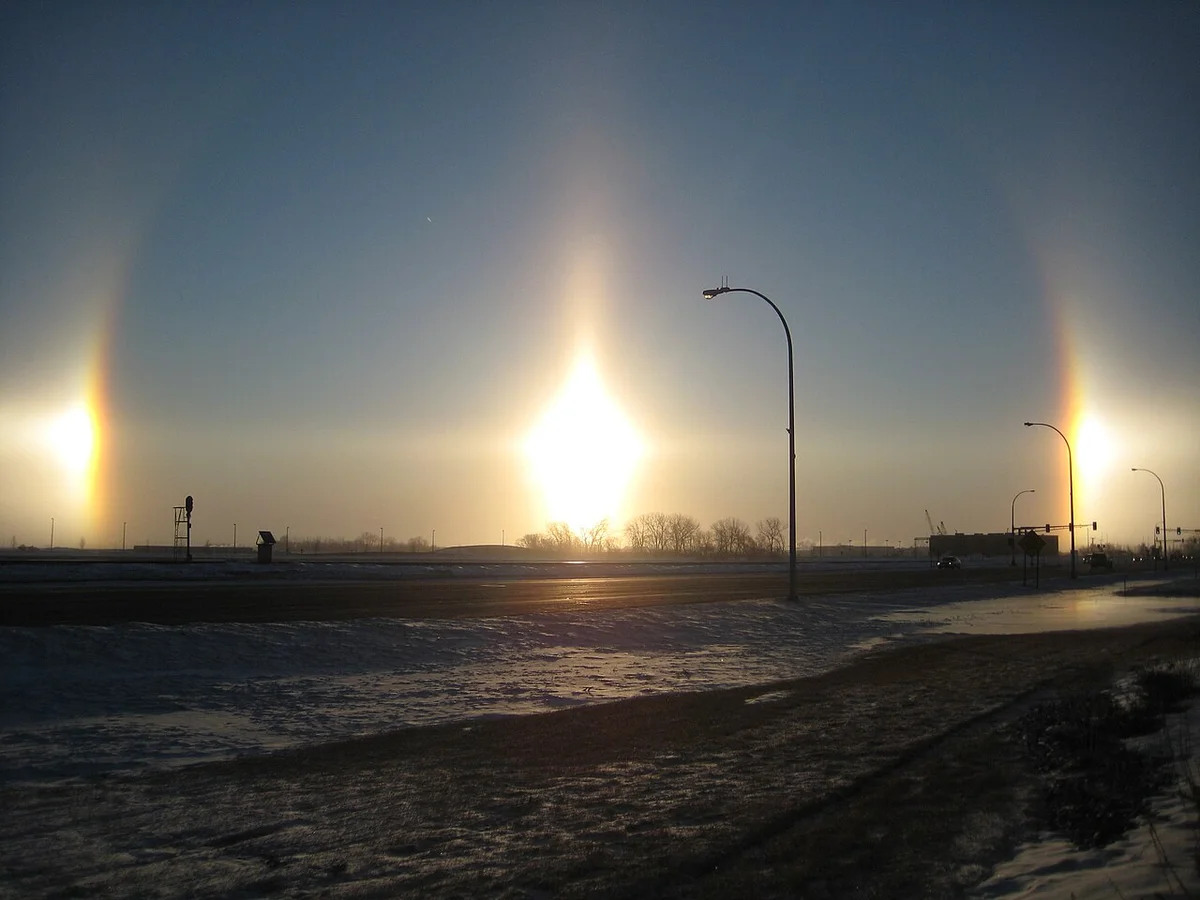
Sun dogs at Fargo, North Dakota
Gopherboy6956 · Source image · License: Public domain
Responsive WebP conversion by PRESDA. Full composition retained. ShareAlike derivatives retain the stated license.
8. Blood Falls
Blood Falls emerges at Taylor Glacier in Antarctica. Iron-rich saline water reaches the surface and develops its striking reddish appearance through oxidation and the formation of iron-bearing material. Research examining samples has identified tiny iron-rich nanospheres, showing why simply searching for familiar crystalline minerals can miss part of the explanation. Johns Hopkins: the color of Blood Falls
The site lies in the McMurdo Dry Valleys, where glacier, brine and exposed landscape create an exceptional setting. It is neither blood nor a waterfall colored by a red animal. Its significance extends beyond appearance: unusual cold, saline environments help researchers investigate how water, chemistry and microbial ecosystems persist under conditions unlike ordinary surface streams.
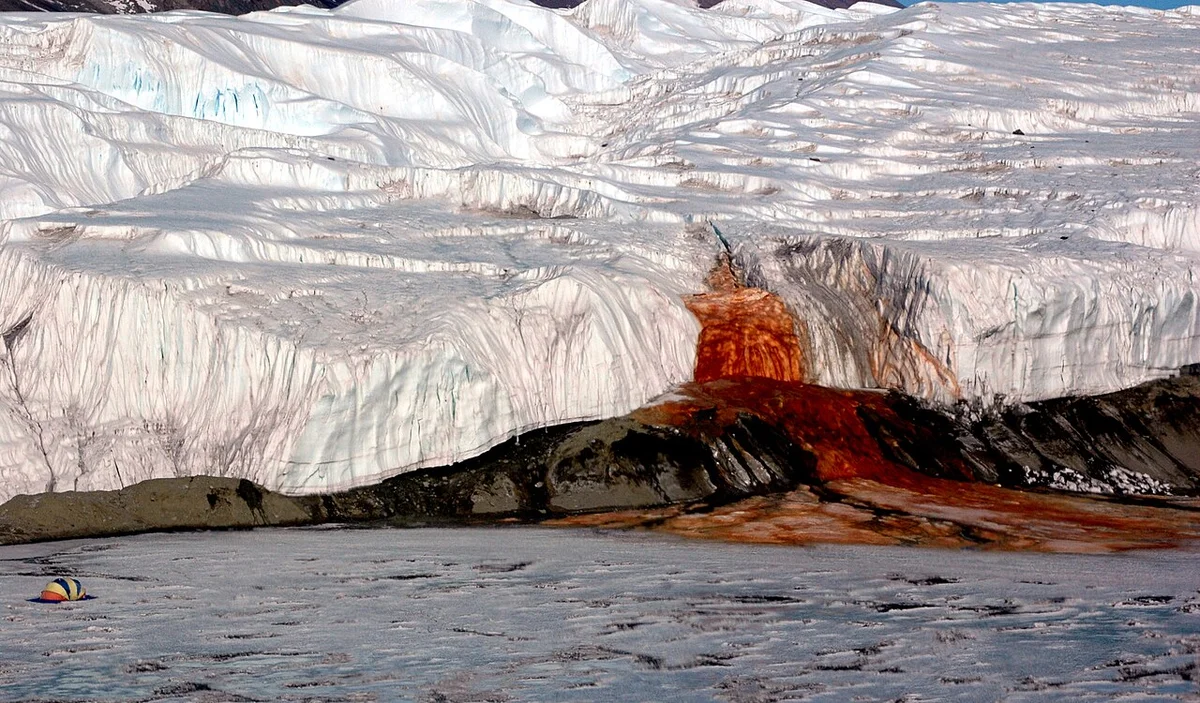
Blood Falls at Taylor Glacier, Antarctica
National Science Foundation/Peter Rejcek · Source image · License: Public domain
Responsive WebP conversion by PRESDA. Full composition retained. ShareAlike derivatives retain the stated license.
9. Frozen Methane Bubbles
Columns and pale disks of gas can become trapped as lake ice grows. Methane produced by microbes breaking down organic material can rise from sediments and become enclosed beneath successive layers. The gas is trapped within frozen water; it is not ordinary solid methane sitting inside a lake. Images of these bubbles reveal both a winter pattern and a pathway for carbon emissions. NASA: methane bubbles in lake ice
Alaskan lakes are studied directly, while Abraham Lake in Alberta is a well-known photographic example of bubble-filled ice. Appearance alone does not identify every bubble’s gas composition. Ice thickness can vary around gas seeps, and methane is flammable. A photograph is an invitation to understand the process, not to test lake ice or ignite a bubble.
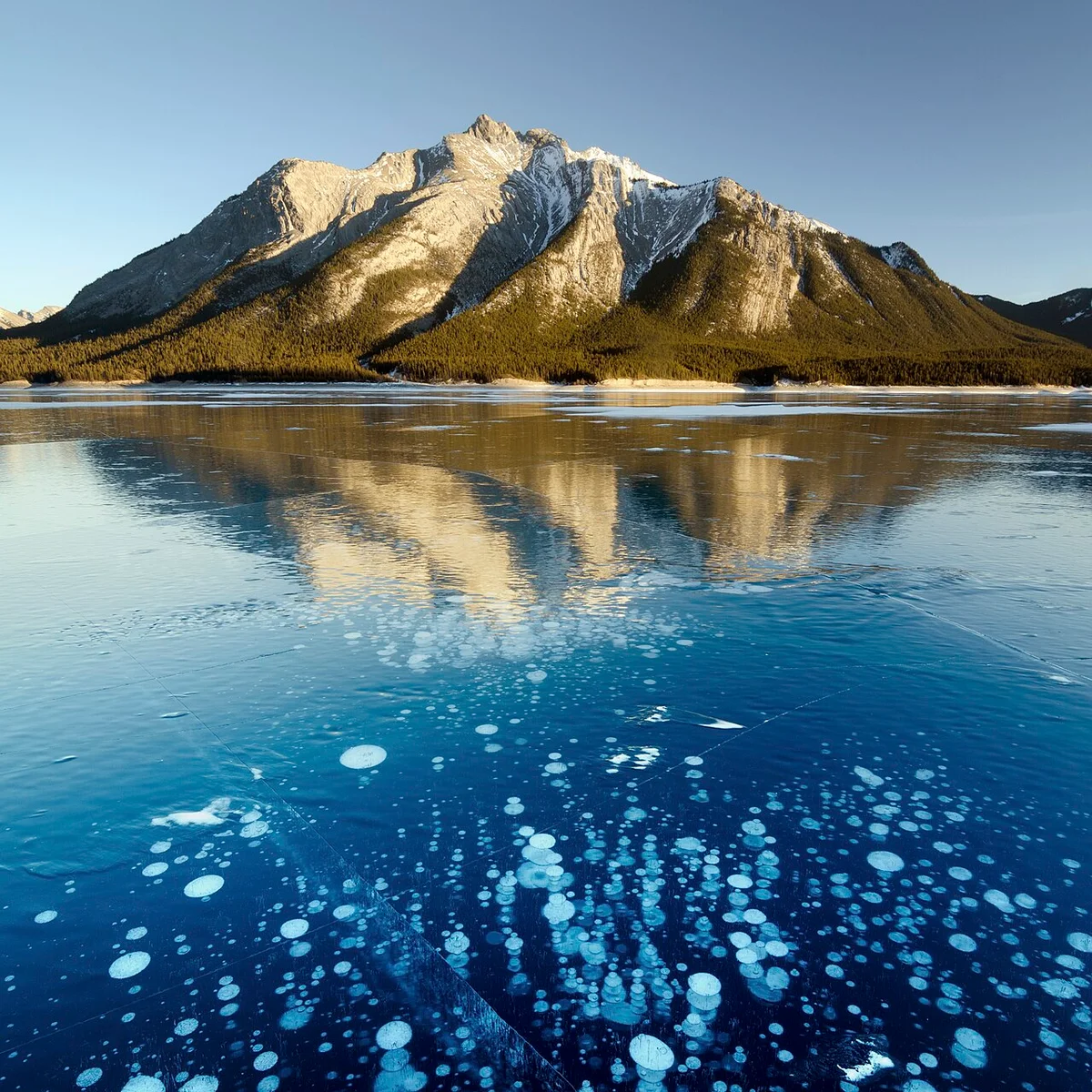
Bubbles within the ice of Abraham Lake, Alberta
Jakub Fryš · Source image · License: CC BY-SA 4.0
Responsive WebP conversion by PRESDA. Full composition retained. ShareAlike derivatives retain the stated license.
10. Morning Glory Clouds
Morning Glory clouds are long, rolling cloud formations associated with propagating atmospheric disturbances. In the Gulf of Carpentaria region of northern Australia, interactions involving sea breezes and the lower atmosphere help create the conditions. Air rises and condenses at one part of the traveling wave and sinks elsewhere, giving the cloud its striking cylindrical appearance. Australian Bureau of Meteorology: unusual weather photographs
Burketown in Queensland is especially associated with sightings. Similar roll clouds occur elsewhere, so location alone does not identify every cloud band as the same regional event. The visible roll is part of an organized moving atmospheric system. Its beauty does not remove the strong winds and turbulence that can accompany it.
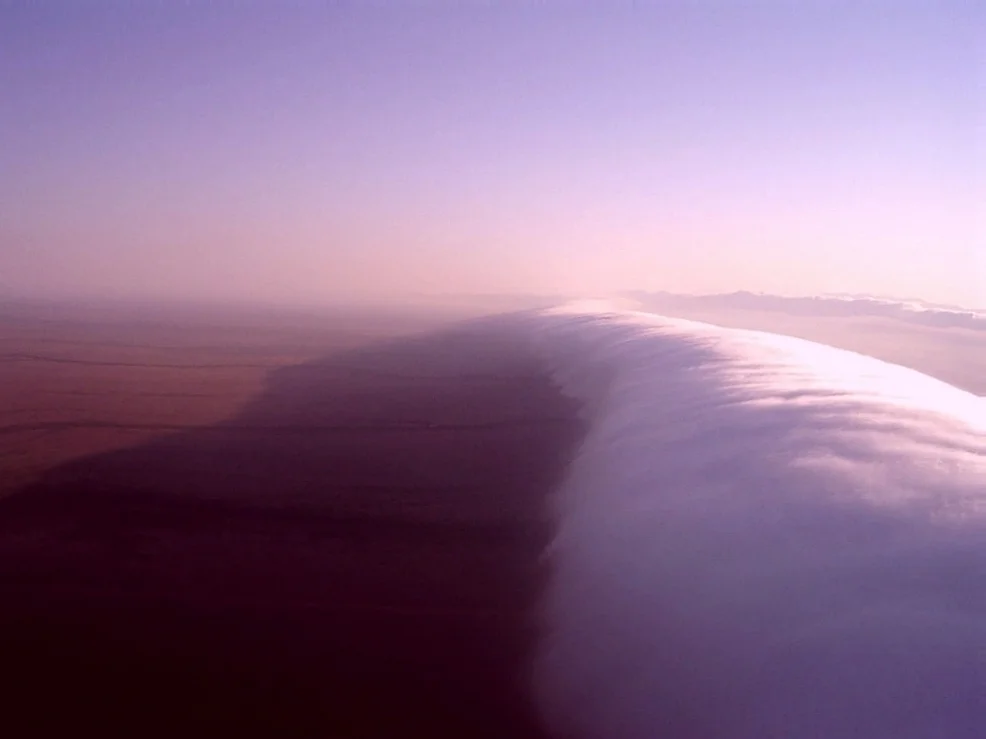
Morning Glory cloud near Burketown, Australia
Ulliver · Source image · License: Public domain
Responsive WebP conversion by PRESDA. Full composition retained. ShareAlike derivatives retain the stated license.
11. Ball Lightning
Ball lightning describes reports of luminous, ball-like objects associated with thunderstorms. The category remains scientifically difficult because reports vary and reliable measurements are rare. A Chinese team recorded a candidate event and its optical spectrum during a 2012 thunderstorm, publishing the analysis in 2014. That evidence is more informative than an unexplained photograph without context. American Physical Society: first spectrum of ball lightning
The observation does not establish a single mechanism for every report. Proposed explanations include processes involving material vaporized by a lightning strike, alongside other models. The accompanying nineteenth-century image is a historical depiction, not a verified photograph. No destination can responsibly promise a ball-lightning sighting, and an unidentified luminous object should not automatically receive that label.
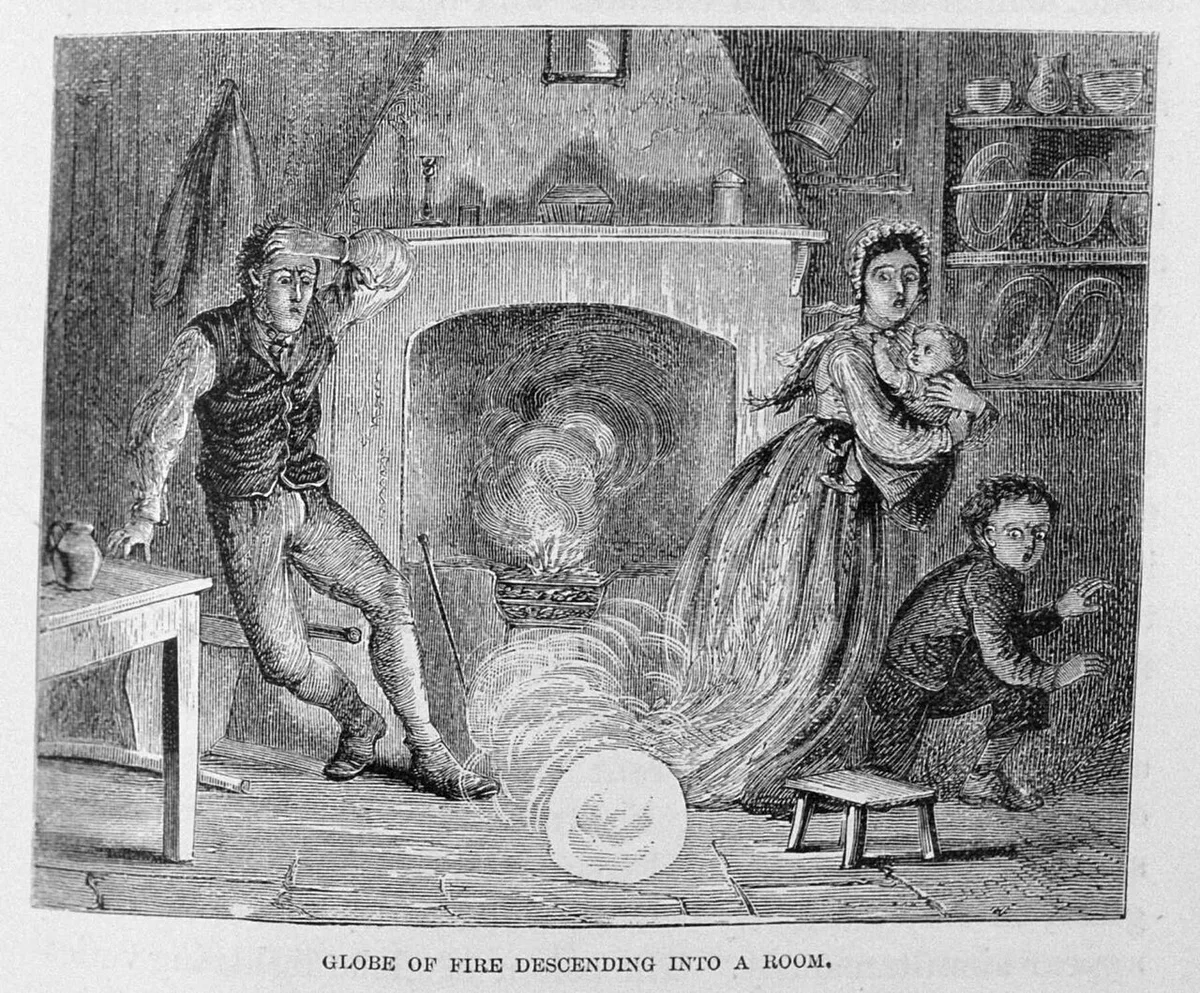
Historical illustration of reported ball lightning, published in 1886
The Aerial World (1886), G. Hartwig; illustrator uncredited · Source image · License: Public domain
Responsive WebP conversion by PRESDA. Full composition retained. ShareAlike derivatives retain the stated license.
12. STEVE
STEVE, short for Strong Thermal Emission Velocity Enhancement, commonly appears as a narrow mauve or whitish arc, sometimes accompanied by green structures. Satellite measurements and ground observations connect it with intense subauroral plasma flows and heating. Its visual resemblance to an aurora does not mean its purple arc is produced by exactly the same process as ordinary auroral curtains. NASA: the study of STEVE
Citizen scientists in Canada played a prominent role in bringing observations together; a documented image shows it over Alberta. Research continues into its different components and fine structure. It is neither a cloud lit from a city nor a phenomenon explained simply by expanding its acronym. Combining sky photographs with measurements is what turned an unusual sight into a research subject.
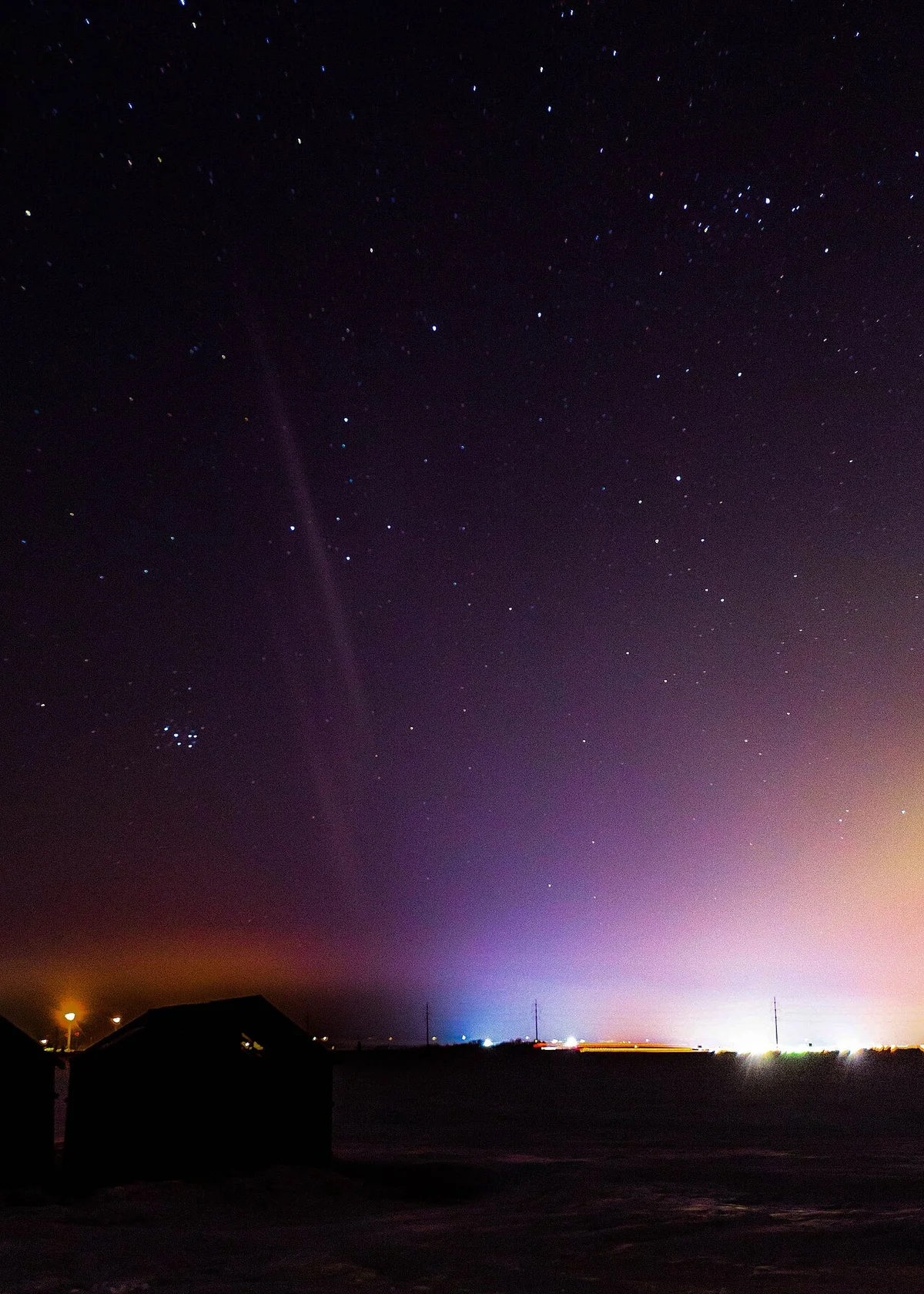
STEVE over Crossfield, Alberta
Chris Ratzlaff / NASA Goddard Space Flight Center · Source image · License: CC0
Responsive WebP conversion by PRESDA. Full composition retained. ShareAlike derivatives retain the stated license.
13. The Green Flash
Near sunset or sunrise, atmospheric refraction and dispersion can briefly make the upper edge of the Sun appear green. Mirage conditions can enhance the separation so that a flash becomes visible. A clear, distant horizon helps, but the effect is sensitive to atmospheric structure. It is an optical phenomenon, not the Sun changing its physical color. American Meteorological Society: green flash
Coastal observations, including documented photographs from California, are familiar examples, although the effect is not confined to the sea. Many photographs show a green rim rather than a distinct separated flash. Never use unfiltered binoculars or a telescope to search for it; magnified sunlight can damage eyesight before discomfort provides a warning.
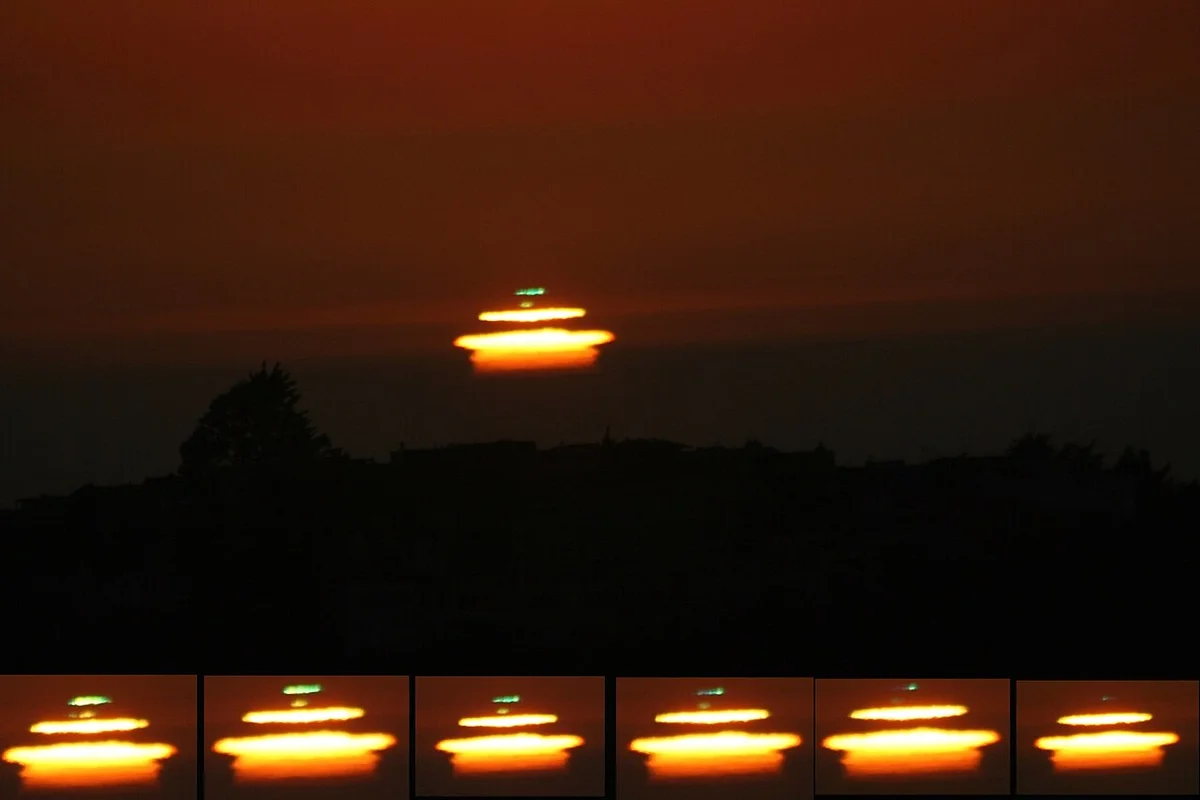
Green-flash photographic sequence from San Francisco
Brocken Inaglory · Source image · License: CC BY-SA 4.0
Responsive WebP conversion by PRESDA. Full composition retained. ShareAlike derivatives retain the stated license.
14. Penitentes
Penitentes are blade-like formations of snow or ice that develop through uneven ablation under suitable conditions. Strong sunlight, dry air and sublimation help small differences in the surface grow into troughs and sharp ridges. Reflection, shading and local energy exchange matter, making the process more complex than wind simply carving spikes from a snowfield. Physical processes in penitente formation
High, dry parts of the Andes are classic locations, including the Agua Negra area between Argentina and Chile. Laboratory work investigates related structures on smaller scales, but extrapolating their existence to other planets or moons needs separate evidence. On Earth, the field of frozen blades is a visible expression of how sunlight removes material unevenly.
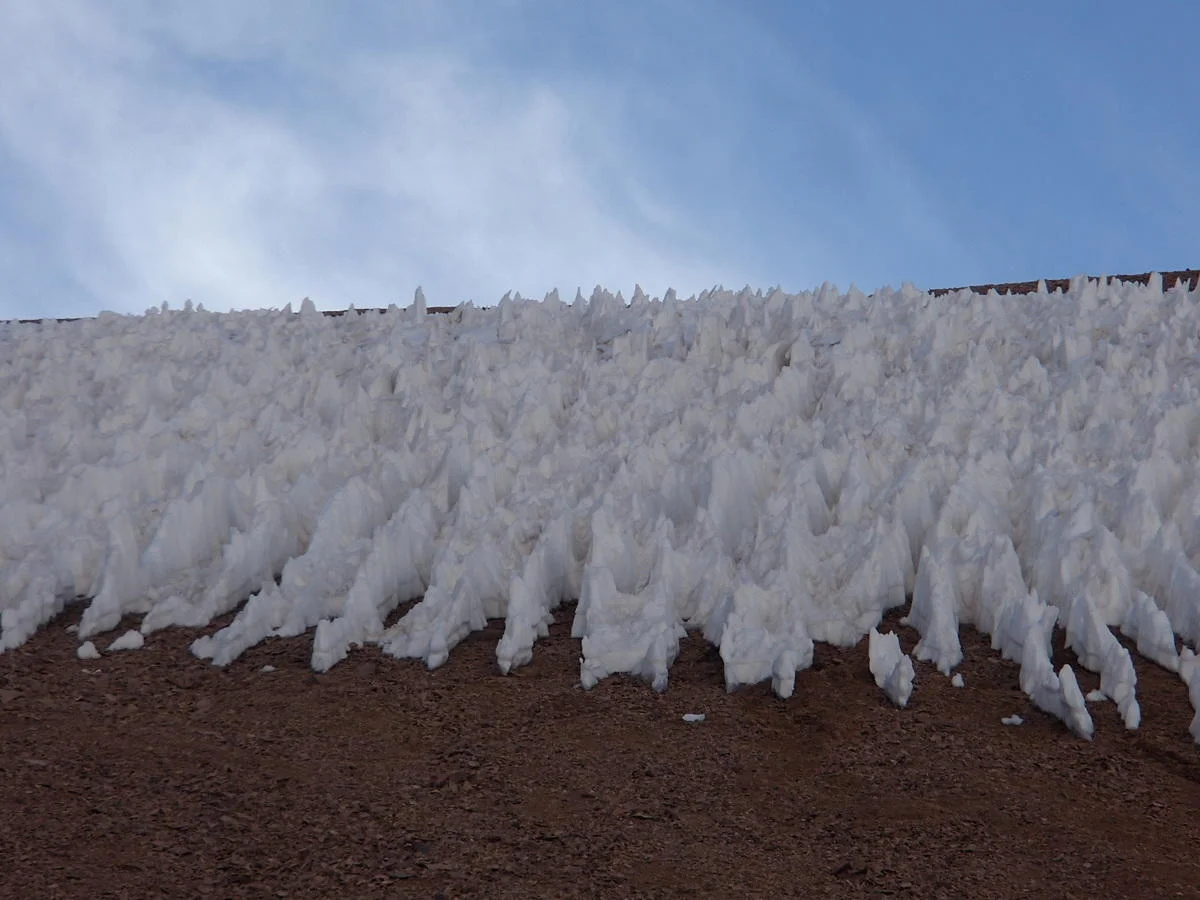
Snow penitentes at Agua Negra in the Andes
Vrac · Source image · License: CC BY-SA 4.0
Responsive WebP conversion by PRESDA. Full composition retained. ShareAlike derivatives retain the stated license.
15. Brinicles
When sea ice forms, it rejects much of its salt, producing very cold, dense brine. Under suitable conditions that brine descends into seawater and freezes surrounding water into a hollow tube. A brinicle therefore grows downward around a liquid flow. Its dramatic popular nickname should not obscure this specific combination of salinity, temperature and density. Research: brinicles as inverse chemical gardens
They have been observed beneath polar sea ice, including Antarctic settings. They are not ordinary freshwater icicles pointing in the wrong direction. The accompanying explanatory diagram illustrates the mechanism and is labeled as such. Models investigate how heat transfer, salt transport and flow interact; the name alone does not explain when a tube will form or remain stable.
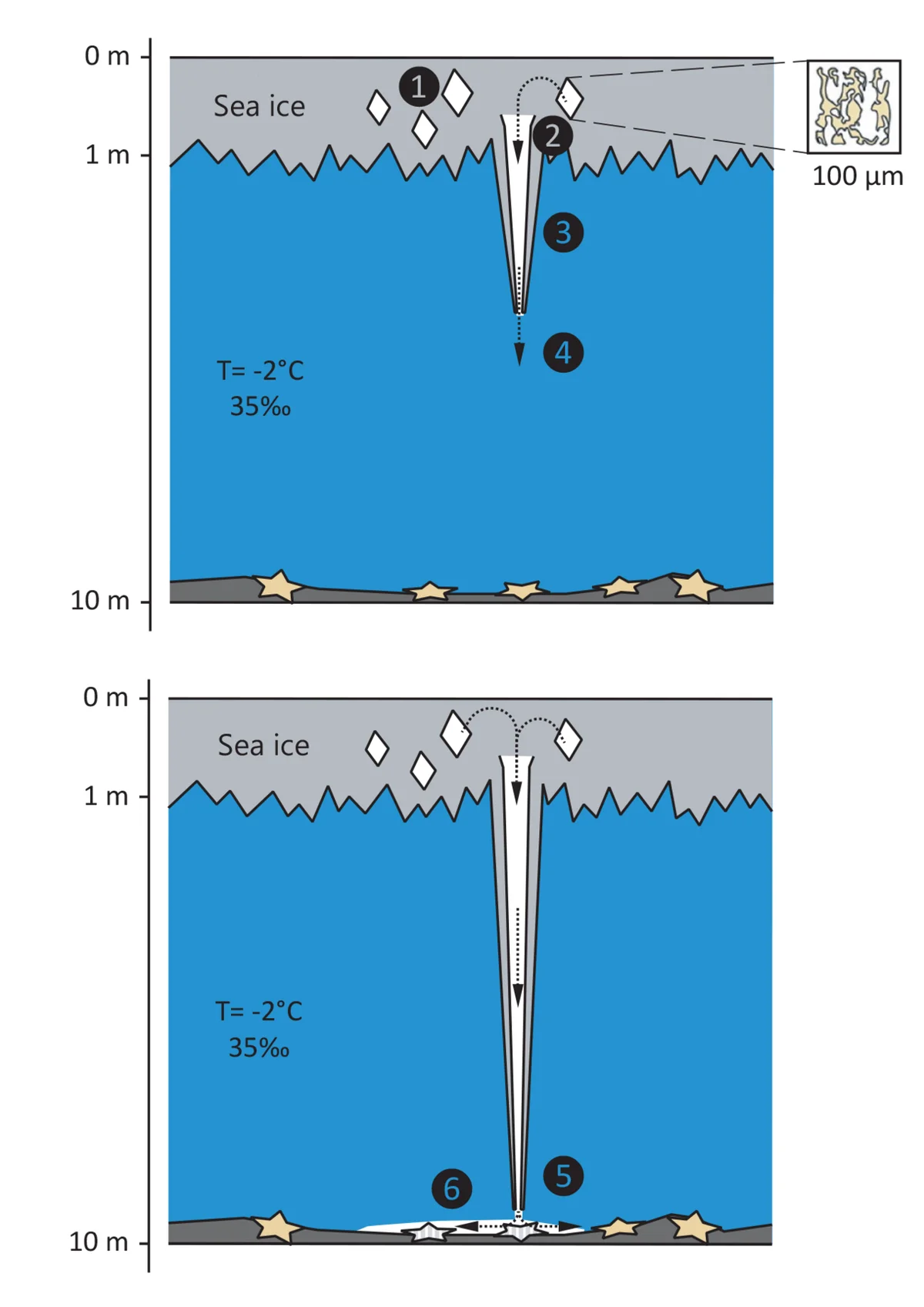
Explanatory diagram of brinicle formation
Nix Sunyata · Source image · License: CC BY 4.0
Responsive WebP conversion by PRESDA. Full composition retained. ShareAlike derivatives retain the stated license.
16. Sailing Stones
On Racetrack Playa in California’s Death Valley, rocks leave long tracks across a nearly level surface. Direct observations documented movement when shallow water froze into thin floating ice and then broke into panels. Light winds moved the panels, which pushed stones across wet mud. The necessary sequence explains why motion can be rare even when tracks remain visible for a long time. National Park Service: the Racetrack
The stones do not need hidden engines or an unexplained magnetic force. Nor does every track require hurricane-strength wind. The combination of shallow water, freezing nights, thawing ice and breeze matters. Visitors should avoid walking on wet playa or moving the stones, since disturbing the surface damages the very evidence that makes the location scientifically interesting.
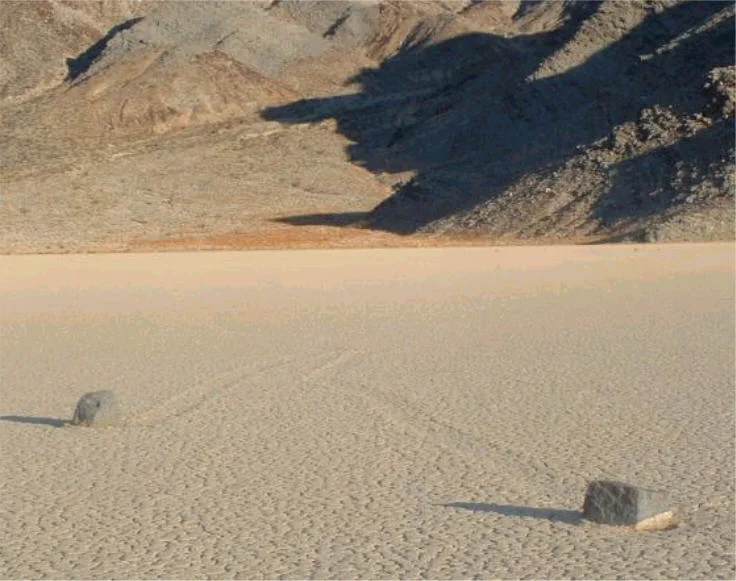
Sailing stones and tracks at Racetrack Playa, Death Valley
Daniel Mayer · Source image · License: CC BY-SA 3.0
Responsive WebP conversion by PRESDA. Full composition retained. ShareAlike derivatives retain the stated license.
17. Light Pillars
Light pillars appear as vertical shafts above or below a source when suitably oriented ice crystals reflect its light toward the observer. Streetlights, other artificial lights or the Sun can produce them. The apparent column does not mean a beam is physically shooting upward through that exact narrow shaft of space. It is a pattern formed by many separate reflections. National Weather Service: unusual optical weather
Cold nights in places such as Ontario provide photographs of colorful pillars from ground lighting. Their color often follows the light source, while their shape depends on the crystals and geometry. The effect can look supernatural precisely because the individual floating reflectors are too small and distant to distinguish.
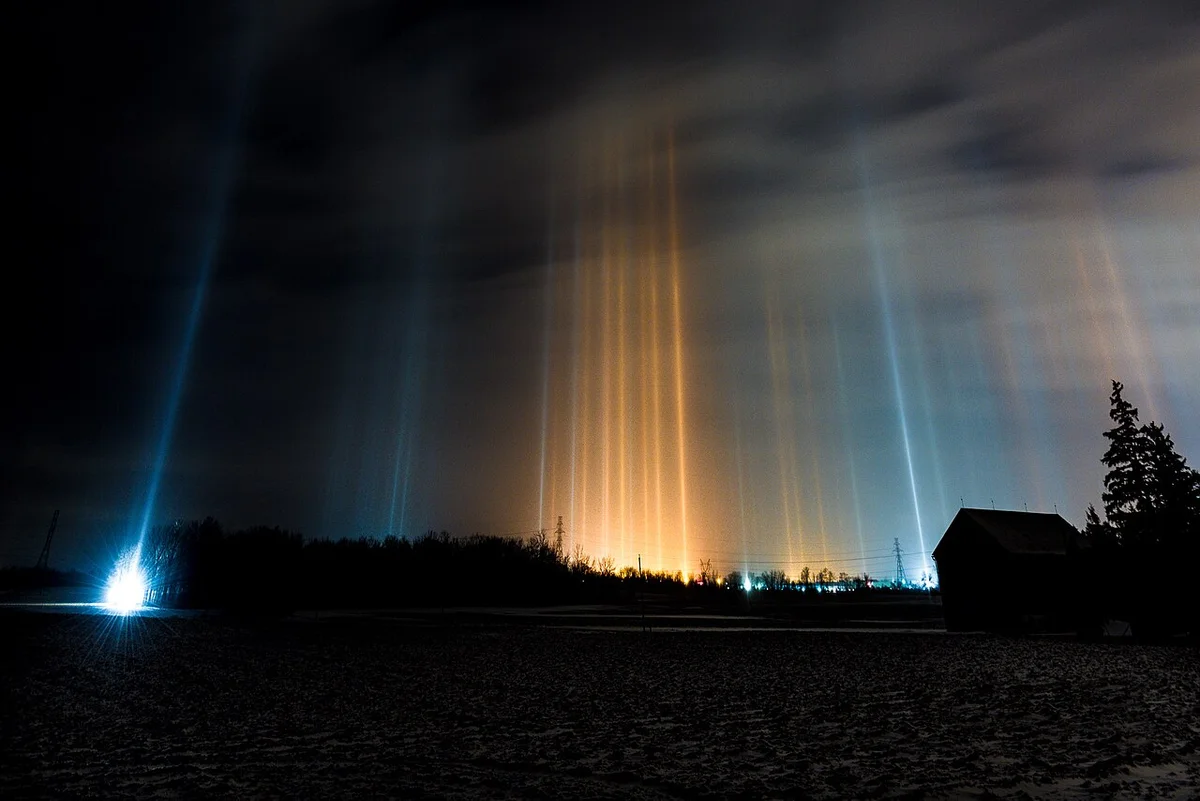
Light pillars over London, Ontario
Ray Majoran · Source image · License: CC BY-SA 4.0
Responsive WebP conversion by PRESDA. Full composition retained. ShareAlike derivatives retain the stated license.
18. Brocken Spectre
A Brocken spectre is the observer’s shadow projected onto mist or cloud, often with a colored glory around the head. With the Sun behind the observer, the shadow can seem enormous or detached from normal scale. Perspective and moving droplets make the figure appear to move strangely. The glory involves scattering of light by droplets, not an aura emitted by the person. Met Office: optical effects
The name refers to the Brocken in Germany’s Harz Mountains, but the effect occurs on other mountains and from aircraft under suitable geometry. Each observer’s glory is centered on their own viewing direction. Two people standing together therefore do not literally share one luminous halo fixed around a distant figure.
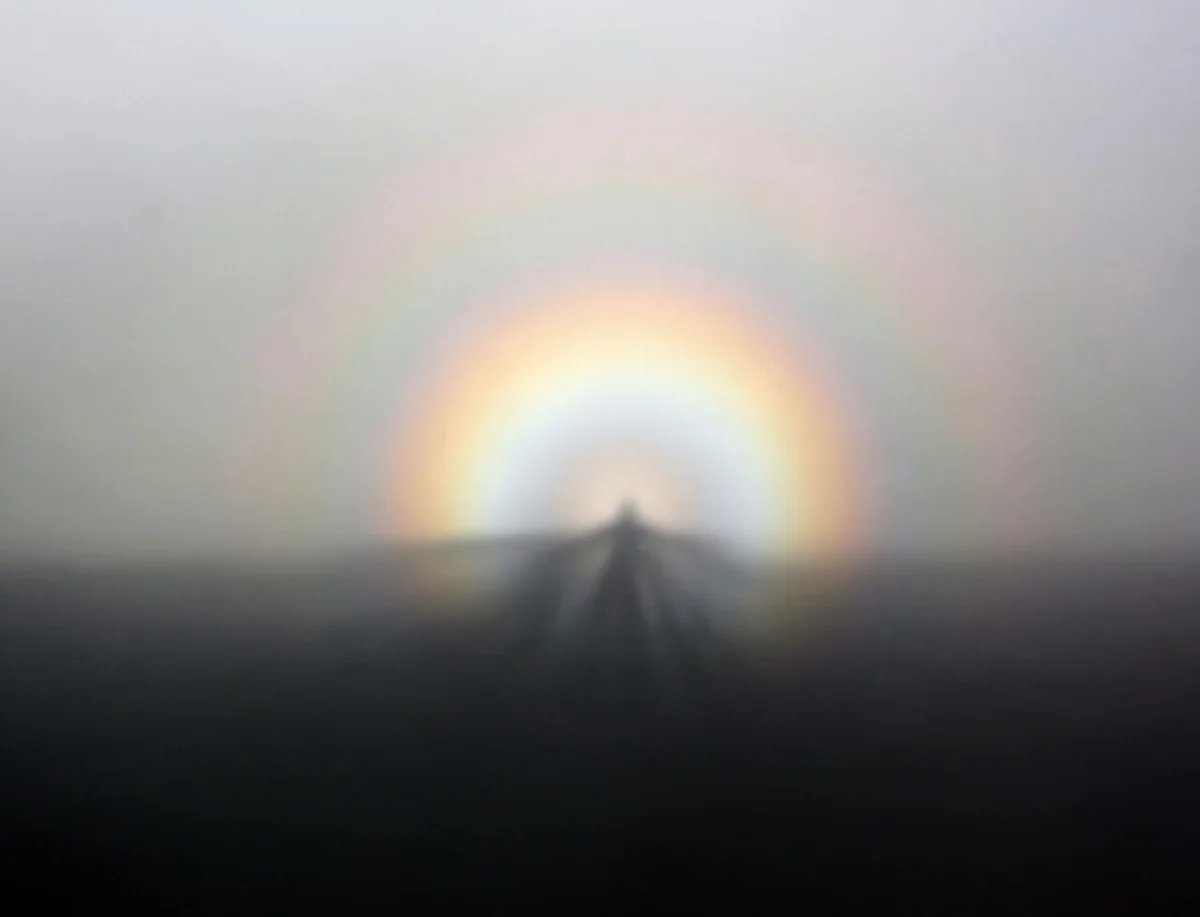
Solar glory and Brocken spectre photographed in fog
Brocken Inaglory · Source image · License: CC BY-SA 3.0
Responsive WebP conversion by PRESDA. Full composition retained. ShareAlike derivatives retain the stated license.
19. Ice Circles
Ice circles or disks can occur in cold rivers and other water bodies. Rotation and interaction with surrounding water can round an ice mass, while currents may keep a disk turning. Laboratory experiments also show that melting and the resulting water motion can produce rotation without reproducing every feature of a river. Several pathways can therefore contribute to superficially similar circles. Experimental study: rotation of melting ice
Examples have been documented in Quebec and northern Europe. A neat circle does not demonstrate deliberate cutting or an exotic force. To explain a particular example, researchers need information about flow, temperature, formation history and contact with surrounding ice. The viral image often omits precisely those conditions.
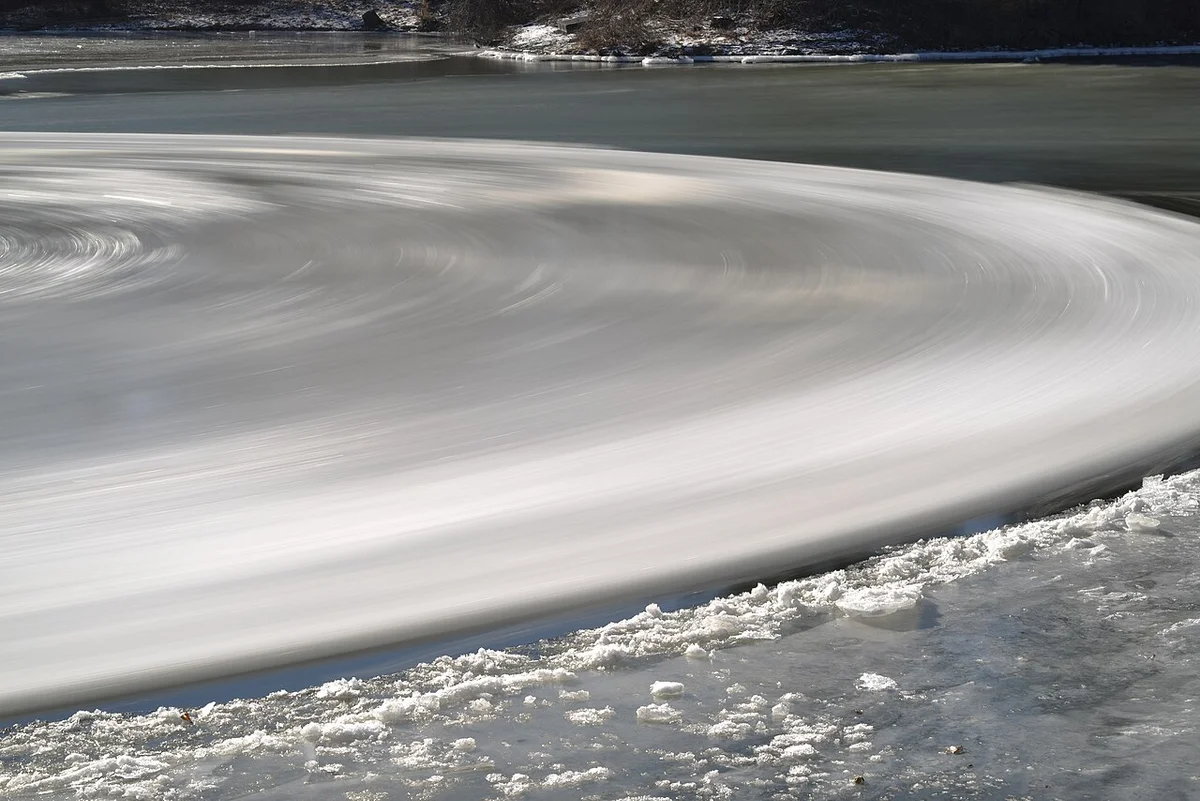
Long exposure showing a rotating ice circle in Esopus Creek, New York
Juliancolton · Source image · License: CC0
Responsive WebP conversion by PRESDA. Full composition retained. ShareAlike derivatives retain the stated license.
20. Catatumbo Lightning
The Lake Maracaibo region of Venezuela is an exceptional lightning hotspot. Moist air, local circulation and surrounding terrain favor frequent thunderstorms, particularly during nighttime development in parts of the basin. Satellite lightning observations made it possible to compare this concentration with other regions. This is recurrent thunderstorm electricity, rather than one continuous bolt suspended above the landscape. NASA: Earth’s lightning capital
The Catatumbo River’s outlet and nearby areas are associated with the name. Activity varies with weather and season, so no nightly display is guaranteed. Popular claims that methane alone explains the lightning bypass the meteorology and the observational evidence. Its astonishing frequency is enough to make the phenomenon remarkable without turning it into an exception to atmospheric physics.
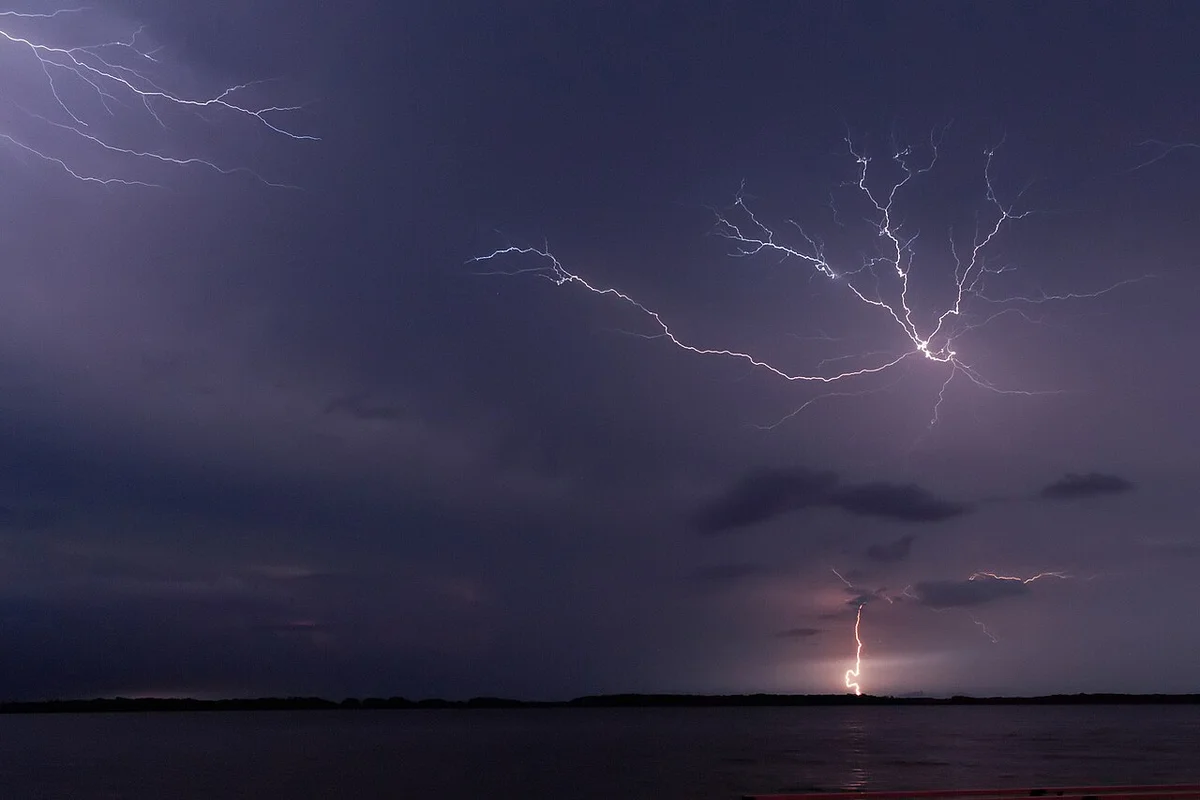
Catatumbo lightning over the Lake Maracaibo region, Venezuela
Fernando Flores · Source image · License: CC BY-SA 3.0
Responsive WebP conversion by PRESDA. Full composition retained. ShareAlike derivatives retain the stated license.
How should we read an extraordinary nature image?
Ask whether the image is a photograph, diagram or reconstruction, whether its location and credit are documented, and whether the explanation matches the geometry shown. Long exposures can combine moments; color processing can heighten a faint signal; a legitimate photograph can still circulate with the wrong caption. Here, source and license links accompany each image so that readers can examine its provenance.
Uncertainty is not an embarrassment to science. The mechanisms of many halos are firmly understood, while ball lightning remains much less settled. Placing them in the same collection need not give them the same evidentiary status. The point of this journey is to recognize both the power of an explanation and the questions that a compelling image cannot answer on its own.
Further reading in this collection: The Lost Library of Alexandria: The Knowledge That Vanished · The Anatomy of Power: Why Do People Obey Authority?.
FAQ
Frequently Asked Questions
What is this PRESDA article about?
Discover 20 extraordinary natural phenomena, their science, documented locations and licensed images, from red sprites to Catatumbo lightning.
Which category does this story belong to?
This story is part of PRESDA's Science coverage.
Who published this article?
20 Rare Natural Phenomena That Seem Impossible was published by PRESDA Editorial on PRESDA.
PRESDA Dispatch
Stay Informed. Stay Aware.
A sharp briefing across AI, gaming, sport, business, world affairs, paparazzi, and lifestyle.