The Lost Library of Alexandria: The Knowledge That Vanished
Explore Alexandria’s library, its scholars and lost texts. Separate evidence from myths about Caesar, the Serapeum and its destruction.
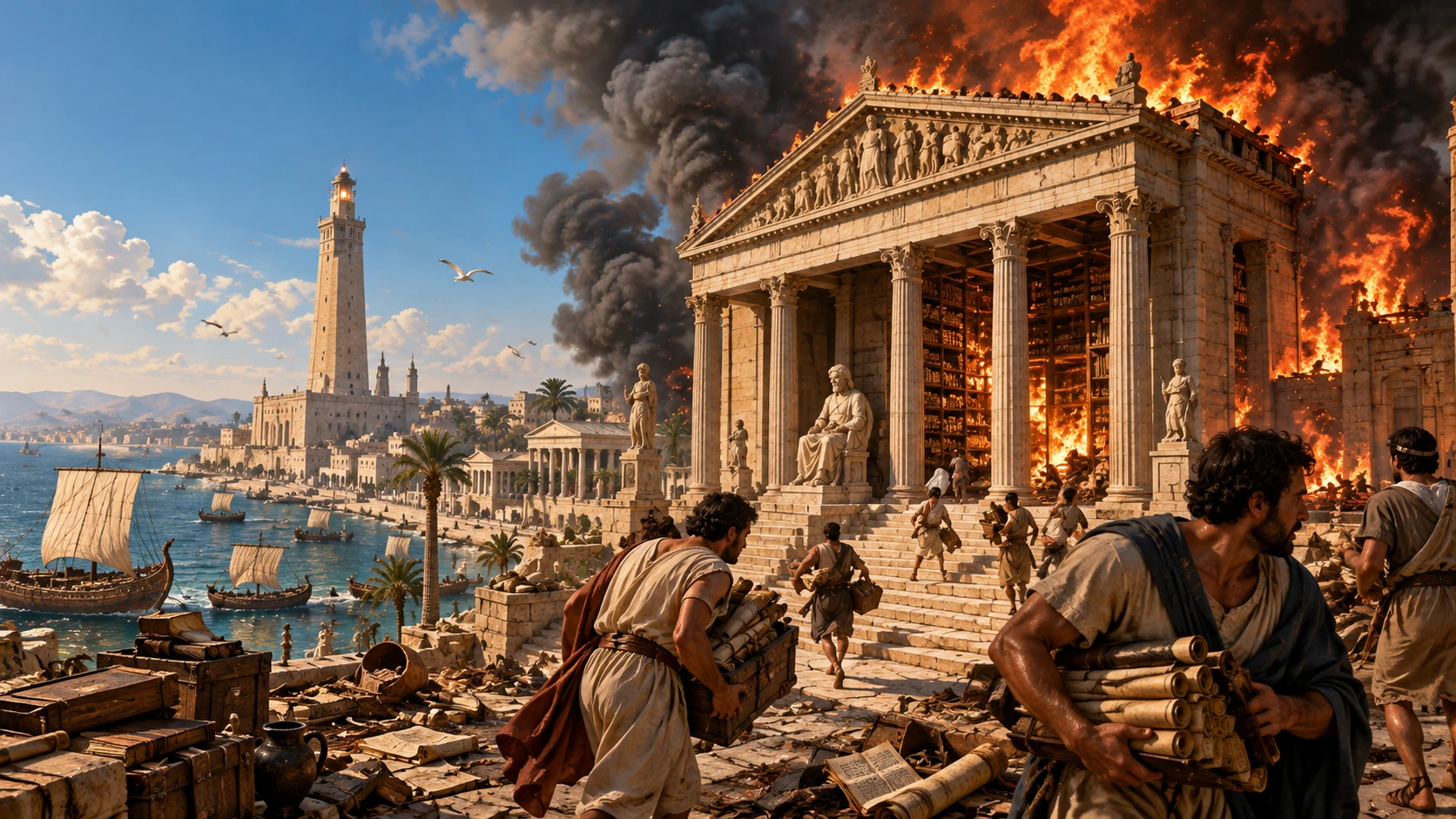
Approved editorial reconstruction of a library fire in ancient Alexandria. The architecture and scene are illustrative, not an authenticated reconstruction of a documented single destruction.
The Library of Alexandria was a royal collection and scholarly institution in Ptolemaic Egypt, associated with the Mouseion, a community devoted to the Muses. Its importance is real. The familiar story of all ancient knowledge disappearing in one fire is much less secure. No surviving inventory allows us to count its losses, and no single destruction narrative explains its entire history.
Imagine the library through an act quieter than burning: a scholar placing two copies of a poem beside each other and noticing that their words disagree. Which reading belongs to the poet? Which was introduced by a copyist? Alexandria mattered because it concentrated the resources needed to ask such questions systematically. Collecting books was the beginning of its work, not its conclusion.
How did the library begin?
After Alexander’s death in 323 BCE, his empire fragmented. Ptolemy established a dynasty in Egypt, and Alexandria became its capital. The royal library emerged in the early Ptolemaic period, conventionally associated with Ptolemy I and Ptolemy II. A precise founding ceremony, date and architectural plan cannot be recovered. Demetrius of Phalerum appears in foundation traditions, but the surviving evidence does not justify treating every detail as settled biography. UCL: the Alexandrian Mouseion
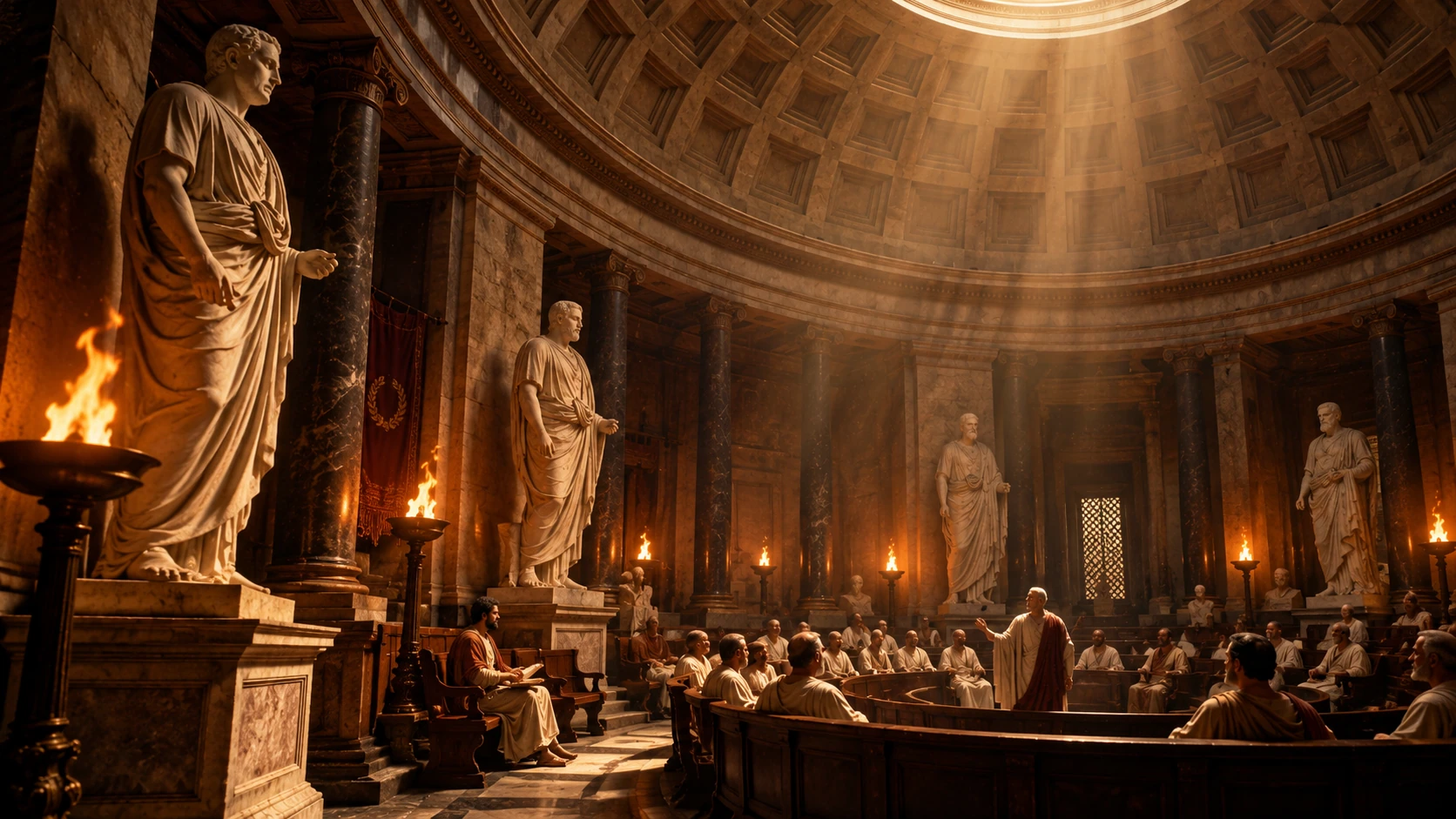
The Mouseion was more than a building containing objects. Strabo describes a community in the royal quarter with a shared dining hall, a covered walk and a priest appointed under royal, then imperial, authority. This testimony establishes an institutional setting for scholarship. It does not supply a floor plan of book storage or prove that later representations of immense marble reading rooms reproduce an actual interior.
A library was also an instrument of power
The Ptolemies could use cultural patronage to make their capital a rival to older intellectual centers. A royal collection advertised command of texts as well as territory. Recruiting learned people, acquiring manuscripts and supporting research gave the dynasty prestige. That political setting does not diminish the scholarship, but it prevents us from imagining an institution entirely detached from the ambitions and resources of rulers. Berti and Costa: the ancient library and classical scholarship
The word “universal” requires particular care. An aspiration to collect extensively is different from an achieved collection of everything humanity knew. Literary Greek dominated the institution’s surviving reputation. Egypt, Mesopotamia, India and China possessed intellectual traditions that cannot be reduced to the holdings of one Mediterranean center. Alexandria was extraordinary without being the sole container of civilization’s memory.
What did scholars do among the scrolls?
Textual comparison was central. Zenodotus, Aristophanes of Byzantium and Aristarchus of Samothrace belong to the history of Alexandrian work on Greek literature, especially Homer. They confronted a problem familiar to anyone studying handwritten transmission: copies vary. Scholars could compare readings, mark doubtful passages and explain difficult language. Their work helped make a literary inheritance into an object of organized critical study. The exact responsibilities and chronology of individuals still require caution. Berti and Costa
Callimachus’s Pinakes organized information about authors and writings. The work has not survived intact, so its structure must be reconstructed from later testimony and fragments. Its significance lies in making a collection intellectually navigable: who wrote a work, what kind of writing it represented and how it related to other texts. Calling it an ancestor of the library catalog is useful; imagining a surviving modern-style database would be misleading. Bibliotheca Alexandrina: Callimachus and the Pinakes
Measuring a world larger than the library
Eratosthenes, associated with the Alexandrian library, used geometry and observations of the Sun to estimate Earth’s circumference. In the familiar account, the difference between the Sun’s position at Syene and Alexandria, combined with the distance between them, gives a fraction of a full terrestrial circle. This was a quantitative argument about a spherical Earth, not the discovery of its shape by someone otherwise surrounded by universal flat-Earth belief. American Physical Society: Eratosthenes measures Earth
Modern retellings sometimes give his result a spectacularly precise error margin. That precision depends partly on the length assigned to the ancient stadion and on which transmitted figure is used. The stronger claim is also the more interesting one: a scholar could connect a local measurement to the scale of a planet. Alexandria’s contribution was an environment in which mathematical argument, geographical information and learned exchange could reinforce one another.
How many books were there?
Ancient and later reports offer impressive totals, often hundreds of thousands of rolls. These are not verified stock counts. A roll was not necessarily a complete work, a distinct title or a modern bound volume. Multiple copies and multi-roll compositions complicate every comparison. Roger Bagnall’s study urges particular skepticism toward the enormous numbers that have become attached to the library’s image. Roger Bagnall: Alexandria, Library of Dreams
The absence of a trustworthy total matters. If we do not know the collection’s size or contents, we cannot calculate the percentage of ancient learning destroyed there. Nor can we write an authenticated list of uniquely held masterpieces burned on a particular evening. We can establish the loss of many ancient works from other evidence, but that is a different historical claim from identifying their last copy in Alexandria.
The manuscripts that vanished, and the ones that traveled
Much Greek literature survives through a narrow selection, while many works are known only from titles, quotations, summaries or fragments. Sophocles wrote far more plays than the seven that survive complete. Sappho’s poems often reach us through damaged papyri and citations. These examples reveal the scale of ancient literary loss. They do not establish that all missing texts were once held in Alexandria or destroyed in its library. Oxford: the Oxyrhynchus Papyri
Survival depended on repeated decisions to copy, teach, translate and preserve. A manuscript left uncopied could disappear without a dramatic act of violence. Conversely, a text copied in several places could survive the destruction of one collection. The book’s history is therefore a network rather than a single chain running through one building. Scholars working in Greek, Syriac, Arabic, Latin and other languages all participated in later transmission, selection and interpretation.
Did Julius Caesar burn it down?
During Caesar’s Alexandrian war in 48 BCE, fire spread from naval operations. Ancient writers differ about the books lost and their location. Some accounts refer to books near the harbor, while later narratives make the episode the library’s decisive catastrophe. The evidence supports a serious fire and reports of book losses. It does not securely establish that the entire royal library, its scholars and its future work ended together that day. Open University: destruction narratives
This distinction changes the story. A warehouse holding rolls destined for a collection, part of an existing collection and the total destruction of an institution are different events. Later scholarly activity in Alexandria also warns against an instantaneous before-and-after account. Caesar’s fire belongs in the history of the library’s possible losses, but it should not become a blank explanation into which every missing ancient book is placed.
The Serapeum and the violence of 391 CE
The Serapeum, a temple complex associated with a separate book collection, was destroyed during religious conflict in 391 CE. The destruction of the sanctuary is historically grounded. The existence and scale of a functioning library inside it at that moment are less certain. Combining the royal library, the Mouseion and the Serapeum into one unchanging institution collapses centuries and obscures what each source actually describes. Open University: evaluating the evidence
The murder of Hypatia in 415 CE was another episode of violence in Alexandria’s intellectual and political history. It was not the burning of the original Ptolemaic library. Linking the two as if they occurred in the same scene makes a powerful film sequence and poor chronology. Religious conflict can be examined seriously without replacing evidence with a convenient emblem of enlightenment confronting darkness.
Why the conquest legend is unreliable
A much later story claims that the seventh-century Arab conquest led to an order to burn the library’s books. Its late appearance, narrative problems and lack of contemporary corroboration make it unreliable as an account of the royal library’s end. It should be presented as a destruction legend, not an established command by the caliph Umar. Repeating a memorable quotation attributed centuries afterward cannot repair that evidentiary gap. Bagnall: the problem of assigning blame
Other proposed turning points include damage to the royal quarter during third-century warfare, especially Aurelian’s reconquest. Here too, destruction of a district is stronger evidence than a detailed account of what happened to its library shelves. Institutional decline, interrupted funding, changing scholarly networks and physical destruction could all matter. Their relative contributions cannot be reconstructed as a continuous, documented sequence.
What did humanity actually lose?
We lost texts, contexts and opportunities to hear ancient voices directly. We cannot quantify centuries of hypothetical technological delay caused by Alexandria’s disappearance. Claims that its survival would have produced industrialization, modern medicine or space travel in antiquity confuse possibility with evidence. Knowledge needs materials, institutions, incentives and repeated testing as well as written propositions. A missing manuscript is not proof of a missing modern invention.
The enduring lesson is practical. Preservation requires more than accumulating objects. Collections need descriptions, maintained copies, distributed access and people with the training and freedom to interpret them. The modern Bibliotheca Alexandrina, inaugurated in 2002, renews the city’s association with scholarship without claiming to have recovered the ancient shelves. Alexandria’s greatest legacy may be the ambition to connect knowledge, accompanied by the humility to admit what the surviving record cannot tell us. Bibliotheca Alexandrina
Further reading in this collection: The Anatomy of Power: Why Do People Obey Authority? · 20 Rare Natural Phenomena That Seem Impossible.
FAQ
Frequently Asked Questions
What is this PRESDA article about?
Explore Alexandria’s library, its scholars and lost texts. Separate evidence from myths about Caesar, the Serapeum and its destruction.
Which category does this story belong to?
This story is part of PRESDA's World coverage.
Who published this article?
The Lost Library of Alexandria: The Knowledge That Vanished was published by PRESDA Editorial on PRESDA.
PRESDA Dispatch
Stay Informed. Stay Aware.
A sharp briefing across AI, gaming, sport, business, world affairs, paparazzi, and lifestyle.