AIRPLANES: FROM THE WRIGHT BROTHERS TO MODERN AVIATION
Twelve seconds above the sand changed what humans thought possible. Turning that moment into everyday flight required a century of engineering, cooperation and hard lessons.
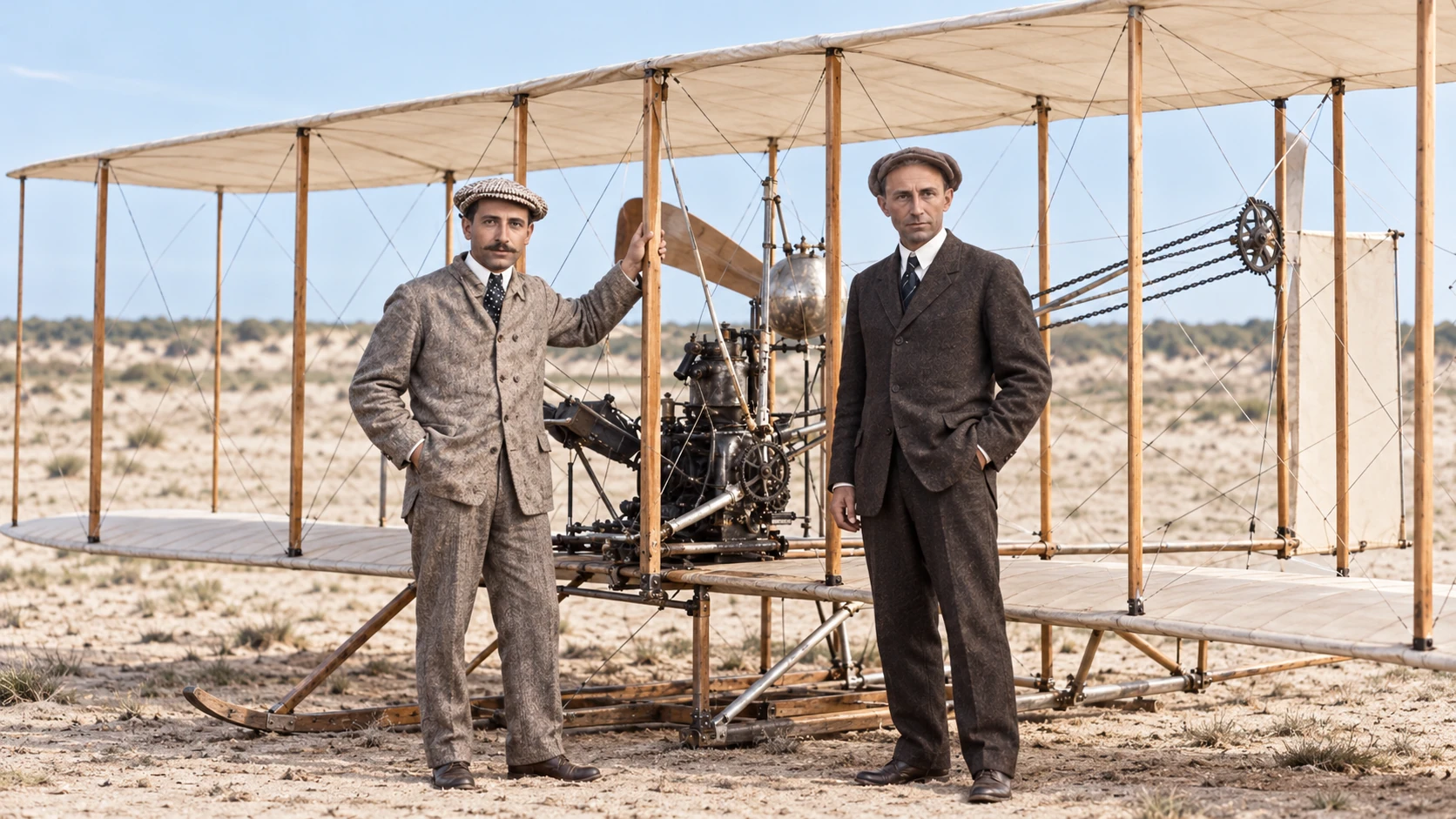
AI-generated artistic reconstruction of the Wright brothers and an early biplane. Not a historical photograph or an exact technical reconstruction of the 1903 Flyer.
For twelve seconds, the future stayed above the sand. On December 17, 1903, Orville Wright flew a powered airplane about 120 feet at Kill Devil Hills, near Kitty Hawk, North Carolina. The distance was modest; the combination was revolutionary: a pilot, an engine, lift and workable control. An airplane is a powered, heavier-than-air flying machine whose wings generate aerodynamic lift. Making one leave the ground was only part of the problem. Making it obey was the breakthrough. NASA: the 1903 flight
A modern passenger sees a different ritual: runway lights, a rising engine note, a cabin that tilts toward the clouds. Hidden behind that familiar ascent are materials laboratories, weather forecasts, maintenance records, software and international agreements. Aviation did not become ordinary because flight became simple. It became ordinary because thousands of difficult tasks were made repeatable. Its history connects the handmade workshop to a global technological system, with remarkable achievements and consequences that engineers alone cannot resolve.
Before the engine, the problem of control
Wilbur and Orville Wright inherited questions rather than an empty sky. George Cayley helped distinguish lifting surfaces, propulsion and control. Otto Lilienthal tested gliders and produced aerodynamic observations that later experimenters studied. Balloons had already carried people, but buoyancy was not the same challenge as sustained airplane flight. The Wrights' achievement belongs within this wider experimental tradition, while retaining its specific significance: controlled, sustained, powered flight with a person aboard a heavier-than-air machine. Smithsonian: flight before the airplane
The brothers treated flight as an interconnected engineering problem. They tested gliders, questioned existing aerodynamic data and used a wind tunnel. Wing warping helped control roll; an elevator controlled pitch, and a movable rudder addressed yaw. Their propellers were not merely miniature ship screws but aerodynamic devices. The successful aircraft emerged from experiments that linked one problem to another. This method matters more than the comforting legend that a single flash of inspiration suddenly conquered the air. Smithsonian: researching the Wright way
The 1903 Flyer was not yet an airline business. Its open structure, fabric-covered wings and exposed pilot belonged to an experimental machine. Further work produced a more practical airplane in 1905. That distinction prevents a familiar historical shortcut: the first successful demonstration and a dependable transport system are different milestones. The illustration accompanying this feature is an artistic reconstruction, not a photograph documenting the brothers, their clothing or the exact construction of the original Flyer. Smithsonian: the 1903 Flyer
How does something so heavy fly?
Four forces provide a useful starting point: weight pulls downward, lift acts across the airflow, thrust propels the aircraft and drag resists its motion through the air. In steady, level, unaccelerated flight, the forces balance. During takeoff, acceleration, climbing and turning, the relationships change. An engine does not normally hold a jetliner up by pointing its exhaust at the ground. It supplies thrust while the wings interact with moving air to produce the required lift. NASA: four forces
A wing produces a pressure distribution around its surface and turns the surrounding flow. Pressure differences and the downward change in air momentum are compatible descriptions of the same physical process. The familiar claim that air parcels must reunite simultaneously after passing above and below a wing is wrong. NASA explicitly rejects that equal-transit explanation. Wing shape matters, but so do speed, air density and angle of attack, the angle between the wing's reference line and the oncoming airflow. NASA: lift NASA: the equal-transit error
The practical challenge is not simply to create more lift. Designers must manage drag, weight, stability and controllability together. A wing that performs well at one speed may be less suitable at another. Flaps change the wing's aerodynamic characteristics for slower flight during takeoff and landing. A stall concerns disrupted airflow and loss of lift at excessive angle of attack, not necessarily an engine stopping. The vocabulary matters because misleading explanations can make an ordinary aerodynamic event sound like a mysterious mechanical failure. NASA: aerodynamics guide
War accelerates the machine
The First World War transformed aviation's scale and purpose. Reconnaissance aircraft could observe enemy positions; opposing forces then needed to stop those observers. Fighters, aerial photography and bombing developed within that escalation. Governments funded engines, production and training at a pace civilian experimentation alone could not match. Technical progress came with lethal consequences. It is possible to recognize the engineering acceleration without presenting war as a benevolent inventor or forgetting the people beneath the aircraft. Smithsonian: World War I aviation
The Second World War intensified demands for speed, range and production. Germany's Messerschmitt Me 262 demonstrated operational jet-fighter performance, while Britain's jet work grew from Frank Whittle's engine development. Hans von Ohain's work in Germany forms another major strand of that history. Jets did not appear fully mature overnight: engines, materials and reliability had to catch up with the principle. Military breakthroughs would influence postwar aviation, but adapting them for paying passengers required different priorities, economics and operating discipline. Smithsonian: Me 262 RAF historical scholarship
From fabric to the modern airframe
Between the wars, the passenger airplane became a more coherent product. The Boeing 247 of 1933 helped define the modern airliner through its integrated design, and the Douglas DC-3 became a landmark in practical airline economics. Enclosed cabins, improved performance and dependable service mattered as much as spectacular demonstrations. The commercial question was changing: could an aircraft carry people regularly, at a cost an operator could sustain? An airline needed a repeatable timetable, not merely a record-breaking flight. Smithsonian: making the modern airliner
Metal construction brought new possibilities, but no material eliminated engineering trade-offs. Modern composites place strong fibers within a surrounding matrix, allowing designers to tailor structural properties. They coexist with aluminum, titanium and steel because different components face different loads, temperatures and repair requirements. A lighter structure can reduce the fuel needed to carry it, yet manufacturing quality and inspection remain essential. Progress is not a simple replacement of primitive material by perfect material; it is a better match between material and task. Airbus: metals and composites
Inside the jet engine
A gas-turbine engine draws in air, compresses it, adds fuel and burns the mixture. Expanding hot gas drives turbines that power the compressor and, in a turbofan, the fan. The remaining flow exits through the exhaust system. In a high-bypass turbofan, much of the air moved by the large front fan travels around the engine core. Accelerating a large mass of air by a smaller amount helps make this arrangement efficient for subsonic transport. NASA: turbofan engine
That elegant sequence conceals severe demands. Rotating parts must survive enormous stresses, hot sections need suitable materials and cooling, and an engine must keep performing across changing conditions. Bigger is not automatically better: fan dimensions, weight, ground clearance, noise and drag must be reconciled. NASA's work on turbofan technology illustrates how improvements accumulate through components and testing. The spectacular machine under a wing is a system of compromises refined until it becomes reliable enough to seem unremarkable. NASA: jetliner propulsion
When the world acquired a timetable
BOAC began pure-jet passenger services with the de Havilland Comet in 1952. The jet age later expanded through aircraft including the Boeing 707, while the 747 entered airline service in 1970. Larger cabins and improved productivity changed long-distance travel. The chronology is not interchangeable: a prototype's first flight, an aircraft's first delivery and its first commercial service are separate dates. Treating them as one event produces deceptively tidy histories. British Airways: airline history Smithsonian: the jet age
Air travel grew through networks as well as aircraft: airports, reservations, air-traffic services and connections turned individual journeys into a global system. ICAO's 2025 Safety Report describes approximately 4.528 billion passengers transported in 2024, using its stated data series. That is a dated traffic measure, not a count of unique people or a 2026 forecast. The scale explains aviation's economic significance, while concealing unequal access: a busy world network does not mean everyone can afford to use it. ICAO: 2025 Safety Report
Boeing and Airbus: competing systems, shared constraints
Boeing and Airbus compete over more than the aircraft passengers recognize at the gate. Airlines evaluate operating costs, range, capacity, training, maintenance and delivery certainty. A design can be technically impressive yet unsuitable for a particular network. Manufacturer comparisons therefore need matched missions and clearly defined assumptions. A promotional fuel-saving percentage is not a universal result applying to every route, cabin configuration and generation of rival aircraft. Competition is most illuminating when its engineering claims are made specific.
Airbus introduced digital fly-by-wire flight controls into commercial service with the A320 in 1988. Pilot inputs become electronic commands interpreted by computers rather than simply mechanical movements transmitted through cables. Common cockpit approaches across aircraft families can also simplify transitions, within the relevant training requirements. Automation changes the pilot's relationship with the machine; it does not remove the need to understand the system's modes and limitations. Airbus: jetliner history
The Boeing 787 and Airbus A350 show another direction: extensive composite structures. Boeing documents approximately 50 percent composites by structural weight for the 787; Airbus identifies 53 percent for the A350 structure. These figures describe material composition, not percentages of fuel saved. Their importance lies in a wider design strategy involving wings, engines, aerodynamics and manufacturing. Neither a material statistic nor a brand name, by itself, establishes an aircraft's overall efficiency or safety. Boeing: composite structure Airbus: A350 materials
Icons and records: always ask which category
Concorde carried passengers at approximately Mach 2, twice the local speed of sound. Scheduled services began in 1976 and ended in 2003. Its achievement was not just speed but sustained supersonic passenger operation, with demanding aerodynamic, thermal and commercial constraints. It also demonstrates why aviation history is not a straight line toward faster tickets: an impressive capability does not automatically produce an enduring business model. British Airways: Concorde
NASA's X-15 reached Mach 6.7 in 1967, a very different category of achievement. It was a rocket-powered research aircraft launched from a B-52, not a jetliner taking holidaymakers from a runway. Airbus's A380, which entered commercial service in 2007, pursued capacity instead: a full-length double-deck passenger aircraft with a 79.8-metre wingspan. Speed records, passenger capacity and wingspan measure different things. Combining them into a single biggest-or-best ranking erases the design purpose that makes each machine interesting. NASA: X-15 Airbus: A380
Safety is a system, not a promise
An airliner depends on layers of protection: design assessment, testing, production oversight, maintenance, trained crews and operational procedures. FAA certification addresses compliance with airworthiness requirements; it does not declare that failure is impossible. A sophisticated aircraft can still be undermined by poor information, defective work or organizational decisions. Learning from incidents and accidents matters because the system must confront what actually happens, not merely what its designers expected. FAA: aircraft certification
Navigation and surveillance also evolved. Satellite navigation helps establish position, while ADS-B broadcasts aircraft information for surveillance. These are related functions, not interchangeable names for an autopilot. The FAA warns that satellite-navigation signals can be disrupted or misleading and emphasizes cross-checking and reporting anomalies. Modern precision therefore depends on resilient procedures and alternative information, not blind confidence in a moving symbol on a screen. FAA: ADS-B FAA: navigation resilience
Automatic systems can reduce workload and execute precise flight paths, but managing them is itself a skill. The FAA's flightpath-management guidance combines manual flying, automated-system management, pilot monitoring and energy management. This is a more realistic picture than either the infallible computer or the obsolete pilot. The strongest cockpit is a coordinated human-machine system whose operators recognize uncertainty, understand changing modes and can respond when circumstances depart from the plan. FAA: flightpath management
The next frontier is not only speed
Aviation's environmental challenge extends beyond carbon dioxide. Persistent contrails can influence climate, and their formation depends on atmospheric conditions and emissions. NASA and DLR research found that selected sustainable-fuel blends could reduce soot and ice-crystal formation under tested conditions. That does not mean every fuel blend eliminates contrails or every visible trail has the same warming effect. Climate performance requires examining the whole system, including the conditions in which an aircraft flies. NASA: contrail research
Sustainable aviation fuel is likewise a lifecycle proposition, not fuel that produces no exhaust. ICAO's accounting includes feedstock, production, transport and combustion, with further sustainability requirements. Environmental benefits depend on how a fuel is made and what it replaces. In 2022, ICAO adopted a collective aspirational goal of net-zero carbon emissions from international aviation by 2050. This is a policy objective, not evidence that the technical, financial and supply challenges have already been solved. ICAO: fuel lifecycle ICAO: climate goal
Electric propulsion, improved airframes and more efficient engines offer different routes forward. NASA studies electric motors, power systems and materials as parts of that effort. Electrifying propulsion is not synonymous with putting a battery into today's long-haul airliner: energy storage, power, weight and heat must work together. Demonstrators can answer important engineering questions without establishing an airline-ready product or a guaranteed commercial launch date. The future will likely be judged by useful performance across real missions rather than the attractiveness of a concept rendering. NASA: electrified propulsion
The unfinished invention
The timeline runs from 1903's controlled powered flight through the 1933 Boeing 247, 1952 jet services, the 747's 1970 airline debut, Concorde's 1976 service and the A380's 2007 arrival. Yet the deeper continuity is a method: test, measure, revise and explain failure. For a related examination of evidence in aviation stories, read PRESDA's Bermuda Triangle investigation, or explore more in AI & TECH.
The Wright brothers did not invent the crowded departure hall, the transcontinental family visit or the debate about the atmosphere's future. They helped make them possible. Their machine asked whether people could control powered flight. Our machines ask a larger question: how can a world built around flying make that freedom safer, more accessible and less damaging? The next great achievement may not be the aircraft that travels fastest, but the system that deserves the confidence of those it carries.
FAQ
Frequently Asked Questions
When did the Wright brothers first fly?
On December 17, 1903, at Kill Devil Hills near Kitty Hawk, North Carolina. Orville's first flight covered about 120 feet in 12 seconds, demonstrating controlled, sustained, powered flight.
How do airplane wings generate lift?
A wing creates a pressure distribution and changes the momentum of surrounding air. Shape, speed, air density and angle of attack matter. Air above and below the wing does not have to reunite simultaneously.
Are jetliners faster than Concorde?
Concorde cruised at approximately Mach 2. Ordinary modern passenger jetliners operate below the speed of sound; efficiency and capacity do not require beating Concorde's speed.
Does automation make pilots unnecessary?
No. Operating automated systems, monitoring their modes and maintaining manual skills are central to FAA flightpath-management guidance. Automation changes duties rather than eliminating responsibility.
Does sustainable aviation fuel have zero emissions?
No. ICAO evaluates lifecycle emissions, including production, transport and combustion. The term does not imply exhaust-free flight, and benefits depend on the fuel's pathway.
PRESDA Dispatch
Stay Informed. Stay Aware.
A sharp briefing across AI, gaming, sport, business, world affairs, paparazzi, and lifestyle.