VIRGIN TRAINS: A NEW RIVAL TO EUROSTAR EMERGES
Virgin unveils its future cross-Channel train and Alstom agreements. Explore planned routes, funding, approvals and the limits of its 2030 launch target.
Virgin has given its proposed Eurostar challenger a more tangible identity: a red-and-black train design and signed agreements with Alstom for a future cross-Channel fleet. The manufacturer’s October 9, 2026 announcement covers 12 Avelia Stream high-speed trains and long-term maintenance. Services are planned from 2030. The train is not operating, tickets are not on sale under the announced plan, and the agreements remain subject to important conditions.
The business story is larger than a new livery. Virgin is trying to turn a familiar travel brand into a new operator on the passenger-rail corridor linking Britain and mainland Europe. For passengers, the prospect is more choice. For investors, it is a capital-intensive project whose success depends on trains, depots, border facilities and access across several networks all being ready together.
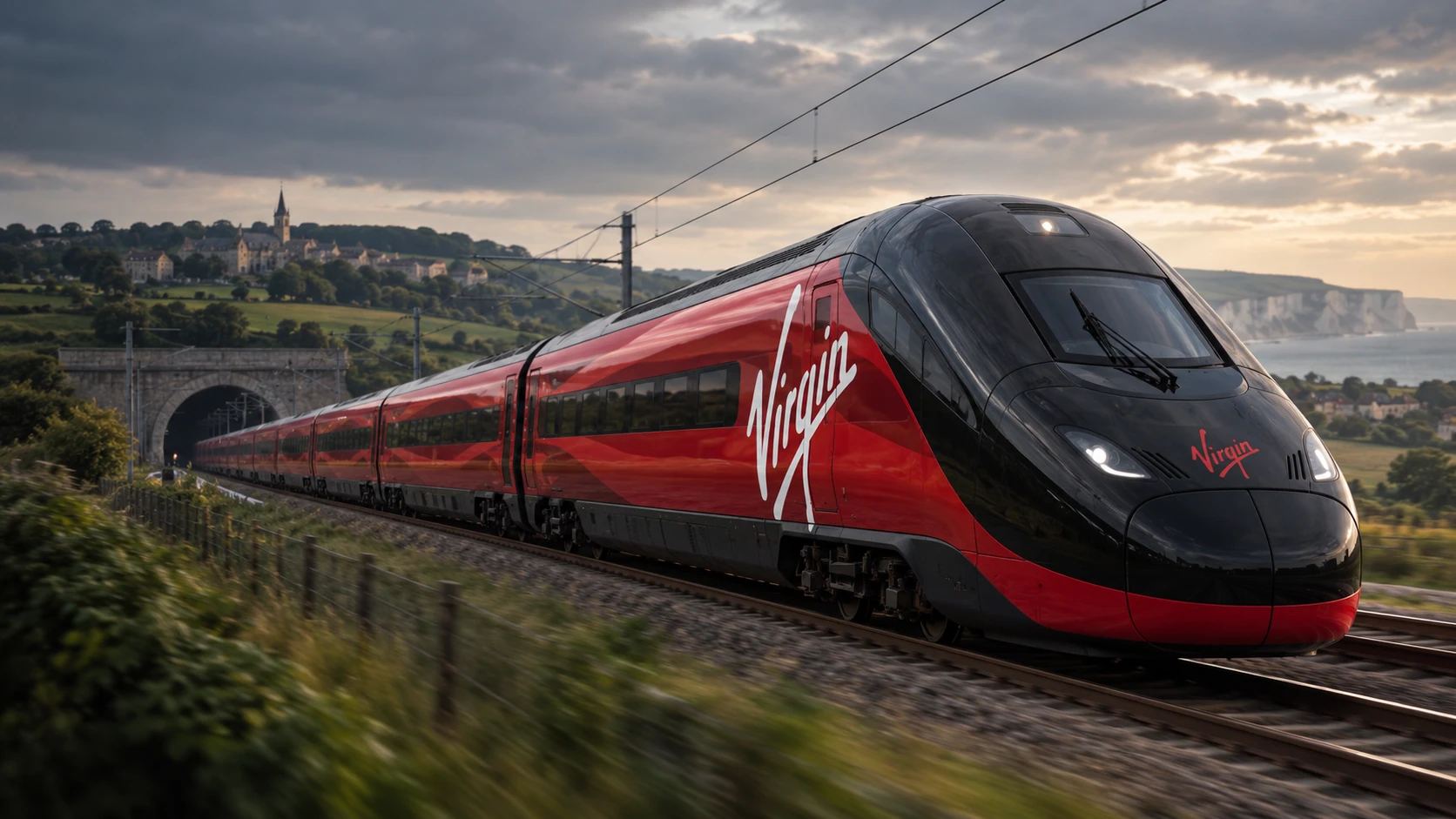
Illustration note: the approved hero is an AI-generated cinematic concept. It is not a photograph of an operating Virgin cross-Channel train or Alstom’s official design rendering. Its scenery and train details are illustrative.
What Virgin has unveiled
The preview reported on October 9 shows the proposed red-and-black exterior and describes tailored interiors, accessibility priorities and social spaces inspired by Virgin Atlantic’s airport Clubhouses. These are design and hospitality ambitions, not a finished passenger product. Final seating layouts, catering details and the complete onboard offer have not been established by the material reviewed for this report.
Alstom says the trains will be designed and manufactured in Savigliano, Italy, with maintenance delivered in the UK. The agreement revives a relationship that included the Pendolino trains used by Virgin on Britain’s West Coast Main Line. The cross-Channel project is a new international operation, not the reinstatement of Virgin’s former domestic franchise.
Richard Branson’s challenger strategy
In his October 2025 statement, Richard Branson framed the proposal as an extension of Virgin’s approach to challenging established travel businesses: recognizable branding, hospitality and competition. That is the sponsor’s strategy, not a guarantee of lower prices or market share. Virgin Group chief executive Josh Bayliss has presented the project’s commercial plans; Alstom’s latest announcement also includes his endorsement of the partnership.
The ORR described around £700 million of planned investment in 2025. That figure concerns the project, not a verified personal contribution by Branson or proof that all financing has closed. Virgin’s submission described an operating company and a separate train-owning asset company, supported by equity and debt. Such a structure spreads operational and asset risks, but announced backing and completed financing are different milestones.
London to Paris, Brussels and Amsterdam
The ORR’s August 2026 decision pre-approved a framework agreement covering up to 20 daily return services between London and Paris, Brussels or Amsterdam. The access period runs from October 1, 2030 to December 31, 2040. This is an access window, not confirmation that passengers will board on its first day. Virgin still needs the train fleet, access to other networks and relevant safety approvals.
AFP reported Bayliss’s intended daily allocation: 13 return services to Paris, four to Brussels and three to Amsterdam. That is a proposed full-service pattern rather than a bookable timetable. Virgin projects almost 7.5 million additional seats a year. Seats measure offered capacity, not passengers carried, occupied seats or proven demand. Wider European expansion remains an ambition rather than a confirmed launch network.
Speed, capacity and the technology challenge
Virgin’s published rolling-stock proposal specified a maximum operating speed of 300 km/h and 200-metre, seven-car trainsets with distributed traction and multi-voltage equipment. These are proposed specifications, not an achieved Virgin service speed. Running through several countries also requires compatibility with their signalling and electrification, alongside Channel Tunnel fire-safety and evacuation requirements. Certification of the specific trains matters more than the speed printed in a brochure.
The final number of seats per train is not established in the October announcement reviewed here. Virgin’s earlier regulatory submission redacts the capacity entry in its main product table. The annual seat projection should therefore not be reverse-engineered into an asserted final seating layout. Nor should maximum train speed be converted into a promised journey time: paths, intermediate restrictions and timetable planning all affect the actual trip.
Funding and approvals: what is actually secured?
The distinction between signing and financial completion is crucial. Alstom’s October 9 announcement says it expects to book the order upon regulatory approval and financial close. AFP separately reported Bayliss describing a €650 million train agreement. The manufacturer’s announcement does not state that value. The reported fleet figure and the older £700 million project requirement concern different scopes and currencies; they should not be added together or treated as confirmed cash already spent.
The ORR’s depot register now lists the executed agreement between Eurostar and VTE OpCo for Temple Mills, dated September 4, 2026. That addresses a critical maintenance and storage bottleneck. The regulator’s track-access decision covers the British high-speed line; it does not replace access agreements for the Channel Tunnel and continental networks, or safety authorisation. The 2030 target remains dependent on completing the whole operating system.
Eurostar is not standing still
Eurostar remains the established operator of international passenger trains through the Channel Tunnel. Its 2025 group results, published in June 2026, report 20 million passengers across the wider Eurostar network. That total includes continental services and is not a Channel Tunnel-only passenger figure. Virgin would be challenging an incumbent with an existing network, operating experience and established customer base.
Eurostar has announced a €2 billion fleet investment, with 30 firm Alstom Celestia train orders and options for 20 more. Its stated plan is for commercial service with the first new trains in May 2031. These are future double-decker trains based on Avelia Horizon, distinct from Virgin’s Avelia Stream proposal. An option is not a firm order, and a planned introduction is not a train already carrying passengers.
Will Virgin tickets be cheaper?
No public Virgin fare schedule or confirmed starting price was established in the announcements reviewed for this article. More competition could encourage sharper pricing, better service and a wider choice of departures, but cheaper tickets are a possible outcome, not a promise that can yet be priced. Infrastructure charges, financing, demand and the passenger product will all shape fares. Claims of a specific bargain launch fare would be premature.
Virgin’s hospitality pitch could appeal to business travellers who value productive time onboard and leisure passengers who want a different journey experience. Yet the practical benefits will depend on accessible boarding, useful departure times, reliable service and clear conditions for changes and refunds. Those details should be judged when they are published, rather than inferred from branding or a concept image.
The infrastructure test behind the rivalry
Eurostar’s July 2026 call for infrastructure investment highlights depot capacity, expansion at St Pancras and more seamless border processing. More trains alone do not ensure more workable departures. Station space, border controls, maintenance slots and timetable paths must support the additional passengers. If those constraints are not resolved, competitors could end up sharing limited capacity instead of growing the market.
Other prospective operators, including Trenitalia, have also explored the cross-Channel market. An intention to enter is not equivalent to a completed operating licence, an approved train or a published timetable. Virgin’s progress is significant because its fleet and depot arrangements have become more concrete. The remaining challenge is delivering a commercially viable service across jurisdictions, rather than winning attention for a new train.
What it means for European high-speed rail
A credible new entrant could make cross-border rail more competitive and encourage investment in the whole journey, from booking to arrival. The benefits remain conditional on execution. For people considering work and travel across borders, our official work-abroad guide covers a different practical question: the permissions needed to live and work abroad. A future rail connection does not alter immigration or employment rules.
Virgin’s announcement belongs to a broader competition story in transport, also explored in our BYD business feature: established operators face challengers combining technology, capital and brand strategy. For cross-Channel rail, the decisive next milestones will be financial completion, train authorisation, network access and a timetable passengers can actually book. As of October 10, 2026, the rivalry is emerging. The service is still being built.
FAQ
Frequently Asked Questions
Is Virgin already running trains through the Channel Tunnel?
No. Services are planned from 2030 and depend on the fleet, financing, network access and safety approvals.
Which routes does Virgin plan?
London to Paris, Brussels and Amsterdam, with a proposed full pattern of 20 daily return services. This is not a bookable timetable.
Has Virgin secured 12 trains?
Alstom confirms signed agreements covering 12 Avelia Stream trains and maintenance. Its October 9 announcement says order booking is expected upon regulatory approval and financial close.
Will tickets be cheaper than Eurostar?
No confirmed Virgin starting fare was established in the announcements reviewed. Competition could improve value, but a specific saving cannot yet be promised.
Does the £700 million figure mean Branson personally invested that sum?
No. It is a stated project investment requirement, not a verified personal contribution or confirmation that all finance has closed.
PRESDA Dispatch
Stay Informed. Stay Aware.
A sharp briefing across AI, gaming, sport, business, world affairs, paparazzi, and lifestyle.
Related