BYD Overtakes Tesla: How China’s EV Giant Took the Lead
BYD beat Tesla in 2025 annual battery-electric vehicle sales. Explore its battery roots, affordable models, overseas factories, charging technology and trade risks.
The electric-car race has a new annual sales leader. BYD sold about 2.26 million battery-electric passenger vehicles in 2025, ahead of Tesla’s 1.64 million deliveries. The comparison is specifically for fully battery-electric vehicles, or BEVs. It does not add BYD’s plug-in hybrids to its tally against Tesla. AP: 2025 annual BEV crossover Tesla: full-year 2025 deliveries
WHAT BYD ACTUALLY OVERTOOK
This is a full calendar-year comparison for 2025, the latest completed year as of October 5, 2026. Tesla’s official total was 1,636,129 deliveries. BYD’s broader “new energy vehicle” business includes plug-in hybrids, which combine an engine with a rechargeable battery. Those vehicles belong in a different comparison. The BEV lead says nothing by itself about revenue, profit, market value or leadership in every country. Tesla: full-year 2025 deliveries
The change matters because Tesla helped make battery cars a global consumer category. BYD has demonstrated that another route can reach greater annual volume: start with batteries, develop a wide range of vehicles and compete for ordinary household budgets. Winning the sales ranking is a milestone, not a guarantee that the next year will look the same.
THE BATTERY COMPANY THAT BECAME A CARMAKER
Founded in Shenzhen in 1995 as a rechargeable-battery business, BYD entered the automotive industry in 2003. Its starting point helps explain why batteries remain central to its identity. Rather than treating the pack as an outside component, the company develops battery technology alongside vehicles and related electrical systems. BYD: company origins
The Blade Battery, introduced in 2020, uses lithium iron phosphate chemistry, known as LFP. Its elongated cells and pack design aim to use space efficiently. BYD promotes its safety testing, but a manufacturer’s demonstration should not be read as proof that any battery is incapable of failure. Chemistry, pack engineering and vehicle protection all matter. BYD: Blade Battery technology
AFFORDABILITY IS A PRODUCT STRATEGY
BYD’s range reaches from small urban cars to larger sedans and SUVs. The Dolphin Surf’s European launch in 2025 illustrates its effort to reach buyers below the premium end of the market. A smaller vehicle and an appropriately sized battery can make electric driving accessible without requiring every customer to buy the longest range or highest performance. BYD: Dolphin Surf European launch
The wider Chinese industry supplies part of the explanation. The International Energy Agency links improving EV affordability to lower battery costs, integration across the supply chain and intense competition. Making more components internally can help a company coordinate costs and development. It does not make production costless, or ensure that every discount is profitable. IEA: electric car affordability
Prices also travel badly across borders. Shipping, local taxes, tariffs, distribution and equipment specifications affect the final offer. A low Chinese sticker price cannot simply be converted into euros or dollars and treated as the overseas retail price. Model selection, financing and reliable servicing matter alongside the headline number.
EXPANSION MEANS BUILDING OUTSIDE CHINA
Europe, Asia and Latin America require more than exported cars. BYD opened its Rayong factory in Thailand in July 2024, with a stated annual capacity of 150,000 vehicles. In Brazil, it reported the first locally built Dolphin Mini rolling off the line at Camaçari in July 2025. Installed capacity and a first vehicle are milestones, not proof of sustained output at full capacity. BYD: Rayong factory opening BYD: first electric car built in Brazil
The European story continues to evolve. Reuters reported in September 2026 that BYD was ramping up production in Hungary. Its European adviser Alfredo Altavilla said the company would eventually need three vehicle factories and a battery plant in Europe, with a second location decision expected by year-end. Those additional facilities were a stated ambition, not three operating plants. Reuters: European factory plans, September 2026
Local production can reduce exposure to shipping and some import barriers, but it creates new obligations: suppliers, workforce training, regulatory approval and after-sales support. Expansion succeeds when customers can buy, repair and keep using a vehicle confidently, not merely when a factory is announced.
CHARGING AND RANGE: READ THE CONDITIONS
In March 2026, BYD introduced Blade Battery 2.0 and FLASH Charging. It claimed up to 1,500 kW charging power and a 10% to 97% charge in nine minutes for compatible technology. It also cited range above 1,000 km on China’s CLTC test. These are company specifications under defined conditions, not universal results for every BYD car or public charger. BYD: Blade Battery 2.0 and charging claims
The distinction matters in everyday use. A peak charging rating does not describe power sustained throughout a session. Battery temperature, state of charge, vehicle capability and the charging installation affect the result. Likewise, a CLTC range figure should not be compared directly with a different model’s WLTP or EPA figure as though the tests were identical.
BYD’s March announcement targeted 20,000 FLASH stations in China by the end of 2026 and an overseas rollout. The date and status are important: a network target is not a verified count of chargers already available. The practical innovation is the combination of car, battery and infrastructure, rather than a laboratory-style number alone. BYD: Blade Battery 2.0 and charging claims
TARIFFS AND COMPETITION STILL SET LIMITS
The European Commission’s 2024 decision imposed an additional 17% countervailing duty on BYD battery-electric vehicles made in China. The measure concerns manufacturing origin and product scope, not every BYD vehicle worldwide. In January 2026 the Commission issued guidance on price undertakings as a possible alternative mechanism. Guidance is not, by itself, a blanket removal of duties. European Commission: definitive China BEV duties European Commission: price undertaking guidance, 2026
Nor does sales leadership remove pressure at home. AP reported that BYD’s 2025 profit fell 19% despite its BEV sales crown. Tesla remains a competitor, while Chinese rivals and established international automakers contest the same customers. Aggressive pricing, overseas investment and technology spending must ultimately support a sustainable business. AP: BYD profit and competitive pressure
WHAT BYD’S RISE MEANS FOR ELECTRIC CARS
The IEA’s 2026 report finds that nearly 70% of BEVs sold in China in 2025 were cheaper than comparable combustion cars before incentives. That is an industry measure, not a BYD-only result, and it cannot be applied automatically to other markets. It nevertheless shows how far the cost discussion has moved beyond electric cars as exclusively premium purchases. IEA: global electric car market, 2026 report
BYD’s rise raises the competitive standard for price, battery engineering and manufacturing scale. Its next challenge is to turn volume into durable trust and healthy returns across very different markets. For buyers, the useful question is increasingly which electric car fits their budget and charging needs. For automakers, it is how to meet that expectation without losing money.
Read more about the industrial context in PRESDA’s China robot revolution feature.
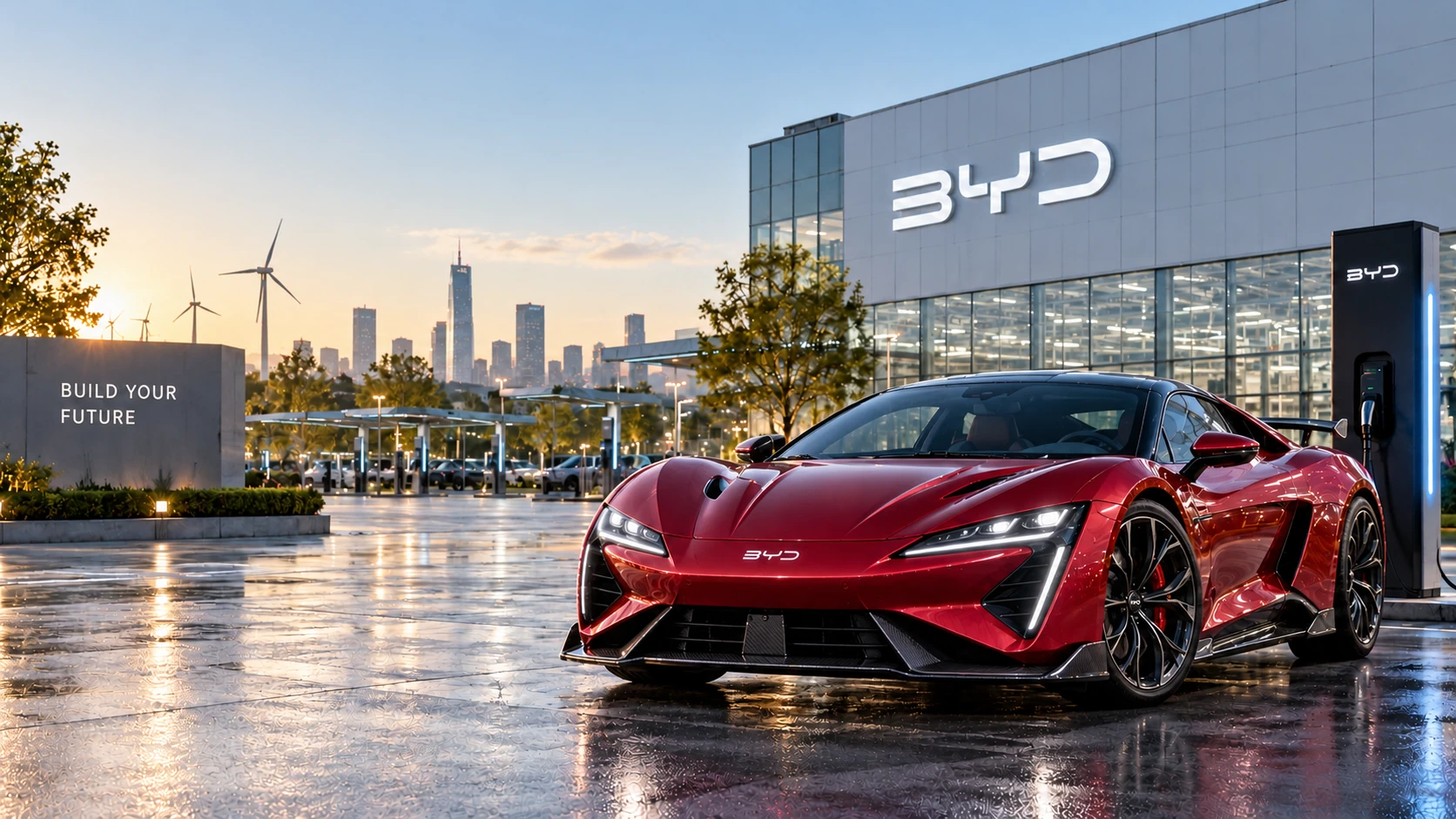
Image note: the supplied hero is an AI-generated editorial illustration, not a documentary photograph or confirmation of a particular BYD production model.
FAQ
Frequently Asked Questions
When did BYD overtake Tesla in annual electric-car sales?
In 2025, BYD sold about 2.26 million passenger BEVs, compared with Tesla’s 1.64 million deliveries.
Does the comparison include BYD plug-in hybrids?
No. It compares battery-electric vehicles. BYD’s plug-in hybrids are excluded.
Can every BYD recharge in nine minutes?
No. The 2026 claim concerns compatible Blade Battery 2.0 and FLASH Charging technology under specified conditions. It is not a promise for every model or charger.
PRESDA Dispatch
Stay Informed. Stay Aware.
A sharp briefing across AI, gaming, sport, business, world affairs, paparazzi, and lifestyle.