China’s Robot Revolution: Inside the World’s Most Automated Industrial Giant
China installs most of the world's new industrial robots. Behind the humanoid headlines lies a bigger transformation involving factory arms, logistics, software and the future of work.
At BYD's battery complex in Xiangyang, a September 2026 factory report described robotic arms, automated vehicles and towering storage equipment doing work that once demanded rows of people. Yet the complex still employed more than 8,000 people. That contrast captures China's automation story better than the image of an abandoned workshop: fewer hands at particular production stages, supported by an enormous industrial organisation. Seoul Economic Daily: reporting from BYD's Xiangyang battery factory, September 2026
China is the world's largest industrial robot market, but size is not the same as intensity. It does not lead the latest comparable robot-density ranking. Its revolution is already substantial in conventional factory automation; humanoids remain a much smaller, unevenly documented frontier. Understanding both requires separating working machinery from trials, performances and promises. IFR: World Robotics 2026, installations in 2025 IFR: revised 2024 robot density, April 8, 2026
THE SCALE: MOST NEW INDUSTRIAL ROBOTS GO TO CHINA
The International Federation of Robotics' World Robotics 2026 release, published September 24, reports 354,000 industrial robot installations in China during 2025, up 20% from 2024. China accounted for 59% of global installations. These are annual additions, not the total number of robots operating in Chinese factories, and not a census of every autonomous vehicle or intelligent machine. IFR: World Robotics 2026, installations in 2025
For operating stock, the latest China-specific figure directly verified in the public IFR documents reviewed here is 2,027,000 units in 2024. IFR said that stock had doubled within three years. Its 2025 report assigned China 43.5% of worldwide operating stock for 2024. The reporting years matter: 59% concerns new installations in 2025; 43.5% concerns accumulated stock in 2024. IFR: China's operating stock and installations in 2024 IFR: World Robotics 2025 foreword, 2024 stock shares
The newer release puts worldwide operating stock at roughly five million in 2025, but does not supply a China stock total in the public releases used here. Adding 354,000 to the older Chinese stock would produce a misleading estimate because machines also leave service. This feature keeps the verified country figure and its year visible instead of presenting an invented live count. IFR: World Robotics 2026, installations in 2025 IFR: China's operating stock and installations in 2024
Share of worldwide industrial robot installations, 2025. These are annual additions, not operating stock.
- China
- 59%
- Rest of world
- 41%
China: 354,000 installations. The remaining 41% is calculated as 100% minus IFR's rounded 59%.
Sources
PRESDA Data Graphics
A DENSITY REVISION THAT CHANGES THE COMPARISON
Robot density divides operating industrial robots by manufacturing employment. In April 2026, IFR revised China's 2024 figure to 166 robots per 10,000 manufacturing employees after incorporating updated workforce data. That was 17% higher than the previous year on the updated basis. The revision reflects a changed denominator, not a sudden disappearance of machines. IFR: revised 2024 robot density, April 8, 2026
Older publications carried a much higher Chinese figure. Those values should not be joined to the revised series to draw a collapse. On IFR's April 2026 comparison for 2024, South Korea stood at 1,220, Germany at 449, Japan at 446 and the United States at 307. China's vast manufacturing workforce helps explain why its huge robot fleet does not translate into the highest density. IFR: revised 2024 robot density, April 8, 2026
Density also cannot tell a reader how productive, profitable or autonomous a factory is. It counts industrial robots relative to employees, not the percentage of physical work performed by machines. An electronics cluster, a garment workshop and a vehicle body shop have different tasks and opportunities for automation. National averages compress those differences.
Industrial robots per 10,000 manufacturing employees, 2024. All five countries use IFR's April 2026 release.
- South Korea1,220
- Germany449
- Japan446
- United States307
- China166
China's denominator was revised using updated workforce data. Do not splice these values into older published Chinese density series. Bars start at zero.
Accessible data table
| Country | Robots per 10,000 employees |
|---|---|
| South Korea | 1,220 |
| Germany | 449 |
| Japan | 446 |
| United States | 307 |
| China | 166 |
Sources
PRESDA Data Graphics
WHY AUTOMATION BECAME A NATIONAL PRIORITY
The transition predates the current humanoid boom. A 2019 Journal of Economic Perspectives study traced China's rapid robot adoption through both company decisions and industrial conditions. Rising labour costs, production requirements and government support helped make robots attractive. The long-term ambition was to move beyond competing mainly through abundant labour toward manufacturing with greater precision and technological capability. Cheng and colleagues: The Rise of Robots in China, JEP, 2019
Policy increasingly treated robots as infrastructure for upgrading industry. The 2023 Robot Plus action plan targeted broader applications across manufacturing and other sectors, including a goal to double manufacturing robot density from its 2020 level by 2025. That was a policy target. It should not be declared achieved by comparing figures compiled with different employment denominators. State Council portal: Robot Plus action plan, January 2023
The 2026–2030 planning cycle adds emphasis on AI acting through physical machines. IFR's May 2026 assessment describes robotics as central to China's industrial strategy. Local support is also concrete: Beijing's 2023 measures offered support of up to 30 million yuan for qualifying major robotics projects. That ceiling is a programme rule, not total national investment or evidence that every eligible project received the maximum. IFR: China's 2026–2030 industrial strategy, May 2026 State Council portal: Beijing robotics support measures, August 2023
THE FACTORIES BEHIND THE NUMBERS
Automotive production makes the transformation easy to see, particularly in electric vehicles and batteries. Welding, handling and repetitive assembly lend themselves to machines working inside carefully organised processes. IFR's China release records 78,900 robot installations in automotive manufacturing in 2025, a 38% increase. Large volumes can justify equipment and integration costs that are harder for a small workshop to absorb. IFR: China market and industries, September 24, 2026
At BYD's Xiangyang operation, the manufacturer described its battery-cell assembly line as fully automated. That claim concerns a particular process, not every job in the complex. The visiting reporter's account of robot arms and automated transport is independent observation; the company's automation percentage remains attributed to the company. Maintenance, engineering and the wider production organisation still matter. Seoul Economic Daily: reporting from BYD's Xiangyang battery factory, September 2026
Electronics is equally important. China installed 96,400 industrial robots in electrical and electronics manufacturing in 2025, up 16%, according to IFR. Metal and machinery accounted for another 78,700. These sectors show why the story extends beyond cars: component placement, machine loading, inspection and material movement can all be reorganised around repeatable, measurable tasks. IFR: China market and industries, September 24, 2026
ARMS, WHEELS, CAMERAS AND SOFTWARE
An industrial robot is often an arm with an end effector designed for a specific job. A mobile robot moves materials between workstations. Machine vision supplies information about position or defects, while control software coordinates motion and timing. These components can work together without producing a human-shaped machine or a system capable of understanding every task in a factory. Inovance: industrial robotics components and control systems
AI can make inspection more adaptable by finding patterns in images, help flag equipment problems and improve production decisions. CATL's manufacturing description, for example, identifies image recognition, machine learning and predictive algorithms among its tools. This establishes how the company describes its production system. It does not independently quantify how much every model reduces defects or prove that human quality control has disappeared. CATL: company description of smart manufacturing
Automated guided vehicles and autonomous mobile robots are also different from a fixed arm. The former generally follow defined guidance; the latter can use sensing and mapping to navigate more flexibly. Neither label guarantees unrestricted autonomy. A logistics system still needs workable routes, reliable handovers and a response when a pallet, person or broken machine interrupts the intended flow.
HOW DARK IS A DARK FACTORY?
The phrase dark factory usually describes production that can run with little direct human attendance, sometimes without normal lighting. It is not a standard measure of the automation of an entire company. A highly automated cell can sit inside a plant that relies on people for materials, repairs, changeovers and exceptions. Removing workers from a photograph says little about the total labour behind a finished product.
Reuters' August 2026 investigation found extensive conventional automation at Xiaomi's EV factory, including hundreds of body-shop robots. It also described humanoid training and trials. At Geely's Zeekr plant in Ningbo, the company said arms and automated guided vehicles performed the key active assembly tasks after humanoid sorting trials. The distinction is between machines sustaining production and machines being evaluated for future roles. Reuters investigation: China's humanoid industry and factory trials, August 2026
The meaningful test is sustained output at an acceptable cost and quality, including downtime, supervision and maintenance. An unattended shift on one stable product is a narrower achievement than a factory that can independently adapt to any order. Human-light manufacturing is real in selected processes; evidence for a generally workerless Chinese manufacturing economy is not.
HUMANOIDS: WHAT HAS ACTUALLY REACHED A FACTORY?
Humanoids are attractive because factories already contain tools and spaces designed around people. In principle, one adaptable machine could move between jobs that currently require different specialised equipment. In practice, gripping varied objects, handling errors and working safely at production speed are demanding. A body shaped like a person does not supply human dexterity, judgment or economic usefulness.
There are named production-line claims. On June 24, 2026, CATL said Galbot S1 robots had been deployed in module and battery-pack manufacturing, including material handling. This is a company-reported operational deployment, stronger evidence than a stage performance but not an independent audit of fleet size, uptime or financial return. It does not demonstrate that humanoids are widespread across Chinese factories. CATL: Galbot S1 production-line deployment announcement, June 24, 2026
Xiaomi's 2026 interim report describes July factory demonstrations and additional workstations involving sorting and box folding. It reports improved success on a nut-loading task, from 90.2% to 98%. Those are company-reported task results, not a factory-wide productivity rate. The disclosure does not provide enough information to equate a success percentage with months of reliable, unsupervised commercial operation. Xiaomi: 2026 interim report, page 9, company-reported robot trials
Demonstrations belong in a separate category. Associated Press' coverage of the August 2026 World Robot Conference described machines boxing and performing for audiences. Such displays can show advances in balance and motion. They do not establish readiness for a repetitive industrial job with safety requirements and a delivery deadline. Associated Press: World Robot Conference demonstrations, August 2026
Announced production capacity is another category again. UBTECH's November 2025 release described Walker S2 deliveries alongside future manufacturing-capacity targets. Producing or delivering a robot is not the same as documenting productive hours at a customer factory. Treat capacity, shipments, orders and installed working units as different measures, rather than adding them into a supposed humanoid workforce. UBTECH: Walker S2 deliveries and capacity targets, November 2025 company release
Selected examples reviewed October 3, 2026. This is not a census or a ranking of manufacturers.
1. Operating production
BYD: conventional automation observed in a battery factory. CATL: Galbot S1 production-line use reported by the company, without an independent performance audit.
2. Factory trials
Xiaomi's July 2026 task results and Zeekr's humanoid trials. A task success rate is not a plant-wide productivity measure.
3. Demonstrations
World Robot Conference performances show capabilities under particular conditions, not sustained industrial employment.
4. Announced future capacity
UBTECH's November 2025 release combines deliveries with future capacity targets. Capacity and orders are not verified working hours.
Sources
PRESDA Data Graphics
BUILDING A DOMESTIC ROBOTICS INDUSTRY
China is expanding the supplier base behind the machines as well as buying more of them. IFR reports that Chinese robot manufacturers supplied 195,000 domestic installations in 2025, a 55% market share. Their volume increased even though their share was below 2024's 57%. A falling share can therefore coexist with growth in a rapidly expanding market. IFR: World Robotics 2026, installations in 2025
The supply chain includes motion control, motors, drives, sensors, precision mechanical parts and integration expertise. Inovance, for example, markets servo and control systems for industrial robotics. Alongside conventional robot suppliers, companies such as UBTECH and Galbot pursue humanoid applications, while Xiaomi develops embodied-intelligence models. These are different roles in an ecosystem, not interchangeable competitors producing the same machine. Inovance: industrial robotics components and control systems UBTECH: Walker S2 deliveries and capacity targets, November 2025 company release CATL: Galbot S1 production-line deployment announcement, June 24, 2026 Xiaomi: 2026 interim report, page 9, company-reported robot trials
Domestic brand share does not establish that every component is Chinese, nor does a foreign brand necessarily imply an imported finished robot. The competitiveness question extends to component reliability, software, service networks and the ability to integrate equipment into a customer's process. Counting robots alone misses much of the value and many of the remaining dependencies.
AN AGEING WORKFORCE AND A DIFFERENT ECONOMIC MODEL
China's National Bureau of Statistics reported 323.38 million people aged 60 or above at the end of 2025, representing 23% of the population. That is a demographic measure, not a count of retirees or manufacturing vacancies. It nevertheless gives context to an industrial strategy seeking more output without depending on endlessly expanding supplies of younger workers. National Bureau of Statistics: China's population at the end of 2025
Automation can reduce exposure to heavy, repetitive work and help firms maintain consistent processes. But the business case depends on utilisation, financing, integration, maintenance and demand for the product. A machine that is technically impressive but often idle may be a poor investment. Subsidising capacity does not itself establish that customers can use it profitably.
Peer-reviewed evidence supports a more precise discussion than either technological salvation or inevitable mass unemployment. A 2024 Journal of Economic Behavior & Organization study estimated productivity gains among Chinese robot-adopting firms, with effects varying across time and types of firms. It used matching and difference-in-differences methods. Such findings concern the studied businesses and assumptions, not a guaranteed gain from every robot purchase. Li, Jin and Cheng: industrial robotics and firm productivity, JEBO, 2024
WHICH JOBS CHANGE, AND WHO GAINS?
Routine handling, welding and some inspection tasks can require fewer workers when automated. Integration, maintenance, process engineering and troubleshooting create different demands. A 2024 China Economic Review study found higher employment within robot-adopting firms, especially for more educated and skilled workers, alongside labour reallocation toward adopters. Growth at successful firms does not show that every displaced worker benefits. China Economic Review: robot adoption and employment adjustment, 2024
A different perspective comes from Giuntella, Lu and Wang's NBER working paper using Chinese household data. It associated greater robot exposure with worse employment and wage outcomes, concentrated among less-educated workers. That working paper is distinct from the firm-level study and is not presented here as a peer-reviewed result. The units of analysis differ: a company can expand while particular workers or communities lose ground. Giuntella, Lu and Wang: Chinese workers and robot exposure, NBER working paper, 2022
Training therefore cannot be treated as a slogan attached to an equipment purchase. Workers need accessible routes into the new tasks, and factories need people who understand both production and the systems controlling it. Neither the latest installation totals nor company demonstrations establish a reliable number of net jobs that China will gain or lose by 2030.
SAFETY IS PART OF THE PRODUCTION SYSTEM
Traditional industrial robots can be powerful and fast, which makes separation, risk assessment and reliable protective systems essential. ISO 10218-1:2025 addresses industrial robot safety; integration into applications requires additional attention. Its scope should not be stretched into a blanket certification of every mobile or humanoid system. Adding an AI model does not remove the obligation to control physical hazards. ISO 10218-1:2025: industrial robot safety requirements
For an adaptive machine, the questions include what happens when perception is wrong, a person enters the work area or communications fail. Connected equipment also makes access control and recovery planning operational concerns. A factory needs defined responsibilities and safe failure behaviour, not simply an impressive demonstration. The gains from speed disappear if stoppages or unsafe interactions make the system unusable.
CHINA AND ITS INDUSTRIAL COMPETITORS
China's scale contrasts with more intensive automation in several established manufacturing economies. In IFR's 2025 installation data, the United States moved ahead of Japan into second place, with almost 38,500 installations versus Japan's 36,219. South Korea installed about 30,000 and Germany fewer than 25,000. Those flow figures should not be confused with the density comparison above, which uses 2024 employment and stock. IFR: World Robotics 2026, installations in 2025
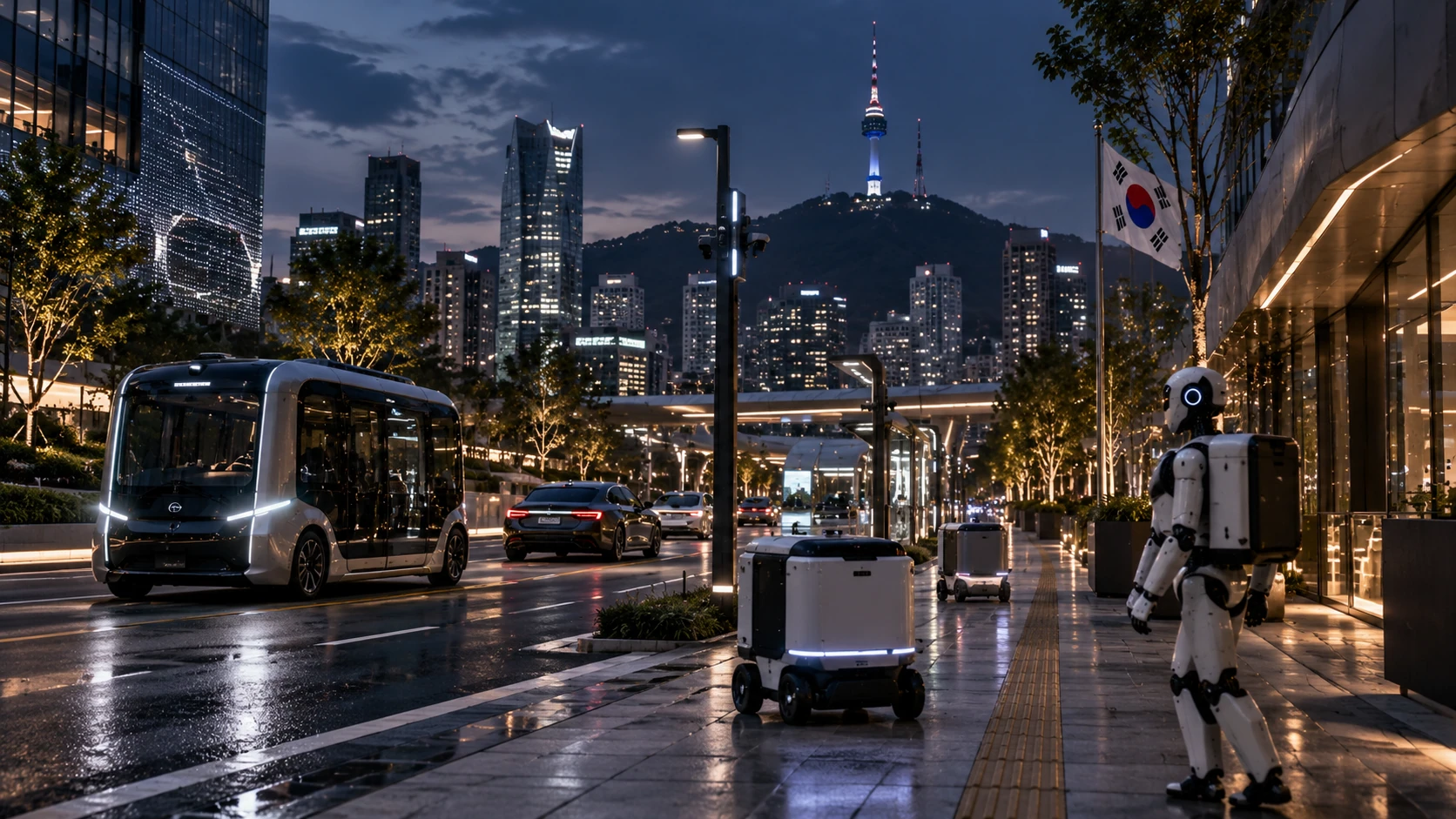
There is no single race with one finish line. A country can lead in robot deployment, another in particular components, and another in the density of an industry. Competition also involves export markets, software and manufacturing know-how. PRESDA's Seoul Physical AI feature follows a related attempt to take autonomous systems beyond factory boundaries and into shared urban space.
WHAT COULD CHINESE FACTORIES LOOK LIKE BY 2030?
IFR's China outlook anticipates further growth, but forecasts are not observed installations. A defensible view of 2030 is conditional: more integrated arms, mobile logistics, inspection and software where they prove economical; humanoids in selected tasks if reliability and cost improve. The available evidence does not justify predicting a nationwide replacement of production workers by human-shaped robots. IFR: China market and industries, September 24, 2026
The indicators worth following are repeat customer use, sustained task completion, human interventions, safety, total operating cost and worker outcomes. Factory pilots need to cross those thresholds before they can support larger claims. The same distinction between engineering progress and commercial proof runs through Japan's fusion programme: an ambitious target can direct investment without guaranteeing the promised outcome.
China is already performing a vast amount of industrial work with machines. Calling it the first economy where robots do much of the physical work would require a comparable measure of work performed across countries, which robot counts do not provide. The established transformation is more concrete: the world's largest robot market is reorganising production, and the consequences will depend as much on how factories and jobs are redesigned as on the next machine's abilities.
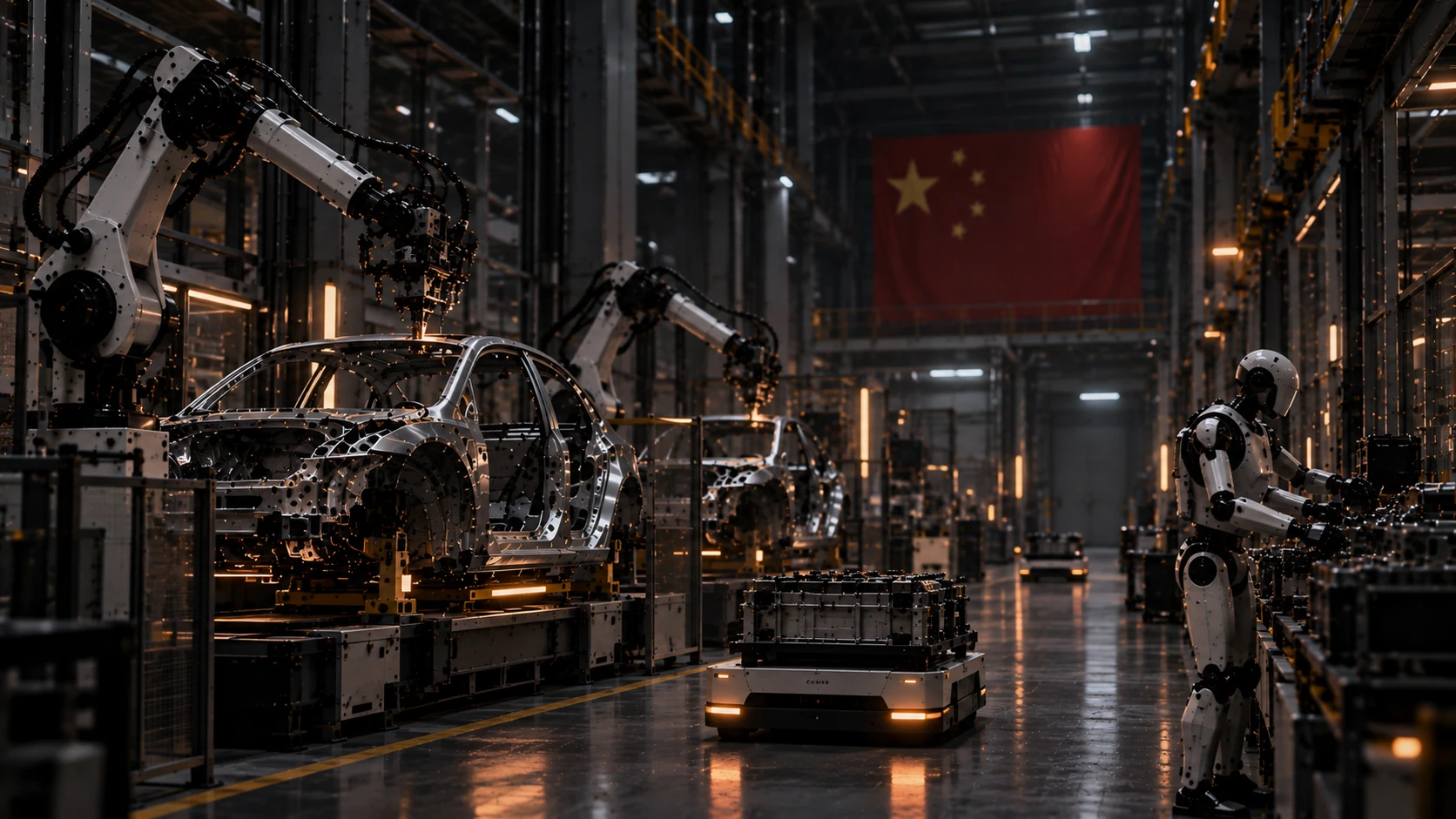
Information checked October 3, 2026. Installation, stock and density figures retain their source years; company claims and future targets are attributed. The approved hero is an editorial illustration, not documentary evidence of humanoids working at a named Chinese factory.
FAQ
Frequently Asked Questions
How many industrial robots operate in China?
The latest China-specific operating-stock figure directly verified in the public IFR documents reviewed for this feature is 2,027,000 in 2024. IFR's September 2026 release reports 354,000 new Chinese installations in 2025, a different measure that cannot simply be added to older stock without accounting for retirements.
What share of new industrial robots is installed in China?
China accounted for 59% of global industrial robot installations in 2025, according to IFR's World Robotics 2026 release. Its 43.5% share of global operating stock refers to 2024 and should not be confused with annual installations.
Does China have the world's highest robot density?
No. IFR's April 2026 revision puts China's 2024 manufacturing density at 166 industrial robots per 10,000 employees, compared with South Korea's 1,220. Updated Chinese workforce data changed the denominator, so older published values are not directly comparable.
Are humanoid robots already working in Chinese factories?
There are company-reported production-line deployments, including CATL's June 2026 Galbot announcement, alongside factory trials and demonstrations. Evidence does not establish widespread humanoid employment or audited long-term performance across Chinese manufacturing.
Are China's dark factories completely workerless?
The term can describe a highly automated process or shift. It does not show that maintenance, engineering, logistics, changeovers and the wider company operate without people.
Will robots replace China's manufacturing workers by 2030?
No verified evidence supports that sweeping prediction. Automation can remove tasks and create different skill demands. Research finds both gains at adopting firms and adverse outcomes for exposed workers, so effects depend on the setting and people involved.
PRESDA Dispatch
Stay Informed. Stay Aware.
A sharp briefing across AI, gaming, sport, business, world affairs, paparazzi, and lifestyle.