Seoul Wants to Become a Living Lab for Robots and Physical AI
Seoul wants robots and autonomous systems to become part of everyday urban life. Some services already carry passengers; the larger citywide experiment is still taking shape.
At 3:30 in the morning, the promise of an intelligent city can be surprisingly ordinary: a bus arriving before the conventional morning rush. Seoul's April 2026 launch notice for the A148 autonomous route connected the technology to people who need to travel early. Its buses combine onboard sensing with traffic-signal information. This is a more useful starting point for the city's robotics ambitions than a pavement crowded with humanoids. Seoul: A148 launch and connected traffic signals, April 2026
On January 30, 2026, Seoul announced a Physical AI strategy intended to turn the city into a continuing test environment for machines operating in the real world. It links research, robotics facilities and public services. The ambition is citywide; present operations are much narrower. A pilot may carry real passengers while remaining a limited experiment, and a construction target is not an operating service. Seoul: Physical AI strategy announced January 30, 2026
WHAT PHYSICAL AI MEANS
Physical AI describes systems that connect perception and decision-making to action in the physical world. A robot interprets sensor information, chooses an action and moves an arm, wheels or legs, then responds to what happens next. Unlike generating a plausible paragraph, completing a physical task requires coping with friction, obstacles, timing and the consequences of contact with people or objects. Google DeepMind: Gemini Robotics and physical action, March 2025
Generative AI and Physical AI are not rival categories. A generative model can help a robot understand instructions or plan actions. Google DeepMind's Gemini Robotics work, for example, connects vision and language to robotic action. But an autonomous bus, a factory arm and a conversational companion do not necessarily use the same models or possess comparable abilities. Putting existing automation under a new label does not make it generally intelligent. Google DeepMind: Gemini Robotics and physical action, March 2025
WHY SEOUL WANTS TO INVEST
The city sees a chance to connect industrial growth with practical needs: journeys outside normal service hours, assistance with physically demanding work and care for older residents. Money is following that argument. Seoul allocated KRW 42.5 billion to its broader 2026 R&D programme, including KRW 10.2 billion for Physical AI. The smaller sum is part of the larger one, not an additional allocation. Funding demonstrates a policy commitment, not a proven social return. Seoul: 2026 R&D allocations and testbed support Seoul: elderly-care robots and nursing-home pilots, 2024
South Korea already has unusual depth in industrial automation. The International Federation of Robotics' World Robotics 2025 report puts its 2024 density at 1,220 industrial robots per 10,000 manufacturing employees. That is a national manufacturing measure, not the number of robots per Seoul resident, and it says nothing directly about humanoids on streets. The challenge is to carry technical capability from comparatively controlled workplaces into shared public space. International Federation of Robotics: World Robotics 2025, 2024 data
THE BELT: TWO HUBS, DIFFERENT JOBS
The proposed Seoul Physical AI Belt connects Yangjae's AI cluster with Suseo's robotics cluster. Yangjae is intended to supply research, software and talent; Suseo is intended to help turn those capabilities into working machines and businesses. The existing Seoul AI Hub is a starting point. The larger AI Tech City is a development project, with construction targeted to start in 2028. Seoul: Physical AI strategy announced January 30, 2026
Suseo's Robot Plus Test Field opened in 2024. A larger Seoul Robot Tech Center is targeted for completion in 2030, alongside phased plans for company space and public robotics experiences. These are different facilities at different stages, not one finished robot district. Their value would lie in giving developers places to test, improve and certify products before attempting wider use. Seoul: Yangjae–Suseo robotics belt and demonstration projects
Yongsan International Business District is a separate proposed showcase, not a third completed node of the belt. The city envisages connected operations, sensors, robotic parking and underground logistics there. Its announcement describes an intended intelligent district. It does not establish that an integrated district of this kind is already functioning. Seoul: Physical AI strategy announced January 30, 2026
Structured location guide, not a geographic map. Existing anchors and proposed developments are distinct.
Yangjae · AI research
Existing anchor: Seoul AI Hub. AI Tech City construction targeted to begin in 2028.
Suseo · Robotics
Robot Plus Test Field opened in 2024. Robot Tech Center completion targeted for 2030.
Yongsan · Separate proposed showcase
Planned intelligent business district, including connected operations and logistics. Not a completed third belt hub.
Sources
PRESDA Data Graphics
HOW A CITY BECOMES A TEST SITE
Seoul's R&D programme describes a practical intermediary role: matching companies with demonstration sites, examining regulatory constraints and supporting certification and commercialisation. The Physical AI strategy also scheduled a Testbed Demonstration Center for the second half of 2026. That remains an announced milestone in the evidence reviewed here; a timetable alone is not verification that a facility has opened. Seoul: 2026 R&D allocations and testbed support Seoul: Physical AI strategy announced January 30, 2026
One earlier example is Neubility's delivery robot at Nanji Camping Site. Seoul says it helped a demonstration navigate rules that had restricted heavier powered devices in parks, contributing to regulatory change. This illustrates why real-world testing matters: a viable machine needs a lawful route as well as working software. The city's account is evidence of the demonstration and its policy role, not an independent guarantee of reliability everywhere. Seoul: Yangjae–Suseo robotics belt and demonstration projects
The same municipal overview identifies Robotis delivery robots in Yangcheon parks, Aetech recycling-sorting equipment and fire-patrol robots from Irop Robotics. These examples span delivery, waste handling and inspection. They should not be read as a citywide inventory or evidence that all neighbourhoods have such services. A successful demonstration in one setting still leaves questions about maintenance, weather, pedestrian interaction and operating costs elsewhere. Seoul: Yangjae–Suseo robotics belt and demonstration projects
AUTONOMOUS TRANSPORT: REAL RIDES, BOUNDED OPERATIONS
Seoul's August 2026 bus roadmap reported 24 autonomous vehicles operating across six districts: 16 buses, seven taxis and one demand-responsive vehicle. It also reported cumulative ridership exceeding 234,000 by the end of July. That is an aggregate use figure, not 234,000 unique residents or proof of unrestricted driverless operation. The same roadmap's 500 autonomous buses by 2030 is a target, not today's fleet. Seoul: August 2026 bus roadmap and July operating figures
A separate August notice announced an expansion of the Gangnam late-night taxi service from seven vehicles to 19, starting August 20. The city reported 15,140 completed rides from September 26, 2024, through July 31, 2026, and a move to paid rides in April 2026. Booking through Kakao T makes the pilot accessible through a familiar app, but its limited service conditions still matter. The August expansion should not be silently inserted into the other notice's fleet count. Seoul: August 2026 taxi expansion and revised Sangam schedule
Early-morning buses address a different gap. The April notice names SUM as the A148 operator and Autonomous A2Z on A741. For A148, the city described access to signal-phase and timing information at 98 intersections. It also required passengers to remain seated, with no standing riders. Those conditions reveal how deployment depends on route design and operating rules, not just a vehicle's ability to steer. Seoul: A148 launch and connected traffic signals, April 2026
Schedules have already changed. The initial strategy anticipated a Level 4 robotaxi launch in October 3026; the later August taxi notice instead points to November in Sangam. This feature uses the newer target and does not report that launch as completed. Level 4 concerns automated driving within specified operating conditions, not permission to drive everywhere in every situation. The public value of a system depends on where, when and how it can actually operate. Seoul: Physical AI strategy announced January 30, 2026 Seoul: August 2026 taxi expansion and revised Sangam schedule
Selected milestones reviewed October 3, 2026. Spacing does not represent elapsed time. A public pilot can carry real passengers while retaining restrictions.
2024
Existing facility
Robot Plus Test Field opens in Suseo. [1]
April 2026
Public pilot
A148 early-morning autonomous bus launches; seated passengers only. [2]
August 2026 notice
City-reported snapshot
24 autonomous vehicles: 16 buses, 7 taxis and 1 demand-responsive vehicle, across six districts. [3]
November 2026
Revised target
Sangam Level 4 robotaxi service. August notice supersedes earlier October expectation. [4]
2028
Construction target
Start of AI Tech City construction, not completion. [5]
2030
Development targets
Robot Tech Center completion; separately, a city fleet target of 500 autonomous buses. [6] [7]
Targets are not achieved outcomes. Separate city notices report different snapshots; do not combine their fleet counts.
Sources
PRESDA Data Graphics
THE INFRASTRUCTURE AROUND THE ROBOT
Some intelligent infrastructure predates the Physical AI campaign. Seoul's TOPIS describes automated Green Traffic Zone enforcement operating since December 2019, linking vehicle recognition with emissions information. It is an example of sensing, data exchange and an administrative response. It does not establish that every Seoul traffic light is controlled by AI, or that the entire transport network is autonomous. Seoul TOPIS: Green Traffic Zone and automated enforcement
Safety applications also need precise descriptions. The city documents fire-patrol robot demonstrations and proposes broader inspection and care-related applications. A machine that carries a camera or flags a possible hazard is not an autonomous emergency service. Detection must lead to a useful human response. The relevant questions include missed incidents, false alarms and who takes responsibility when a warning is wrong. Seoul: Yangjae–Suseo robotics belt and demonstration projects
CARE: ASSISTANCE WITHOUT A PROMISE TO REPLACE PEOPLE
The care story is already more varied than a humanoid nurse. A 2024 Seoul notice described 430 companion robot dogs distributed in 2023 and a pilot involving two toileting-assistance robots in municipal nursing homes in 2024. It also discussed rehabilitation equipment. These dated examples establish that trials and distributions occurred; they do not prove universal availability in 2026, clinical effectiveness or reduced staffing needs. Seoul: elderly-care robots and nursing-home pilots, 2024
Independent evidence requires caution. A 2024 review of social-robot research examined outcomes including loneliness, mood and social interaction among older adults. Findings from specific interventions cannot be extended automatically to every product or vulnerable person. A 2025 peer-reviewed analysis also argues that care robots must support meaningful caregiving, rather than treat human work merely as a burden to remove. PRESDA's Japan AI-care feature explores that wider tension. Systematic review: social robots and older adults, 2024 Voinea and Wangmo: robots and meaningful care work, 2025
THE ECOSYSTEM BEHIND THE EXPERIMENT
Seoul can draw on a national base spanning vehicles, electronics, semiconductors and AI. NVIDIA's 2025 announcement of infrastructure commitments with the Korean government and companies including Samsung, SK, Hyundai and NAVER describes a push to expand computing capacity. Those commitments are national and corporate projects, not a count of equipment already installed for Seoul's belt. Chips and computing can enable robotics without settling the harder questions of safe behaviour. NVIDIA: South Korean government and industry infrastructure commitments, 2025
The research links are concrete. The National AI Research Lab describes a consortium of KAIST, Korea University, POSTECH and Yonsei, supported by the Ministry of Science and ICT. Physical AI and robotic foundation models are one of its research pillars, and its listed facilities include Seoul AI Hub. That is an identifiable research presence, not a claim that every participating university has a contract to operate robots on Seoul's streets. National AI Research Lab: university consortium and research pillars
Humanoid robots give the industrial push its most visible form. At CES 2026, Hyundai Motor Group described its AI robotics strategy, Boston Dynamics' Atlas and collaboration with Google DeepMind. Its plan placed initial Atlas parts-sequencing work at its Georgia manufacturing site in the United States in 2028, with more complex work later. Those company targets concern factory deployment, not a confirmed rollout of humanoids across Seoul. Hyundai Motor Group: AI robotics strategy and Atlas targets, CES 2026
Stage demonstrations deserve their own label. Associated Press reported that the Atlas demonstration at CES was remotely piloted by an engineer. That distinction does not make the engineering trivial; it prevents an audience from confusing a controlled performance with independent operation. For any humanoid or service robot, useful questions are what it can do repeatedly, what assistance it needs and what happens when the environment changes. Associated Press: the Atlas demonstration at CES 2026 Google DeepMind: Gemini Robotics and physical action, March 2025
REGULATION IS PART OF THE ENGINEERING
South Korea's 2023 legal changes opened a path for safety-certified outdoor mobile robots to use pavements, rather than granting unrestricted access to any machine. KOTRA's account explains the amendments to the robot and road-traffic frameworks. The implementing legislation also requires liability insurance before certified outdoor mobile robots operate. Certification and insurance create responsibilities; neither removes the need to examine how a particular deployment treats pedestrians. KOTRA: 2023 amendments governing outdoor mobile robots Korean legislation: outdoor mobile robot liability insurance
For vehicles, the word autonomous must not erase the operating crew. Seoul's June 2025 Gangnam taxi explanation explicitly said a driver remained onboard for emergencies. The later service announcements reviewed here should not be treated as evidence that this safeguard disappeared. Reporting a pilot's passenger totals is different from demonstrating that it operated without a safety driver or remote assistance. Seoul: Gangnam taxi operating conditions and safety driver, June 2025 Seoul: August 2026 taxi expansion and revised Sangam schedule
A CITY THAT CAN SEE MUST ANSWER FOR ITS DATA
Moving robots carry cameras into spaces shared by people who did not order a ride or delivery. Korea's Personal Information Protection Commission has addressed the distinction between recording for navigation and retaining identifiable footage to develop AI. Its 2024 account described legal conditions for mobile cameras and safeguarded sandbox cases involving Neubility, Woowa Brothers, 42dot and Kakao. This was not blanket permission to keep every face encountered on a pavement. Personal Information Protection Commission: mobile cameras and robot data, 2024
The privacy question therefore extends beyond whether a robot stores video. Residents need intelligible answers about purpose, retention, access, sharing and complaint routes. Linking vehicles, cameras and city systems could increase the consequences of a breach or misuse. These are governance risks to evaluate, not evidence that every Seoul project conducts unlawful surveillance. PRESDA's Estonia digital-government feature examines the related distinction between connected services and unlimited access to personal data. Personal Information Protection Commission: mobile cameras and robot data, 2024
WHO BENEFITS, AND WHO DOES THE NEW WORK?
Automation can change tasks before it eliminates an occupation. Someone still maintains equipment, handles exceptions, cleans sensors, responds to passengers and helps care recipients. The care-work research warns against designing systems without considering professional judgment and the meaning of human contact. Seoul's later taxi notice also acknowledges consultation with the taxi industry. Neither an inevitable employment collapse nor a guaranteed jobs dividend follows from an announcement. Voinea and Wangmo: robots and meaningful care work, 2025 Seoul: August 2026 taxi expansion and revised Sangam schedule
Accessibility belongs in the test, not at its end. A robot that blocks a wheelchair route or a service usable only through a smartphone can make an apparently efficient city harder to navigate. Seoul's AI Companion Bus, launched in 2025 to introduce older residents to AI tools, recognises the need for support. That education initiative is not itself evidence of autonomous driving. Public services should retain usable human help and alternatives when a machine or connection fails. Seoul: AI Companion Bus and older residents' digital inclusion, 2025
SEOUL IS NOT THE ONLY URBAN LABORATORY
San Francisco offers a different stage of development. California's regulator approved expanded paid driverless passenger-service authority for Waymo in 2023. That is a regulatory milestone for commercial robotaxis, not evidence that an entire city became autonomous. Comparing it with Seoul requires separating vehicles without onboard drivers from supervised pilots, and distinguishing permitted operating areas from a company's broader ambition. California Public Utilities Commission: driverless fare permits, 2023
Singapore's approach is closer to a staged public-transport experiment. Its Land Transport Authority described closed-course testing, on-road trials, community rides and eventual commercial services for Punggol shuttles, with onboard safety operators throughout those phases. CNA subsequently reported public rides opening from April 1, 2026. The comparison illustrates different deployment models, rather than a meaningful league table based on incompatible passenger and vehicle counts. Singapore LTA: phased autonomous shuttle testing and safety operators CNA: Punggol public shuttle rides from April 1, 2026
A transferable model would be the institutions around the machines: defined test areas, accountable operators, published limits and a path from trial to service. Seoul's public-site matching and certification support address part of that problem. Other cities would still need to adapt procurement, street design, labour arrangements and data rules. Copying a robot or a district's name would not reproduce those conditions. Seoul: 2026 R&D allocations and testbed support
WHAT WOULD COUNT AS SUCCESS?
For residents, the strongest evidence would be mundane and measurable: a dependable journey, a delivery that does not obstruct the pavement, a care task made safer, or a hazard detected in time. Evaluation should include failures, interventions, costs and accessibility, not just demonstration counts. The city's 2030 bus ambition provides a future benchmark, but a larger fleet alone would not show that service quality improved. Seoul: August 2026 bus roadmap and July operating figures
The next showcase is already on the calendar. Seoul announced Smart Life Week for October 6–8, 2026, with AI and robotics demonstrations. As of this feature's October 3 review, that event is still ahead. A showroom can help residents understand an idea; it cannot substitute for evidence from repeated operation in rain, traffic and the unpredictable routines of a city. Seoul: Smart Life Week planned for October 6–8, 2026
Seoul's wager is that a city can help technology mature while improving everyday life. The evidence already includes limited public transport services, research facilities and robot demonstrations. The larger promise still depends on construction, safe scaling and public trust. Becoming a living laboratory will matter only if the people who live there gain more than the role of test subjects.
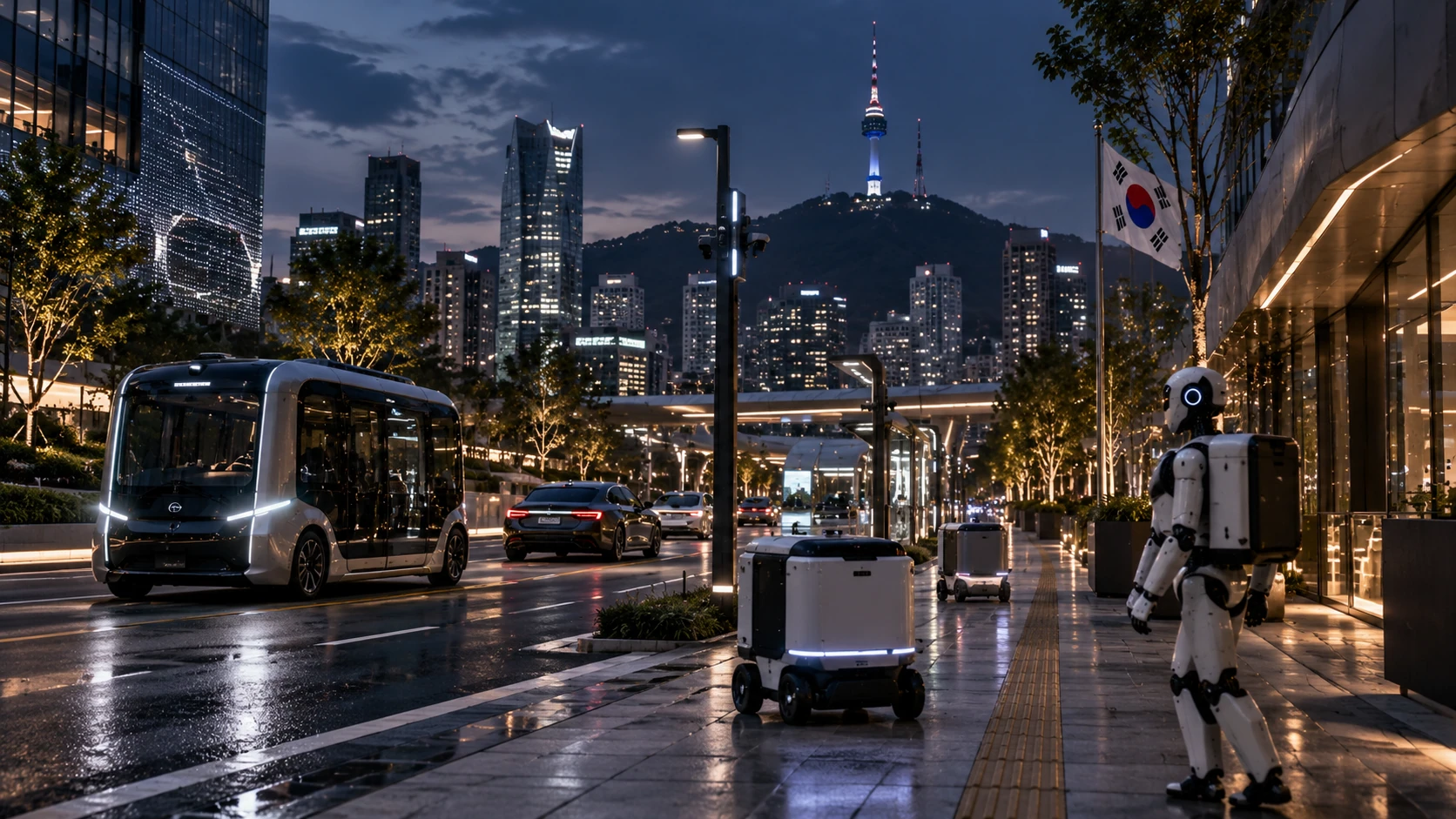
Information checked October 3, 2026. Operating figures are dated and attributed to their publishers; planned milestones are not reported as completed. The approved hero is an editorial illustration, not documentary evidence of robots or autonomous vehicles deployed on a particular Seoul street.
FAQ
Frequently Asked Questions
What is Seoul Physical AI?
It is Seoul's strategy for testing AI that acts through machines and physical infrastructure, including robots and autonomous vehicles. Announced in January 2026, it combines research clusters, demonstration sites and proposed public-service applications.
Where is the Seoul Physical AI Belt?
The planned belt connects the Yangjae AI cluster with the Suseo robotics cluster. Existing facilities anchor it, while AI Tech City construction is targeted for 2028 and the Robot Tech Center for completion in 2030.
Are autonomous buses and taxis already operating in Seoul?
Yes, within limited services and pilots. Seoul reported 24 autonomous vehicles in its August 2026 roadmap. Operating conditions, routes and human safety support must be distinguished from unrestricted driverless service.
Has Seoul launched its planned Sangam Level 4 robotaxi service?
The August 2026 city notice targeted November, replacing an earlier October expectation. The sources reviewed for this October 3 feature do not establish that the planned service has launched.
Will Seoul's robots replace care workers?
Existing trials do not establish that. Robots may assist with specific tasks, but independent research emphasises human judgment, meaningful care work, safety and the limits of evidence.
Is Physical AI the same as generative AI?
No. Generative AI produces outputs such as text or images; Physical AI connects sensing and decision-making to physical action. Generative models can be components of physical systems.
PRESDA Dispatch
Stay Informed. Stay Aware.
A sharp briefing across AI, gaming, sport, business, world affairs, paparazzi, and lifestyle.