Japan’s Fusion Gamble: Can It Build a Machine That Runs Like the Sun?
In Japan, a twisting superconducting magnet is taking shape. The harder task lies ahead: turning a promising fusion design into a machine that reliably exports electricity.
At a research site in Toki, Japan, the fusion-energy story is becoming a manufacturing story. Helical Fusion is assembling the magnetic hardware for Helix HARUKA, a machine intended to test technologies for a future power plant. Reuters reported on September 29, 2026 that construction of its first spiral coil, begun earlier that year, was largely complete. The company targets initial energization tests in 2027. Reuters: HARUKA construction and targets, September 29, 2026
That is progress, but it is not electricity generation. As of October 2, 2026, no commercially viable fusion power plant exists. Japan has not built a commercial fusion reactor or demonstrated net fusion electricity through HARUKA. The Helix Program links component tests to a later power demonstrator, Helix KANATA, with major scientific and industrial hurdles between them. Reuters: HARUKA construction and targets, September 29, 2026 Helical Fusion: Helix Program roadmap and design goals
WHAT IT MEANS TO RUN LIKE THE SUN
Nuclear fusion joins light atomic nuclei and releases energy. The Sun is powered by fusion, but a terrestrial reactor is not a miniature star. Solar gravity confines enormously dense matter. On Earth, magnetic-confinement machines instead seek a sufficiently hot, dense plasma, held for long enough that fusion heating can compete with energy losses. Temperature alone is not a measure of success. IAEA: magnetic and inertial confinement
For many proposed power reactors, the fuel is deuterium and tritium, two forms of hydrogen. Their fusion produces helium and an energetic neutron. The Sun mainly follows a different chain of reactions beginning with ordinary hydrogen. The comparison concerns the underlying source of energy, not identical fuel, pressure or operating conditions. IAEA: magnetic and inertial confinement ITER: what a power-plant blanket must do
Fission, used in today's nuclear power stations, splits heavy nuclei; fusion combines light ones. Fusion does not sustain the same neutron-driven chain reaction. Yet a fusion plant still requires nuclear engineering: tritium is radioactive, and energetic neutrons can damage and activate structural materials. Calling fusion low-carbon does not make its fuel handling or radioactive waste disappear. US NRC: nuclear fission and fusion explained NIFS: fusion reactor engineering challenges
A MAGNETIC BOTTLE, WITH A TWIST
Plasma is an electrically conducting mixture of ions and electrons. Charged particles spiral around magnetic field lines, allowing carefully shaped fields to keep most of the hot fuel away from the vessel walls. Heating, fueling and exhaust systems must work alongside confinement. Turbulence and escaping particles can carry energy away, even when a magnetic configuration is stable enough to avoid a sudden collapse. IAEA: magnetic and inertial confinement ITER: making fusion work
Helical devices belong to the stellarator family. Their external coils create the twisting magnetic geometry needed for confinement without requiring the large toroidal plasma current central to a conventional tokamak. That makes continuous operation an attractive design goal. The trade-off is intricate three-dimensional coils and demanding manufacturing precision. A helical design is not a guarantee against every plasma instability or heat-loss mechanism. Max Planck IPP: the stellarator approach
Tokamaks combine external fields with a substantial current in the plasma. Transformer-driven operation is naturally pulsed, but additional current-drive systems can support longer or steady operation. It would therefore be wrong to say that only stellarators can pursue continuous fusion. The approaches distribute their engineering difficulties differently: plasma-current control on one side, complex magnetic geometry on the other. Max Planck IPP: the stellarator approach
Helical / stellarator
External three-dimensional coils supply the confining twist. No large toroidal plasma current is required for the basic confinement design.
Opportunity: continuous operation. Challenge: complex coils and precise manufacturing.
Tokamak
External magnets and a substantial plasma current together shape the confinement field.
Transformer operation is pulsed; additional current drive can support longer or steady operation.
Qualitative comparison, not a ranking. Both approaches still face heat exhaust, materials, fuel-cycle and power-plant engineering challenges.
Sources
PRESDA Data Graphics
JAPAN'S LONG EXPERIMENT BEFORE THE STARTUP
The National Institute for Fusion Science, or NIFS, spent decades investigating this approach. Its Large Helical Device began plasma experiments on March 31, 1998 and ended its experimental campaign on December 25, 2025, after more than 200,000 discharges. That is an extensive research foundation, not a history of selling fusion electricity. Results from a research plasma cannot simply be carried over to a neutron-producing power station. NIFS: Large Helical Device experimental history
Helical Fusion, founded in 2021, draws on this Japanese research base. The company describes a joint research group established with NIFS in 2024, and HARUKA Phase 1 is being built in dedicated space at the institute in Toki. The relationship provides research expertise and facilities. It does not turn the company's commercial timetable into an independently established outcome. Helical Fusion: HARUKA Phase 1 site, March 2026
Japan is not betting exclusively on helical machines. JT-60SA, a superconducting tokamak built through Japan-Europe cooperation, achieved first plasma in October 2023. Its purpose is research supporting future fusion, including ITER. Public laboratories and private developers are exploring complementary routes, rather than following a single national reactor blueprint. QST: Japan-Europe JT-60SA first plasma, October 2023
HARUKA: TWO PHASES, DIFFERENT QUESTIONS
Phase 1 asks whether the three-dimensional superconducting magnet system can be manufactured and energized as intended. In March 2026, Helical Fusion identified the NIFS site and said manufacturing and construction were already underway. The target is energization in 2027. Switching on that magnet would be an engineering milestone, not proof of a burning plasma or a power plant. Helical Fusion: HARUKA Phase 1 site, March 2026
Phase 2 is intended to integrate the magnets with blanket and divertor technology and the supporting systems for long-duration plasma operation. Integrated testing is targeted around 2030. The company's March announcement did not disclose the Phase 2 site. A planned sequence of equipment integration must not be mistaken for an already assembled, fully operating reactor. Helical Fusion: HARUKA Phase 1 site, March 2026 Helical Fusion: Helix Program roadmap and design goals
The two phases also separate kinds of evidence. A conductor can carry current successfully while a complete coil still faces mechanical and thermal problems. A functioning magnetic system can precede a successful plasma experiment. A sustained plasma can precede an efficient heat-to-electricity system. Each stage removes some uncertainty; none automatically proves the next.
Status checked October 2, 2026. Steps are not spaced to a time scale. Future dates are conditional company targets.
2025
Reported test
Superconducting coil test reported by the company and Reuters.
2026
Construction underway
First spiral coil largely complete in September, according to Reuters.
2027
Target
HARUKA Phase 1 magnet energization.
Around 2030
Target
HARUKA integrated systems testing.
KANATA: 2030s
Company roadmap
Larger demonstrator aimed at net electricity, steady operation and maintainability.
2040s
Commercial ambition
Commercial plant as early as the 2040s, according to the CEO’s September 2026 outlook.
Sources
PRESDA Data Graphics
WHY THE REBCO MAGNETS MATTER
The program uses high-temperature superconducting material known as REBCO, a rare-earth barium copper oxide. Despite the name, high-temperature superconductors in this application still require cryogenic cooling. Their attraction is the possibility of carrying large currents in strong magnetic fields under conditions useful for compact fusion engineering. The reactor's hot plasma and its cold magnets must remain thermally separated. Helical Fusion: REBCO conductor test, February 2024 NIFS: fusion reactor engineering challenges
Helical Fusion reported a conductor test in February 2024 carrying 19 kiloamperes at 20 kelvin in an 8-tesla field. Those are company-reported test conditions for a conductor, not HARUKA's operating plasma specifications. A July 2025 update described a test coil manufactured by Metal Technology Co., Ltd. and prepared for testing at NIFS. Reuters subsequently reported a successful 2025 superconducting coil test. Helical Fusion: REBCO conductor test, February 2024 Helical Fusion: coil manufacturing and testing, July 2025 Reuters: HARUKA construction and targets, September 29, 2026
The manufacturing challenge is to form the conductor into a precise three-dimensional helix while preserving its performance. Electromagnetic forces, joints, cooling and protection if superconductivity is lost all matter. A coil that works during a test must eventually become part of a reliable, serviceable machine. NIFS identifies high-current conductors and the mechanical strength of magnet structures among the central reactor-engineering problems. NIFS: fusion reactor engineering challenges
THE BLANKET MUST DO MORE THAN CATCH HEAT
In a deuterium-tritium plant, energetic neutrons leave the plasma and deposit energy in surrounding structures. A power-plant blanket must capture useful heat, protect components and breed replacement tritium using lithium. Tritium is scarce; deuterium's availability in water does not by itself provide a complete fuel supply. A viable plant needs a functioning fuel cycle, including recovery and recycling. ITER: what a power-plant blanket must do
The divertor handles particles and intense exhaust heat at the plasma edge. Helical Fusion proposes a liquid-metal blanket and divertor system, with flowing material intended to help withstand the plasma environment and carry heat away. This is a development concept. Circulation, corrosion, compatibility with the magnetic field and recovery of tritium must work together under reactor conditions. Helical Fusion: magnets and liquid-metal blanket concept NIFS: fusion reactor engineering challenges
Heat must then reach a power-conversion system at useful temperatures. Generating fusion energy inside the plasma is only the beginning of that chain. ITER will test relevant blanket technologies, but ITER itself is not designed to produce electricity. Its work illustrates why heat extraction and fuel breeding deserve as much attention as spectacular plasma temperatures. ITER: turning fusion neutrons into electricity
KANATA AND THE DIFFERENCE BETWEEN GAIN AND NET ELECTRICITY
Helix KANATA is the planned larger power-generation demonstrator. Helical Fusion's published roadmap places it in the 2030s and sets three objectives: net electricity, steady-state operation and maintainability. These are design ambitions, not operating results. HARUKA is meant to reduce the technical risk before that larger step. Helical Fusion: Helix Program roadmap and design goals
In September 2026, Reuters reported a company target of 50 megawatts of net power for KANATA and a commercial plant as early as the 2040s. These statements concern different stages from HARUKA's 2027 magnet tests. The website's 2030s power-generation ambition and the later commercial outlook should both be read as conditional company schedules, not promised delivery dates. Reuters: HARUKA construction and targets, September 29, 2026
Scientific energy gain compares fusion output with a defined energy input, often the energy reaching the target or heating the plasma. Net electricity instead requires an entire facility to generate more electricity than it consumes after accounting for heating, cooling, pumps and other systems. Commercial viability adds construction cost, financing, maintenance, component replacement and competitive electricity prices. US Department of Energy: fusion and ignition ITER: making fusion work
Continuous operation could make the power output more predictable and reduce the burden of repeated starts. It also means equipment must survive prolonged exposure. Planned shutdowns and repairs still count: a stable plasma cannot compensate for a blanket that takes too long to replace. The company's aim of high availability remains something to demonstrate, not an established property of its proposed plant. Helical Fusion: Helix Program roadmap and design goals ITER: making fusion work
A NATIONAL INDUSTRIAL PUSH, NOT ONE MACHINE
Japan revised its Fusion Energy Innovation Strategy in June 2025, adopted a policy on implementation in April 2026 and published a public-private investment roadmap in July 2026. The Cabinet Office also identifies the J-Fusion industry association. This framework connects laboratory science with manufacturing, supply chains and eventual deployment; it is not evidence that a commercial reactor has been delivered. Japan Cabinet Office: fusion strategy and 2026 implementation policy
The practical industrial ecosystem includes superconducting conductors, precision fabrication, cryogenics, heating equipment and nuclear-grade components. Helical Fusion's work with Metal Technology is one concrete example. Government ambitions, private fundraising and physical construction are different measures of progress and should not be combined into a misleading total of money already spent. Helical Fusion: coil manufacturing and testing, July 2025 Japan Cabinet Office: fusion strategy and 2026 implementation policy
For a broader view of how Japan connects research, industry and social needs, see PRESDA's coverage of AI and elderly care in Japan and its history of Japan's industrial transformation. Neither technological momentum nor industrial experience guarantees a successful fusion business.
A GLOBAL RACE WITH DIFFERENT FINISH LINES
The United States' National Ignition Facility achieved fusion ignition in 2022, producing more fusion energy than the laser energy delivered to its target. That boundary excludes the whole facility's electricity consumption and is not a demonstration of net electric power. US research also includes magnetic-confinement approaches. A laser-target result cannot be ranked directly against HARUKA's magnet tests. US Department of Energy: fusion and ignition
In Europe, ITER is a multinational tokamak experiment, while Germany's Wendelstein 7-X investigates the stellarator route. China has advanced long-pulse tokamak research: its academy reported 1,066 seconds of high-confinement plasma operation in EAST on January 20, 2025. Duration is an important achievement, but that experiment did not establish commercial electricity generation. ITER: turning fusion neutrons into electricity Max Planck IPP: the stellarator approach Chinese Academy of Sciences: EAST plasma experiment, January 2025
These programs compete for talent, capital and industrial capacity while also sharing a research field. The useful comparison is not which machine has the most dramatic nickname. It is which requirements have been demonstrated: confinement, sustained performance, component endurance, fuel breeding, net electricity and eventual cost. Different experiments address different parts of that list.
WHAT WOULD MAKE THE GAMBLE PAY OFF?
The remaining obstacles are linked. Better confinement is insufficient if materials cannot endure neutron damage. A durable vessel is insufficient without tritium supply and efficient heat removal. Good component performance is insufficient if remote maintenance keeps the plant offline or scaling makes it too expensive. Plasma control, nuclear engineering and economics must succeed in the same facility. ITER: making fusion work ITER: what a power-plant blanket must do
The next credible evidence will therefore be concrete: published magnet-test performance, successful integrated operation, realistic component lifetimes and a full accounting of electrical input and output. Japan's helical research gives Helical Fusion a serious foundation. Whether the Helix Program can turn that foundation into dependable power remains an open engineering question.
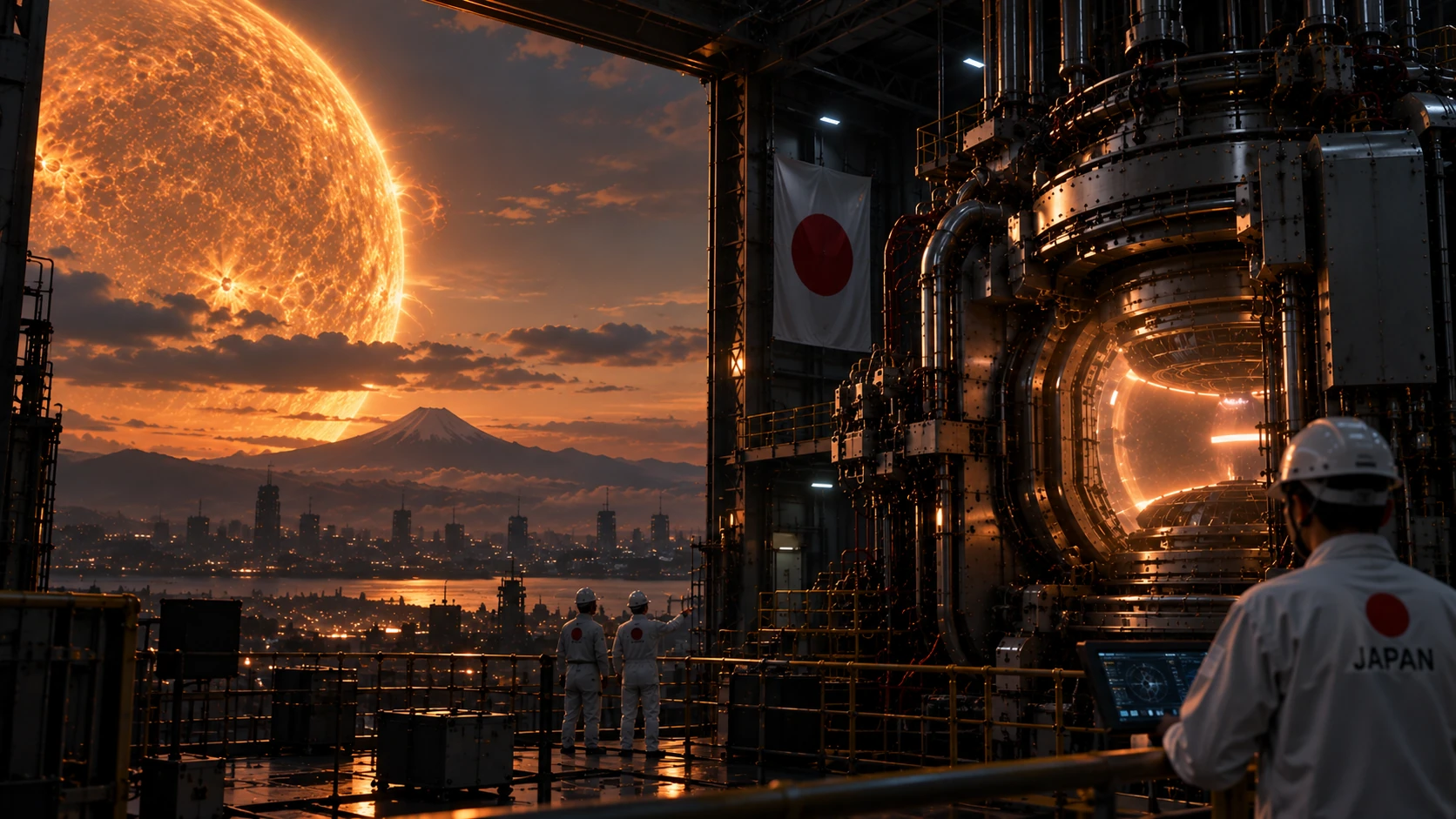
The hero image is an AI-generated conceptual illustration. It is not a photograph of HARUKA, KANATA or an existing Japanese fusion power station. This feature was checked against sources available on October 2, 2026; company schedules remain targets.
FAQ
Frequently Asked Questions
Has Japan built a commercial fusion reactor?
No. HARUKA is a technology-demonstration project. No commercially viable fusion power plant exists as of October 2, 2026.
When will Helix HARUKA start testing?
Helical Fusion targets Phase 1 magnet energization in 2027 and integrated testing around 2030. These are company targets, not completed milestones.
What is the difference between HARUKA and KANATA?
HARUKA is intended to demonstrate and integrate key technologies. KANATA is the planned larger machine intended to demonstrate net electricity, steady operation and maintainability.
Why use a helical reactor instead of a tokamak?
External helical coils can provide confinement without the large plasma current required by a conventional tokamak, making continuous operation attractive. Complex coils and demanding engineering remain trade-offs, and tokamaks also pursue steady operation.
PRESDA Dispatch
Stay Informed. Stay Aware.
A sharp briefing across AI, gaming, sport, business, world affairs, paparazzi, and lifestyle.