Can We Bring Extinct Animals Back to Life? The Science of De-Extinction
Reading ancient DNA and engineering lost traits are real scientific achievements. Restoring an extinct species and its place in nature is a much harder task.
De-extinction can recover genetic information and recreate some traits of extinct animals. It does not yet offer a general way to restore an original species, its diversity and its ecosystem. The central question is what has actually been produced: a DNA sequence, an edited cell, a living animal or a self-sustaining population.
The IUCN uses the term proxy for an organism intended to stand in for an extinct species. That distinction matters: resemblance, ancestry and ecological function are different measures of success. IUCN SSC: guidelines on proxies of extinct species
CLONING: COPYING A PRESERVED CELL
In somatic cell nuclear transfer, researchers place a body-cell nucleus into an egg whose nucleus has been removed. Development must then succeed in a compatible reproductive system. The starting material is a usable nucleus, not a computer file containing a genome. NHGRI: cloning fact sheet
A remarkable test involved the extinct Pyrenean ibex subspecies, or bucardo. A clone born in 2003 from preserved cells died minutes later with lung defects. The peer-reviewed report appeared in 2009. A live birth was achieved; a surviving population was not. Folch et al., Theriogenology (2009): cloned Pyrenean ibex
ANCIENT DNA: READING IS NOT RESURRECTION
Ancient DNA survives as damaged fragments that researchers sequence and assemble, often using living relatives as references. A 2021 Nature study recovered genomic data from mammoth specimens more than a million years old. These were sequences, not living mammoth cells. Nature (2021): million-year-old mammoth DNA
Think of the difference between recovering parts of an instruction manual and obtaining a working machine. Missing sequence, chromosome organisation and developmental context still matter. A genome reconstruction cannot simply be injected into an egg and expected to become the animal it describes.
CRISPR AND SELECTIVE BREEDING
CRISPR systems can direct enzymes to selected DNA sites. Researchers can disrupt genes or introduce specific changes, then test their effects. Editing a relative to express an extinct animal's traits changes that relative; it does not automatically reconstruct an entire extinct genome. NHGRI: how genome editing works
Selective breeding takes another route, choosing living animals with desired inherited traits over successive generations. Back-breeding can concentrate ancestral-looking features, as in cattle bred to resemble aurochs. It cannot recover genetic variants absent from the breeding population. Rewilding Europe: Tauros selective breeding programme
The methods can overlap: gene editing may change a donor cell, and cloning may then help produce an animal from it. Calling the result a clone does not mean its donor was an extinct animal. Ask which organism supplied the cells and which changes were introduced.
WOOLLY MAMMOTH: AN ELEPHANT WITH SELECTED TRAITS
Colossal describes its woolly mammoth de-extinction goal more specifically as a cold-resistant elephant with mammoth characteristics. Claims about restoring Arctic ecosystems and climate benefits are project ambitions, not demonstrated outcomes from released mammoth herds. Colossal: stated mammoth project objectives
A 2026 Cell Reports Methods paper reports multiplex-edited mice with altered coat traits. This is peer-reviewed evidence of trait engineering in mice. It does not demonstrate a mammoth birth, successful elephant gestation or the climate performance of a future animal. Cell Reports Methods (2026): multiplex editing in mice
Hair is only one part of cold adaptation. Development, physiology, reproduction and behaviour must work together. An animal that looks convincing in a photograph is not proof that these systems function safely across its lifetime.
DIRE WOLF: WHAT WAS ACTUALLY MADE?
Colossal's 2025 announcement described animals made using edited gray wolf cells and dog surrogates. Its methods page reports 20 edited sites across 14 genes. Those figures describe selected changes in a living species, not replacement with a complete ancient dire wolf genome. Colossal: reported dire wolf editing methods
Ancient DNA research also complicates the resemblance argument. A 2021 Nature paper identified a deeply divergent dire wolf lineage. Nature (2021): ancient dire wolf lineage
A peer-reviewed 2026 Cell Genomics paper, involving Colossal researchers, instead proposes mixed ancestry from two ancient canid lineages. That updates the evolutionary evidence; it does not show that edited gray wolves recreate the extinct lineage. The company label and that biological claim are not interchangeable. Cell Genomics (2026): dire wolf ancestry
DODO: THE CHALLENGE OF MAKING A BIRD
Colossal's dodo programme proposes engineering cells from its living relative, the Nicobar pigeon, and developing surrogate reproduction. Bird projects focus on primordial germ cells, precursors of eggs and sperm, rather than simply applying mammalian cloning to an egg. Colossal: dodo project and proposed germ-cell approach
A 2026 Journal of Heredity paper reports long-term culture of rock dove primordial germ cells. This is a useful reproductive research result, not the hatching of a dodo. Cell culture, inherited editing and production of a healthy bird are separate milestones. Journal of Heredity (2026): rock dove germ-cell culture
THYLACINE: A MARSUPIAL DEVELOPMENT PROBLEM
The University of Melbourne's TIGRR programme combines thylacine genome research with marsupial reproductive work. Its goal is to develop tools for both de-extinction and conservation. Understanding a living marsupial model is part of that programme, not proof that a thylacine has returned. University of Melbourne: TIGRR research programme
In May 2026, Colossal reported dunnart development across stages of an artificial-womb system. The company described progress toward complete development outside the uterus. That announcement should not be read as a verified thylacine birth or a completed artificial gestation system for every species. Colossal: May 2026 dunnart development update
PASSENGER PIGEON: RESTORING AN ECOLOGICAL ROLE
Revive & Restore proposes editing band-tailed pigeons to recover passenger-pigeon-like traits and forest functions. Its current programme page targets first new birds in the 2030s. That is a goal, not a hatch announcement; older dates circulating online should not be treated as achieved milestones. Revive & Restore: current passenger pigeon programme
A single bird cannot recreate the effects of an enormous flock. Population size, social behaviour, habitat and interactions with other species would all affect any ecological restoration. Demonstrating an inherited trait is only an early step toward that much larger objective.
WHAT COULD CONSERVATION GAIN?
The tools can help species that still exist. In 2024, the US Fish and Wildlife Service reported surviving offspring from Antonia, a cloned black-footed ferret created using banked tissue. This shows reproduction in a conservation-cloning programme, rather than resurrection of an extinct species. US Fish and Wildlife Service: cloned ferret offspring, 2024
Potential benefits include preserving genetic options and improving reproductive techniques. Success should be measured in healthy animals, useful genetic diversity and conservation outcomes, not only in the novelty of a birth. Protecting habitat remains essential to whatever population the technology helps create.
WELFARE, ECOLOGY AND THE ETHICAL DEBATE
Welfare assessment must include egg donors, surrogates, unsuccessful pregnancies and offspring, with lifelong care planned. Ecological assessment must address disease, competition, habitat suitability and the communities affected by a release. IUCN guidance treats conservation benefit and risk assessment as central requirements. IUCN: conservation translocation guidelines
There is also an opportunity cost. A peer-reviewed 2017 modelling study found that funding the conservation of resurrected species could reduce the number of living species protected under constrained budgets. Its result depends on funding assumptions; it is not a prediction that every project must harm conservation. Bennett et al. (2017): conservation funding trade-offs
The ethical choice is therefore broader than whether an experiment can work. Who decides which animal is made, who cares for it, and who bears the consequences of release? Supporters can reasonably value new tools, while critics ask whether the same resources would prevent more extinctions today.
HOW TO READ THE NEXT BREAKTHROUGH
Check the species supplying the cells, the changes made, the publication status and the outcome actually measured. A company announcement, a preprint and a peer-reviewed paper provide different levels of scrutiny. Even a strong paper supports its tested result, not every future application proposed around it.
As of October 2, 2026, the sources reviewed here do not establish restored wild populations of the five featured extinct animals. The evidence supports substantial technical progress, while the task of rebuilding viable populations and ecological relationships remains distinct.
For related context, explore human adaptation in the Bajau and Greenland's changing Arctic environment. Neither is evidence that a proposed de-extinction project has succeeded.
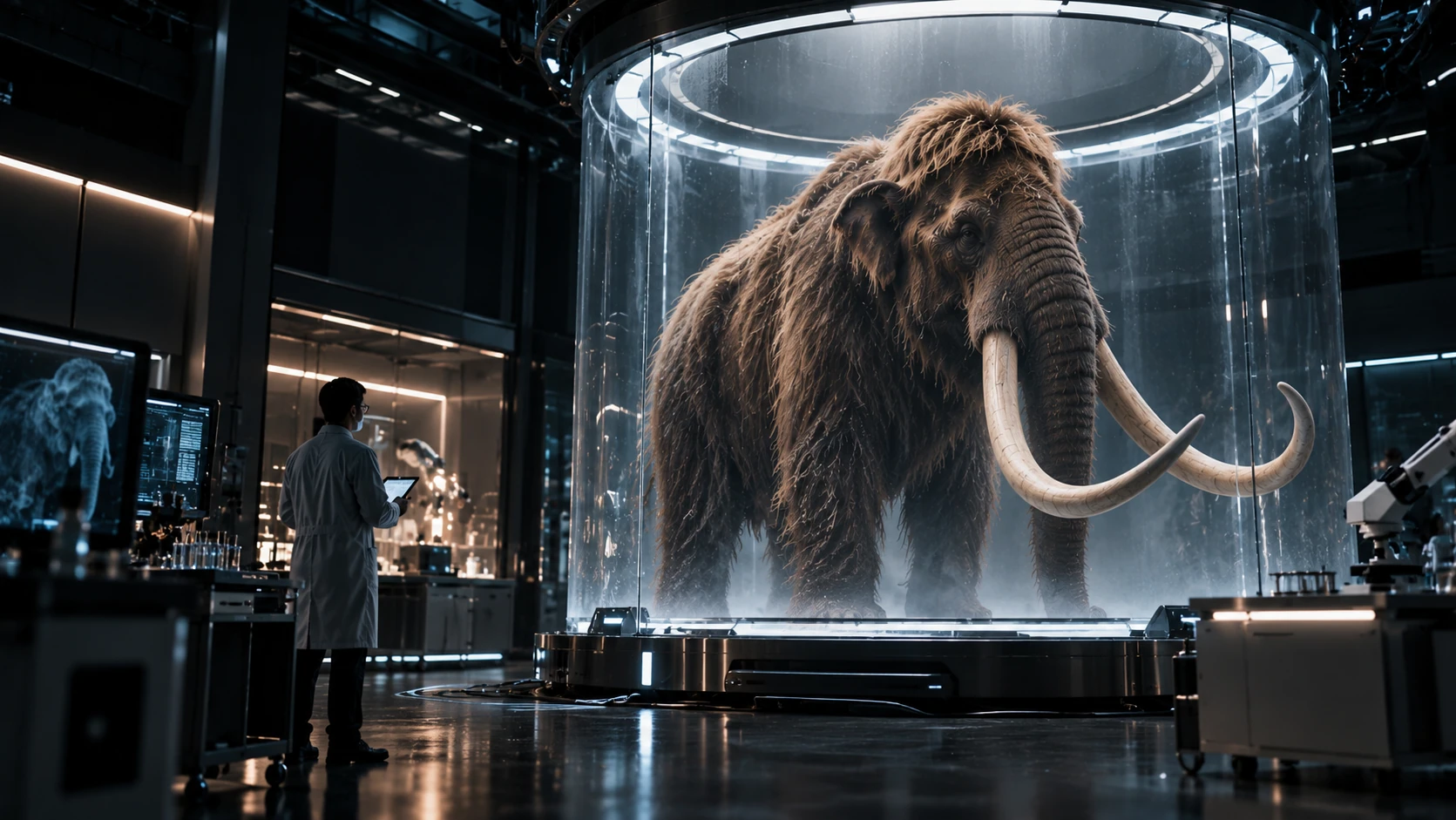
The hero is a conceptual illustration of a mammoth in a laboratory. It does not depict a real revived mammoth or a documented research facility.
FAQ
Frequently Asked Questions
What does de-extinction mean?
It describes attempts to recreate extinct animals or some of their traits and ecological functions, often through living relatives.
Has a woolly mammoth been brought back?
The sources reviewed for this article do not establish a living revived mammoth. Edited mice are not mammoths.
Are the edited dire wolves clones of ancient animals?
No. The reported process used living gray wolf cells with selected edits, not preserved dire wolf cells.
Can CRISPR restore an extinct species by itself?
No. Genome editing must be combined with successful development, reproduction and population management; it does not restore an ecosystem by itself.
PRESDA Dispatch
Stay Informed. Stay Aware.
A sharp briefing across AI, gaming, sport, business, world affairs, paparazzi, and lifestyle.