Greenland: Why the World’s Powers Are Competing for the Arctic Island
A new US security agreement puts Greenland at the center of Arctic strategy. Military access, mineral ambitions and changing seas meet a people's right to decide their future.
Greenland matters because it sits between North America, the Arctic Ocean and the North Atlantic. Its location supports missile warning and military access; its geology attracts interest in critical minerals; and retreating sea ice is changing the waters around it. But Kalaallit Nunaat, Greenland's own name, is also a society with elected institutions and a legally recognized right to self-determination. It cannot be understood simply as a strategic asset on somebody else's map.
On September 22, 2026, Greenland's Prime Minister Jens-Frederik Nielsen, Denmark's Prime Minister Mette Frederiksen and US President Donald Trump signed a new security agreement at the United Nations in New York. It provides for a stronger American military presence while recognizing the Kingdom of Denmark's sovereignty and Greenlanders' right to determine their future. Signing is not the same as completing the parliamentary procedures required for entry into force. Danish Prime Minister's Office: agreement signed, September 22, 2026
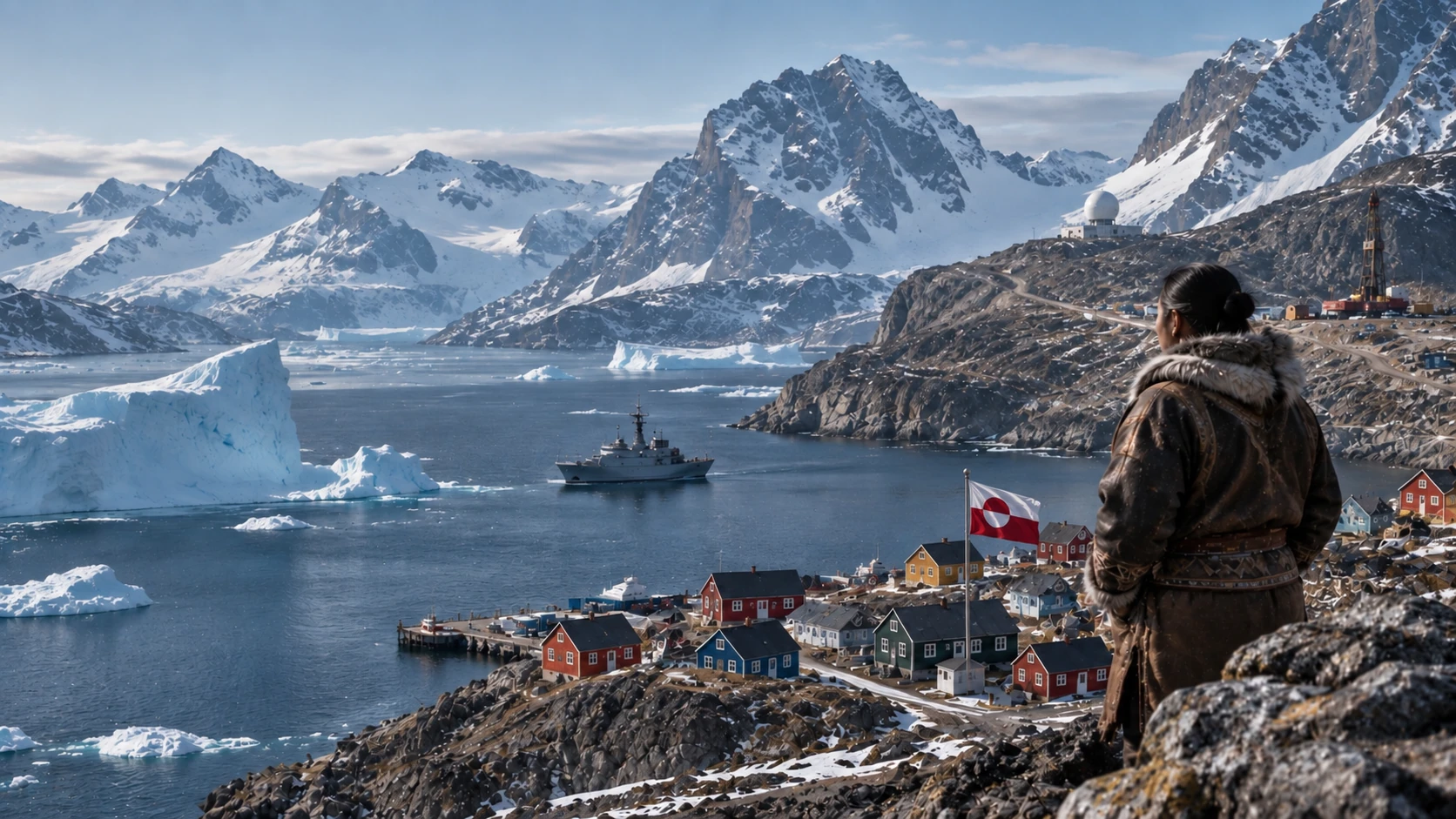
This article reflects information verified as of October 1, 2026. Dates distinguish announcements, signed commitments and reported implementation. The opening image is an editorial illustration, not documentary evidence of a particular settlement, military deployment or base.
WHY GREENLAND'S LOCATION MATTERS
Look at the Arctic from above the North Pole rather than through a conventional world map. The northern approaches connect the North American and Eurasian continents, while Greenland anchors one side of the North Atlantic. For military planners, this is a region where warning systems, air access, maritime surveillance and reinforcement routes meet. NATO describes the Arctic as a gateway containing important transport, trade and communications links between North America and Europe. NATO: Arctic security and Arctic Sentry, updated July 24, 2026
The Greenland–Iceland–UK gap, usually shortened to GIUK, is the stretch of seas between those land masses. Monitoring it helps protect the Atlantic connections on which European and North American security depends. Britain's September 2026 account of operations on Norway's Jan Mayen island explicitly identifies the waters north of this gap as strategically important. Greenland's value therefore extends well beyond its coastline: it forms part of a larger network of islands, airfields, sea lanes and sensors. UK Ministry of Defence: Operation Atlantic City, September 6, 2026
Geography does not, however, settle sovereignty. An ally can obtain access through agreements without acquiring the territory itself. That distinction is central to understanding both the long US military presence and the dispute over Trump's demands for Greenland. PRESDA's history of the United States as a global power provides the wider historical context.
THE SEPTEMBER 2026 SECURITY AGREEMENT
The new agreement amends and supplements the 1951 defence arrangements. Its military provisions allow expansion at Pituffik and additional defence areas at Narsarsuaq and Mestersvig, with technical details to be agreed. Further defence areas require proposals and consultations; requests for unmanned installations outside them receive accelerated approval procedures. These provisions describe an agreed framework, not proof that new bases are already built. Primary text: US, Denmark and Greenland security agreement, September 22, 2026
It also restricts persistent military deployments by non-NATO states unless the parties agree otherwise. For sensitive investment, Article X covers states and investors outside NATO members, NATO partners and EU members, subject to an agreed exception where activities would not threaten national security or public order. Sensitive sectors include critical infrastructure and resource extraction. This is not a blanket ban on every foreign investment. Primary text: US, Denmark and Greenland security agreement, September 22, 2026
The text has no end date and provides for amendment by mutual consent. Entry into force depends on a diplomatic note notifying Washington that Denmark and Greenland have completed the necessary parliamentary procedures. The verified signing announcement and September 29 parliamentary briefing do not establish that those procedures were completed by this article's cutoff. House of Commons Library: the new Greenland agreement, September 29, 2026
Confirmed provisions and political descriptions
Trump described the emerging deal as giving Washington permanent control over Greenland's security. Denmark and Greenland said sovereignty would not be ceded. Those are attributed political positions, not interchangeable legal descriptions. Reuters reported the disagreement before the signed text was published; the subsequent document and official signing statement are the basis for describing what the parties actually agreed. Reuters: Denmark and Greenland reject ceding sovereignty, September 19, 2026
The September 22 announcement expressly recognizes Danish sovereignty and territorial integrity and the Greenlandic people's right to self-determination. There was no announced transfer of Greenland to the United States. Expanded military access should therefore not be reported as an American purchase or annexation. Danish Prime Minister's Office: agreement signed, September 22, 2026
PITUFFIK: MISSILE WARNING AT THE TOP OF THE WORLD
Pituffik Space Base, formerly Thule Air Base, is an existing US installation in northwestern Greenland. The United States renamed it in April 2023 to reflect Greenlandic cultural heritage and its space mission. The name change did not create the base or begin American involvement on the island. US Space Force: Thule renamed Pituffik, April 2023
The 12th Space Warning Squadron operates an Upgraded Early Warning Radar there. According to the US Space Force, its missions include missile warning, missile defence support and space domain awareness. The radar supplies detection and assessment data concerning intercontinental and sea-launched ballistic missiles threatening the United States or Canada; it also supports tracking of objects in orbit. US Space Force: 12th Space Warning Squadron mission
These functions need careful wording. Providing warning and tracking data is not the same as physically intercepting a missile. Pituffik is one part of a wider defence network. Nor should today's radar mission be confused with a completed new missile shield: the 2026 agreement's preamble references the proposed US Golden Dome system, but that reference does not demonstrate that such a system has been installed in Greenland. House of Commons Library: the new Greenland agreement, September 29, 2026
RUSSIA, CHINA AND THE LIMITS OF THREAT CLAIMS
Russia is an Arctic state with substantial military interests in the region. NATO identifies reopened and new military sites, airfields, ports and weapons development as reasons for its increased attention. It also identifies closer Russian–Chinese cooperation as a planning concern. These are NATO's assessments of the wider Arctic security environment, and should be presented as such. NATO: Arctic security and Arctic Sentry, updated July 24, 2026
That wider competition does not verify every claim about Greenland itself. On January 16, 2026, Danish Joint Arctic Command chief Major General Søren Andersen told Reuters that Russian and Chinese ships operated in the Arctic Ocean but that his command was not seeing them around Greenland. His statement directly challenged the picture of hostile ships massing around the island. It is a dated observation, not a guarantee about every later movement or an assertion that surveillance reveals every submarine. Reuters: Danish Arctic commander on Russian and Chinese ships, January 16, 2026
Russia disputed NATO's depiction of a Russian and Chinese threat to Greenland in January and criticized the alliance's Arctic activity. That response is Moscow's political position; it does not independently establish the intentions of either government. A responsible account separates documented capabilities, dated observations and each side's public claims. Reuters: Russia disputes NATO's Greenland threat assessment, January 15, 2026
China's interests are broader than military bases
China's 2018 Arctic policy white paper describes the country as a near-Arctic state and promotes a Polar Silk Road. Those are Beijing's own policy terms. The document emphasizes scientific research, shipping, resources and participation in Arctic governance. It is evidence of declared interests, not a title to Greenland or proof of a plan to seize it. China's State Council: Arctic policy white paper, 2018
Mineral supply chains give this competition an economic dimension. Reuters reported in May 2026 that the United States and its allies were seeking alternatives to China's strong position in rare-earth processing. Greenlandic deposits attract attention partly because diversification requires sources of material as well as the ability to process it. The existence of a deposit does not resolve either commercial or industrial bottlenecks. Reuters: Tanbreez and REalloys offtake agreement, May 21, 2026
PRESDA's US–China technology competition explainer examines another part of this contest over strategic capabilities. Greenland's case adds a distinct question: how foreign investment and security screening interact with local control over development.
NATO, THE UK AND DENMARK'S ARCTIC DEFENCE
NATO launched Arctic Sentry in February 2026 to coordinate and strengthen allied activities in the Arctic and High North. It is led by Joint Force Command Norfolk. Seven of the eight Arctic states are now NATO allies, following Finland's and Sweden's accession; Russia is the exception. The alliance's growing regional presence should not be mistaken for a change in Greenland's ownership. NATO: Arctic security and Arctic Sentry, updated July 24, 2026
A recent example of British involvement is Operation Atlantic City, conducted on Jan Mayen from August 26 to September 4, 2026. The UK Ministry of Defence reported that RAF personnel and commandos worked with Norwegian and American forces on sensors and communications as part of Arctic Sentry. This exercise took place on a Norwegian island, not on Greenland. UK Ministry of Defence: Operation Atlantic City, September 6, 2026
Denmark has also committed to stronger regional capabilities. Its October 2025 second Arctic and North Atlantic agreement set out DKK 27.4 billion in planned acquisitions, including additional Arctic vessels, maritime patrol aircraft capability, drones, an East Greenland air-surveillance radar and a new Joint Arctic Command headquarters in Nuuk. Procurement commitments must be distinguished from equipment already delivered and operational. Danish Ministry of Defence: second Arctic investment agreement, October 10, 2025
On September 28, 2026, Danish Defence Minister Jeppe Bruus told Reuters that Copenhagen wanted the increased NATO presence to last and hoped Arctic Sentry would become permanent. He expressed confidence in continuing allied interest. That is a current Danish objective and assessment, not confirmation that NATO has adopted an indefinite deployment schedule. Reuters: Denmark seeks lasting NATO presence, September 28, 2026
RARE EARTHS: REAL RESOURCES, DIFFICULT PROJECTS
Greenland's geological potential is substantial, but mineral headlines often skip the hardest distinction: a resource in the ground is not a commercially operating mine. GEUS, the Geological Survey of Denmark and Greenland, identifies occurrences of 24 of the 34 materials on the EU critical-raw-materials list. Its overview also cautions that shrinking land ice will not soon expose extensive new areas for exploration. Reduced sea ice may instead change transport access. GEUS: mineral resources in Greenland, official overview
Rare earths are only one part of the critical-minerals picture. Their importance comes from specialized industrial uses and concentrated supply chains. For Greenland, the practical questions include permissions, finance, infrastructure, processing and the local effects of extraction. Counting mineral occurrences answers a geological question; it does not establish how much material can be recovered profitably or when exports will begin.
Tanbreez and Kuannersuit illustrate different outcomes
In May 2026, Critical Metals announced a binding 15-year agreement for REalloys to buy 15 percent of annual rare-earth concentrate output from its Tanbreez project. Reuters reported the agreement and Greenland's earlier approval for Critical Metals to increase its ownership to 92.5 percent. The announcement concerned future supply and the project's progress toward production, not evidence that the contracted volumes had already been shipped. Reuters: Tanbreez and REalloys offtake agreement, May 21, 2026
Kuannersuit, also known as Kvanefjeld, has faced a different path. Reuters reported on June 26, 2026 that Greenland rejected the developer's application to renew its exploration licence. The 2021 uranium ban had already halted development of the rare-earth project, whose deposit also contains uranium. This is a concrete reminder that Greenlandic environmental choices and law can block a project despite outside demand for its minerals. Reuters: Greenland rejects Kuannersuit exploration licence renewal, June 26, 2026
Neither project justifies treating Greenland as a ready-made replacement for existing global supply. Security agreements, offtake contracts and geological estimates describe different stages of a process. They should not be added together and presented as completed mining capacity.
MELTING ICE AND ARCTIC SHIPPING ROUTES
The climate signal is clear, but individual years still vary. On September 23, 2026, the National Snow and Ice Data Center reported a likely annual Arctic sea-ice minimum of 4.60 million square kilometres, reached on September 12. It tied for tenth lowest in the satellite record. NSIDC described the finding as preliminary and noted that the lowest 20 annual minima all occurred within the last 20 years. NSIDC: preliminary 2026 Arctic sea-ice minimum, September 23, 2026
Arctic shipping is already increasing. PAME, the Arctic Council's marine working group, counted 1,812 unique ships entering the Arctic Polar Code area in 2025, 40 percent more than in 2013. Distance sailed increased by 95 percent over that period. These figures cover activity across the defined Arctic area; they are not a count of container ships making complete journeys between Europe and Asia. Arctic Council/PAME: 2013–2025 shipping trends, February 12, 2026
China's Arctic white paper distinguishes the Northeast Passage, Northwest Passage and routes across the central Arctic Ocean. These are different corridors, not one continuous Greenland-controlled shortcut. Interest in them helps explain attention to the broader region, but Greenland does not control all Arctic navigation simply because it is the world's largest island. China's State Council: Arctic policy white paper, 2018
Less ice does not make navigation straightforward. The International Maritime Organization identifies cold, remoteness, limited charts and communications, and the difficulty of rescue and pollution response as particular polar hazards. Its Polar Code addresses ship design, equipment, operations, training and environmental protection. Commercial decisions must account for these demands; a shorter line on a map is not proof of a reliable, cheaper year-round service. International Maritime Organization: Polar Code and operating risks
It is also essential to distinguish floating sea ice from Greenland's land-based ice sheet. Shipping statistics describe voyages at sea; mineral access concerns the geology and terrain on land. Treating all melting ice as one process produces misleading claims about both new transport routes and an imminent mining bonanza.
HOW GREENLAND AND DENMARK BECAME CONNECTED
Greenland's history long predates the modern Danish state. Inuit communities and earlier migrations belong at the center of the island's story; Norse settlement is another chapter. Danish–Norwegian missionary and colonial activity intensified with Hans Egede's arrival in 1721. Greenland remained under Danish colonial administration until its formal incorporation into the Danish realm in 1953. Danish Ministry of Foreign Affairs: Greenland history and culture
Formal constitutional change did not erase unequal relationships or make local consent automatic. Home rule followed in 1979, and a broader self-government arrangement took effect on June 21, 2009. These dates mark distinct changes in political authority, rather than a single moment when every function passed from Copenhagen to Nuuk. Danish Ministry of Foreign Affairs: Greenland history and culture
Today, Greenland has its own parliament, Inatsisartut, and government, Naalakkersuisut. Greenlandic is the official language. Denmark retains responsibility for areas including defence, security and monetary policy, while Greenland administers transferred responsibilities. Control of mineral resources passed to Greenland in January 2010. Describing the island merely as property owned by Denmark obscures these institutions and the rights recognized in the self-government settlement. Danish Prime Minister's Office: Greenland's self-government arrangements
SELF-GOVERNMENT AND THE INDEPENDENCE DEBATE
The 2009 Self-Government Act recognizes Greenlanders as a people with a right to self-determination. Under Section 21, a decision to seek independence belongs to the people of Greenland. Negotiations then follow between the governments, and an independence agreement requires Greenlandic parliamentary consent, a referendum in Greenland and consent from Denmark's parliament. Independence is therefore a defined political and legal process, not an automatic consequence of an election or a foreign leader's demand. Primary law: Act on Greenland Self-Government, 2009
The debate is also about timing and economic capacity. Nielsen's Demokraatit party won the March 2025 election while advocating a gradual approach; Naleraq favored a faster path. Reuters described that disagreement as central to the campaign. Support for eventual independence should not be confused with support for becoming American, nor should Greenlanders be presented as holding a single view. Reuters: Greenland's independence gradualists win the 2025 election
Statistics Greenland's published economic overview identifies fish and seafood as central exports and records Denmark's substantial annual block grant. That structure helps explain why public services, employment and future revenue matter in the debate. Mineral development is one possible source of diversification, but prospective mine income cannot be treated as revenue already available to fund an independent state. Statistics Greenland: Greenland in Figures 2025
The September 2026 security agreement also addresses potential independence: Denmark and Greenland are to ensure that an independent Greenland assumes the defence obligations and agrees to remain in NATO, applying for membership if necessary. This provision seeks continuity in security arrangements; it does not announce that independence has occurred or set a date for it. House of Commons Library: the new Greenland agreement, September 29, 2026
THE IUD SCANDAL AND DENMARK'S 2025 APOLOGY
The IUD scandal, known in Danish as spiralsagen, concerns contraception imposed on Greenlandic women and girls without informed consent. IUDs are contraceptive devices placed in the uterus. The historical investigation also covered other contraceptive practices and Greenlandic pupils at schools in Denmark. The issue is the denial of bodily autonomy, not contraception chosen freely.
An independent investigation released on September 9, 2025 examined the period 1960–1991. The University of Greenland says 354 women contributed personal accounts and describes a research team working across Greenlandic and Danish institutions. That is the number of women who gave accounts to the investigation, not a complete count of everyone affected. University of Greenland: independent IUD investigation, September 9, 2025
The harm cannot be reduced to a dispute over paperwork. In her September 24 apology speech in Nuuk, Frederiksen acknowledged non-consensual contraception, the use of devices intended for adults on girls, and discrimination against people because they were Greenlanders. She explicitly connected acknowledgment of this history with trust in the present relationship between Greenland and Denmark. Primary speech: Denmark's apology in Nuuk, September 24, 2025
The public apology had two stages that are sometimes conflated: Denmark and Greenland issued a joint apology on August 27, 2025; the ceremony with survivors in Nuuk followed on September 24. Greenland's assumption of healthcare responsibility in 1992 is also important when distinguishing the periods covered by subsequent redress arrangements. Associated Press: joint apology announced August 27, 2025 Patienterstatningen: applications opening July 1, 2026
Compensation: what is verified as of October 1, 2026?
The Danish scheme accepts claims for non-consensual contraception during 1960–1991 in Greenland or Denmark. Applications opened on July 1, 2026, and the scheme came into force on September 1. On September 4, Patienterstatningen, the patient compensation authority, announced awards to the first four women. The award is DKK 300,000 per eligible woman. Patienterstatningen: first four compensation awards, September 4, 2026 Patienterstatningen: applications opening July 1, 2026
Its September 30, 2026 update records 627 applications: 138 approved, four rejected and 485 awaiting decisions. All four rejections concerned women already compensated through settlements with the state. These are application and decision totals, not a verified tally of completed bank payments. The authority says the ministry pays compensation within five weeks of a decision. Patienterstatningen: compensation rules and September 30, 2026 case totals
Applications remain open through September 1, 2028. The authority assesses eligibility individually, including the account of contraception without consent and the relevant connection to Greenland. Its guidance distinguishes this Danish scheme from Greenland's separate arrangement concerning events from 1992 onward. Receiving the full Danish award through an earlier state settlement does not entitle someone to another award for the same covered period. Patienterstatningen: compensation rules and September 30, 2026 case totals
The estimated number potentially eligible is another distinct measure. In June 2026, the authority cited the ministry's estimate of approximately 4,500 women. That estimate, the investigation's 354 participants and September's application totals describe different populations. None should be substituted for another. Patienterstatningen: applications opening July 1, 2026
WHAT THE COMPETITION MEANS FOR GREENLANDERS
Greenland's international importance is established by its position, its existing defence role and the policies and agreements surrounding it. What remains contingent is implementation: parliamentary steps, the details of new defence areas, the delivery of capabilities, the progress of individual mines and the resolution of compensation applications.
The island's future cannot be explained by military competition alone. Sovereignty involves elected government; resource development involves local choices; and trust between Greenland and Denmark involves confronting abuses against real people. Reading the security agreement alongside the self-government law and the compensation record makes that distinction visible. Greenland is a participant in these decisions, with institutions and rights of its own.
FURTHER READING ON PRESDA
For broader historical context, read how the United States became a global superpower, the rise and fall of the Russian Empire and Sweden's history as a European power. These background articles do not substitute for the dated primary sources and reporting used for current Arctic developments below.
FAQ
Frequently Asked Questions
Is Greenland part of the United States?
No. As of October 1, 2026, Greenland remains a self-governing part of the Kingdom of Denmark. The September security agreement provides for expanded US military access, not a transfer of sovereignty.
Why is Pituffik Space Base important?
Its radar supports warning and assessment of ballistic missile launches threatening North America, missile defence and tracking of objects in space. Warning and tracking are distinct from intercepting a missile.
Can Greenland become independent?
The 2009 Self-Government Act provides a process involving a decision by Greenlanders, negotiations, parliamentary consent and a referendum. The September 2026 security agreement addresses continuity of defence obligations if independence occurs.
How much is compensation in the Greenland IUD case?
The Danish scheme provides DKK 300,000 per eligible woman for the covered 1960–1991 period. Its September 30, 2026 update lists 138 approved applications, four rejected and 485 pending. Approval totals are not the same as completed payments.
PRESDA Dispatch
Stay Informed. Stay Aware.
A sharp briefing across AI, gaming, sport, business, world affairs, paparazzi, and lifestyle.