RUSSIAN EMPIRE: HOW THE TSARS BUILT ONE OF THE LARGEST EMPIRES IN HISTORY
From Moscow’s tsars to St. Petersburg’s palaces, the story of imperial expansion, unequal lives, ambitious reforms and the crises that brought down the Romanovs.
The Russian Empire formally existed from 1721, when Peter the Great took the title of emperor, until the fall of the monarchy in 1917. Its foundations were older: the princes of Moscow had consolidated territory, Ivan IV had been crowned tsar in 1547, and the Romanov dynasty had taken power in 1613. Over centuries, conquest, settlement, diplomacy and taxation connected an immense, diverse territory across Europe and Asia.
From St. Petersburg, imperial power could look like a palace reflected in the Neva. From a Siberian community required to supply furs, a village tied to a landlord, or a factory district short of bread, it looked different. The history of the Russian Empire lies in the relationship between those worlds: extraordinary territorial reach and persistent difficulty governing the people within it.
Its rulers built armies, institutions and cities that changed Eurasia. Their achievements depended on labor, taxes and coercion, while their subjects made cultures and communities that cannot be reduced to the lives of the tsars. This is the story of how that system grew, adapted and ultimately broke.
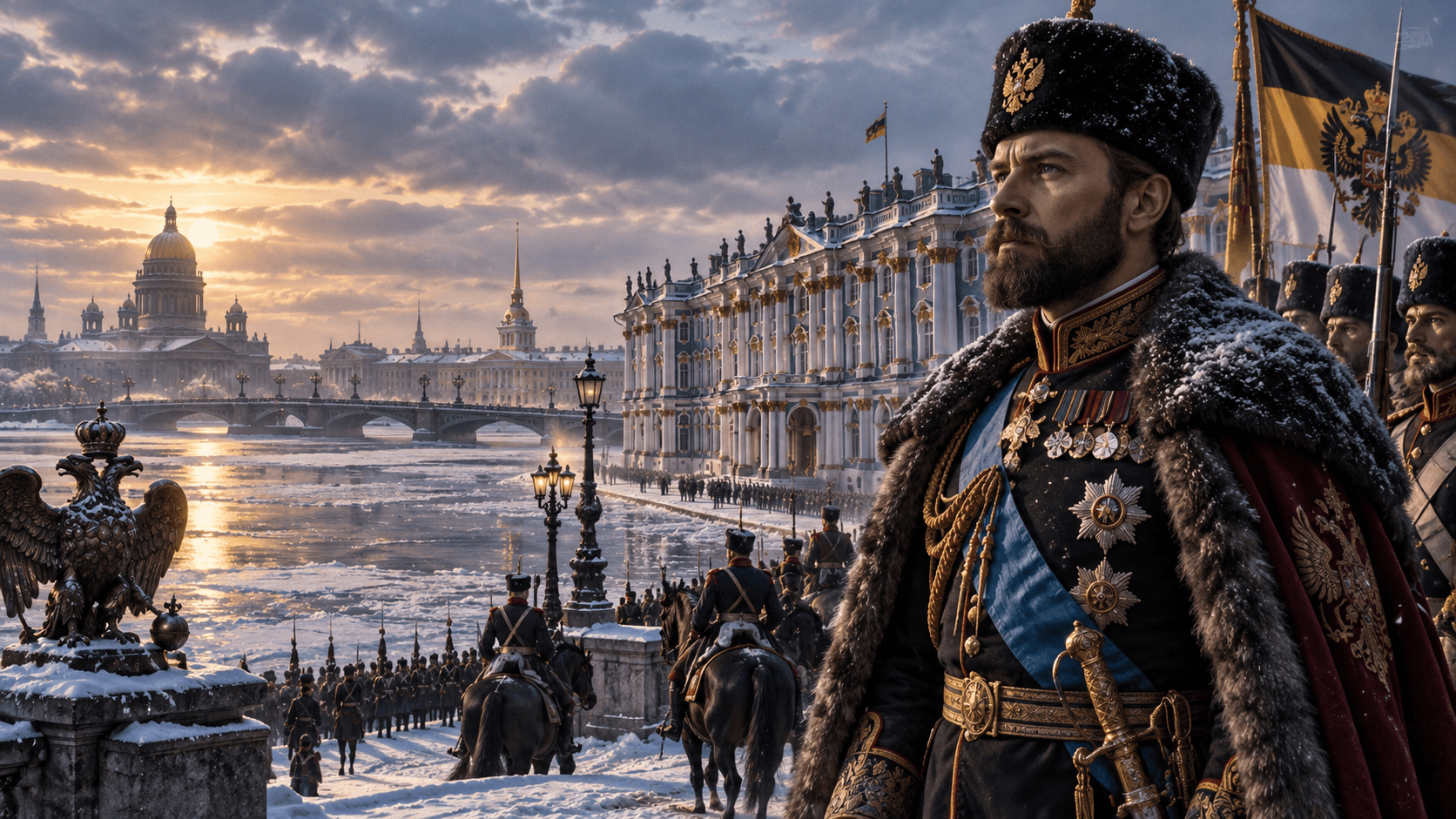
The supplied hero is an imaginative editorial illustration of imperial Russia and St. Petersburg. It is not an authenticated portrait of a particular tsar or a reconstruction of one historical occasion.
HOW DID RUSSIA BECOME AN EMPIRE?
Russia became an empire through a long process of territorial consolidation before adopting the formal imperial title in 1721. Moscow rose among the principalities of medieval Rus' under Mongol overlordship, then extended its own authority over neighboring lands. That history involved negotiation and service to more powerful rulers as well as warfare. PRESDA's history of the Mongol Empire explains the wider Eurasian setting.
Ivan IV's coronation in 1547 established the Tsardom of Russia. His conquest of Kazan in 1552 expanded Moscow's power along the Volga and incorporated populations with different languages and religious traditions. Imperial diversity therefore preceded Peter's European-style title. Ivan's reign also demonstrated the violence of personal rule, particularly through the confiscations and terror associated with the oprichnina. Library of Congress Country Study: Muscovy
The Romanovs inherited a damaged state
Dynastic conflict, famine and foreign intervention made the early seventeenth century a period remembered as the Time of Troubles. Michael Romanov's selection as tsar in 1613 began a new dynasty, not a new country. The Romanovs inherited both ambitions for expansion and the immediate task of restoring government. Their dynasty remained on the throne until Nicholas II's abdication in 1917. PBS, Russian Archives Online: Romanov family history
The distinction matters when reading dates. The Tsardom, the Romanov dynasty and the Russian Empire overlap, but they are not interchangeable labels. Nor should medieval Rus' be treated as a modern nation-state with today's borders. Later rulers used claims about inheritance and religion to justify authority over territories whose inhabitants had their own political histories.
PETER THE GREAT: WAR, REFORM AND A NEW CAPITAL
Peter the Great strengthened Russia as a European military power through war, naval development and administrative reform. Victory over Sweden in the Great Northern War, which ended in 1721, secured important Baltic territories. Peter then assumed the imperial title. His victory at Poltava in 1709 had been a major turning point, but the war continued for years afterward. Library of Congress Country Study: Early Imperial Russia
His interest in foreign expertise was practical. During his visit to England in 1698, he studied shipbuilding and naval organization. The Royal Collection's account places that journey within his broader effort to acquire technical knowledge. Learning from other states did not mean accepting limits on his own power: imported skills could serve an autocratic government. Royal Collection Trust: Peter the Great
Peter reorganized military and civil service, and his Table of Ranks of 1722 linked advancement to service within an official hierarchy. Reform demanded recruits, revenue and work from the population. The state's greater capacity was therefore also a greater capacity to extract resources. Modernization did not automatically mean freedom for the people who financed it.
Why build St. Petersburg?
Founded in 1703, St. Petersburg made Russia's Baltic ambitions visible. Its location offered a connection to European maritime routes, while its planned streets, waterways and monumental buildings expressed the authority of a ruler determined to create a new political center. UNESCO describes the city as a major planned urban achievement developed under Peter and his successors. UNESCO: Historic Centre of Saint Petersburg
The city seen today is not simply Peter's city preserved intact. Later monarchs, architects and generations of workers produced its palaces and ensembles. Its beauty invites admiration, but a capital's architecture is also evidence of concentrated power: decisions about labor, resources and public space were made on a scale ordinary subjects could rarely influence.
CATHERINE THE GREAT: ENLIGHTENMENT AND EXPANSION
Catherine II ruled from 1762 to 1796. She cultivated the language of Enlightenment reform and corresponded with European intellectuals, yet preserved autocracy and the privileges on which her rule depended. Historian Andrew Kahn's British Academy account emphasizes this tension between her cultivated public image, ambitious government and the harsh social order beneath it. British Academy: Catherine the Great and imperial Russian history
Her reign brought expansion toward the Black Sea and into the lands of the Polish-Lithuanian Commonwealth. Crimea was annexed in 1783. The partitions of Poland in 1772, 1793 and 1795 enlarged Russia's western territories and helped destroy the Commonwealth as an independent state. These gains brought more people under imperial authority rather than creating a culturally uniform country. UCL Press: Reconnoitring Russia
The relationship with the Ottoman Empire was central to southern expansion. Ports, military access and control of borderlands mattered alongside religious and dynastic claims. An imperial map can make these changes look inevitable; for communities whose sovereignty or livelihoods changed, they were disruptive political events.
Catherine's reputation as an enlightened ruler should not conceal the limits of reform. Noble privileges remained fundamental, and serfdom endured. The contradictions were structural: a monarch could value education and administrative improvement while refusing changes that threatened the social groups supporting the throne.
HOW DID RUSSIA BECOME SO LARGE?
Russia's size resulted from successive advances on different frontiers, not one conquest or a single master plan. Fur wealth helped drive movement into Siberia; military rivalry and settlement shaped other regions. Local commanders, merchants, Cossacks, officials and settlers all played roles. Authority often spread unevenly, with a fort or tribute demand preceding effective control of an entire territory.
Siberia: furs, forts and Indigenous resistance
In seventeenth-century Siberia, valuable pelts drew traders and armed expeditions eastward. Historian Janet Hartley describes a chain of forts and stockades followed by officials collecting tribute from Indigenous peoples. That tribute, often paid in furs, could be extracted through violence. Siberia was neither empty land nor a frontier acquired exclusively through peaceful trade. Janet M. Hartley, Yale University Press: Traders and Tribute-Takers
A claim on a map could be much stronger than government on the ground. Distances, local resistance and dependence on Indigenous knowledge complicated imperial control. Remembering those limits makes expansion more intelligible: the empire grew through relationships that could include exchange and cooperation, but also unequal demands and force.
The Caucasus and Central Asia
Expansion in the Caucasus involved prolonged warfare against societies that resisted Russian domination. The final campaigns against western Circassian communities in the 1860s culminated in mass expulsion and flight toward the Ottoman Empire. Scholarship treats this displacement as a central consequence of conquest, not a minor footnote to border changes. Exact population and death estimates require careful definition and remain difficult to establish. International Journal of Middle East Studies: Muslim displacement from the Russian Empire
In Central Asia, nineteenth-century Russian expansion combined campaigns, annexations and unequal relationships with surviving local rulers. Alexander Morrison's archival history cautions against reducing this process to a simple contest with Britain or a single economic motive. Decisions emerged from regional conflicts, military ambitions and changing calculations within the empire. Alexander Morrison, Cambridge University Press: The Russian Conquest of Central Asia
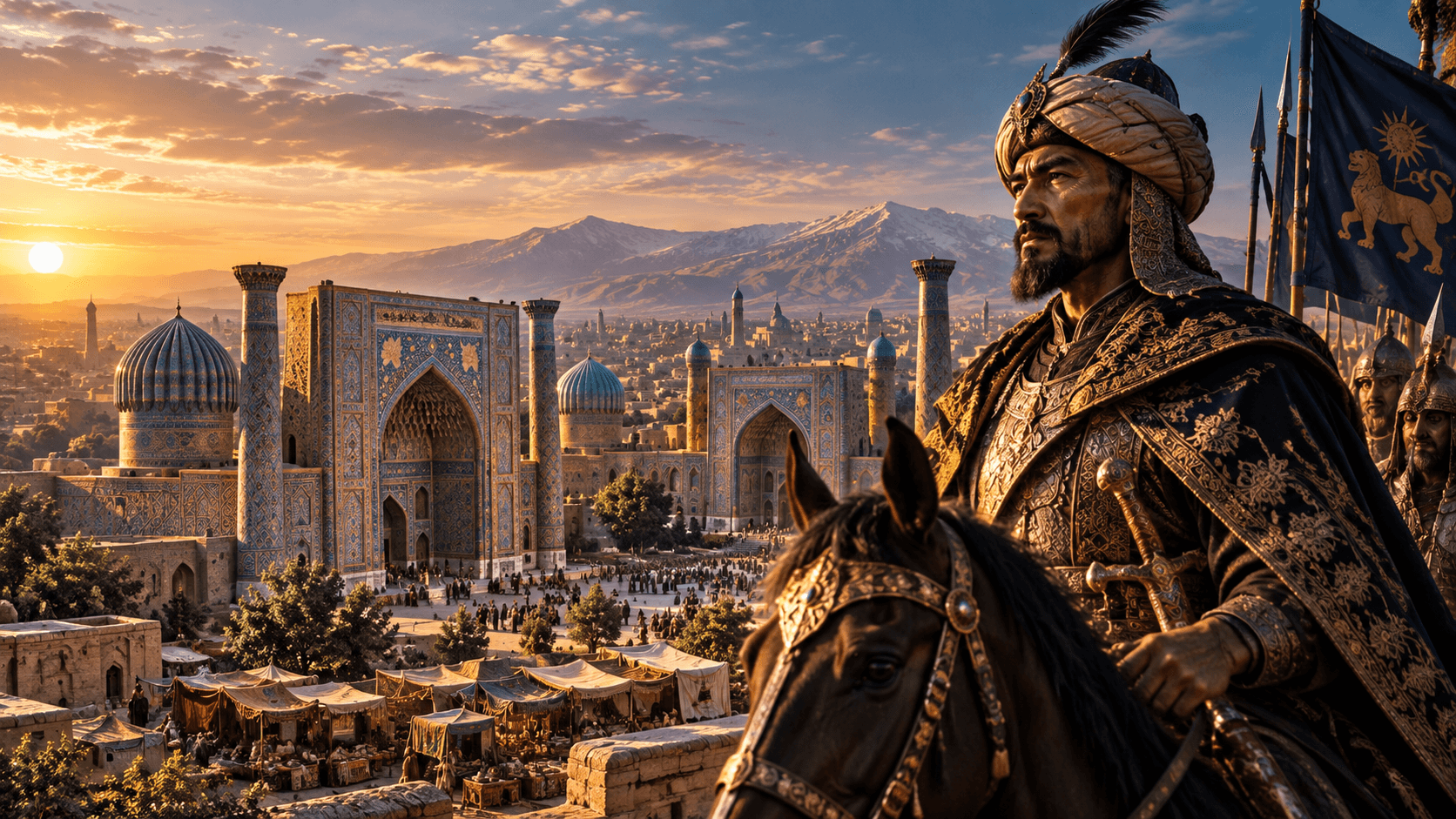
These regions had sophisticated political and urban histories before Russian rule. Samarkand, for example, had been the capital of Timur centuries earlier. PRESDA's Timurid Empire history provides that earlier context. Conquest added another chapter; it did not begin the history of Central Asia.
An empire that also crossed an ocean
Russian expansion reached Alaska through maritime exploration and the fur trade. The Library of Congress documents how traders relied on and exploited Native maritime skills in obtaining valuable pelts. This history complicates the familiar contrast between Russia's land empire and other powers' overseas colonies. Library of Congress: Crown and Commerce in Russian America
Russia sold Alaska to the United States in 1867. Territorial growth was therefore not uninterrupted, and imperial governments could relinquish possessions as well as acquire them. The transaction transferred a colonial claim between states; it did not erase the interests or rights of the Indigenous peoples already living there. Library of Congress: The Alaska Purchase
NAPOLEON'S INVASION: WHY DID THE 1812 CAMPAIGN FAIL?
Napoleon invaded Russia in June 1812 during Alexander I's reign. His army advanced across enormous distances while Russian forces withdrew and resisted. The campaign's central problem was political as well as military: Napoleon needed a decisive result that would force the tsar to negotiate. Occupying territory did not guarantee that result. Fondation Napoléon: From the Niemen to Moscow
After the battle of Borodino, the French entered Moscow in September. The city suffered devastating fires, but Alexander did not offer the settlement Napoleon sought. Holding Moscow left the invaders far from secure supply arrangements and without a clear way to turn possession of the city into victory.
The retreat began in October. Hunger, disease, exhaustion, losses among horses, Russian attacks and worsening weather combined to destroy the army's effectiveness. Severe cold magnified an existing disaster; it did not create all the campaign's problems at once. The familiar story of an army defeated only by winter overlooks the damage already done before the coldest conditions. Fondation Napoléon: The Russian campaign retreat
Russia emerged from the Napoleonic struggle as a major arbiter of European affairs. Yet battlefield prestige did not solve the empire's internal problems. Military strength could coexist with social restriction, uneven infrastructure and unresolved arguments about how far rulers should permit reform.
LIFE UNDER THE TSARS: WHOSE RUSSIA?
There was no single experience of imperial life. A noble family, a peasant household, a Jewish merchant, an Indigenous Siberian hunter and an urban factory worker faced different obligations and opportunities. Religion, legal status, language, location and wealth all mattered. Describing every subject as culturally Russian obscures the diversity that made this an empire.
The photographs of Sergei Prokudin-Gorskii, preserved by the Library of Congress, make that diversity visible. His early twentieth-century surveys show villages and workshops alongside railways, industrial sites, churches and mosques. They are valuable historical evidence, but not a neutral statistical sample: a state-supported photographic journey framed and selected what viewers would see. Library of Congress: The Empire That Was Russia
Serfdom and unequal freedom
Serfdom restricted movement and placed peasants under extensive landlord authority. The legal consolidation of these restrictions developed over time; it was not invented by one Romanov decree. The 1649 law code was an important stage in binding peasants to their status and residence. Other rural groups, including state peasants, lived under different legal arrangements.
For a household, these institutions shaped decisions as basic as where to work and whether to leave. The contrast with courtly luxury is historically important, but peasants were not simply passive scenery. Their labor sustained the state, while flight, resistance and demands for land repeatedly challenged the terms on which it operated.
Religion, discrimination and imperial belonging
The monarchy's privileged relationship with Orthodoxy did not make its population religiously uniform. Imperial rule encompassed Muslims, Jews, Catholics, Protestants, Buddhists and other communities. Legal treatment varied, and some groups faced systematic restrictions.
John Klier's YIVO account explains the Pale of Settlement, the western territories where most imperial Jews were permitted permanent residence, subject to changing rules and exceptions. It was a major legal restriction on where people could live. Discussing imperial diversity without this inequality would mistake the presence of many cultures for equal citizenship. YIVO Encyclopedia, John Klier: Pale of Settlement
ALEXANDER II: EMANCIPATION AND ITS LIMITS
The Crimean War exposed serious weaknesses in Russian power. Britain and France intervened against Russia alongside the Ottoman Empire, and the fall of Sevastopol helped bring the conflict to an end. The Treaty of Paris in 1856 restricted Russian military power in the Black Sea. Defeat made reform more urgent. National Army Museum: The Crimean War
Alexander II's emancipation reform of 1861 ended the legal bondage of privately owned serfs. It was a transformative change, but freedom came through a complicated settlement involving land allotments, obligations and redemption payments. Personal emancipation did not automatically provide a prosperous farm, unrestricted mobility or political equality. Library of Congress Country Study: Transformation in the nineteenth century
Reforms also changed courts, local government and military service. They created new institutions and opportunities while preserving the monarchy. The central tension remained: could an autocratic state modernize society without allowing society a decisive voice in government?
Alexander II was assassinated in 1881. The subsequent turn toward tighter control under Alexander III did not erase earlier reforms, but it demonstrated their vulnerability. Reform and repression were not separate eras with a clean boundary; they could operate together within the same imperial system.
INDUSTRIALIZATION: A MODERN ECONOMY WITHOUT POLITICAL SECURITY
Late imperial Russia developed factories, mines, railways and growing industrial cities. Prokudin-Gorskii's collection records metal production, agriculture, public works and transportation alongside older occupations. The evidence resists the caricature of a country untouched by modern technology. Library of Congress: About the Prokudin-Gorskii Collection
Growth was uneven. Industrial work concentrated people in workplaces and neighborhoods where wages, hours, food prices and government authority became shared concerns. The scholarly International Encyclopedia of the First World War describes manufacturing cities already experiencing substantial labor conflict before the war began in 1914. Industrialization brought new productive power and new forms of collective pressure. 1914–1918 Online: Labour in the Russian Empire
A railway could carry troops, goods and migrants across a continent, but it could not by itself resolve disputes over land, representation or national identity. The question was no longer whether the empire could change. It was whether its political institutions could manage the consequences of changes already underway.
NICHOLAS II, JAPAN AND THE 1905 REVOLUTION
Nicholas II became emperor in 1894. His reign combined economic development with a determination to preserve monarchical authority. Abroad, rivalry with Japan over influence in northeastern Asia led to the Russo-Japanese War of 1904–1905. Defeat damaged the regime's prestige and exposed the limits of projecting military power across immense distances.
The Treaty of Portsmouth ended the war in September 1905. It recognized important Japanese gains, including the transfer of southern Sakhalin. The United States Office of the Historian places the settlement in the context of rivalry over Manchuria and Korea, costly fighting and diplomatic mediation. U.S. Office of the Historian: Portsmouth and the Russo-Japanese War
Domestic upheaval was not merely a reaction to defeat. Bloody Sunday, the shooting of demonstrators in St. Petersburg in January 1905, helped turn grievances into a broader crisis. Strikes, rural unrest and demands from different national communities challenged the state. The October Manifesto promised civil liberties and legislative participation through an elected Duma. Library of Congress Country Study: The Last Years of the Autocracy
The monarchy survived, but constitutional change remained constrained. The Duma did not become a parliament sovereign over the emperor, and the government restricted representation and opposition. The resulting order offered participation without settling the fundamental question of who ultimately controlled the state.
WORLD WAR I AND THE BREAKDOWN OF AUTHORITY
World War I placed extraordinary pressure on an already contested political system. Military losses, displacement, inflation and disruptions to transport and food distribution made the war a crisis of everyday survival as well as strategy. The state had to sustain the front while retaining the confidence of soldiers, workers and civilians. 1914–1918 Online: Russian Empire
Nicholas took personal command of the army in 1915, tying his authority more directly to military fortunes. By early 1917, shortages and demonstrations in Petrograd, the wartime name of St. Petersburg, converged with the refusal of parts of the garrison to uphold the old order. A government dependent on obedience could not function when the forces expected to defend it ceased to be reliable. 1914–1918 Online: Nicholas II, Emperor of Russia
Nicholas abdicated on March 15, 1917, or March 2 under the Julian calendar then used in Russia. The U.S. diplomatic record preserves the text announcing his renunciation of supreme authority. The collapse was therefore more than a change of ministers: the dynasty's claim to rule had failed at the center. U.S. diplomatic record: Nicholas II’s abdication
WHY DID THE RUSSIAN EMPIRE COLLAPSE?
The Russian monarchy collapsed because wartime disruption intensified older social and political conflicts, while the regime lost support among people and institutions needed to keep it in power. Neither poverty alone nor one ruler's personality explains the timing. War connected pressures that the government could no longer contain.
Land grievances divided the countryside. Industrial conflict challenged urban order. Demands for representation collided with autocracy, while national movements questioned imperial authority. Military and civilian elites increasingly doubted the government's competence. These were different problems, and the people opposing the regime did not all want the same future.
The immediate mechanism was the loss of effective authority in the capital, including the breakdown of military obedience. Long-standing grievances explain vulnerability; the circumstances of 1917 explain why vulnerability became revolution. Historians disagree over how viable the monarchy might have been without the war, so its collapse should not be presented as predetermined decades in advance. Library of Congress Country Study: Revolutions and Civil War
FROM RUSSIAN EMPIRE TO SOVIET UNION
The Soviet Union did not immediately replace the tsar on the day he abdicated. The February Revolution ended monarchical rule and produced a Provisional Government, alongside the growing authority of soviets representing workers and soldiers. The Bolsheviks seized power later in the October Revolution. These events occurred in March and November respectively under the Gregorian calendar. The National Archives: The Russian Revolution
Civil war, foreign intervention and competing national projects followed. Bolshevik victory over much of the former empire was a contested process, not a simple administrative renaming. The USSR was established in 1922 with a different ideology, constitutional form and ruling organization, while inheriting important territories, institutions and problems from the imperial past. 1914–1918 Online: Russian Civil War
Continuity and rupture both matter. A common geographical inheritance does not make tsarist and Soviet rule identical, just as revolutionary language does not eliminate every inherited relationship. PRESDA's history of the Soviet Union follows the subsequent state from its creation to its dissolution.
MYTH VS REALITY: THE RUSSIAN EMPIRE
“The Russian Empire began with the first Romanov”
The Romanov dynasty began in 1613. The formal imperial title dates to 1721, and the Tsardom to 1547. These describe different stages of state and dynastic history.
“Expansion was a peaceful movement into empty land”
Indigenous communities and established states already occupied the territories the empire acquired. Trade and negotiation mattered, but so did conquest, compulsory tribute, settlement and displacement.
“Napoleon was defeated only by winter”
His army suffered from supply problems, disease, exhaustion and Russian resistance before extreme cold compounded the retreat. Weather belongs in the explanation, not in place of the rest of it.
“Emancipation solved the peasant question”
Ending legal bondage was momentous. Land arrangements, debt and unequal power meant that it did not settle every rural grievance or create immediate prosperity.
“Everyone in the empire was Russian”
Imperial subjects belonged to many linguistic, religious and national communities. The state's name cannot substitute for the identities of the people it governed.
“The Bolsheviks overthrew the tsar and immediately created the USSR”
The monarchy fell in the February Revolution. The Bolsheviks displaced the Provisional Government later in 1917, and the Soviet Union was established in 1922 after years of upheaval.
WHAT THE IMPERIAL LEGACY LEAVES BEHIND
The Russian Empire left cities, transport routes, institutions and cultural works, but also memories of dispossession, discrimination and resistance. Its history belongs to many peoples, including those whose accounts do not place St. Petersburg or the Romanovs at the center.
Its greatest historical puzzle is not simply how rulers acquired so much land. It is how a state that repeatedly increased its reach struggled to make authority durable at home. Expansion and reform could strengthen the empire while creating new obligations and conflicts. In 1917, the monarchy could no longer hold those relationships together.
FAQ
Frequently Asked Questions
When did the Russian Empire begin and end?
The formal Russian Empire began in 1721 when Peter the Great assumed the imperial title. The monarchy fell in 1917. The earlier Tsardom dated to 1547, while the Romanov dynasty began in 1613.
How did Russia become so large?
Its territory expanded over centuries through conquest, settlement, diplomacy and tribute collection. Siberian fur trading, military competition and advances into the Caucasus and Central Asia involved different actors and motives.
Why was Peter the Great important?
Peter strengthened military and administrative institutions, developed naval power, founded St. Petersburg in 1703 and secured Baltic gains against Sweden. In 1721 he adopted the title of emperor.
What did Catherine the Great do?
Catherine II, who ruled from 1762 to 1796, expanded the empire toward the Black Sea and into Polish-Lithuanian territories, promoted cultural patronage and administrative reform, and preserved autocracy and serfdom.
Why did Napoleon fail in Russia?
The 1812 invasion failed through a combination of supply difficulties, disease, exhaustion, Russian resistance and the absence of a negotiated settlement. Severe winter conditions compounded the disastrous retreat.
When did Russia abolish serfdom?
Alexander II’s 1861 reform emancipated privately owned serfs. Land settlements, obligations and redemption payments meant that legal freedom did not immediately resolve rural poverty or inequality.
Why did the Russian Empire collapse?
World War I intensified military, economic and social pressures while the monarchy lost crucial support. Demonstrations and the breakdown of military obedience in the capital brought its long-standing political vulnerabilities to a crisis in 1917.
Did the Soviet Union immediately replace the Russian Empire?
No. A Provisional Government followed the monarchy’s fall in 1917. The Bolsheviks took power later that year, civil war followed, and the USSR was established in 1922.
PRESDA Dispatch
Stay Informed. Stay Aware.
A sharp briefing across AI, gaming, sport, business, world affairs, paparazzi, and lifestyle.