MONGOL EMPIRE: HOW GENGHIS KHAN CONQUERED HALF THE KNOWN WORLD
From Temüjin’s precarious childhood to an empire spanning Eurasia: how the Mongols conquered, governed, destroyed and connected a world larger than any single ruler could control.
Before the empire, there was a family struggling to survive on the steppe. Before the name Genghis Khan frightened distant cities, there was Temüjin: a boy whose position depended on people who could abandon him, capture him or kill him. His later power makes that beginning look inevitable. It was not.
The Mongol Empire grew from the violent politics of pastoral communities into a system linking China, Central Asia, Iran and the western Eurasian steppe. Its armies destroyed cities. Its rulers also employed administrators, protected selected trading routes and moved specialists across extraordinary distances. Neither history cancels the other.
“Half the known world” is a dramatic description, not a geographical measurement. The empire never covered half the Earth, and Genghis Khan did not personally conquer all the lands later ruled by his dynasty. Understanding those distinctions makes the actual story more remarkable: an empire built across generations, whose capacity to connect people was inseparable from its capacity to coerce them.
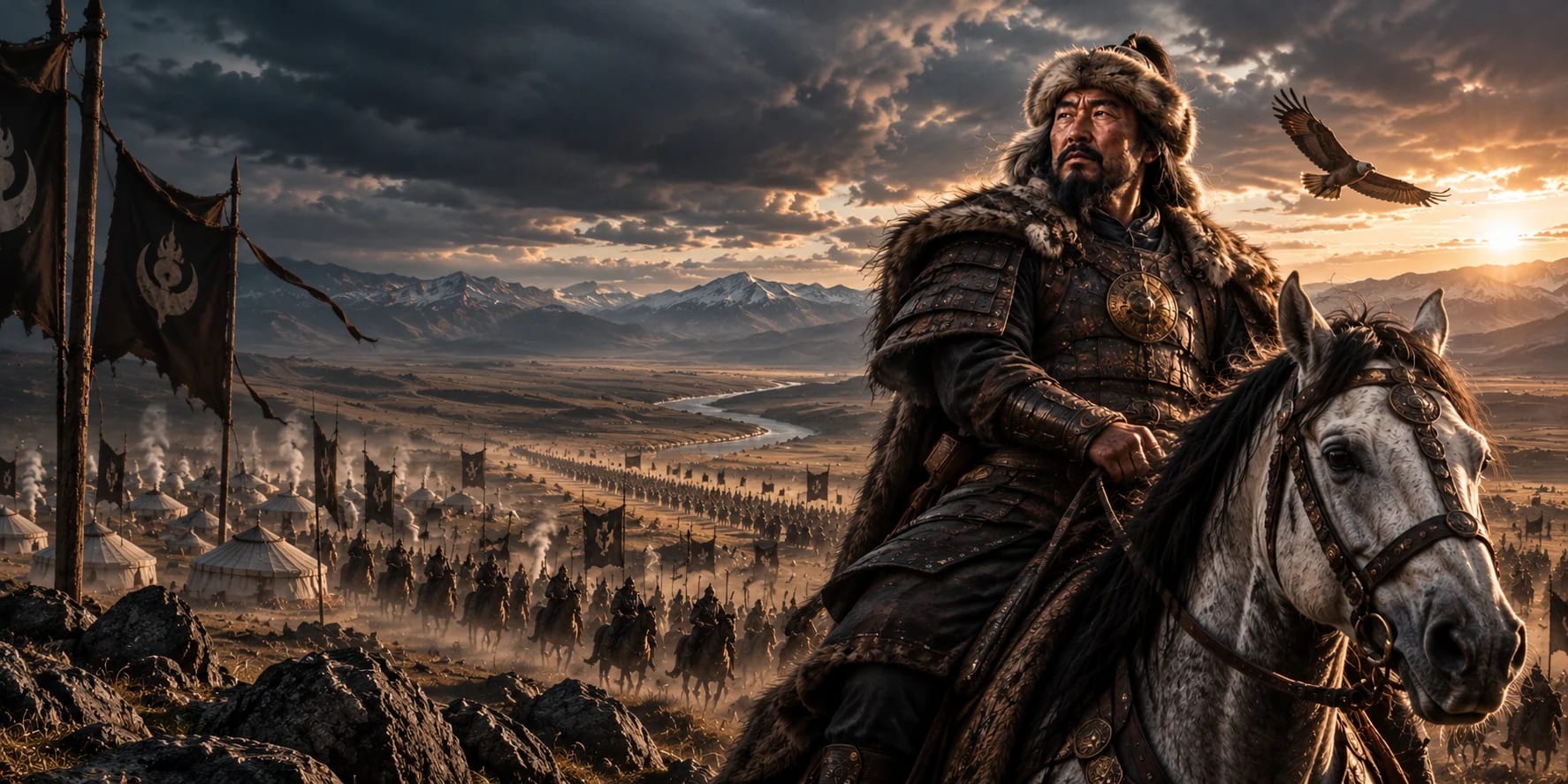
The hero image is an editorial historical reconstruction. It is not an authenticated portrait of Genghis Khan or a documentary depiction of a particular campaign.
FROM TEMÜJIN TO GENGHIS KHAN
A childhood without security
Temüjin was born around 1162, although his birth year remains uncertain. His father, Yesügei, belonged to the steppe elite. The familiar description of Genghis Khan as a poor boy therefore needs qualification: he was born into a family with status, then experienced its collapse. After his father's death, followers abandoned his mother, Höelün, and her children. Survival required gathering food and living with the consequences of lost protection. Columbia University: Genghis Khan's early life
Accounts of his youth include captivity by a rival group and escape. Such episodes reveal the insecurity of a society in which kinship, dependence and force could determine whether a household survived. They also come through sources written with knowledge of his eventual triumph; the childhood of a founder is especially vulnerable to becoming a story about destiny. World History Encyclopedia: Genghis Khan
The most important Mongolian narrative, *The Secret History of the Mongols*, describes his marriage to Börte, her abduction by the Merkits and the alliance that helped recover her. Toghril, a powerful ruler associated with Temüjin's father, and Jamukha, Temüjin's sworn companion and eventual rival, mattered enormously to his rise. Börte appears as a participant in political decisions, not simply a figure waiting outside them. The narrative preserves an intimate world of relationships; it is also a work shaped by the ruling family's memory. The Secret History, translated by Igor de Rachewiltz
The assembly of 1206
Temüjin rose through alliances, defections, victories and the destruction of rival power centers. He built loyalty that could cross inherited group boundaries, while demanding obedience to himself. This was neither peaceful national consolidation nor a simple revolt of the poor against the rich. It was a struggle over who could command people and distribute the rewards of power.
In 1206, an assembly of leading figures recognized him as Genghis Khan, also rendered Chinggis Khan. The title's precise interpretation is debated. The political outcome is clearer: a new authority stood above communities that had previously fought and negotiated as rivals. Unification supplied the human and organizational foundation for expansion beyond Mongolia. Columbia University: uniting the Mongols
THE WORLD THAT MADE THE MONGOLS
Steppe life required movement, but movement was not the absence of order. Pastoral households followed seasonal opportunities for grass and water. Herds were wealth, transport and subsistence; drought or severe winter could turn security into disaster. Decisions about migration depended on knowledge of landscapes and animals accumulated over generations.
This society was connected to settled neighbors through exchange and political relationships. The old picture of isolated nomads suddenly discovering civilization obscures those contacts. Mobile communities needed products they did not make themselves, while settled states needed horses and other goods from pastoral regions. Trade, tribute and conflict existed alongside one another. Columbia University: pastoral nomadism
Empire changed these relationships. A leader who could unite mounted warriors could demand more from neighboring states. A ruler who wanted enduring revenue, however, also needed people who understood cities, records and taxation. The tension between taking wealth immediately and preserving the people who produced it would follow Mongol rule across Eurasia.
WHY WERE THE MONGOLS SO DIFFICULT TO DEFEAT?
Mobility supported by organization
A large state's population did not automatically translate into an effective field army. Mongol commanders could bring organized forces against divided opponents, while their enemies struggled to coordinate distant resources. Historians also treat impressive medieval army totals cautiously: the image of an inexhaustible horde can conceal the organizational achievement. Timothy May: the Mongol military
Mounted warriors commonly traveled with several horses, allowing animals to rest while riders continued. Columbia's account describes three or four mounts as a normal arrangement, rather than a universal quota. Remounts helped sustain movement over distance, but horses still required pasture, water and care. Mobility had an ecological foundation; it was not limitless speed. Columbia University: horses in Mongol warfare
The army's decimal organization grouped men into units conventionally described as tens, hundreds, thousands and ten-thousands. Actual strength could differ from the nominal number. Discipline made coordinated movements possible, including the famous feigned retreat: an apparent withdrawal that was part of an organized battle plan. Its significance was collective control, not some mysterious instinct possessed by every rider. Columbia University: military organization
Skill, information and the willingness to learn
Composite bows combined materials to produce powerful weapons suited to mounted use. Long familiarity with riding and archery supported their effectiveness. Commanders also valued reconnaissance, information from travelers and defectors, and communication between separated forces. Their armies entered campaigns with knowledge as well as weapons.
Genghis Khan rewarded demonstrated service and ability, allowing some men to rise beyond inherited standing. That did not make the empire a modern meritocracy: royal descent, personal loyalty and hierarchy remained fundamental. Success came from a combination of competent leadership and a political order able to enforce decisions.
Adaptation was equally important. Chinese and Persian specialists contributed siege techniques and engineering knowledge that pastoral cavalry alone could not supply. The conquest of fortified cities depended on skills acquired from other societies. World History Encyclopedia: Mongol warfare
The armies themselves increasingly included conquered and allied peoples. “Mongol army” describes an imperial organization, not an unchanging force composed only of ethnic Mongols. Uyghurs and other groups contributed personnel and expertise; local rivalries sometimes gave the conquerors allies. Their opponents were not uniformly weak, and victory was never guaranteed, but the Mongols repeatedly turned other people's divisions and abilities into imperial resources. Columbia University: allies and conquered peoples
THE FIRST GREAT CONQUESTS: WESTERN XIA AND JIN CHINA
Expansion initially brought Genghis Khan against powerful neighbors rather than an empty map. Western Xia, the Tangut state, submitted after the campaign of 1209, but submission did not yet mean its final destruction. Relations later broke down, leading to the devastating final campaign of 1226–1227.
War against the Jin dynasty began in 1211. Mongol forces captured Zhongdu, at the site of modern Beijing, in 1215. The Jin court had already moved south; taking this city did not immediately eliminate the dynasty. The distinction matters because the conquest of northern China was a prolonged process, continued after Genghis Khan's death. Columbia University: the major campaigns
Cities introduced challenges different from those of steppe warfare. Walls, food supplies, engineering and the management of surrendered populations became central. The empire was learning how to attack settled states while becoming increasingly dependent on their people.
KHWAREZM: A DIPLOMATIC CRISIS BECOMES A CATASTROPHE
The Khwarazmian Empire ruled a vast region of Central Asia and Iran. Relations with the Mongols deteriorated after the killing of a merchant party at Otrar in 1218. The subsequent mistreatment of Genghis Khan's envoys, including the killing of one, helped precipitate the invasion of 1219. The episode explains the immediate diplomatic rupture; it does not justify what followed. Encyclopaedia Iranica: envoys and the Khwarazmian crisis
Mongol campaigns shattered the state's centers of power. Bukhara and Samarkand became names in a much larger history of conquest, flight and political collapse. The war spread through Central Asia and into Iran. What began as a confrontation between rulers became a disaster borne by people who had made neither ruler's decisions.
The conquerors' reputation traveled ahead of them. Surrender could offer better prospects than resistance, but submission did not guarantee safety, and subsequent rebellion could bring severe punishment. Artisans and other useful specialists might be spared and relocated while others were killed or enslaved. Such distinctions were calculations of power, not humanitarian protections. Encyclopaedia Iranica: the Mongols in Iran
HOW MANY PEOPLE DID THE MONGOLS KILL?
There is no verified total. The frequently repeated figure of “40 million” should not be treated as an exact body count, nor assigned confidently to Genghis Khan personally. It compresses different campaigns, generations and uncertain estimates into a number that sounds more precise than the evidence permits.
Medieval chroniclers described immense massacres. Peter Jackson's scholarly survey cautions that enormous reported totals for places such as Merv, Nishapur and Herat cannot be accepted literally. They remain evidence of how contemporaries understood the scale of destruction. Rejecting inflated arithmetic does not mean rejecting the reality of mass killing. Encyclopaedia Iranica: conquest and its consequences
Population decline and deaths in massacres are different measurements. People could disappear from records because they fled, because administrations stopped registering them or because borders and counting practices changed. Warfare also caused hunger, disease and reduced births. Even when a decline is real, separating those mechanisms requires evidence that often does not survive. Historical population series themselves demand interpretation. John D. Durand: historical population statistics of China
The responsible conclusion is neither a spectacularly exact total nor a reassuring dismissal. Mongol conquests caused widespread killing and profound disruption. The surviving evidence cannot support a single audited death toll. Uncertainty about numbers should sharpen attention to victims rather than make them disappear behind an argument over arithmetic.
1227: THE DEATH OF GENGHIS KHAN
Genghis Khan died in 1227 during the final struggle against Western Xia. The exact cause remains uncertain. Accounts of illness and a riding accident exist alongside later legends, but no surviving evidence settles the question as a modern medical record might. His burial location has not been securely identified. World History Encyclopedia: death and burial traditions
His death did not end the project he had created. It transferred the problem of succession to a ruling family with immense armies, competing ambitions and a shared claim to his authority. The empire's most familiar outline on modern maps still lay ahead.
ÖGEDEI, BATU AND THE WESTWARD EMPIRE
Ögedei became great khan in 1229. Under his reign, Mongol expansion continued, including the final defeat of the Jin in 1234 and major campaigns farther west. The distinction between founder and successors is essential: the dynasty's achievements cannot all be placed inside one man's biography. Columbia University: expansion under the successors
Ögedei also developed institutions. Karakorum became an imperial center, while taxation and administration required officials capable of managing settled populations. Muslim administrators participated in this work. The empire increasingly had to decide how to collect resources repeatedly rather than merely seize them once. Columbia University: Ögedei's government
Batu, a grandson of Genghis Khan through Jochi, led the expansion associated with the western domains later called the Golden Horde. Campaigns devastated Rus principalities and established a new political order across the steppe north of the Black and Caspian seas. Many Rus rulers subsequently governed under Mongol overlordship and tribute obligations; this was not simply the wholesale replacement of every local institution. The lower Volga became a major center of power. Encyclopaedia Iranica: the Golden Horde
In 1241, Mongol armies struck Poland and Hungary. They withdrew from Hungary in 1242. A familiar explanation attributes the withdrawal entirely to Ögedei's death, but historians debate the relative importance of succession politics, resistance, logistics and environmental conditions. Climate research has proposed that wet conditions created difficulties; other scholars have challenged how much that explanation can bear. A contested retreat should not become another story of effortless Mongol destiny. Büntgen and Di Cosmo: environmental factors, Pinkе and colleagues: a critical reassessment
HÜLEGÜ AND BAGHDAD, 1258
Hülegü, another grandson of Genghis Khan, led the expansion into the Middle East under orders from his brother, the great khan Möngke. His campaigns overwhelmed the Nizari Ismaili strongholds and then reached Baghdad.
In February 1258, the city fell. The Abbasid caliph al-Musta'sim was killed, and the sack inflicted catastrophic violence. The destruction ended the Abbasid caliphate centered in Baghdad. Exact casualty totals remain uncertain; later repetition does not make medieval estimates reliable.
The Mongols were not invincible. After Möngke's death, Hülegü withdrew much of his army from Syria. In 1260, the Mamluks defeated the force left behind at Ayn Jalut. This was a major limit on further expansion in the region, not the disappearance of Mongol power in Iran. Encyclopaedia Iranica: Hülegü Khan
Baghdad's history also continued after catastrophe. Its earlier political decline and subsequent administration complicate the familiar claim that one sack abruptly ended all intellectual life across the Islamic world. A city's devastation must be described fully without turning the histories of many societies into a single dramatic ending. Encyclopaedia Iranica: Baghdad and its Iranian connections
KUBLAI KHAN AND THE CONQUEST OF SONG CHINA
Kublai Khan founded the Yuan dynasty in 1271. The final defeat of the Southern Song in 1279 completed the conquest of China, more than half a century after Genghis Khan's death. This was a world of rivers, fleets, densely populated cities and agricultural taxation. Success depended on capacities far beyond the mounted warfare of the steppe. The Metropolitan Museum of Art: the Yuan dynasty
Kublai retained and adapted Chinese institutions, including major organs of central government. His court had to present itself within Chinese traditions of rulership while preserving the privileges and authority of a conquering dynasty. Administration was not an incidental decoration added after victory. It was the means by which victory could become government. Columbia University: Kublai's administration
Japan and the limits of conquest
The invasions of Japan in 1274 and 1281 involved forces and resources drawn from more than Mongolia alone, including Korea and China. Japan's resistance to demands for submission became a military confrontation on and around northern Kyushu. National Archives of Japan: the Mongol invasions
Storms, particularly the destructive storm of 1281, became central to the memory of *kamikaze*, or divine winds. Weather should not erase Japanese resistance, difficulties coordinating fleets or the problems of sustaining an overseas invasion. The failures illustrate the limits of imperial adaptation as well as the power of later national stories. Columbia University: naval campaigns
The illustrated account commissioned by the Japanese warrior Takezaki Suenaga offers a valuable participant's perspective. Like other personal records, it also served its maker's purposes. Images and narratives preserve evidence; they do not remove the need to ask who produced them and why. Bowdoin College: the Mongol invasion scrolls
HOW LARGE WAS THE MONGOL EMPIRE?
Its maximum extent is commonly estimated at roughly 24 million square kilometers, or 9.3 million square miles. It is called the largest contiguous land empire because its territories formed a connected Eurasian expanse, rather than a collection of widely separated overseas possessions. Historical borders were not survey lines, and the total is an estimate. Guinness World Records: largest contiguous empire
That maximum outline also combines territories whose rulers were increasingly independent of one another. It must not be mistaken for a single tightly administered state at the height of Genghis Khan's personal rule. Nor does it mean half the Earth's land surface. The phrase “known world” depends on whose geographical knowledge is being discussed; medieval Chinese, Persian and European observers did not share one fixed horizon.
Why the empire fragmented
By the 1260s, succession struggles and regional interests had fractured effective unity. The familiar major divisions were the Yuan realm in China and Mongolia, the Chagatai domains in Central Asia, the Golden Horde in the western steppe and Rus sphere, and the Ilkhanate in Iran and neighboring territories. These were related dynastic powers, not simply identical provinces waiting for instructions from one capital. Columbia University: the four khanates
Competition over territory and revenue could outweigh family solidarity. The Golden Horde and Ilkhanate, for example, fought one another. Religious changes and local political relationships further differentiated the successor states. Fragmentation was therefore not just a consequence of distance: the ruling family itself had become several competing centers of power. Encyclopaedia Iranica: rivalry among the khanates
THE OTHER SIDE OF EMPIRE: PAX MONGOLICA
“Pax Mongolica” describes periods of relative security and intensified exchange under Mongol rule. It does not mean that everyone across Eurasia enjoyed a century of peace. War, extraction and local insecurity persisted. For some travelers, however, movement across regions became more feasible under rulers who valued trade and protected particular routes. Columbia University: Pax Mongolica
Merchants benefited from elite patronage and opportunities across imperial territories. The Silk Road was not one road suddenly invented by the Mongols; older networks were reconfigured and, in important places, strengthened. Money, textiles and information traveled alongside people. This belongs to the wider story of how money connected societies, rather than a claim that the conquerors invented international commerce. Columbia University: merchants and trade
The Yam, writing and law
The Yam relay system supplied official travelers and messengers with staged access to transport and provisions. It helped make distance administratively manageable. Such services required resources from communities along the routes; a swift message for the government could represent a heavy obligation for someone else. The Mongols expanded a powerful communication network, not the first postal service in human history. Encyclopaedia Iranica: postal relays
Genghis Khan's government adopted a writing system derived from Uyghur practice, giving the new state tools for recording commands and decisions. This was institution-building through borrowing. Conquerors could impose authority while remaining dependent on the expertise of others. Columbia University: Genghis Khan's institutional legacy
The *yasa* is often presented as a complete written constitution devised by Genghis Khan. Scholars distinguish individual decrees, customary rules and later descriptions of a supposed comprehensive code. No intact original “Great Yasa” survives to settle every claim made about it. The existence of governing rules is clear; the neat modern image of a single preserved lawbook is not. Encyclopaedia Iranica: the yasa
Religious pragmatism and traveling ideas
Mongol rulers could patronize different religious communities and grant privileges to their specialists. Buddhists, Christians, Muslims and Daoists found opportunities at different courts. This flexibility helped rulers manage diverse populations, but it was not modern equal citizenship, nor a guarantee against persecution or violence. Policy varied across rulers and successor states. Columbia University: religious tolerance
Contacts ran in several directions. Rabban Bar Sauma, a Christian traveler from the East Asian world, eventually journeyed to Europe. His story helps correct the habit of imagining Eurasian exchange only as Europeans going east. Diplomats, religious figures and merchants carried knowledge through networks that no one society owned. Columbia University: cultural interchange
Art provides another record of these connections. Under the Ilkhans, Iranian artistic production incorporated influences associated with China and other regions. Cultural creation continued in societies profoundly damaged by conquest. Recognizing it does not turn the earlier destruction into a necessary or beneficial sacrifice. The Metropolitan Museum of Art: the legacy of Genghis Khan
How much should we believe Marco Polo?
Marco Polo's account is an important witness to the possibilities and imagination of long-distance travel. There are strong scholarly arguments that he reached China, but that does not authenticate every episode or official position claimed in the text. Some stories contain chronological problems, and accounts of his administrative role require caution.
The work reached readers through literary collaboration and a complicated manuscript tradition. It is neither a modern travel diary to accept sentence by sentence nor a book to discard because some details are unreliable. Its value grows when compared with other evidence. Morris Rossabi: evaluating Marco Polo
CONNECTION ALSO CARRIED DISEASE
Routes that moved goods and people could also facilitate the movement of pathogens. This does not mean the Mongols invented plague or that one simple route explains the Black Death.
A 2022 ancient-DNA study identified *Yersinia pestis* in people buried in 1338–1339 in what is now Kyrgyzstan. The genomes placed these infections close to the ancestry of the lineages associated with the Black Death, with evidence pointing toward the wider Tian Shan region. The finding is a major advance in locating the pandemic's origins, not a complete itinerary of its spread.
Ecology, animal hosts, human mobility and regional trading connections all require consideration. The Black Death occurred long after Genghis Khan's death. Connecting its history to Mongol-era Eurasian networks is reasonable; assigning the pandemic to a single conqueror is not. Spyrou and colleagues, Nature: the source of the Black Death
GENGHIS KHAN: MONSTER OR STATE BUILDER?
For communities subjected to invasion, memories of slaughter and dispossession were not abstract objections to an otherwise impressive achievement. They were the history experienced by families and cities. Mongolian historical memory, meanwhile, often emphasizes the founder who united divided peoples and established a state whose identity outlived its conquests.
These perspectives emerge from different relationships to power. Neither requires historians to pretend that the other did not exist. Genghis Khan could build institutions for his followers while bringing devastation to others. State-building is a description of political activity, not a certificate of moral innocence. Columbia University: Genghis Khan in historical memory
The question becomes less useful when it demands only one word in reply. It becomes more useful when it asks whose security increased, whose labor sustained the new order and whose losses were omitted from the ruler's story. Similar questions complicate the familiar grandeur of the Roman Empire. Empire looks different from its capital and from a city awaiting an army.
MONGOL EMPIRE: MYTH VS REALITY
“They were primitive barbarians without administration.”
Conquest relied on organized command; rule increasingly depended on writing, taxation, officials and communication. The empire's readiness to borrow institutions is evidence of adaptation, not proof that it lacked government.
“Genghis Khan conquered everything on the map.”
He died in 1227. The conquest of Baghdad in 1258 and the final defeat of the Song in 1279 belonged to later generations. A map of maximum extent is not a map of his personal campaigns.
“Every city was automatically destroyed.”
Treatment varied with resistance, surrender, rebellion and the conquerors' calculations. Some populations suffered catastrophic massacres; others survived under new rulers. Variation should neither erase atrocities nor turn conditional mercy into benevolence.
“The empire covered half the Earth.”
It did not. The conventional maximum estimate is about 24 million square kilometers. Its contiguous scale was extraordinary without inflating it into half the planet.
“The Mongols invented everything they spread.”
They transmitted, adapted and sponsored techniques from different societies. Paper money, printing and postal practices had histories before Mongol expansion. Connecting regions is a major historical role; it does not confer authorship of every idea that traveled between them.
“DNA proves that millions of people descend from Genghis Khan.”
A widely discussed 2003 study identified a common paternal lineage across parts of Asia and proposed an association with Genghis Khan's family. That was a historical hypothesis about the lineage's expansion, not a DNA identification of Genghis Khan himself. A Y chromosome follows one paternal line; it is not a count of all genealogical descendants. Zerjal and colleagues: The Genetic Legacy of the Mongols
Later sequencing research placed the relevant lineage's origins substantially earlier and challenged a simple identification with one medieval ruler. Genetic patterns can illuminate population history without supplying a famous ancestor's name. The viral claim remains stronger than the evidence warrants. Whole-sequence analysis of the C2 star cluster
AN EMPIRE OF DESTRUCTION AND CONNECTION
The Mongol Empire cannot be understood only as a trail of burning cities, because that leaves out the political and cultural structures that followed. It cannot be understood only as a bridge between civilizations, because that removes the people killed, displaced and compelled to build that bridge.
Its history joins the household insecurity of Temüjin's childhood to problems on a continental scale: governing difference, controlling distance, rewarding followers and managing succession. It also shows how power can travel farther than any single ruler's plans—and how the institutions created to sustain it can eventually serve competing rulers.
The paradox does not need to be resolved into praise or condemnation alone. The Mongols created one of history's most destructive waves of conquest. They also connected enormous parts of Eurasia more closely than ever before. Both belong to the same history, and neither should be allowed to hide the other.
SOURCES AND HISTORICAL METHOD
This article uses Columbia University's *The Mongols in World History*, specialist entries in *Encyclopaedia Iranica*, museum scholarship, academic research and a scholarly translation of *The Secret History of the Mongols*. Citations appear beside the relevant discussion; the source list below provides direct links.
Medieval chronicles are treated as evidence produced by particular people in particular circumstances. Their casualty totals, speeches and explanations of victory require comparison and criticism. Territorial estimates are approximate; contested medical, demographic and genetic claims are identified as uncertain. No reconstructed conversation or unverified quotation has been presented as the words of Genghis Khan.
FAQ
Frequently Asked Questions
What is this PRESDA article about?
From Temüjin’s precarious childhood to an empire spanning Eurasia: how the Mongols conquered, governed, destroyed and connected a world larger than any single ruler could control.
Which category does this story belong to?
This story is part of PRESDA's History coverage.
Who published this article?
MONGOL EMPIRE: HOW GENGHIS KHAN CONQUERED HALF THE KNOWN WORLD was published by PRESDA Editorial on PRESDA.
PRESDA Dispatch
Stay Informed. Stay Aware.
A sharp briefing across AI, gaming, sport, business, world affairs, paparazzi, and lifestyle.