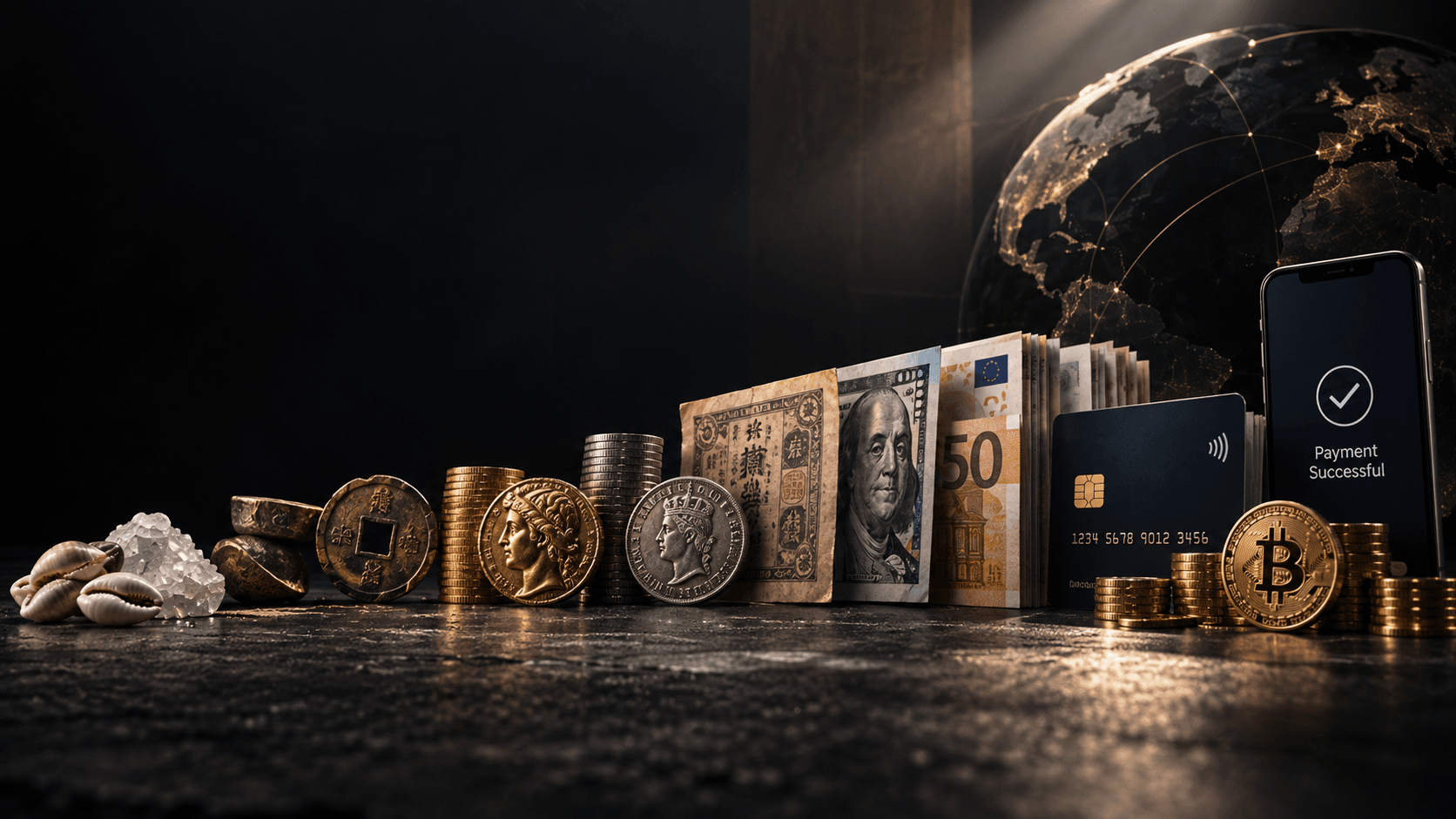
MONEY: HOW PAPER, GOLD AND NUMBERS CAME TO RULE THE WORLD
From shells, silver and gold to banknotes, credit cards and digital payments, money has changed form for thousands of years, but its real power has always depended on trust.
Why would anyone exchange food, labor, a car or even a house for pieces of paper?
And why would anyone trust numbers glowing inside a banking app?
A $100 bill is physically just printed material. A bank balance is largely information stored in financial systems. A card payment is a message moving through networks. Yet billions of people organize their lives around these symbols.
That is why the history of money is not simply the history of coins, banknotes and payment apps. It is the history of trust.
Humanity moved from trading physical goods to trusting shells, metal, paper, bank ledgers, plastic cards and digital balances because societies built systems that made those things acceptable to other people.
The central question is simple: how did money become powerful enough to rule the world?
For more PRESDA context on money, power and history, read the Roman Empire, the history of gold and PRESDA's wider Business coverage.
Before Money
Before standardized currency, people exchanged goods, labor, promises and obligations in many different ways. The old classroom story says early humans lived in simple barter economies: one goat for three bags of wheat, one tool for a basket of fish.
That did happen in some circumstances, but it is too simple as a universal origin story. Many early economies depended on credit, debt, reciprocal exchange, social obligation, tribute, gift relationships and accounting systems.
If people lived in the same community, they did not always need immediate one-for-one barter. They could remember favors, record debts, settle obligations later or use shared measures of value without handing over coins.
Money emerged because exchange became easier when societies had widely recognized ways to measure, store and transfer value.
When Objects Became Money
Objects became money when people began accepting them not only for direct use, but because others would accept them too.
Different societies used different forms of commodity money: cowrie shells, grain, cattle, salt, cloth, metal, beads and other objects. The choice depended on local environment, trade networks, social meaning and practical convenience.
Useful money tends to share certain properties. It should be recognizable, relatively scarce, portable, durable, divisible and difficult to fake. Not every historical money form had all these qualities equally, but the pattern helps explain why some objects traveled farther than others.
Cowrie shells, for example, were portable, recognizable and widely valued in parts of Africa, Asia and the Indian Ocean world. Grain could measure value in agricultural societies, but it was bulky and perishable. Metal was durable and divisible, which made it especially useful for long-distance trade.
Why Gold And Silver?
Gold and silver became powerful monetary materials because they combined scarcity, durability, beauty, divisibility and portability. They do not rust like iron. They can be melted, weighed, divided and stored. Their supply is limited by mining and refining.
But gold did not become money everywhere because of some natural universal law. Its monetary role developed historically and socially. People valued gold and silver because other people valued them, rulers accepted them, merchants traded them and institutions built systems around them.
Precious metals also solved a problem of trust. A piece of metal could be weighed and tested. If people believed its purity and weight, it could move through trade networks more easily than many local goods.
That did not make metal money perfect. Coins could be clipped, debased, counterfeited or hoarded. Metal was heavy. Large transactions could still be difficult. The next stages of money tried to solve those problems.
The Invention Of Coins
Coins changed money because they allowed political authorities to stamp metal with signs of weight, purity and legitimacy.
Early coinage is often associated with Lydia in western Anatolia in the first millennium BCE. Lydian electrum coins, made from a naturally occurring gold-silver alloy, are among the most famous early examples of stamped coinage.
The stamp mattered. Instead of weighing metal from scratch every time, users could rely on an issuing authority's mark, at least in theory. A coin was still metal, but it was also a political promise.
Coinage spread through the Greek world, the Persian Empire, the Roman world and many other monetary systems. Coins made armies easier to pay, taxes easier to collect and trade easier to standardize.
Money And The Roman Empire
Rome shows how money could become imperial infrastructure. Roman coins such as the denarius and aureus helped pay soldiers, collect taxes, move goods and link provinces into a wider economy.
Coins were also political media. Emperors placed their faces, titles, victories, gods and messages into people's hands. A coin could tell subjects who ruled, what the ruler wanted remembered and what values the regime claimed to defend.
In that sense, Roman money was never just economic. It was propaganda, administration and identity in metal form.
The empire's monetary system changed across centuries, especially as military costs, political instability and fiscal pressure grew. Those changes connect directly to PRESDA's deeper feature on life inside the Roman Empire.
When Rulers Destroyed Their Own Money
Coin debasement happens when authorities reduce the precious-metal content of coins while keeping their official denomination or appearance.
Governments did this for practical reasons: to stretch resources, pay armies, cover fiscal pressure or respond to shortages. But debasement could damage confidence if people realized that a coin contained less silver or gold than before.
Roman history provides famous examples, especially with the gradual reduction of silver content in some coinage. Debasement could contribute to inflation and distrust, but it should not be treated as the single simple cause of Rome's decline.
Money works through confidence. When users suspect that the unit of account is being quietly weakened, prices, trust and political legitimacy can all become unstable.
China And The Revolution Of Paper Money
Paper money was revolutionary because it separated monetary value from the material value of the object itself.
In China, large-scale commerce made heavy metal currency inconvenient. Merchants and financial institutions developed notes and exchange instruments, and government-issued paper money developed under the Song period. Jiaozi is often discussed as one of the earliest paper monetary forms.
The exact definition of the first paper money can be complex because private notes, exchange certificates and government-issued currency overlap in historical development. But China clearly pioneered paper monetary systems centuries before modern European banknotes became common.
The breakthrough was conceptual as much as technical. A piece of paper could represent purchasing power because people trusted the issuer, the law, the redemption system or the broader monetary order.
Money no longer had to be valuable because of what it was made from. It could be valuable because a trusted system said it was.
Marco Polo And The Amazement Of Paper Money
European encounters with Chinese paper money became part of the medieval imagination. Marco Polo famously described the use of paper currency under Mongol rule in China, presenting it as an astonishing system of state-backed value.
His account should be read carefully. Medieval travel writing mixed observation, translation, wonder and literary convention. Not every detail should be treated as unquestionable evidence.
Still, the reaction makes sense. To Europeans accustomed to metal money and local credit instruments, a government turning paper into accepted money could seem almost magical.
The deeper point is not that paper itself was magical. It is that state authority, administration and public acceptance could make paper behave like money.
How Banknotes Reached Europe
European paper money developed through banking, trade and credit institutions rather than by simply copying China directly.
Merchant banking, bills of exchange, deposit receipts and early banks helped merchants move value without physically transporting large amounts of metal. A written promise could be safer and more efficient than bags of coins on dangerous roads.
Over time, banknotes became more familiar as claims on banks or issuing institutions. They could circulate because people believed they could be redeemed or accepted by others.
This was another trust leap. A banknote was not merely paper. It was a claim embedded in a legal and financial network.
What Did A Banknote Originally Promise?
Historically, many banknotes promised some form of redeemability. A note might represent a claim on gold, silver or assets held by a bank.
This helps explain three useful categories. Commodity money has value partly because the object itself is valued, as with precious metal. Representative money is a claim on something else, such as a note redeemable for metal. Fiat money is money accepted by law, institutions and social use without being redeemable for a fixed amount of commodity.
Real monetary systems often blurred these categories. Coins could be token money. Banknotes could be only partially backed. Governments could suspend convertibility during crises.
The important lesson is that money has always mixed material, legal and social trust.
The Gold Standard
The gold standard linked currencies to gold through rules of convertibility and fixed prices. In an idealized version, a currency unit represented a defined amount of gold, and international exchange rates were shaped by those definitions.
Supporters valued the gold standard because it could limit arbitrary money creation and support international confidence. It made currencies seem anchored to something scarce and globally recognized.
But the system also constrained governments and central banks. During financial crises, wars or depressions, maintaining gold convertibility could force painful choices: higher interest rates, reduced spending, deflationary pressure or limits on monetary flexibility.
The gold standard was not one timeless system. Different versions operated in different countries and periods, with suspensions, restorations and political compromises.
Why Countries Abandoned Gold
Countries weakened or abandoned gold for many reasons: wars, banking crises, depression, capital flows, changing trade balances and the need for monetary flexibility.
World War I strained gold systems as governments borrowed and spent heavily. The interwar period brought attempts to restore monetary order, but the Great Depression exposed how difficult gold convertibility could be under severe economic stress.
For many policymakers, the ability to respond to unemployment, banking failures and falling demand became more important than defending a fixed gold link.
The shift away from gold did not happen in one neat global moment. It was a long process of suspension, redesign and institutional change.
Bretton Woods: When The Dollar Sat At The Center
In 1944, delegates from 44 countries met at Bretton Woods, New Hampshire, to design a postwar monetary order.
The system linked many currencies to the US dollar, while the dollar was linked to gold for foreign monetary authorities at $35 per ounce. The International Monetary Fund and the World Bank emerged from the same postwar institutional vision.
Bretton Woods made the dollar central because the United States held enormous economic and financial power after World War II. Dollar convertibility into gold helped make the system credible, while US markets and institutions gave the dollar global reach.
It was not simply a gold system and not simply a dollar system. It was a hybrid: national currencies, dollar pegs, gold convertibility for official holders and international institutions designed to stabilize payments.
1971: When The Dollar Broke With Gold
In August 1971, President Richard Nixon announced that the United States would suspend dollar convertibility into gold for foreign monetary authorities.
The decision came under pressure. Foreign dollar holdings had grown, US gold reserves were limited, inflation was rising, balance-of-payments problems persisted and confidence in convertibility weakened.
This did not mean Nixon invented fiat money overnight. Many forms of non-commodity money already existed, and the transition out of Bretton Woods unfolded through negotiations, exchange-rate changes and institutional adjustment.
But 1971 remains a major turning point. The world's most important currency moved decisively away from a fixed gold promise.
So What Gives Money Value Today?
Modern fiat money has value because it is embedded in a system of acceptance, law, taxation, institutions, monetary policy, productive capacity and public confidence.
Money works because people expect other people to accept it.
That trust is not merely psychological. Governments require taxes to be paid in their currency. Courts enforce contracts. Central banks manage monetary conditions. Businesses price goods. Workers accept wages. Banks maintain payment systems. Markets create liquidity.
If enough people stop believing that a currency will hold value or be accepted tomorrow, the system weakens. If institutions remain credible and the economy remains productive, pieces of paper and digital balances can command real goods and services.
Who Creates Money?
Money creation is more complicated than the phrase printing money suggests.
Central banks issue physical currency and create reserves used within the banking system. They also influence interest rates, liquidity and financial conditions. But most money in modern economies does not exist as banknotes.
Commercial banks also play a major role. When a bank makes a loan, it can create a matching deposit in the borrower's account. That deposit is spendable money, even though no new paper cash was printed at that moment.
This does not mean banks can create unlimited money without constraint. Capital rules, regulation, borrower demand, credit risk, reserve systems, central-bank policy and repayment all matter. Modern money is created through institutions, not magic.
Why Can't Governments Just Print More Money?
Governments and central banks cannot create purchasing power without limit because money is only useful when it can command real goods and services.
If the supply of money or credit expands far beyond an economy's ability to produce goods and services, prices can rise. Expectations matter too: if people expect money to lose value, they may spend faster, demand higher wages or refuse the currency.
But the slogan printing money causes inflation is too simple. Inflation can also come from supply shocks, energy prices, exchange-rate changes, wars, market power, demand surges and expectations.
The better rule is this: creating spending power is not automatically disastrous, but creating too much relative to real capacity and confidence can destroy a currency's purchasing power.
When Money Collapses
Hyperinflation is what happens when money loses purchasing power at extreme speed and confidence collapses.
Famous cases include Weimar Germany in the early 1920s, Hungary after World War II, Zimbabwe in the 2000s and Venezuela in the 2010s. Each case had its own causes, including war, debt, fiscal crisis, production collapse, political instability, external pressure or loss of confidence.
Hyperinflation produces surreal banknotes because denominations chase prices upward. A note with many zeros is not a sign of wealth. It is often a sign that ordinary units no longer buy much.
The human cost is severe: wages lag, savings evaporate, pricing becomes chaotic and people search for alternative stores of value.
The Strangest Banknotes Ever Printed
Money history is full of unusual banknotes, but the strangest examples usually come from crisis, experimentation or symbolism.
Hungary issued enormous denominations during its post-World War II hyperinflation, including notes denominated in pengo units so large they became symbols of monetary collapse. Zimbabwe later printed extremely high-denomination notes during its own hyperinflation.
Emergency money has appeared when official currency systems broke down or coin shortages made everyday exchange difficult. Some communities, companies and governments issued temporary notes to keep commerce moving.
Banknotes have also been printed on unusual materials. Modern polymer notes, used by countries including Australia, Canada and the United Kingdom, were designed partly for durability and security.
The lesson is that a banknote's design is never random. It reflects technology, trust, crisis, identity and the practical problem of keeping payments moving.
Why Does Money Have Portraits?
Money carries portraits because money is also a public message.
Banknotes and coins often show monarchs, presidents, national heroes, scientists, writers, buildings, animals, inventions and landscapes. These choices tell citizens and foreigners what a state wants to honor.
A portrait on money turns political memory into daily habit. People may handle a national founder, a queen, a poet or a scientist thousands of times without thinking about it.
That is why currency design can become controversial. Changing a banknote is not only a design decision. It is a debate over identity, history and legitimacy.
The War Against Counterfeiting
Counterfeiting is as old as money itself. If a society trusts a token, someone will try to fake it.
Ancient coinage faced clipping, base-metal substitution and false stamps. Paper money created new problems because skilled printers could imitate notes. Digital money created still different risks around fraud, identity theft and payment-system security.
Modern banknotes use watermarks, security threads, microprinting, holograms, special inks, raised printing, transparent windows and polymer substrates. Governments redesign notes because counterfeiters learn and technology changes.
The basic battle is always the same: preserve trust by making money recognizable, hard to imitate and easy enough for ordinary people to verify safely.
The Rise Of The US Dollar
The US dollar became the dominant international reserve currency through a combination of economic scale, postwar institutions, deep financial markets, political power, trade networks and trust in dollar-denominated assets.
Bretton Woods mattered, but it does not explain everything. The dollar's role also depends on the size and liquidity of US financial markets, the use of dollars in global trade, the depth of Treasury markets and network effects.
A reserve currency is useful when many others already use it. That creates inertia. Central banks hold it, companies borrow in it, commodities may be priced in it and international payments often move through it.
Dollar dominance is powerful, but history warns against treating any monetary order as permanent.
Why Is The Dollar Still So Powerful?
The dollar remains powerful because it is liquid, widely accepted and deeply embedded in global finance.
Central banks hold reserves partly in dollars. International debt is often issued in dollars. Many commodities and contracts use dollar pricing. Investors can buy and sell large quantities of US government debt in deep markets.
This gives the United States advantages, including easier financing and geopolitical influence through the financial system. It also creates responsibilities and vulnerabilities because global demand for dollars links domestic US policy to international stability.
Reserve-currency power is not just about national pride. It is about networks, legal trust, market depth and the belief that others will continue accepting the same unit.
From Cash To Plastic
Payment cards changed money by letting people spend without handing over cash.
Charge cards, credit cards, bank cards and payment networks created systems in which a purchase could be authorized, recorded and settled later. ATMs made bank deposits more accessible without visiting a teller.
Cards did not eliminate money's older functions. They changed the interface. The customer saw plastic. Behind the plastic were banks, merchants, card networks, credit decisions, fees and settlement systems.
This was another step toward invisible money: value moving through records rather than physical objects.
When Money Became Numbers
Much of modern money never exists as physical cash.
It exists as ledger entries inside banks, payment processors and financial systems. Salaries arrive as deposits. Bills are paid through electronic transfers. Stores accept contactless payments. Families send money through apps. International finance moves through messages and settlement networks.
This makes money faster and more convenient, but also more dependent on infrastructure. Electricity, telecommunications, cybersecurity, identity systems and institutional trust become part of monetary life.
A coin can sit in a pocket without a password. Digital money needs a system around it.
Bitcoin: Money Without A Central Bank?
Bitcoin launched in 2009 after the publication of a white paper under the name Satoshi Nakamoto. It proposed peer-to-peer electronic cash using a blockchain, fixed issuance rules and decentralized validation rather than a central bank.
Supporters describe Bitcoin as digital money or digital gold because its supply rules are algorithmic and it can be transferred without a traditional financial intermediary.
The comparison has limits. Bitcoin's price is volatile. Everyday payment adoption remains limited in many places. Custody can be risky. Regulation continues to evolve. Scaling and energy use have been debated heavily.
Bitcoin matters historically not because it replaced money, but because it made a new monetary question mainstream: can digital scarcity exist without a central issuer?
Crypto Is Not Just Bitcoin
Cryptocurrency is broader than Bitcoin. Other networks use different designs, governance structures and technical goals.
Stablecoins are especially important because they are designed to track existing currencies or assets, most commonly the US dollar. Their purpose is different from highly volatile cryptocurrencies: they aim to make digital tokens behave more like familiar money.
Tokenized assets are another development, where claims on financial instruments or real-world assets are represented digitally. The promise is faster settlement and programmability; the risks include regulation, custody, transparency and operational failure.
Crypto should not be treated as one thing. A speculative token, a dollar-backed stablecoin and a central-bank digital currency raise very different questions.
Central Bank Digital Currencies
A central bank digital currency, or CBDC, would be a digital form of sovereign money issued or backed by a central bank.
Central banks research CBDCs for many reasons: payment efficiency, financial inclusion, resilience, competition with private payment systems, cross-border settlement and the future role of public money.
CBDCs also raise serious questions. How private would transactions be? How would commercial banks be affected? Would people move deposits out of banks in a crisis? How much state oversight would be built into payment infrastructure?
A global cashless CBDC future is not inevitable. Different countries are moving at different speeds, and some remain cautious because payments, privacy and banking systems are politically sensitive.
Will Cash Disappear?
Cash may become less dominant in some economies, but disappearance is not guaranteed.
Cash persists because it is private, familiar, resilient during outages, useful for small transactions, accessible to people outside digital banking and culturally trusted in many places.
Digital payments keep growing because they are fast, convenient and deeply connected to e-commerce, smartphones, subscription services and global platforms.
The likely future is uneven. Some places may become nearly cash-light. Others will keep cash for resilience, inclusion and trust. Money's history suggests that new forms often layer on top of old ones rather than replacing them instantly.
Money: Myth Vs Reality
MYTH: Barter was simply replaced by coins.
REALITY: Credit, debt, reciprocal exchange and commodity exchange existed alongside many early monetary systems.
MYTH: Paper money was invented in modern Europe.
REALITY: China pioneered paper monetary systems centuries earlier.
MYTH: Every dollar was once directly backed by an equivalent piece of gold.
REALITY: Historical monetary systems were more complicated and changed over time.
MYTH: Modern money has no value because it is just paper.
REALITY: Its value comes from an institutional and economic system of acceptance, law, taxation, production and trust.
MYTH: Governments create all money simply by printing it.
REALITY: Most modern money exists electronically, and commercial banking plays a major role in deposit-money creation.
MYTH: Bitcoin was the first digital money.
REALITY: Electronic forms of conventional money existed decades before Bitcoin. Bitcoin introduced a different decentralized monetary architecture.
The Future Of Money
The hero image of money's history would look strange because money itself keeps changing costume.
Shells. Coins. Gold. Paper. Bank ledgers. Plastic cards. Phones. Crypto wallets. Digital tokens. Central-bank experiments.
What comes next may include less physical cash, faster global payments, tokenized financial assets, stablecoins, CBDCs and new private payment networks. It may also include renewed demand for cash and public money if digital systems feel too fragile or too surveilled.
The future is not known. But the pattern is clear: every new form of money must solve the same old problem.
People must believe someone else will accept it.
Money Is A Story We Agree To Believe
For thousands of years, the physical form of money has repeatedly disappeared.
Shells gave way to metal. Metal became stamped coins. Coins were supplemented by paper. Paper became bank accounts. Bank accounts became cards and smartphone screens.
Yet one element survived every transformation: trust.
Money has never been defined only by the material in our hands. Gold, paper and pixels work only when societies agree that they represent value. The objects changed. The institutions changed. The technology changed. But from an ancient coin to a number glowing on a smartphone, money has always depended on the same invisible asset: trust.
FAQ
Frequently Asked Questions
What is the history of money?
The history of money is the story of how societies moved from credit, obligation and commodity exchange to objects such as shells and metal, then coins, paper banknotes, bank deposits, cards and digital payment systems.
Who invented paper money?
China pioneered paper monetary systems centuries before modern European banknotes became common. The Song period and instruments such as jiaozi are central to the history of early paper money.
What is fiat money?
Fiat money is money that is not redeemable for a fixed amount of a commodity such as gold. Its value depends on law, institutions, public acceptance, economic capacity and trust.
Who creates money today?
Central banks issue physical currency and reserves, but most modern money exists electronically. Commercial banks also create deposit money when they make loans, within regulatory and economic constraints.
Will cash disappear?
Cash may become less dominant in some economies, but it is unlikely to disappear everywhere soon because it remains useful for privacy, resilience, accessibility, offline payments and financial inclusion.
PRESDA Dispatch
Stay Informed. Stay Aware.
A sharp briefing across AI, gaming, sport, business, world affairs, paparazzi, and lifestyle.