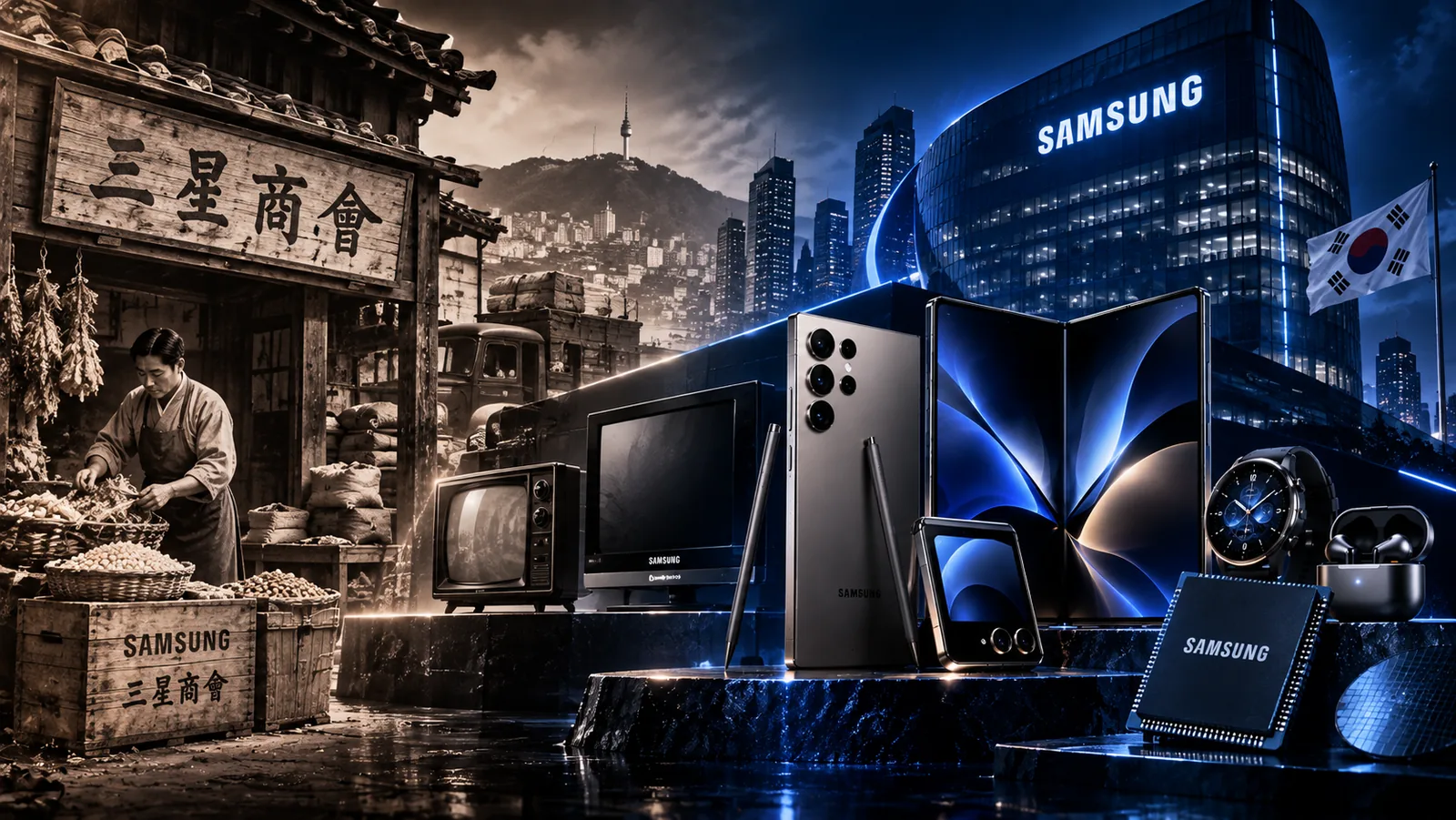
SAMSUNG: FROM SELLING FOOD TO BUILDING A GLOBAL TECH EMPIRE
Samsung began in 1938 as a small Korean trading company dealing in food. Decades later, it became a global powerhouse in smartphones, semiconductors, displays, appliances and advanced technology.
Samsung did not begin as a smartphone company.
It did not begin with chips, televisions, foldable screens or artificial intelligence.
Samsung began in 1938 as a small trading business in Korea, dealing in everyday goods such as groceries, dried fish, noodles and regional exports.
That origin has become one of the most surprising corporate stories in modern business: a food-trading company became one of the world's most important technology groups.
The transformation was not instant and it was not inevitable.
It took industrial policy, manufacturing ambition, family control, risk, engineering scale, export discipline and a willingness to move from one category to the next before competitors were comfortable.
A Small Trading Company In 1938
Samsung was founded by Lee Byung-chul in 1938 in Daegu, Korea. Samsung's own company heritage materials describe the business as beginning with trading, food and regional commerce before expanding into broader industries.
The famous 'selling food' hook is true only if it is kept precise.
Samsung was not a restaurant and not a modern grocery chain.
It was a trading company that handled goods such as dried fish, noodles, groceries and other local products, moving them through regional markets.
That mattered because trading taught Samsung its first lesson: business scale depends on supply, distribution, trust and timing.
Lee Byung-chul was not building a phone empire in 1938.
He was building a commercial base in a Korea that would soon pass through colonization, liberation, war and reconstruction.
What Does Samsung Mean?
The name Samsung is commonly translated as 'Three Stars.'
In Korean business symbolism, the idea was associated with something large, numerous and enduring. The name suggested ambition beyond a single shop or product.
That symbolism became useful later, but it did not create the empire by itself.
Names do not build factories.
Samsung's rise came from the way the company repeatedly converted ambition into manufacturing capacity.
Korea's Transformation And Samsung's Expansion
Samsung's growth cannot be separated from South Korea's economic transformation.
After the Korean War, South Korea was poor, damaged and under pressure to industrialize quickly. In the decades that followed, the country developed an export-driven economy built around manufacturing, infrastructure, education and large family-controlled conglomerates known as chaebol.
Samsung became one of the most important of those groups.
A chaebol is not just a company. It is a network of affiliated firms, often controlled through family and cross-shareholding structures, operating across multiple sectors.
That distinction matters.
Samsung Electronics is the most internationally famous Samsung business, but it is not the entire Samsung group.
The wider Samsung ecosystem has included businesses connected to finance, construction, shipbuilding, insurance, consumer goods, technology and other sectors.
From Trading To Manufacturing
Before Samsung became known for electronics, it expanded into manufacturing and consumer industries.
The company entered areas such as sugar refining, textiles and insurance as South Korea's economy moved from basic trading toward industrial production.
This step was crucial.
Trading companies depend on moving other people's goods. Manufacturing companies learn to make their own.
Once Samsung began building manufacturing knowledge, it created the foundation for later electronics, appliances, displays and semiconductors.
The story is not simply that Samsung 'switched' from food to phones.
It climbed through layers of capability: trading, manufacturing, export discipline, electronics assembly, components, chips, screens, devices and ecosystem products.
Samsung Electronics Is Founded
Samsung Electronics was founded in 1969. Encyclopaedia Britannica identifies the late-1960s creation of Samsung Electronics as the beginning of the group's best-known technology arm.
Its early products included televisions and other consumer electronics.
Samsung's first phase in electronics was not about inventing the smartphone future.
It was about learning mass production, quality control, component sourcing and export markets.
Televisions were a training ground.
They required screens, circuits, industrial design, assembly lines, suppliers and after-sales reliability.
Every television factory was also a school for the next product category.
Early Televisions And Consumer Electronics
Samsung's early black-and-white televisions helped the company enter homes before it entered pockets.
From there, Samsung expanded through consumer electronics, appliances and industrial products.
The company learned how to compete not only through branding, but through manufacturing repetition.
A global electronics company has to make millions of products that work the same way, ship on time and meet local standards across different countries.
That is not glamorous, but it is one of Samsung's great strengths.
Behind the familiar logo is an ability to turn factories, suppliers, components and logistics into global scale.
The Semiconductor Bet
Samsung's move into semiconductors changed the company more than almost any product launch.
Semiconductors are the hidden infrastructure of modern technology. Phones, computers, cars, appliances, servers and AI systems all depend on chips.
Samsung Semiconductor's history pages trace the company's development from early semiconductor work into memory-chip leadership, including major DRAM milestones in the 1980s.
DRAM is dynamic random-access memory. It stores data temporarily so computers and devices can operate quickly.
Memory chips are intensely competitive because prices fall, factories cost billions and each generation demands better precision.
Samsung succeeded because it was willing to invest heavily, learn quickly and compete at enormous scale.
The semiconductor business also gave Samsung a strategic advantage in phones and electronics.
A company that makes screens, memory, processors, storage and finished devices can coordinate the stack in ways many competitors cannot.
How Samsung Became A Memory Powerhouse
Becoming a major DRAM manufacturer required patience and capital.
Samsung had to absorb foreign technology, build domestic engineering capability, hire and train specialists, and survive brutal price cycles.
The reward was enormous.
Memory chips became one of Samsung Electronics' most important profit engines and one of South Korea's most important export strengths.
This is one reason Samsung is different from many consumer-electronics brands.
It is not merely designing gadgets and outsourcing everything else.
It is also one of the companies making the components that the digital world runs on.
Displays, Appliances And Global Manufacturing
Samsung's expansion into displays and appliances reinforced the same pattern.
Screens connect televisions, monitors, tablets, laptops, phones and foldables.
Appliances connect homes.
Manufacturing networks connect regions.
Samsung became strong because it did not depend on a single breakthrough category. It built a portfolio across consumer devices and industrial components.
That breadth can make the company complicated to describe.
Samsung is a phone brand, but not only a phone brand.
A chipmaker, but not only a chipmaker.
A TV company, but not only a TV company.
Its power comes from being all of those things at once.
The Rise Of Mobile Phones
Before Galaxy, Samsung sold many mobile phones across different markets and form factors.
The company competed in flip phones, feature phones and early smartphones before Android became the dominant non-Apple smartphone platform.
Samsung's advantage was speed.
It could experiment with designs, screens, cameras and price tiers quickly. It had distribution around the world and manufacturing scale behind it.
When the smartphone market shifted after the iPhone, Samsung was one of the few companies able to respond with enough hardware ambition and production capacity to compete globally.
Galaxy S And The Smartphone Breakthrough
The Galaxy S line became Samsung's global smartphone breakthrough.
Samsung Newsroom's Galaxy S history traces the line from the original Galaxy S in 2010 through later generations that emphasized display quality, cameras, processing power and Android integration.
Galaxy S gave Samsung a clear premium identity against Apple.
The competition was not just technical.
It was cultural.
Apple sold integration, simplicity and brand prestige. Samsung answered with large screens, hardware variety, carrier reach, aggressive marketing and fast iteration.
By the 2010s, Samsung was no longer just following the smartphone market.
It was shaping it.
Galaxy Note And The Big-Screen Strategy
The Galaxy Note line was one of Samsung's boldest mobile bets.
At launch, large-screen phones were mocked by some critics as awkward. Samsung pushed anyway.
The Note combined a big display with the S Pen, aiming at productivity, drawing, handwriting and multitasking.
The broader market eventually moved toward larger phones.
That does not mean every Note decision was perfect, but it shows Samsung's willingness to test categories before they were universally accepted.
Today's large flagship phones owe part of their mainstream acceptance to that period.
Samsung saw that the phone was becoming not only a calling device, but a camera, notebook, video screen, work tool and personal computer.
Competition In The Smartphone Market
Samsung's smartphone position has always been contested.
Apple dominates much of the premium profit pool. Chinese manufacturers such as Huawei, Xiaomi, Oppo, Vivo and Honor have pressured Samsung in price, camera innovation, battery technology and domestic-market strength.
Google controls Android's core software direction while also competing through Pixel.
Samsung's answer has been breadth.
It sells flagship Galaxy S and Z devices, midrange Galaxy A phones, tablets, watches, earbuds and services.
That range allows Samsung to compete in markets where Apple is premium-only and where Chinese brands attack aggressively.
But breadth also creates complexity.
Samsung has to keep software updates, pricing, branding and hardware differentiation clear across a very large lineup.
The Galaxy Note 7 Setback
Samsung's rise also includes serious setbacks.
The Galaxy Note 7 recall in 2016 remains one of the most important safety crises in modern consumer electronics.
The U.S. Consumer Product Safety Commission announced a formal recall of Galaxy Note7 smartphones because batteries could overheat and pose fire and burn hazards. Samsung also published its own global exchange and safety communications.
The recall damaged trust and forced Samsung to overhaul parts of its battery safety and quality process.
It also showed the risk of competing at high speed in complex hardware.
A smartphone is not one product.
It is a dense system of chemistry, software, radio hardware, display technology, heat management, cameras, memory and industrial design.
When one part fails, the whole brand can be hit.
Foldables And Samsung's Early Bet
Samsung also made one of the industry's earliest major bets on foldable smartphones.
The Galaxy Fold and later Galaxy Z Fold and Z Flip devices pushed flexible displays into the consumer market before foldables were fully mainstream.
That strategy fit Samsung's identity.
Because Samsung is strong in displays and manufacturing, it could take risks that many competitors could not.
Foldables were expensive and imperfect at first, but they gave Samsung an innovation story and helped it define a category before Apple entered it.
The bet also connected Samsung's component strength to consumer branding.
A foldable phone is both a device and a display technology showcase.
Samsung Today
Samsung today is a global technology group centered publicly around Samsung Electronics but supported by a wider Samsung ecosystem.
Samsung Electronics reports across major business areas including Device eXperience, semiconductors and display-related operations in its investor materials and annual reports.
Its products include Galaxy smartphones, foldables, tablets, watches, earbuds, televisions, displays, home appliances, memory chips, storage, image sensors and AI-enabled devices.
Samsung also supplies components to other companies that may compete with it in finished products.
That is unusual but powerful.
Samsung can be a rival, supplier and platform participant at the same time.
Why Samsung Succeeded
Samsung succeeded because it combined several advantages.
Scale: it could manufacture at volumes that made global competition possible.
Vertical integration: it made many of the components inside its own devices.
Semiconductors: memory and chip expertise gave it profit, leverage and technical depth.
Displays: screen leadership helped Samsung compete in TVs, phones and foldables.
R&D: sustained research spending allowed the company to move across categories.
Speed: Samsung was willing to test new sizes, designs and product families quickly.
Ecosystem ambition: phones, watches, TVs, appliances and services increasingly connect.
None of those strengths alone explains the whole story.
Together, they explain how Samsung moved from trading sacks of food products to shaping the hardware layer of the digital world.
The Final Answer
So how did a small 1938 trading company become a global technology empire?
It kept moving up the chain of value.
Samsung began by moving goods.
Then it made goods.
Then it made electronics.
Then it made components.
Then it made the chips, screens and devices that define modern life.
Along the way, it benefited from South Korea's industrial rise, the chaebol model, export markets, disciplined manufacturing and an unusually aggressive appetite for new categories.
The result is a company that can sell a phone, build the screen inside it, produce memory for it, make appliances for the home it connects to and compete in the AI device future.
Samsung's story is not a fairy tale.
It includes setbacks, recalls, controversies, intense competition and the complexity of family-controlled corporate power.
But as a business transformation, it is extraordinary.
Samsung started by selling everyday goods in Korea.
It became one of the companies building the technological infrastructure of the world. PRESDA's Business archive follows that same technology economy through Apple's iPhone and foldable strategy, the world's most valuable companies and Mark Zuckerberg's Meta story.
FAQ
Frequently Asked Questions
What is this PRESDA article about?
Samsung began in 1938 as a small Korean trading company dealing in food. Decades later, it became a global powerhouse in smartphones, semiconductors, displays, appliances and advanced technology.
Which category does this story belong to?
This story is part of PRESDA's Business coverage.
Who published this article?
SAMSUNG: FROM SELLING FOOD TO BUILDING A GLOBAL TECH EMPIRE was published by PRESDA Editorial on PRESDA.
PRESDA Dispatch
Stay Informed. Stay Aware.
A sharp briefing across AI, gaming, sport, business, world affairs, paparazzi, and lifestyle.