APPLE'S NEXT ERA: iPHONE 18, FOLDABLES AND THE FUTURE OF ITS PRODUCT EMPIRE
Apple has entered a new hardware cycle with the iPhone 18 Pro, its first foldable iPhone and a growing focus on AI. What do these products reveal about the company's strategy for the years ahead?
Apple's September 2026 launch did not feel like another routine iPhone update.
It was a signal.
The company introduced the iPhone 18 Pro and iPhone 18 Pro Max, announced its first foldable iPhone, pushed Siri AI deeper into the device experience and refreshed wearables that increasingly behave like health, audio and intelligence platforms.
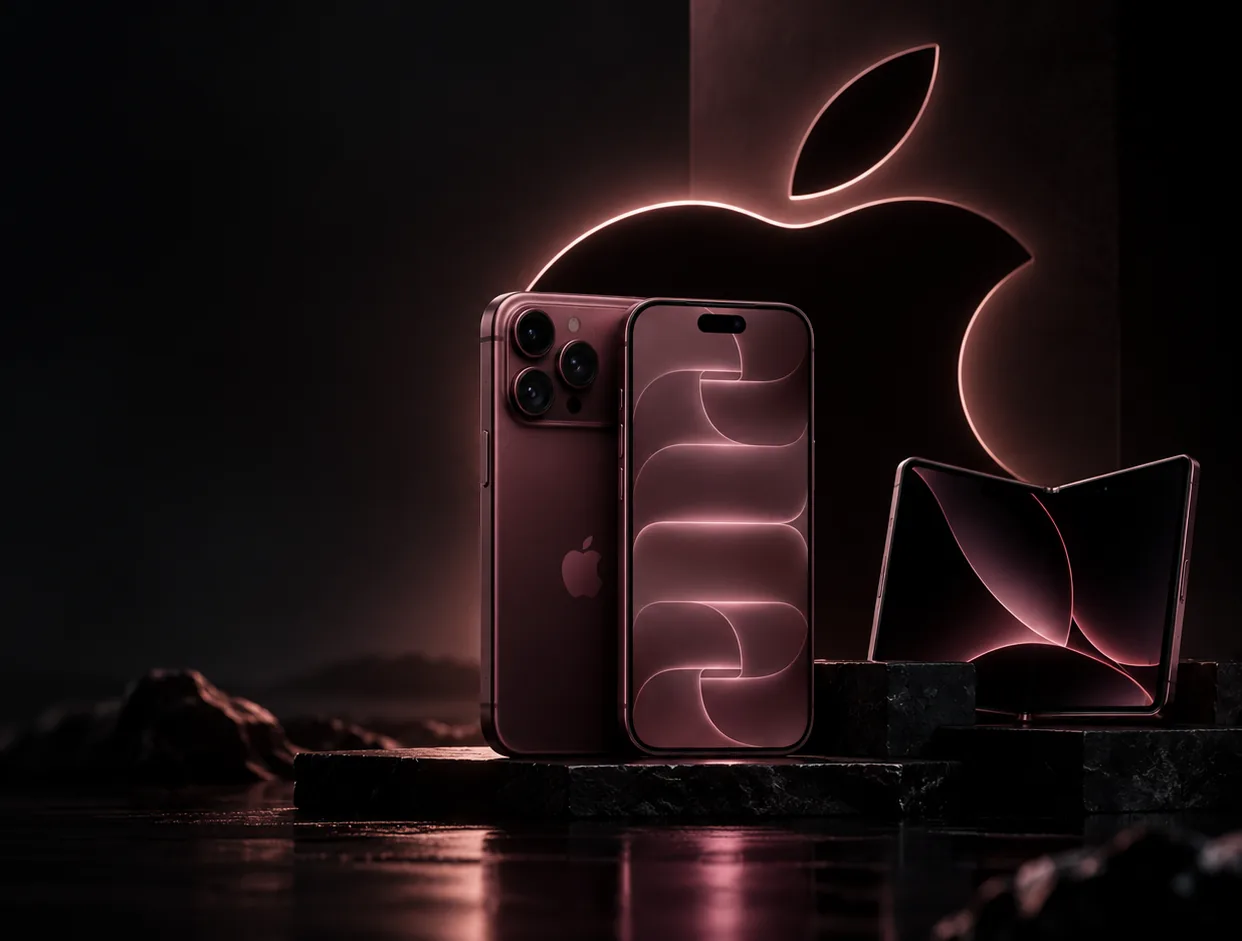
The supplied hero image for this article is a PRESDA editorial illustration, not an official Apple promotional photograph.
The products, however, point to a real strategic question: is Apple entering a new era built less around one device and more around a connected system of premium hardware, AI and services?
Confirmed By Apple: iPhone 18 Pro And iPhone 18 Pro Max
Apple officially debuted the iPhone 18 Pro and iPhone 18 Pro Max on September 9, 2026. Apple's own iPhone 18 Pro product page lists the new A20 Pro chip, a vapor-cooled design, a 48MP Fusion Main camera with variable aperture, redesigned Dynamic Island behavior, improved battery life and the new burgundy finish.
The Pro models are not just faster phones.
They show where Apple believes the highest-value smartphone market is moving: better cameras, more thermal headroom, on-device AI performance, longer battery life and premium materials.
The A20 Pro chip matters because AI features are increasingly limited by local compute, memory bandwidth and heat. Apple's positioning is that the phone itself should handle more intelligence privately and quickly, instead of sending every task to a cloud chatbot.
The variable-aperture main camera is also strategically important. Smartphone cameras are no longer judged only by megapixels. Apple is trying to offer more creative control while preserving the simplicity that made iPhone photography mainstream.
The smaller, more capable Dynamic Island is a subtler move. It suggests Apple still sees the iPhone screen as a live information surface, not merely a launcher for apps.
Apple is concentrating many of these advances in the Pro tier because premiumization is now central to the iPhone business. Higher-end models support stronger margins, longer upgrade cycles and deeper ecosystem attachment.
Confirmed By Apple: The First Foldable iPhone
The bigger strategic break is iPhone Duo.
Apple's iPhone Duo page describes it as the first foldable iPhone, with a foldable design, inner and outer displays, reimagined iOS experiences, Split View multitasking, a 7.6-inch inner display and the A20 Pro chip.
That makes the Duo more than a novelty.
It is Apple's entry into a category Samsung, Huawei, Honor, Oppo and others have been developing for years.
Foldables have always promised a simple dream: phone portability with tablet-like space.
The problem has been execution.
Early foldables faced concerns around durability, price, app support, creases, thickness and whether ordinary users really needed the extra screen. Apple waited until it could connect hardware, iOS, developer guidance, battery design and ecosystem services into one controlled experience.
Apple also has a habit of entering categories late and trying to redefine the commercial version. The iPod was not the first music player. The iPhone was not the first smartphone. The Apple Watch was not the first smartwatch.
The iPhone Duo follows that pattern.
It does not prove Apple invented the foldable category. It shows Apple believes the category is now mature enough to be absorbed into the iPhone ecosystem.
The Missing Standard iPhone 18
One of the most important details was what Apple did not announce.
There was no standard iPhone 18 at the September event.
That absence supports reporting that Apple is moving toward a split iPhone release cycle, with premium devices arriving in the fall and some standard or lower-cost models arriving later.
This is not the same as an Apple confirmation of every future model.
A The Verge report noted that the base iPhone 18 was absent from the fall launch and connected the move to prior reporting about a possible spring 2027 release for non-Pro models.
For Apple, a split cycle could reduce pressure on supply chains, give premium models more launch attention and create more than one iPhone sales moment per year.
For customers, it may also make the lineup more confusing.
Confirmed fact: Apple launched the iPhone 18 Pro models and iPhone Duo in September 2026.
Reported or expected: standard iPhone 18 and lower-cost models may arrive in a later cycle.
Apple's AI Strategy
Apple's AI strategy is not mainly about launching one standalone AI product.
It is about making intelligence feel like part of the device.
Apple Intelligence, Siri AI, on-device processing and Private Cloud Compute all support that direction. Apple's Private Cloud Compute security documentation explains the company's approach to running larger AI workloads in the cloud while preserving privacy guarantees.
The strategy is classic Apple.
Instead of asking users to move their lives into a separate chatbot, Apple wants AI to sit inside Messages, Photos, Safari, Siri, Camera, Health, AirPods, Apple Watch and the operating systems that connect them.
That approach has business logic.
If AI makes Apple devices more useful together, it strengthens ecosystem lock-in. If Siri AI becomes a meaningful assistant across phone, watch and audio, Apple protects the interface layer that competitors want to own.
The risk is speed.
Google, Samsung, OpenAI, Microsoft and Chinese manufacturers are moving aggressively. Apple has to prove that privacy, integration and reliability can compete with faster-moving AI launches.
Apple Watch And AirPods In The Ecosystem
The September 2026 launch also reinforced the role of wearables.
Apple introduced Apple Watch Series 12 and Apple Watch Ultra 4, with Apple highlighting health sensing, readiness and Apple Intelligence-powered features in its Apple Watch health announcement.
It also announced AirPods 5, with Apple describing open-ear active noise cancellation, improved sound and Live Translation in its AirPods 5 press release.
The point is not just specifications.
Apple Watch and AirPods extend the iPhone into the body, the ear and daily routines.
The Watch collects health and fitness signals. AirPods become a voice, translation and audio interface. The iPhone remains the command center. Services turn all of it into recurring value.
That is why Apple's product empire is hard to analyze one device at a time.
The business model is the system.
Reported / Expected - Not Yet Confirmed By Apple
Several future-product ideas remain reported or expected, not confirmed by Apple.
Reported: Apple may release a standard iPhone 18 or lower-cost iPhone model in a later cycle, potentially in 2027.
Reported: future foldable generations could expand the Duo line if demand is strong and production improves.
Reported: Apple has explored smart glasses as the industry pushes toward lighter wearable AI interfaces.
Reported: camera-equipped or AI-focused AirPods have appeared in credible technology reporting, though Apple did not announce such AirPods at this event.
Reported: future wearable and spatial computing products may connect Apple Intelligence, Vision devices, AirPods and Watch more deeply.
None of these should be treated as guaranteed products.
Apple routinely tests ideas that never ship, changes launch timing and withholds product details until it is ready to control the story.
Why This Matters For Apple
The iPhone remains central to Apple.
Apple's fiscal Q3 2026 results said iPhone, Mac and Services revenue set June-quarter records, and Apple's SEC filings continue to show the iPhone as the company's largest product line.
That creates both strength and pressure.
The iPhone funds much of the ecosystem, but mature smartphone markets make growth harder. Consumers keep phones longer. Competitors improve quickly. Regulators scrutinize app stores, payments and platform control.
Premiumization helps Apple defend revenue even when unit growth is limited.
Services help turn the installed base into recurring income.
AI helps Apple argue that older devices are less capable and new devices are more personal.
Foldables offer a possible new high-end category inside the iPhone family.
But Apple is not competing in a vacuum.
Samsung has years of foldable experience. Google is pushing AI deep into Android and Pixel. Huawei and other Chinese manufacturers remain aggressive in hardware design, camera technology and domestic-market strength.
Apple's challenge is to make its ecosystem feel meaningfully better, not merely more expensive.
Is Apple Still An Innovator?
There are two fair answers.
Critics argue that Apple often arrives late.
Foldables existed long before iPhone Duo. Generative AI became a mass-market story before Siri AI caught up. Android manufacturers have experimented with charging, cameras, displays and form factors more aggressively.
Supporters argue that Apple innovates through integration.
Its strength is not always inventing a category first. It is making a category understandable, desirable, reliable and profitable at global scale.
Those are different kinds of innovation.
Inventing a technical concept is one achievement.
Mainstreaming it for hundreds of millions of people is another.
The iPhone Duo will test whether Apple can still do the second.
The Product Empire Comes Together
Apple's next era may not be defined by one revolutionary object.
It may be defined by connection.
Phones become AI computers.
Foldables become flexible work and entertainment screens.
Watches become health and context sensors.
AirPods become voice and translation interfaces.
Services make the hardware more valuable over time.
That is the deeper meaning of the iPhone 18 cycle.
Apple is trying to make every product feel like a doorway into the same system.
The question is whether customers will see that system as useful enough to justify premium prices, slower category entry and deeper dependence on Apple's world.
For now, the strategy is clear.
Apple is not betting on one device to replace the iPhone.
It is betting that the iPhone, foldables, wearables, AI and services can become one increasingly unified product empire. For more on the companies shaping that market, read PRESDA's features on Samsung's rise from food trading to tech, the world's most valuable companies and Sam Altman's next OpenAI chapter.
FAQ
Frequently Asked Questions
What is this PRESDA article about?
Apple has entered a new hardware cycle with the iPhone 18 Pro, its first foldable iPhone and a growing focus on AI. What do these products reveal about the company's strategy for the years ahead?
Which category does this story belong to?
This story is part of PRESDA's Business coverage.
Who published this article?
APPLE'S NEXT ERA: iPHONE 18, FOLDABLES AND THE FUTURE OF ITS PRODUCT EMPIRE was published by PRESDA Editorial on PRESDA.
PRESDA Dispatch
Stay Informed. Stay Aware.
A sharp briefing across AI, gaming, sport, business, world affairs, paparazzi, and lifestyle.