ROMAN EMPIRE: POWER, LUXURY AND LIFE INSIDE ANCIENT ROME
From marble villas and extravagant banquets to gladiators, public baths, slavery, sex work and military conquest, life in the Roman Empire combined breathtaking achievement with violence and inequality.
Ancient Rome is easy to imagine badly.
One version is all marble, columns, banquets, emperors and golden light. Another is all blood, conquest, slavery and spectacle.
The real Roman Empire was both more impressive and more disturbing than either fantasy. It built roads across continents, moved water through aqueducts, filled cities with baths and temples, governed provinces from Britain to Syria and left legal, linguistic and architectural traces that still shape the world.
It also rested on conquest, extraction, hierarchy and slavery. Behind elite villas stood workers with no freedom. Behind public entertainment stood violence. Behind imperial order stood armies, taxation and the threat of punishment.
So the central question is not only how Rome conquered so much territory. It is this: what was it really like to live inside the Roman Empire?
The answer depends on who you were. A senator, an enslaved cook, a soldier on the Rhine, a shopkeeper in Pompeii, a woman managing family property, a prostitute in a brothel, a child in a crowded apartment and an emperor in a palace all lived in Rome's world. They did not live the same Roman life.
For more PRESDA history context, read Al-Andalus, the Egyptian pyramids and the history of medicine.
What Was Life Like In The Roman Empire?
Life in the Roman Empire could mean astonishing public infrastructure, lively streets, religious festivals, markets, baths, theaters, military service, family ambition and social mobility for some people. It could also mean disease, cramped housing, legal inequality, coercive labor, political fear and a daily awareness that status decided almost everything.
The empire was not one uniform place. Rome, Alexandria, Antioch, Carthage, Londinium and a military settlement near the Danube belonged to the same imperial system, but their languages, customs, risks and opportunities differed.
Roman identity itself changed over time. In the early empire, citizenship was a privileged legal status. In 212 CE, the emperor Caracalla extended Roman citizenship to nearly all free inhabitants of the empire. Even then, class, gender, wealth, enslavement and local power shaped what that citizenship meant in practice.
From A Small City To An Empire
Roman tradition said the city was founded by Romulus in 753 BCE. That story belonged to mythology and civic memory, not straightforward modern history. Archaeology and historical evidence point instead to Rome emerging gradually from communities in central Italy.
Early Rome was ruled by kings, then by a republic in which aristocratic families, assemblies, magistrates and the Senate competed for power. The Roman Republic expanded first across Italy, then into the wider Mediterranean.
The Punic Wars against Carthage were decisive. Rome's victories gave it power over the western Mediterranean and eventually opened the way to conquest in Greece, North Africa, Asia Minor, Gaul and beyond.
Expansion made Rome rich, but it also destabilized the Republic. Military commanders gained personal loyalty from soldiers. Inequality widened. Civil wars followed. Julius Caesar's rise and assassination exposed how badly the old political order had fractured.
Augustus And The Birth Of The Roman Empire
After Caesar's murder, another round of civil war brought Octavian, Caesar's adopted heir, to power. In 27 BCE, he took the honorific name Augustus and presented himself as the restorer of Roman order.
Augustus did not announce that the Republic was dead. His genius was subtler. Republican offices, the Senate and public language remained, but real power increasingly centered on the emperor, the army, imperial finances and provincial administration.
The period after Augustus is often associated with the Pax Romana, the Roman peace. The phrase is useful only if handled carefully. It did not mean the empire was peaceful everywhere. Wars, rebellions, executions and border violence continued. But compared with the late Republican civil wars, many regions experienced more predictable imperial administration, trade and infrastructure.
How Powerful Did The Roman Empire Become?
The Roman Empire reached its greatest territorial extent under Trajan in the early second century CE. Its power stretched around the Mediterranean and into parts of Europe, North Africa and the Middle East.
The Mediterranean was the empire's great internal highway. Grain, wine, olive oil, soldiers, enslaved people, officials, letters, marble, taxes and ideas moved by sea and road. Control of ports and shipping mattered as much as control of frontiers.
Population estimates vary, and ancient demographic numbers should be treated cautiously. Still, historians generally describe the Roman Empire as one of the largest and most populous political systems of the ancient world.
Power was administrative as well as military. Provinces paid taxes. Cities governed local affairs under imperial oversight. Roads and ports tied regions together. The army guarded borders, built infrastructure and sometimes decided who became emperor.
The Emperors: Power Without Limits?
Roman emperors could command armies, appoint officials, spend enormous resources, shape law and present themselves as protectors of the Roman world. But their power was never as simple as a king snapping his fingers.
Augustus built the imperial system. Claudius expanded administration and conquest. Nero became a symbol of dangerous excess, though ancient writers had political and moral agendas. Vespasian stabilized the empire after civil war and founded the Flavian dynasty. Trajan represented imperial expansion. Hadrian consolidated and traveled widely. Marcus Aurelius became remembered as a philosopher-emperor ruling during war and plague. Commodus showed how fragile succession could be. Diocletian reorganized imperial government. Constantine reshaped the empire's relationship with Christianity.
Stories about emperors such as Caligula and Nero can be sensational because ancient authors loved moral drama and wrote from elite political viewpoints. Some scandals may preserve real abuses. Others may be exaggerated, hostile or symbolic. Responsible history reads them critically.
Emperors also depended on the army, elite cooperation, provincial administration and public legitimacy. A ruler who lost military support could fall quickly. Imperial power looked limitless from below, but from inside the palace it was often anxious, theatrical and dangerous.
How Rich Were Ancient Romans?
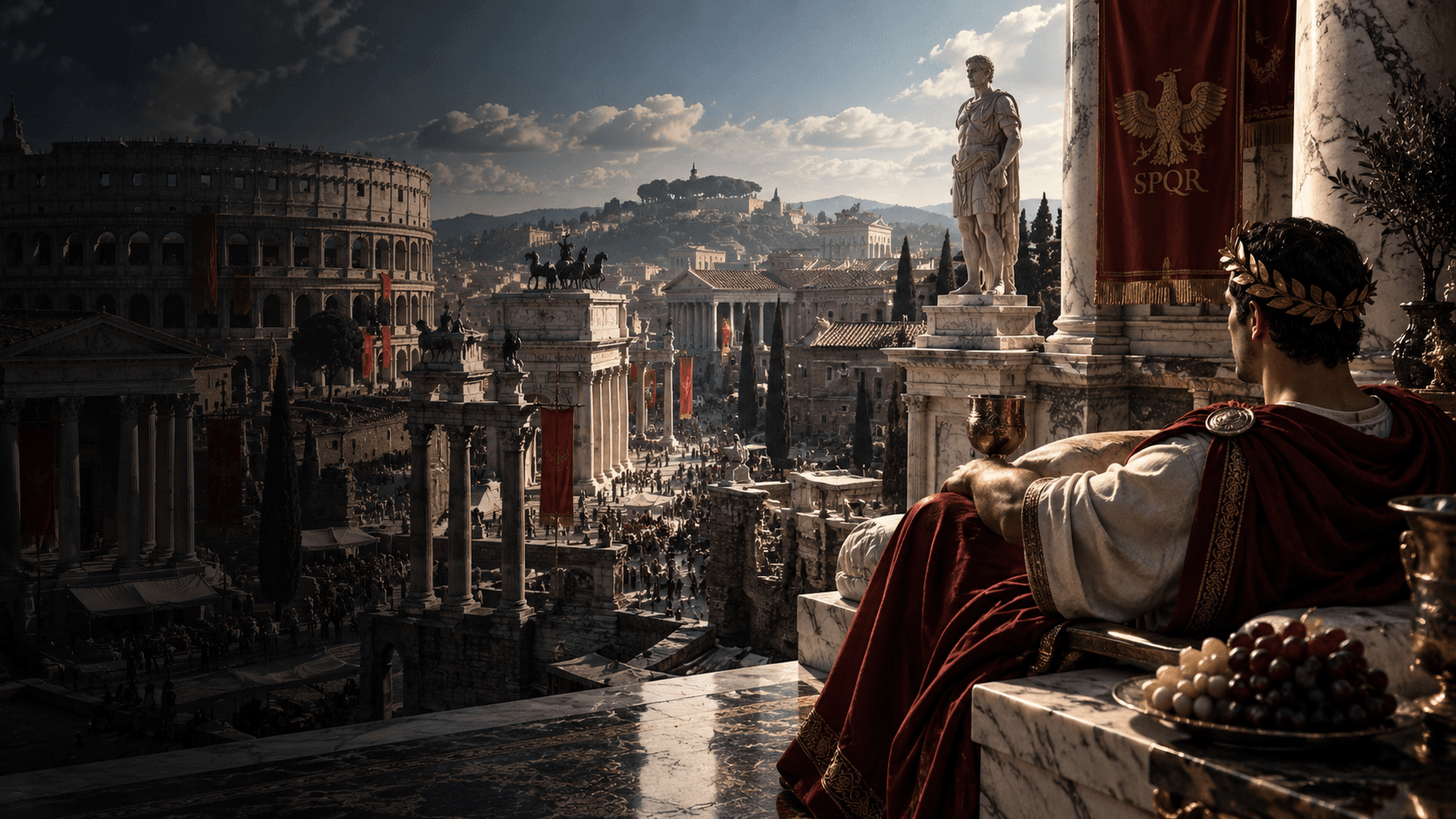
A tiny wealthy minority could live with extraordinary luxury. Elite Romans displayed status through houses, estates, marble, mosaics, fountains, wall paintings, imported foods, silverware, jewelry, perfumes, fine textiles, libraries and large households of servants and enslaved workers.
Architecture made wealth visible. An elite house was not only a private shelter. It was a stage for receiving clients, negotiating status and showing taste. Atriums, reception rooms and dining spaces communicated rank before a guest even sat down.
Country estates could produce agricultural wealth while also offering leisure. Villas combined farming, display, retreat and power over labor. For the richest families, luxury was not merely comfort. It was a public language of dominance.
But this was not normal Roman life. Most people did not recline in marble dining rooms beside fountains. Many lived in apartments, rented rooms, workshops, barracks or rural communities. The empire's richest households were real, but they were never the whole of Rome.
Inside A Roman Villa
Pompeii and Herculaneum preserve some of the clearest evidence for Roman domestic space. Elite houses could include an atrium, an impluvium to collect rainwater, reception areas, bedrooms, service spaces, a triclinium for dining and a peristyle garden surrounded by columns.
Walls might be covered in frescoes. Floors could be laid with mosaics. Gardens used plants, fountains, sculpture and shade to create controlled beauty inside the house. Kitchens and service rooms remind us that comfort depended on labor.
These houses were designed partly for social choreography. Clients might wait in public-facing areas. Guests might be guided deeper into the home depending on status. A Roman house could separate, reveal and rank people through architecture.
Private baths existed in some wealthy settings, but bathing was also a public habit. The domestic ideal of quiet luxury and the urban reality of shared public life were both Roman.
The Roman Banquet
The elite Roman banquet took place in a triclinium, where guests reclined while eating and drinking. The meal could display wealth through imported wine, seafood, fruit, meats, sauces, tableware, musicians, dancers, poetry or conversation.
Garum, a fermented fish sauce, flavored many dishes. Bread, olives, fruit, vegetables, wine and fish appeared in different forms across Roman diets. The very richest tables could become theater: rare ingredients, elaborate presentation and social competition.
Some famous accounts of extravagant banquets come from satire or moralizing literature. They tell us something important about Roman anxieties over luxury, but they should not be read as proof that every elite meal was absurdly excessive.
One myth deserves burial: vomitoria were not rooms where Romans vomited so they could keep eating. A vomitorium was an architectural passageway that helped crowds move in and out of large venues.
Sex, Prostitution And The Roman Double Standard
Sex work existed openly in Roman society, but openness did not mean equality or liberation. Prostitution involved women and men, and it took place in brothels, taverns, inns, streets and other settings.
Status shaped Roman sexual morality. Elite male behavior was judged differently from female behavior. Citizenship, gender, enslavement, freedom, age and social class mattered deeply. A freeborn elite woman's sexual reputation could affect family honor, inheritance and politics.
Many sex workers were enslaved or formerly enslaved. That fact changes the moral picture. Roman prostitution was not simply a market of free choices. It often involved exploitation, legal vulnerability and unequal power.
The Roman state could regulate or tax aspects of sex work, but regulation did not protect everyone equally. A society can be sexually visible and still be deeply coercive.
Did Ancient Rome Have Brothels?
Yes. Pompeii preserves one of the most famous archaeological examples: the Lupanar. The term is connected to lupa, a word that could mean she-wolf and was also used in sexual slang for a prostitute.
The Pompeian Lupanar had small rooms, masonry beds and erotic wall paintings. Graffiti and the building's layout provide rare evidence for how such a place functioned in an urban Roman environment.
Archaeology can show rooms, images, inscriptions and patterns of use. It cannot recover every personal story. We should be careful not to turn the people who lived and worked there into decoration for modern curiosity.
The Lupanar matters because it makes the social world of Roman sex work concrete. It also reminds us that behind every famous ruin were human beings with unequal choices.
Love, Marriage And Adultery
Roman marriage was a family and property institution as well as an emotional relationship. Elite marriages could build alliances, preserve inheritance and connect powerful houses.
Divorce was possible, especially among elites, and remarriage could be politically useful. Women in some circumstances could own property, manage business and influence family strategy, although legal and social expectations remained unequal.
Augustus promoted moral legislation that targeted adultery and elite family behavior. These laws were not simply private morality. They connected sex, fertility, inheritance and the political image of Roman renewal.
Roman love poetry can sound intimate and modern, but it came from specific elite literary worlds. As with all Roman evidence, genre matters.
Women In Ancient Rome
Roman women were neither powerless shadows nor modern equals. Their lives depended on class, legal status, family, wealth, age, location and time period.
Elite women could influence politics through family networks, patronage, property and public reputation. Some managed estates or businesses. Freedwomen and working women appear in inscriptions, shops, tombs and urban life. Religious roles, including the Vestal Virgins, could carry exceptional status.
At the same time, Roman society remained patriarchal. Political office, military command and formal public authority were overwhelmingly male. Female sexuality was policed more heavily than male sexuality, especially among elites.
The most honest answer is mixed: Roman women could exercise real agency in certain spaces, but they did so inside structures built around male power, family control and status hierarchy.
Slavery: The Price Of Roman Luxury
Slavery was central to Roman society. Enslaved people worked in homes, farms, mines, workshops, construction, administration, education, entertainment and sexual exploitation.
Some enslaved people were highly skilled. Some worked as tutors, accountants, secretaries, artisans or managers. Others endured brutal agricultural, mining or domestic labor. Legal status, not talent, defined their lack of freedom.
Manumission allowed some enslaved people to become freedmen or freedwomen, and some freed people gained wealth or influence. That possibility should not soften the reality: slavery was coercive ownership of human beings.
Behind many luxurious villas were people who could be bought, sold, punished and separated from family. Rome's beauty cannot be separated from the labor systems that made it possible.
Rome Beyond The Palaces
Most urban Romans did not live in villas. Many lived in insulae, apartment buildings that could be crowded, noisy and vulnerable to fire or collapse.
Streets were busy with vendors, carts, animals, workshops, religious activity, political notices, arguments and smells. Food could be bought from shops and street stalls. Work and home often overlapped.
Public life mattered because private space was limited. Baths, fountains, markets, temples, theaters and streets became extensions of daily life.
Poverty was not picturesque. Disease, poor sanitation, debt, insecurity and dependence on patrons or employers shaped many lives. Rome's monumental center existed beside difficult urban realities.
What Were Roman Baths Really Like?
Roman baths were social institutions as much as washing facilities. Large thermae could include hot rooms, warm rooms, cold pools, exercise spaces, gardens, libraries and places for conversation.
The usual sequence might involve exercise, sweating, bathing and relaxation, though practice varied. The caldarium was hot, the tepidarium warm and the frigidarium cold.
Baths were places to meet friends, hear news, discuss business and participate in urban culture. The great Baths of Caracalla in Rome show how imperial architecture could turn bathing into a monumental public experience.
They also reveal inequality. Not everyone had the same access to comfort, privacy or hygiene. Public bathing was impressive, but Rome was not a modern sanitary city.
Water, Toilets And Sewers
Roman water engineering was extraordinary. Aqueducts carried water across long distances into cities, supplying fountains, baths, households, workshops and public spaces.
The Cloaca Maxima became a symbol of Rome's drainage and sewer systems. Public latrines existed, and urban water management was one of the empire's great technical achievements.
But modern comparisons can mislead. Water access was unequal. Disease remained common. Sewers and latrines did not create a hygienic environment by modern standards.
Rome's achievement was scale and organization: moving water, draining spaces, supplying public amenities and making infrastructure part of imperial identity.
The Colosseum: Blood, Politics And Entertainment
The Colosseum was built under the Flavian dynasty and opened in the first century CE. It became one of Rome's most famous monuments because it combined architecture, violence, politics and crowd management.
Events could include gladiatorial combat, animal hunts and executions. Capacity estimates vary, but the amphitheater held tens of thousands of spectators.
Games were not only entertainment. They were political theater. Emperors and elites displayed generosity, control and power by sponsoring spectacles for the people.
The arena turned violence into public ritual. That is part of why the Colosseum still unsettles us: it is beautiful architecture built for deadly performance.
Who Were The Gladiators?
Gladiators included enslaved fighters, prisoners, condemned criminals and volunteers. They trained in schools and fought in specialized styles with different weapons and armor.
Some gladiators became famous. Their images appeared in graffiti and objects. Popularity, however, did not erase danger or low status.
Not every gladiator fight automatically ended in death. Trained fighters represented investment, and many contests ended before a killing blow. But the risk was real, and arena violence was part of the appeal.
Gladiators occupied a paradoxical place: admired by crowds, erotically charged in popular imagination, yet socially degraded and often unfree.
Chariot Racing: Rome's Real Mass Sport
If gladiators dominate modern imagination, chariot racing may have been Rome's greater mass passion. The Circus Maximus could gather enormous crowds for races between faction teams traditionally known by colors such as Reds, Whites, Blues and Greens.
Drivers could become celebrities. Fans gambled, argued and identified fiercely with factions. Racing combined danger, speed, skill, money and group loyalty.
The sport also shows that Roman entertainment was not only blood in amphitheaters. It was noise, rivalry, celebrity culture and public emotion on a vast scale.
Why Was The Roman Army So Powerful?
The Roman army succeeded because of organization, training, discipline, logistics, engineering and adaptation. Legionaries, auxiliaries, officers, supply networks and fortifications made conquest possible.
Roman soldiers built roads, camps, walls, bridges and siege works. Military power and engineering were not separate fields. The army could fight, build and administer.
Auxiliary troops from provinces expanded Rome's military capacity and often brought specialized skills. Service could eventually lead to citizenship for some non-citizen soldiers.
But the Roman army was not permanently invincible. It lost battles, faced rebellions, changed structure over time and sometimes became the kingmaker in imperial politics.
Engineering An Empire
Roman engineering worked through scale, repetition and adaptation. Roads connected armies and trade. Bridges crossed rivers. Harbors moved goods. Aqueducts supplied cities. Arches, vaults, domes and concrete allowed ambitious buildings.
Romans inherited much from earlier Mediterranean civilizations, including Greek and Etruscan traditions. Their achievement was not inventing everything from nothing. It was deploying techniques across an empire with astonishing consistency and ambition.
The Pantheon remains one of the most famous examples of Roman concrete and dome construction. The Pont du Gard shows aqueduct engineering as both utility and monument. Roman roads turned geography into administration.
Infrastructure communicated power. A road, bridge or aqueduct told provincial populations that Rome could organize space itself.
Pompeii: A Roman City Frozen In Time
Pompeii is invaluable because it preserves an ordinary Roman city in extraordinary circumstances. Homes, shops, bakeries, taverns, baths, shrines, political notices, graffiti and brothels survive in a way that lets archaeologists reconstruct daily life with unusual detail.
The eruption of Mount Vesuvius in 79 CE buried Pompeii, Herculaneum and nearby settlements. The disaster was catastrophic for the people who lived there, but it preserved evidence that later historians could never have recovered from texts alone.
Pompeii shows Rome from below as well as above: commercial life, street politics, domestic decoration, food production, slavery, religion and sex work all appear in the archaeological record.
For more on how natural hazards become human disasters, read PRESDA's feature on earthquakes, volcanoes and tsunamis.
What Did Romans Eat?
Ordinary Roman diets were far less extravagant than elite banquet stories suggest. Many people relied on bread, grain, legumes, vegetables, olives, fruit, wine, cheese and fish sauce.
Food differed by region, class and season. Urban residents might buy prepared food from shops because cooking space at home was limited. Rural diets depended on local production.
Meat, seafood and imported luxuries existed, but access varied sharply. A senator's dining room and a laborer's meal belonged to the same empire, not the same food world.
Roman food history is most interesting when it shows inequality: who grew food, who transported it, who cooked it, who served it and who got to feast.
Religion Before Christianity
Roman religion was plural and practical. Jupiter, Juno, Minerva, Mars, Venus and many other deities belonged to public worship. Household gods protected family spaces. Rituals, vows, sacrifices and festivals tied religion to civic life.
The empire also contained local gods, mystery cults, philosophical traditions, Judaism and many imported religious practices. Rome often absorbed and reinterpreted divine powers rather than enforcing one simple religious identity.
The imperial cult connected loyalty to Rome with honors paid to emperors or imperial power. In the provinces, religion could express both local identity and participation in the imperial order.
When The Roman Empire Became Christian
Constantine's reign transformed Christianity's position in the Roman world. After the Battle of the Milvian Bridge in 312, Constantine favored Christianity, and the Edict of Milan in 313 helped establish legal toleration.
Constantine supported Christian institutions and convened the Council of Nicaea in 325, but he did not instantly make Christianity the official religion of Rome.
That later shift developed across the fourth century. Under Theodosius I, Nicene Christianity became closely tied to imperial authority, and traditional public cults faced increasing restrictions.
Christianization was not a single moment. It was a long transformation of law, patronage, identity, architecture and everyday practice.
The Dark Side Of Roman Power
Roman achievement came with a human cost. Conquest killed and displaced people. Slavery moved human beings as property. Taxes extracted resources. Political violence removed rivals. Arena executions made punishment public.
Civil wars devastated Roman communities as much as foreign enemies did. Emperors could use treason charges, confiscation and execution. Provincial revolts could be crushed brutally.
Admiring Roman engineering does not require excusing Roman domination. The empire's roads and aqueducts were real achievements. So were its systems of coercion.
Rome's contradictions are not a modern invention. Ancient Romans themselves argued about luxury, corruption, virtue, cruelty, citizenship and power.
Why Did The Roman Empire Fall?
The Roman Empire did not fall because of one simple cause. The western empire fragmented through political instability, civil wars, succession crises, military pressures, fiscal strain, administrative division, changing army structures, migration and the rise of Germanic kingdoms inside former imperial territory.
The traditional date 476 CE marks the removal of Romulus Augustulus, often described as the last western Roman emperor. That date is useful as a symbol, but it can mislead if treated as a sudden collapse.
Western imperial authority had been weakening for generations. Power shifted to generals, regional elites and successor kingdoms. Roman institutions did not vanish overnight.
The fall of Rome is better understood as a long transformation than a single dramatic ending.
Did Rome Really Fall In 476?
Only the western imperial office ended in 476. The Eastern Roman Empire continued from Constantinople for almost another thousand years.
Modern historians often call that later eastern empire the Byzantine Empire, but its inhabitants continued to understand themselves as Romans. They used Roman law, imperial titles and a Roman political identity even as language, religion and territory changed.
This matters because saying Rome disappeared in 476 erases half the story. The western empire fractured; Roman imperial life continued in the east until Constantinople fell in 1453.
The Roman legacy also continued in law, church structures, languages, architecture and political imagination long after emperors disappeared from the west.
What Did The Roman Empire Leave Behind?
Rome left roads, bridges, aqueducts, arches, domes, urban plans, legal concepts, literature, political vocabulary and the Latin language, which later shaped the Romance languages.
Christianity's rise inside the Roman world shaped European, Mediterranean and Middle Eastern history. Roman law influenced later legal traditions. Roman architecture became a model for power from Renaissance palaces to modern government buildings.
But modern Europe is not simply Rome continued. Roman inheritances were reused, contested, transformed and mythologized by later societies.
The empire's most durable legacy may be its double image: a warning about domination and a model of infrastructure, administration and ambition.
Roman Empire: Myth Vs Reality
MYTH: Romans spent every day at orgies and banquets.
REALITY: Extreme luxury existed among some elites, but most Romans lived ordinary working lives shaped by status, labor, family and survival.
MYTH: Vomitoria were rooms for vomiting after meals.
REALITY: Vomitoria were architectural passageways that moved crowds through large venues.
MYTH: Every gladiator fight ended in death.
REALITY: Many fights did not end in death, although gladiatorial combat remained dangerous and violent.
MYTH: Roman society was sexually liberated in the modern sense.
REALITY: Roman sexual behavior was heavily shaped by gender, citizenship, class, slavery and power.
MYTH: Rome suddenly disappeared in 476.
REALITY: Western imperial authority fragmented over centuries, while the Eastern Roman Empire continued much longer.
MYTH: Every Roman lived surrounded by marble and fountains.
REALITY: Luxury belonged primarily to elites. Many urban residents lived in crowded apartments and worked hard for uncertain security.
Power, Luxury And Contradiction
Ancient Rome was magnificent and brutal at the same time.
Its richest citizens could live among marble, gardens, fountains, art, wine and banquets while enslaved people worked behind those walls.
Its engineers moved water across enormous distances. Its soldiers connected and conquered territories across continents. Its arenas transformed violence into mass entertainment. Its streets contained senators, merchants, workers, immigrants, prostitutes, soldiers, enslaved people and emperors.
Rome's greatness cannot be understood without its contradictions.
Ancient Rome was never simply a city of marble palaces, nor merely an empire built by conquest. It was both. Behind the fountains and mosaics stood an enormous system of labor, military power and inequality. Yet the roads, laws, languages, buildings and ideas Rome left behind survived long after its emperors disappeared. The empire eventually fell. Its shadow never really did.
FAQ
Frequently Asked Questions
What was life like in the Roman Empire?
Life in the Roman Empire depended heavily on status. Elites could enjoy villas, banquets and public influence, while many ordinary people lived in crowded apartments, worked in shops or farms, served in the army or endured slavery.
Did Ancient Rome have brothels?
Yes. Sex work existed in Roman society, and Pompeii preserves the famous Lupanar, a brothel with small rooms, wall paintings and graffiti. Many sex workers were enslaved or formerly enslaved, so the subject must be treated as exploitation as well as social history.
Did every gladiator fight end in death?
No. Many gladiator fights did not end in death. Trained gladiators represented investment, although combat remained dangerous and arena violence was central to Roman spectacle.
Why did the Roman Empire fall?
The western Roman Empire fragmented through many pressures, including political instability, civil wars, fiscal strain, military challenges, migration and the rise of successor kingdoms. The year 476 CE is symbolic, not a single instant when Roman civilization disappeared.
Did Rome really end in 476?
Western imperial authority ended in 476 CE, but the Eastern Roman Empire continued from Constantinople for almost another thousand years. Its inhabitants continued to understand themselves as Romans.
PRESDA Dispatch
Stay Informed. Stay Aware.
A sharp briefing across AI, gaming, sport, business, world affairs, paparazzi, and lifestyle.