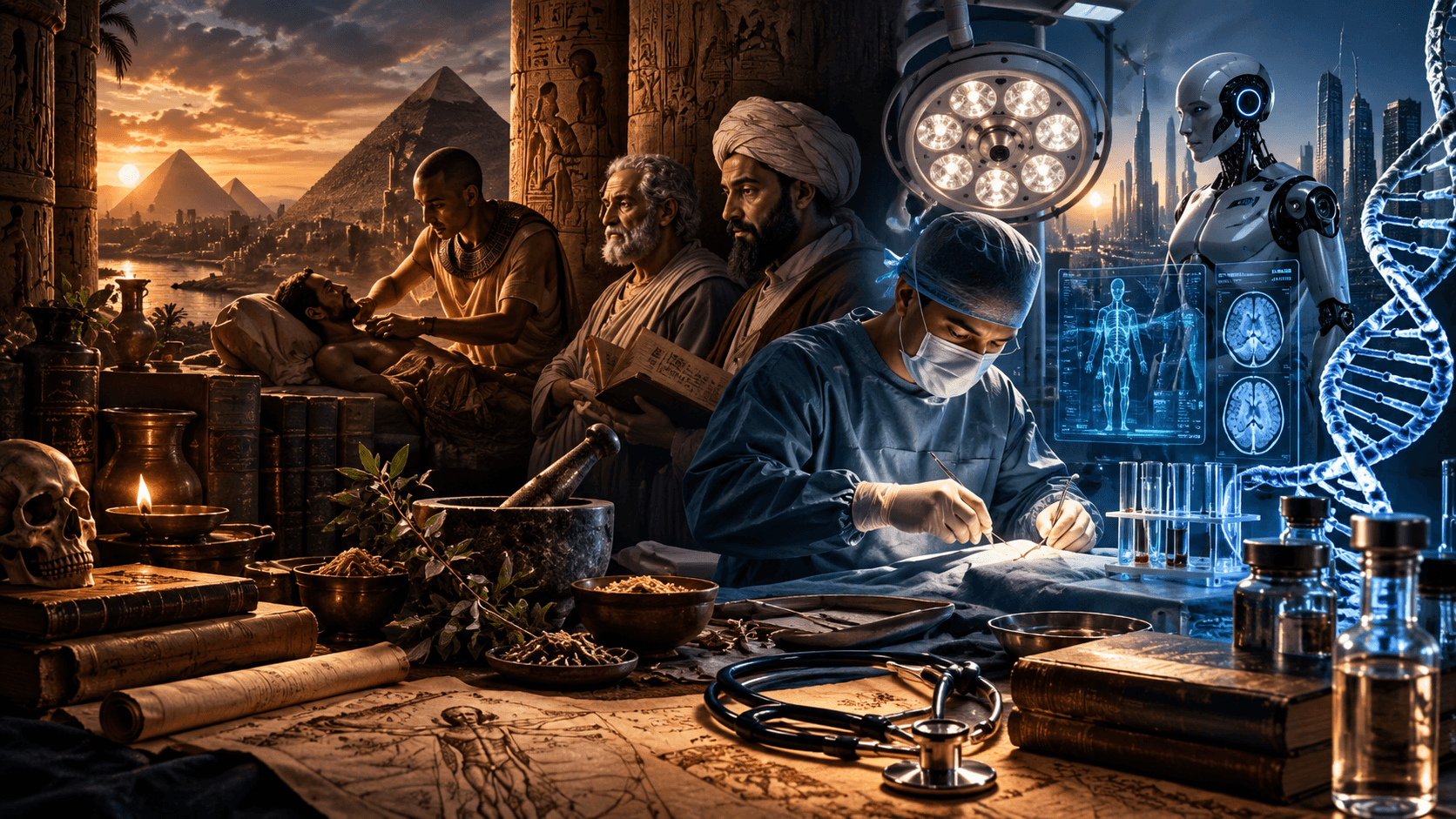
MEDICINE: THE HISTORY AND FUTURE OF HUMAN HEALTH
From ancient remedies and early surgery to vaccines, antibiotics, organ transplants, genetics and artificial intelligence, medicine is the story of humanity learning how the body works - and how to keep it alive.
For most of human history, sickness arrived without explanation.
A fever could burn through a village. A wound could turn fatal. Childbirth could become dangerous within hours. Pain, infection, cancer, epidemics, broken bones, mental illness and inherited disease all existed long before humans understood cells, bacteria, viruses, immunity or genetics.
People still tried to heal.
They watched which plants eased pain, which wounds closed, which foods harmed, which fevers spread and which rituals comforted the frightened. Early medicine mixed observation, herbal remedies, practical treatment, religion, ritual and supernatural explanation because the tools for seeing microbes, organs, blood chemistry and DNA did not yet exist.
Ancient medicine should not be mocked as unintelligent. It was limited by evidence, instruments and theory. The long history of medicine is the story of humanity slowly learning where illness comes from, then learning how to intervene more precisely.
Medicine Before Written History
Medicine began before writing.
Archaeology cannot recover every remedy or spoken explanation, but it can show that prehistoric communities cared for injured people. Healed fractures, dental wear, trepanation holes in skulls and survival after serious injury suggest practical knowledge, wound care and social support.
Trepanation, the deliberate opening of the skull, appears in several ancient contexts. The reasons were probably varied: trauma treatment, ritual, neurological symptoms or beliefs we cannot fully reconstruct. Some individuals survived long enough for bone healing to occur.
Evidence for medicinal plants is harder to prove. Plant residues, dental calculus and ethnobotanical parallels can suggest use, but archaeology must be cautious. A plant found near a burial does not automatically prove a medical prescription.
What can be said with confidence is that care is old. Humans did not wait for modern science to respond to suffering.
Ancient Mesopotamia
Some of the earliest written medical traditions come from Mesopotamia.
Cuneiform tablets show a world in which healing combined observation with religious and spiritual interpretation. Illness could be described through symptoms, prognosis and remedies, but it could also be understood through divine displeasure, demons or ritual impurity.
This was not a simple divide between rational and irrational medicine. A healer might use bandages, oils, plants and diagnostic observation while also reciting incantations or consulting omens.
Surviving texts show that ancient physicians classified symptoms, prepared treatments and recorded patterns. They worked without microscopy, anatomy labs or germ theory, but they were not guessing randomly.
Mesopotamian medicine gives us one of the first written signs of a pattern that would repeat for millennia: practical care living beside cosmology.
Ancient Egypt: Medicine Written On Papyrus
Ancient Egyptian medicine is unusually visible because some medical papyri survived.
The Edwin Smith Papyrus is famous for its surgical and trauma cases. It describes wounds, fractures, examinations and prognoses in a structured way. The Ebers Papyrus preserves a wider range of remedies, including plant, mineral and animal-based preparations, alongside magical and religious formulas.
Egyptian healers treated wounds, splinted fractures, managed abscesses and used dressings. They observed the body carefully, and embalming may have contributed indirect anatomical knowledge.
But their medicine should not be exaggerated into modern surgery. They did not understand circulation, microbes, anesthesia, antibiotics or cellular pathology.
The achievement is still real. Egyptian medicine combined hands-on treatment, pharmacological experimentation and spiritual ideas in a literate medical culture that influenced later traditions.
Hippocrates And Natural Explanations Of Disease
Hippocrates of Kos became one of the symbolic names of medicine.
The Hippocratic tradition emphasized observation, prognosis, clinical description and the idea that illness could have natural causes rather than being only divine punishment. That shift mattered enormously.
The Hippocratic Corpus, however, is not the work of one man alone. It is a collection of texts from different authors and periods associated with a medical tradition.
The famous theory of the four humours - blood, phlegm, yellow bile and black bile - was wrong. It shaped medicine for centuries, but it did not describe human physiology accurately.
The Hippocratic legacy is therefore mixed: stronger clinical observation and ethical reflection, tied to theories that later science had to replace.
The Hippocratic Oath also has a complicated history. It is not identical to every modern medical oath, but it helped root medicine in duties of restraint, confidentiality and responsibility.
Galen: The Doctor Who Influenced Medicine For Centuries
Galen, a Greek physician working in the Roman world, became one of the most influential medical authorities in history.
He wrote extensively on anatomy, physiology, diagnosis, treatment and philosophy. Some of his observations were valuable. His emphasis on anatomy and bodily systems gave later physicians a vast framework for thinking about illness.
But Galen's authority also slowed correction.
Because much of his anatomy depended on animal dissection, some conclusions about the human body were wrong. For centuries, reverence for Galen made it harder for later physicians to challenge inherited errors.
Galen shows a recurring medical lesson: authority can preserve knowledge, but it can also freeze mistakes.
The Islamic Golden Age Of Medicine
Medicine advanced substantially across the Islamic world from the eighth century onward.
Scholars translated Greek, Syriac, Persian and Indian medical knowledge, preserved earlier texts and then criticized, reorganized and expanded them. This was not passive copying. It was an active intellectual culture with hospitals, pharmacies, clinical teaching and medical encyclopedias.
Al-Razi, known in Latin as Rhazes, wrote influential works on clinical medicine and is often associated with careful descriptions of smallpox and measles. He emphasized observation and experience while working inside the medical theories of his era.
Pharmacology expanded through the study of compound drugs, materia medica and practical preparation. Medical writers discussed diagnosis, hygiene, diet, surgery, ophthalmology and public care.
Hospitals, or bimaristans, became important institutions in several Islamic cities. They could provide treatment, teaching and organized care, supported by charitable endowments in some contexts.
The Islamic Golden Age of medicine matters because it formed a bridge and an engine: preserving ancient knowledge while producing new synthesis, commentary and practice.
Ibn Sina And The Canon Of Medicine
Ibn Sina, known in Europe as Avicenna, was one of the most important physicians and philosophers of the medieval world.
His Canon of Medicine organized medical knowledge into a systematic encyclopedia covering principles of medicine, drugs, diseases, diagnosis and treatment. It drew on earlier traditions, including Galenic medicine, but arranged them with extraordinary intellectual ambition.
The Canon influenced medical education across the Islamic world and Europe for centuries.
That does not mean Ibn Sina personally invented every concept later associated with medicine. His importance lies in synthesis, organization, criticism and transmission.
The Canon shows how medicine advances not only through sudden discoveries, but through making knowledge teachable.
Hospitals Become Institutions
Hospitals did not begin as modern high-tech treatment centers.
Across different civilizations, places of care often developed from charity, religious duty, shelter, military medicine and community need. Over time, some institutions became increasingly focused on diagnosis, treatment, training and administration.
Islamic bimaristans are especially important in this story because several were organized spaces of medical care and teaching, with physicians, wards and pharmacy functions.
European hospitals also evolved through monasteries, charitable foundations, urban institutions and later academic medicine.
The modern hospital is therefore not one invention. It is a long institutional transformation: from shelter and mercy toward coordinated diagnosis, treatment, surgery, nursing, education and research.
Renaissance: Opening The Human Body
In 1543, Andreas Vesalius published De humani corporis fabrica.
The book changed anatomy because Vesalius emphasized direct observation of the human body. Human dissection corrected important errors inherited from Galen and forced physicians to compare authority with evidence.
Anatomy did not immediately make doctors able to cure most diseases. Knowing the body more accurately is not the same as having antibiotics, anesthesia or intensive care.
But anatomy transformed the foundation of medicine.
It made the human body a subject that could be examined, mapped, illustrated and corrected through observation.
William Harvey And The Circulation Of Blood
In the seventeenth century, William Harvey demonstrated that blood circulates through the body and that the heart functions as a pump.
His 1628 work, usually known by its shortened Latin title De Motu Cordis, marked a major shift toward experimental physiology.
Harvey used measurement, animal experiments and reasoning about volume to argue that blood could not be endlessly consumed and remade in the older Galenic model.
The result was more than a correction. It showed that the body could be understood as a system with movement, pressure and measurable function.
Modern cardiology begins much later, but Harvey changed the questions medicine could ask.
Before Anesthesia: When Surgery Meant Agony
Before effective anesthesia, surgery was constrained by pain.
Operations had to be fast. Shock, terror, infection and bleeding limited what surgeons could attempt. Many procedures were amputations, drainage of abscesses, removal of stones or emergency interventions.
The public demonstrations of ether anesthesia in the 1840s, followed by chloroform use and other anesthetic developments, transformed surgery.
The change should not be reduced to a single heroic inventor. Many practitioners experimented with pain relief, and adoption varied. But the broad historical impact is clear.
Anesthesia allowed surgeons to operate more carefully, for longer and inside the body in ways previously impossible.
It removed pain as surgery's central clock.
The Simple Idea That Doctors Should Wash Their Hands
Ignaz Semmelweis observed a deadly pattern in nineteenth-century Vienna.
Women giving birth in one clinic had much higher rates of puerperal, or childbed, fever than women in another. Semmelweis connected the deaths to medical students and doctors moving from autopsies to obstetric examinations.
When he introduced hand cleansing with chlorinated lime, mortality fell sharply.
Today, the basic logic seems obvious: contaminated hands can transmit infectious material. At the time, before germ theory was widely accepted, his explanation clashed with medical assumptions and professional habits.
The resistance to Semmelweis should be handled carefully. It was not one simple story in which every doctor rejected hygiene for the same reason. It involved incomplete theory, institutional politics, communication failures and discomfort with blame.
Still, the lesson is hard to miss. A simple intervention can be revolutionary when it is attached to the right causal understanding.
Germ Theory Changes Everything
Before germ theory, many physicians explained epidemic disease through miasma: bad air, foul smells or environmental corruption.
Miasma theory was not irrational for its time. Filth, sewage and crowding really did correlate with disease. But the causal explanation was incomplete.
Louis Pasteur's work on fermentation, pasteurization and microorganisms helped establish that microscopic life could produce powerful biological effects. Robert Koch's work connected specific microbes with specific diseases and helped formalize laboratory methods for identifying pathogens.
Koch's postulates became historically important rules for linking a microorganism to a disease. Modern science recognizes their limits: some pathogens cannot be cultured easily, some diseases involve multiple factors, asymptomatic carriers exist and molecular methods have changed proof.
Germ theory was one of the biggest revolutions in medical history because it changed medicine from reacting to mysterious illness toward interrupting transmission.
It made antisepsis, sterilization, vaccination, public sanitation, infection control, microbiology and antibiotics part of one intelligible world.
Once microbes became visible as causes, prevention became more rational.
Joseph Lister And Antiseptic Surgery
Joseph Lister applied germ theory to surgery.
Using carbolic acid as an antiseptic, he tried to reduce infection in wounds and operating rooms. His methods evolved, and later aseptic practice would move beyond carbolic spray, but the principle was decisive.
Surgical infection was not inevitable. It could be prevented.
Anesthesia and antisepsis together transformed surgery. Anesthesia made longer operations tolerable. Antisepsis and later asepsis made them survivable.
The modern operating room is built on both ideas: control pain, control microbes.
Vaccination: Teaching The Body To Defend Itself
Vaccination has older roots than Edward Jenner.
Variolation, the deliberate exposure to smallpox material, was practiced in parts of Asia, Africa and the Ottoman world before it spread more widely into Europe. It could protect against smallpox, but it also carried serious risk because it used live smallpox virus.
In 1796, Edward Jenner tested whether exposure to cowpox could protect against smallpox. His work helped launch vaccination as a safer and more systematic public-health strategy.
Vaccines work by training immune memory. They expose the immune system to a harmless or controlled version, component or genetic instruction related to a pathogen so the body can respond faster later.
The greatest vaccine triumph remains smallpox eradication. The World Health Assembly declared smallpox eradicated in 1980 after a global vaccination and surveillance campaign.
Later vaccines against diseases such as polio, measles, influenza, hepatitis B, HPV and COVID-19 show how vaccination became one of medicine's most powerful tools.
X-Rays: Seeing Inside The Living Body
In 1895, Wilhelm Rontgen discovered X-rays.
For the first time, physicians could examine internal structures without cutting the body open. Broken bones, foreign objects and some diseases became visible in a new way.
Medical imaging then grew into a family of technologies.
Ultrasound used sound waves to view soft tissues, pregnancies and organs in motion. CT combined X-rays with computing to create cross-sectional images. MRI used magnetic fields and radio waves to produce detailed views of soft tissue without ionizing radiation. PET imaging helped reveal metabolic activity, often in cancer, brain and cardiac medicine.
Imaging changed diagnosis because it changed visibility.
The living body could now be investigated from the inside.
Blood Types Make Transfusion Safer
Blood transfusion was dangerous before blood groups were understood.
In 1900 and 1901, Karl Landsteiner identified the ABO blood groups. Later work helped establish additional blood-group systems, including Rh.
ABO incompatibility can trigger severe immune reactions because the recipient's immune system attacks donor red cells with incompatible antigens.
Blood typing, crossmatching, anticoagulation, refrigeration and blood banking turned transfusion into a cornerstone of surgery, trauma care, childbirth emergencies, cancer treatment and intensive medicine.
Modern medicine often looks high-tech, but many lifesaving interventions depend on something simple: the right blood, available at the right time.
Insulin: Turning A Deadly Disease Into A Treatable One
Before insulin therapy, type 1 diabetes was usually fatal.
Starvation diets could prolong life for some patients, but they were not a cure. The body needed insulin.
In the early 1920s, Frederick Banting and Charles Best worked with J.J.R. Macleod and James Collip in Toronto on extracting and purifying insulin for clinical use.
Banting and Macleod received the 1923 Nobel Prize in Physiology or Medicine. Banting shared his prize money with Best, and Macleod shared his with Collip, reflecting the team nature of the achievement.
Insulin transformed type 1 diabetes from a frequently fatal disease into a manageable chronic condition.
It did not make diabetes simple. People still need monitoring, dosing, supplies, education and access. But insulin changed the prognosis of one of medicine's most feared diseases.
Penicillin And The Antibiotic Revolution
Alexander Fleming observed in 1928 that a mold contaminating a bacterial culture inhibited bacterial growth.
That observation was crucial, but it did not by itself create modern penicillin therapy. Howard Florey, Ernst Chain and collaborators later helped purify, test and develop penicillin as a practical drug, with mass production efforts making it widely useful during and after World War II.
Fleming, Chain and Florey shared the 1945 Nobel Prize in Physiology or Medicine.
Antibiotics transformed wound infection, pneumonia, childbirth, surgery and bacterial disease. They made many once-deadly infections treatable and allowed more complex medical care by reducing bacterial risk.
But the achievement is under threat.
Antibiotic resistance emerges when bacteria evolve ways to survive drugs. Misuse and overuse in humans, animals and agriculture accelerate the problem. Antibiotics do not treat viral infections.
The antibiotic era is one of medicine's greatest successes and one of its most urgent warnings.
The DNA Revolution
DNA changed medicine by changing the meaning of inheritance.
The 1953 model of DNA's double helix is associated with James Watson and Francis Crick, built in a scientific context that included crucial X-ray diffraction work by Rosalind Franklin and Maurice Wilkins.
Franklin's contribution should not be erased. Her Photo 51 and related work helped reveal structural clues essential to understanding DNA.
DNA made heredity molecular. It helped explain genetic disease, cancer mutations, familial risk, viral genomes, molecular diagnostics and the logic behind modern biotechnology.
Cancer genetics is one of the clearest examples. Cancer is not one disease. It is many diseases involving abnormal cell growth driven by different genetic and molecular changes.
The DNA revolution made medicine more precise because it gave disease a molecular language.
The Human Genome Project
The Human Genome Project attempted to sequence and map the human genome.
The project began in 1990. A working draft was announced in 2000, and completion was announced in 2003. Later work, including telomere-to-telomere sequencing, continued to improve and complete reference genomes.
The public project changed biomedical research by making human genetic information a shared scientific infrastructure.
Sequencing costs later fell dramatically, helping move genomics from monumental project to clinical tool. Today, sequencing supports research, rare-disease diagnosis, cancer profiling, ancestry studies and infectious-disease surveillance.
Genomics did not make medicine perfectly predictive. Genes interact with environment, chance, development and society. But the genome became one of medicine's central maps.
Organ Transplantation
Organ transplantation represents surgical and immunological progress at once.
The first successful long-term kidney transplant between identical twins took place in 1954. Kidney transplantation later expanded as tissue matching, surgical methods and immunosuppressive drugs improved.
Heart transplantation became a global symbol after Christiaan Barnard performed the first human-to-human heart transplant in 1967. Liver transplantation advanced through difficult experimental decades before becoming established for selected patients.
Transplantation depends on controlling rejection. The immune system is built to recognize foreign tissue, so immunosuppression is often essential.
The field also faces organ shortages, cost, lifelong medication burdens, infection risk and ethical questions around allocation.
A transplant is never only an operation. It is a system of donors, recipients, surgeons, immunology, intensive care and public trust.
The Rise Of Intensive Care
Modern survival from severe illness depends on systems that did not exist for most of history.
Ventilators can support breathing. Monitors can track heart rhythm, oxygen levels, blood pressure and organ stress. Defibrillation can interrupt some lethal heart rhythms. Intensive care units organize staff and technology around patients whose lives can change minute by minute.
Emergency medicine, trauma systems, ambulances, blood banks and ICUs changed the boundary between survivable and fatal.
These advances did not eliminate death. They gave medicine time: time for antibiotics to work, organs to recover, surgeons to repair damage or families to make decisions.
Intensive care is one of the quiet revolutions of modern medicine.
Cancer: From One Disease To Many Biological Diseases
Cancer used to be discussed as though it were one enemy.
Modern medicine understands cancer as many diseases. A leukemia, a melanoma, a breast cancer and a pancreatic cancer can behave differently because their cells, mutations, environments and immune interactions differ.
Surgery, radiation and chemotherapy remain important. Targeted therapies can attack specific molecular drivers. Immunotherapy can help the immune system recognize or attack certain cancers. Molecular profiling can guide treatment selection.
None of this means cancer has been universally cured.
Some cancers are highly treatable. Others remain devastating. Resistance can develop. Access varies. Side effects can be severe.
The real breakthrough is not one magic cure. It is the movement from one-size-fits-all cancer treatment toward biological classification and more tailored therapy.
Medicine In 2026
Medicine in 2026 is already extraordinary by historical standards.
Doctors can use advanced imaging, minimally invasive surgery, robotic-assisted procedures, genomic testing, targeted cancer therapy, immunotherapy, mRNA vaccine technology, approved gene therapies, wearable monitoring, telemedicine and AI-assisted clinical tools.
But the boundary between established care and experimental medicine matters.
A drug approved for one disease is not automatically useful for another. A trial result is not the same as a standard treatment. A laboratory breakthrough is not a cure available at a pharmacy.
Modern medicine is powerful, but it is not magic. Its strength comes from evidence, regulation, trained clinicians, manufacturing, follow-up and systems of care.
AI Enters Medicine
Artificial intelligence is entering medicine as a tool, not as a replacement for clinicians.
Current and plausible uses include medical imaging support, pathology assistance, clinical documentation, risk prediction, drug discovery, pattern recognition, decision support and patient monitoring.
The near-term model is doctor plus AI, not AI instead of doctor.
That distinction matters because medical AI can be wrong. It can reflect bias in training data, miss unusual cases, produce misleading text, fail outside the population where it was validated or create privacy risks.
AI systems in medicine need clinical validation, regulation, cybersecurity, audit trails, human oversight and clear responsibility when something goes wrong.
Used well, AI may reduce workload, catch patterns and support earlier diagnosis. Used carelessly, it can scale errors.
The future of AI in medicine will depend less on dazzling demos than on trust, testing and accountability.
CRISPR: Editing The Code Of Life
CRISPR-Cas systems gave scientists a programmable way to cut or alter DNA.
Gene therapy and gene editing are related but not identical. Gene therapy can add, replace or modify genetic material in several ways. Gene editing usually refers to directly changing DNA at a specific location.
The regulatory milestone has already arrived. In the United States, the FDA approved Casgevy, a CRISPR-based cell therapy, for sickle cell disease in 2023 and later for transfusion-dependent beta thalassemia. Other regions have also authorized CRISPR-based treatments for selected conditions.
That does not mean CRISPR can cure any genetic disease.
Approved gene-editing treatments are disease-specific, complex and expensive. They often involve removing a patient's cells, editing them outside the body and returning them after intensive preparation.
Base editing, prime editing and in vivo editing are active research areas. They may expand what is possible, but experimental trials should not be described as established cures.
CRISPR is a real medical breakthrough and a reminder that biology is difficult.
One Treatment Instead Of A Lifetime Of Pills?
One dream of future medicine is a long-lasting intervention for diseases now managed with lifelong medication.
For some genetic diseases, durable gene therapy or gene editing may eventually reduce or remove the need for repeated treatment. For some risk factors, such as inherited forms of high cholesterol, researchers are testing longer-lasting genetic approaches.
But the obstacles are serious.
Delivery is hard. The right cells must be reached. Off-target effects must be measured. Immune reactions must be managed. Costs can be extraordinary. Long-term monitoring is essential because a one-time intervention may have lifelong consequences.
The idea is plausible for selected diseases. It is not a promise that all chronic illness will disappear.
Personalized Medicine
Medicine is moving from one disease, one standard treatment toward a more individualized model.
The ingredients include genetics, biomarkers, medical history, environment, imaging, lab values and patient goals.
Pharmacogenomics can help explain why some people respond differently to drugs. Precision oncology can match certain cancers to targeted therapies. Biomarkers can identify who is more likely to benefit from a treatment or who faces higher risk.
Personalized medicine does not mean every patient will soon receive a completely unique drug.
It means that categories are becoming sharper. A diagnosis increasingly asks not only what disease a person has, but which biological version of that disease.
Personalized Cancer Vaccines
Personalized cancer vaccines are an active research area.
Many are therapeutic vaccines, not conventional preventive vaccines against all cancer. They aim to train the immune system to recognize neoantigens - tumor-specific mutations present in an individual's cancer.
Early and mid-stage studies have produced encouraging signals in some cancers, often in combination with immunotherapy, but uncertainty remains around durability, patient selection, manufacturing time and which cancers will benefit most.
These vaccines should not be described as a universal cancer cure.
They represent one branch of a larger shift: using each tumor's biology against it.
Regenerative Medicine: Can We Repair The Body?
Regenerative medicine asks whether damaged tissues can be repaired, replaced or stimulated to heal.
The field includes stem cells, tissue engineering, organoids, biomaterials and cell therapies.
Some regenerative treatments are already real in specific contexts, such as certain stem-cell transplants and engineered tissue or cell-based therapies. Organoids are powerful research tools for studying disease and testing drugs.
But scientists cannot routinely grow replacement human hearts, livers or kidneys on demand for everyone.
The gap between a promising lab model and a safe, durable human therapy is large.
Regenerative medicine may reshape the future, but it must be separated from clinics that sell unproven stem-cell promises today.
Xenotransplantation: Organs From Animals?
Xenotransplantation is the transplantation of cells, tissues or organs between species.
The current frontier involves genetically modified pig organs designed to reduce rejection and infection risks. Experimental pig kidney and pig heart transplants have drawn global attention because organ shortages remain severe.
The promise is obvious: a more reliable supply of transplantable organs.
The risks are also real: immune rejection, infection, animal welfare, consent, long-term monitoring, cost and public trust.
As of 2026, xenotransplantation remains clinical research and exceptional-use medicine, not routine organ replacement for the general public.
It is one of the most dramatic examples of a future that may arrive slowly, through trials, complications and regulation rather than sudden miracle.
Medicine Before You Feel Sick
Another future path is earlier detection.
Wearables can monitor heart rhythm, activity, sleep and other signals. Blood biomarkers can reveal inflammation, organ stress or tumor clues. Genomics can identify inherited risk. AI risk models can look for patterns across records. Liquid biopsy research aims to detect cancer signals in blood.
The possible future is medicine that finds danger before severe symptoms appear.
But early detection has trade-offs. False positives can cause anxiety and unnecessary procedures. Overdiagnosis can turn harmless findings into treatment. Privacy risks grow when bodies generate constant data. Cost can widen inequality.
Prevention is powerful only when it is accurate, ethical and accessible.
Could We Slow Human Aging?
Medicine is increasingly interested in healthspan: the years of life lived with strength, cognition, mobility and independence.
Lifespan is how long people live. Healthspan is how well they live.
Research areas include cellular senescence, epigenetics, metabolism, inflammation, immune aging and regenerative biology. Some interventions affect aging biology in animals. Human evidence is much more limited.
PRESDA's deeper guide to anti-aging and human longevity science makes the key distinction: aging research is real, but broad human age reversal is not established.
No credible medical authority can say that aging has been cured or reversed in humans.
The practical goal for now is healthier aging, not immortality.
What Could A Hospital Look Like In 2035?
A plausible 2035 hospital may feel both more digital and more human.
AI-assisted triage could help prioritize urgent cases. Continuous monitoring could warn nurses before a patient visibly deteriorates. Rapid genetic testing could guide some treatments. Robot-assisted procedures could become more refined. Remote follow-up could keep patients connected after discharge.
But this is a scenario, not a prediction.
Doctors, nurses, surgeons, pharmacists, therapists and caregivers remain central because medicine is not only information processing. It is judgment, consent, touch, explanation, ethics and trust.
The best future hospital is not one where machines replace care. It is one where technology gives people more time and better evidence to care well.
What Probably Will Not Happen Soon
Credible futures need limits.
By 2035, medicine should not be expected to deliver immortality, AI replacing all doctors, a universal cancer cure, replacement organs instantly grown for everyone, gene editing that eliminates all disease, completely reversed aging or every disease predicted before birth.
Biology is extraordinarily complex.
Diseases involve genes, cells, organs, behavior, environment, inequality, randomness and time. A therapy can succeed in one disease and fail in another that looks similar from the outside.
Hope is important in medicine. Hype is dangerous because it can distort funding, exploit patients and make real progress look disappointing.
The Biggest Problems Medicine Still Has Not Solved
Modern medicine has not conquered disease.
Cancer remains a major cause of death. Dementia and neurodegenerative diseases are rising as populations age. Antimicrobial resistance threatens routine care. Cardiovascular disease remains a leading killer. Emerging infections can still disrupt societies.
Rare diseases often lack treatments. Mental illness remains underdiagnosed and undertreated in many places. Maternal and child health disparities persist. Millions of people lack access to basic care, vaccines, safe surgery, essential medicines and trained clinicians.
The future of medicine is not only CRISPR and AI.
It is also clean water, primary care, maternal safety, vaccination, antibiotics that still work, fair access and trust in health systems.
The Price Of The Future
A medical breakthrough is not enough if only a tiny fraction of humanity can access it.
Future medicine may become more powerful, but power can widen inequality. Gene therapies can cost enormous sums. Advanced imaging requires infrastructure. AI tools need data systems. Transplants need surgical teams, immunology labs and lifelong follow-up.
Cost, drug pricing, supply chains, training, rural access, global distribution and ethics will decide whether breakthroughs become public health progress.
The central question is not only what medicine can do.
It is whether future medicine can become both more powerful and more accessible.
Myth Vs Reality
Myth: Ancient medicine was completely useless.
Reality: It mixed ineffective or supernatural explanations with practical observations and treatments, some of which had genuine value.
Myth: Hippocrates invented medicine.
Reality: Medical traditions existed long before him. The Hippocratic tradition was important, but it did not begin healing.
Myth: Ibn Sina merely copied Greek medicine.
Reality: Islamic-era physicians preserved, organized, criticized and expanded earlier medical knowledge.
Myth: Fleming single-handedly created penicillin as a modern drug.
Reality: Fleming's observation was crucial, but Florey, Chain and others were essential to development and deployment.
Myth: Antibiotics cure viral infections.
Reality: Antibiotics target bacteria, not viruses.
Myth: AI will soon replace doctors.
Reality: AI is more plausibly becoming a clinical tool used alongside healthcare professionals.
Myth: CRISPR can already cure any genetic disease.
Reality: Gene editing has achieved major milestones but remains disease-specific and technically challenging.
The History Of Medicine In 15 Moments
Ancient medical texts: Mesopotamian tablets and Egyptian papyri show written traditions of diagnosis, remedies and ritual healing.
Hippocratic medicine: Greek medical writers helped emphasize natural explanations, observation and prognosis.
Galen: His writings shaped medicine for centuries, preserving knowledge and errors.
Islamic Golden Age: Physicians such as Al-Razi and Ibn Sina expanded clinical writing, pharmacology, hospitals and medical education.
1543 - Vesalius: De humani corporis fabrica helped correct anatomy through human dissection.
1628 - Harvey: The circulation of blood made physiology more experimental.
1796 - Jenner: Smallpox vaccination helped launch modern immunization.
1840s - Anesthesia: Ether and chloroform transformed what surgery could attempt.
Mid-1800s - Hand hygiene: Semmelweis showed that cleansing hands could reduce childbed fever.
Late 1800s - Germ theory: Pasteur, Koch and others connected microbes to disease.
1860s - Antiseptic surgery: Lister used antiseptic methods to reduce infection.
1895 - X-rays: Rontgen made the living body's interior visible.
1900-1901 - Blood groups: Landsteiner's ABO discovery made transfusion safer.
1920s - Insulin: Banting, Best, Macleod and Collip changed type 1 diabetes treatment.
1940s onward - Antibiotics, DNA, transplantation, genomics, AI and gene editing moved medicine into increasingly molecular and technological territory.
The Next Chapter
For most of human history, medicine could do little more than comfort the sick and hope the body recovered. Then humans learned to prevent infection, see inside the living body, replace failing organs and read the genetic code.
The next revolution may be different: medicine may increasingly detect disease before symptoms appear - and intervene at the level of individual cells and genes.
That future should be approached with awe and caution.
A world with earlier diagnosis, safer surgery, better vaccines, durable gene therapies, regenerative repair and AI-assisted care would be a profound achievement. But it will matter most if it reaches beyond elite hospitals and wealthy patients.
The future of medicine will not be defined only by how long humans can live, but by how much healthy life medical science can make possible - and how widely that progress can be shared.
The history of medicine is the story of humans learning to turn suffering into evidence, and evidence into care.
FAQ
Frequently Asked Questions
What is the history of medicine?
The history of medicine is the story of how humans moved from practical remedies, ritual healing and early surgery toward anatomy, germ theory, vaccines, antibiotics, organ transplantation, genomics, AI-assisted tools and gene-based therapies.
Why was germ theory so important?
Germ theory showed that microorganisms can cause specific diseases. That made infection control, antiseptic surgery, sterilization, vaccination, microbiology and antibiotics part of a coherent medical revolution.
Did ancient medicine have any value?
Yes, but it was mixed. Ancient medicine included supernatural explanations and ineffective treatments, but it also preserved useful observations about wounds, plants, fractures, diet, hygiene and patient care.
Will AI replace doctors?
AI is more likely to support doctors than replace them. Medical AI can help with imaging, documentation, risk prediction and decision support, but it requires validation, oversight, regulation and human responsibility.
Can CRISPR cure any genetic disease?
No. CRISPR-based therapies have reached major regulatory milestones for selected diseases, but gene editing remains disease-specific, technically complex, expensive and carefully regulated.
PRESDA Dispatch
Stay Informed. Stay Aware.
A sharp briefing across AI, gaming, sport, business, world affairs, paparazzi, and lifestyle.