THE KINGDOM OF GEORGIA: DAVID THE BUILDER, QUEEN TAMAR AND THE GOLDEN AGE
The medieval Kingdom of Georgia united a Caucasian Christian monarchy, reached its greatest influence under David IV and Queen Tamar, and preserved a rich literary and Orthodox culture through later invasions and fragmentation.
The medieval Kingdom of Georgia was a Christian monarchy in the Caucasus whose rulers united much of eastern and western Georgia and projected influence across neighboring regions. Its greatest period came under David IV, known as the Builder, and Queen Tamar in the twelfth and early thirteenth centuries. The kingdom's authority varied from direct administration to tribute, alliance and military influence. Medieval Georgia was not the same territory as the modern Republic of Georgia, and its history cannot be reduced to a single uninterrupted national state.
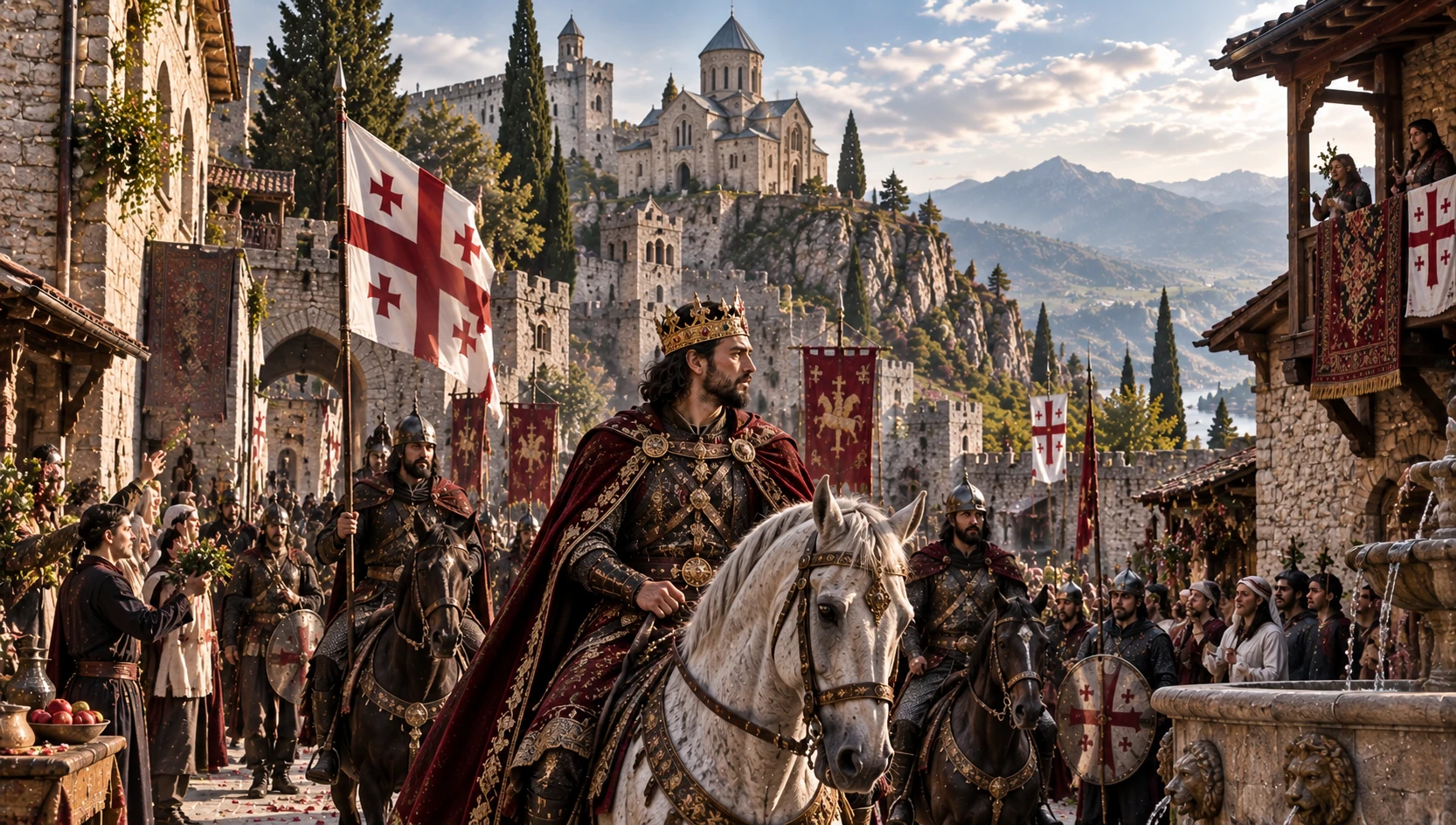
The supplied hero image is an editorial reconstruction of Georgian royal power. It is not a literal portrait of Queen Tamar, David IV or a specific medieval ceremony.
COLCHIS, IBERIA AND CHRISTIANIZATION
The western Georgian region was known to Greek and Roman writers as Colchis, a Black Sea zone of ports, valleys and mountain communities. In the east, the kingdom of Iberia, also called Kartli in Georgian sources, developed around the Mtkvari valley. These ancient polities had different political histories and should not be treated as a single early version of medieval Georgia. Roman, Iranian and local powers competed for influence across the Caucasus.
Christianity became established in Iberia during the fourth century, traditionally associated with Saint Nino and the conversion of King Mirian III. The chronology and details come through later religious and historical traditions, but Christian institutions clearly became central to Georgian kingship. Churches, monasteries and bishops linked Caucasian communities to Byzantine, Armenian and wider Christian worlds while rulers continued to negotiate with Iranian powers.
THE BAGRATIDS AND UNIFICATION
The Bagratid, or Bagrationi, dynasty rose to prominence in several Caucasian territories. Its branches ruled different regions before one line united the Georgian kingdom. Bagrat III, who became king around 1008, is traditionally credited with bringing eastern and western Georgian lands under one crown. Unification was a political process involving dynastic marriage, aristocratic bargains, military campaigns and ecclesiastical support, not the simple absorption of every Georgian-speaking community into a modern nation-state.
Bagratid rulers governed a realm of varied landscapes and local elites. Kartli, Kakheti, Tao, Abkhazia and other regions had their own histories, while neighboring Armenia and Caucasian polities maintained distinct institutions. Tbilisi was an important city but was not always under royal control. The kingdom's political geography changed as local nobles, Muslim amirs, Byzantine authorities and Seljuk rulers competed for power.
SELJUK PRESSURE AND DAVID THE BUILDER
In the late eleventh century, Seljuk expansion placed severe pressure on Georgia. Raids disrupted agriculture and settlement, and King Giorgi II struggled to control an aristocracy divided over strategy and royal authority. His son David IV became king in 1089 while still young and inherited a kingdom facing military and political crisis.
David reorganized the court and army, strengthened royal administration and resettled groups whose military service supported the crown. He reduced the autonomy of powerful nobles without eliminating the aristocratic structure on which the monarchy depended. Georgian forces also included allies and mercenaries from the wider Caucasus and steppe worlds. Reform was therefore administrative and social as well as military.
The Battle of Didgori on August 12, 1121, became the decisive symbol of David's reign. Georgian forces defeated a much larger Seljuk-led coalition near Tbilisi, according to Georgian and Islamic chronicles that give highly dramatic numbers. Exact troop figures are uncertain, and later patriotic accounts magnify the scale. The victory nevertheless changed the balance of power. David captured Tbilisi in 1122 and made it a royal center, while Muslim communities remained part of the city's population and commercial life.
David's kingdom expanded into areas formerly controlled by Seljuk authorities and rival Caucasian rulers. He supported monasteries, schools and the Gelati Academy, whose intellectual and religious activity helped make western Georgia a major center of Orthodox culture. Gelati and other foundations also served as instruments of royal patronage, landholding and political integration. Georgian Encyclopedia: David IV and Tamar
A CAUCASIAN KINGDOM AND REGIONAL POWER
The Georgian Crown was connected to Byzantium through diplomacy, marriage and Christian culture, but it was not a Byzantine province. Georgian rulers also fought, negotiated and traded with Seljuk sultans, Muslim amirs, Armenian princes and the Kingdom of Shirvan. Their titles could claim authority over broad areas while actual power depended on fortresses, tribute, local governors and the ability to move armies through difficult terrain.
The economy rested on agriculture in river valleys, pastoralism in mountain districts, craft production and trade linking the Black Sea, Anatolia, Iran and the northern Caucasus. Tbilisi, Kutaisi, Rustavi, Gori and other towns served as markets and administrative centers. Georgian monasteries operated in the Holy Land and across the Caucasus, while merchants carried textiles, metalwork, wine and other goods through regional routes. Royal revenue came from land, customs, tribute and the obligations of dependent nobles.
QUEEN TAMAR AND THE GOLDEN AGE
Giorgi III associated his daughter Tamar with the throne in the 1170s, and she became sole ruler in 1184. Her accession broke established gender expectations, but Tamar governed through institutions that included nobles, military commanders, bishops and court officials. Later Georgian chronicles and church traditions celebrate her as an ideal monarch, while historians also examine rebellions, factional politics and the limits of royal control.
Tamar's early reign required negotiation with powerful grandees. A rebellion and the difficult career of her first husband, Yuri, showed that the monarchy had to manage aristocratic interests rather than simply command them. Her second husband, David Soslan, became a military commander and political partner. Tamar's authority was expressed through royal charters, patronage and appointments as well as through battlefield victories.
Under Tamar, Georgian armies defeated or contained several regional rivals. The victory at Shamkor in 1195 and the Battle of Basiani around 1203 strengthened Georgian influence, while campaigns in Armenia, Shirvan and eastern Anatolia extended the kingdom's network of clients and tributaries. These successes did not create direct Georgian administration everywhere named in royal titles. The political map included fortresses, allied princes, tribute relationships and zones where control changed with military circumstances.
Tamar's reign supported urban growth, trade, church building and literature. The cave monastery of Vardzia, expanded during her era, combined religious, defensive and economic functions. Georgian Orthodox monasteries copied manuscripts and connected local culture with Byzantine theological traditions. The court patronized metalwork, murals, architecture and poetry. The period is called a Golden Age because of its political reach and cultural production, not because society was free of hierarchy or conflict.
Royal authority was visible in the language of charters and coinage, but daily government depended on local cooperation. Provincial nobles collected dues, maintained fortresses and supplied mounted troops. The court rewarded loyal families with offices and estates, while monasteries received land and exemptions. Tbilisi's merchants included Christians and Muslims, and commercial routes crossed political boundaries even when armies were at war. These arrangements helped Georgia project power without creating a uniformly administered empire.
Diplomacy was equally important. Georgian rulers exchanged envoys with Byzantium, the Seljuk sultanates, Shirvan and Christian communities farther south. Marriage alliances opened routes to military support and prestige, while monasteries acted as cultural and diplomatic bridges. The kingdom's position between Black Sea and Caspian corridors gave its rulers opportunities to tax trade and intervene in regional politics, but it also exposed them to repeated invasions from larger imperial powers.
Shota Rustaveli's poem *The Knight in the Panther's Skin* is usually dated to Tamar's reign or the years around it. Its courtly world, ideals of friendship and treatment of kingship have made it a central work of Georgian literature. The poem is not a straightforward chronicle of Tamar's government. It reflects literary imagination, Persianate influences and the values of a sophisticated medieval court. Georgian Encyclopedia: Rustaveli
MONGOLS, TIMUR AND DECLINE
After Tamar's death, her son Giorgi IV Lasha and later rulers inherited a powerful but exposed kingdom. Mongol armies reached the Caucasus in the 1220s and returned in the 1230s. Georgia became subject to Mongol demands for tribute and military service, while local nobles used the crisis to defend their own authority. The kingdom's political resources were divided between western and eastern regions, and royal control became less consistent.
Mongol domination did not destroy Georgian Christianity or court culture, but it weakened revenue and military autonomy. Later rulers tried to recover territory, yet the kingdom faced competing local interests and the rise of other regional powers. Timur's invasions from the 1380s through the early fifteenth century brought repeated campaigns, destruction and forced submission. Timur's armies attacked cities, fortresses and agricultural areas, although the precise scale of devastation reported by chronicles is difficult to verify.
The Ottoman Empire and Safavid Iran became the dominant external powers in the Caucasus during the fifteenth and sixteenth centuries. Georgian rulers and princes alternated between resistance, alliance, tribute and dynastic diplomacy. The kingdom fragmented into Kartli, Kakheti and Imereti, while principalities such as Mingrelia, Guria and Svaneti maintained varying degrees of autonomy. This was not simply the disappearance of Georgia. Georgian churches, noble houses, towns and literary communities continued in a political landscape without one stable central crown.
FRAGMENTATION AND RUSSIAN ANNEXATION
By the eighteenth century, Georgian rulers sought outside allies against Ottoman and Persian pressure. The eastern kingdom of Kartli-Kakheti signed the Treaty of Georgievsk with Russia in 1783, hoping for protection while retaining its monarchy. Russian intervention proved unreliable during invasions, and in 1801 the Russian Empire annexed Kartli-Kakheti. Other Georgian territories were incorporated over subsequent decades. Annexation brought imperial administration and new infrastructure, but it also ended the remaining Georgian monarchies and subordinated local institutions to St. Petersburg.
Modern Georgia emerged through the collapse of the Russian Empire, the brief Democratic Republic of Georgia from 1918 to 1921, Soviet rule and independence in 1991. The modern republic occupies only part of the historical spaces associated with medieval Georgian influence. Medieval titles and maps should not be used as simple claims about present borders. The enduring legacy lies in language, Orthodox Christianity, literature, architecture, music and memories of political sovereignty.
LEGACY OF THE GEORGIAN GOLDEN AGE
David the Builder and Queen Tamar remain central to Georgian historical memory because their reigns combined political consolidation, military success and cultural patronage. A careful history recognizes the achievements without turning chroniclers' praise into literal statistics or treating tributary relationships as direct rule. The kingdom's power came from a flexible coalition of royal administration, nobles, churches, towns, military communities and diplomatic alliances.
Georgia's medieval heritage is visible in Gelati, Vardzia, Svetitskhoveli, monasteries in Tao-Klarjeti and the churches of the Caucasus. These sites preserve architecture, murals, inscriptions and manuscripts that illuminate a society connected to Byzantium, Armenia, Iran, the Black Sea and the Islamic world. Georgian Orthodoxy provided continuity through invasions and political fragmentation, while the Georgian language and literary tradition carried medieval memory into modern national life.
FREQUENTLY ASKED QUESTIONS
**Was medieval Georgia the same as the modern country?**
No. The medieval kingdom included changing crown lands, tributary territories and allied principalities across the Caucasus. Modern Georgia has different borders and institutions.
**What happened at Didgori?**
On August 12, 1121, David IV's army defeated a Seljuk-led coalition near Tbilisi. The victory enabled the reconquest of Tbilisi in 1122. Medieval troop numbers are disputed and often exaggerated.
**Why is Tamar called the Great?**
Tamar ruled during a period of expansion, military victories, trade and cultural production. The title reflects historical memory and later Georgian tradition as well as the real importance of her reign.
**Did Georgia control the entire Caucasus under Tamar?**
No. Georgian influence reached far beyond the royal core, but control varied among direct administration, tribute, alliance and temporary military occupation.
**How did the medieval kingdom decline?**
Mongol demands, Timur's invasions, succession problems, aristocratic fragmentation and Ottoman-Safavid rivalry gradually weakened central authority and contributed to the emergence of separate Georgian kingdoms and principalities.
SOURCES AND FURTHER READING
For related Caucasian and medieval histories, see PRESDA's Kingdom of Bohemia, Kingdom of Armenia and Kingdom of Hungary articles.
> Georgia's medieval Golden Age was built through royal reform, Caucasian diplomacy and cultural institutions that outlasted the kingdom's later fragmentation.
FAQ
Frequently Asked Questions
Was medieval Georgia the same as the modern country?
No. The medieval kingdom included changing crown lands, tributary territories and allied principalities across the Caucasus.
What happened at Didgori?
David IV defeated a Seljuk-led coalition on August 12, 1121, enabling the reconquest of Tbilisi in 1122.
Why is Tamar called the Great?
Her reign combined expansion, military success, trade and major cultural production, making it a central period in Georgian history.
Did Georgia control the entire Caucasus under Tamar?
No. Influence ranged from direct rule to tribute, alliance and temporary military occupation.
How did the medieval kingdom decline?
Mongol and Timurid invasions, succession problems, aristocratic fragmentation and Ottoman-Safavid rivalry weakened central authority.
PRESDA Dispatch
Stay Informed. Stay Aware.
A sharp briefing across AI, gaming, sport, business, world affairs, paparazzi, and lifestyle.