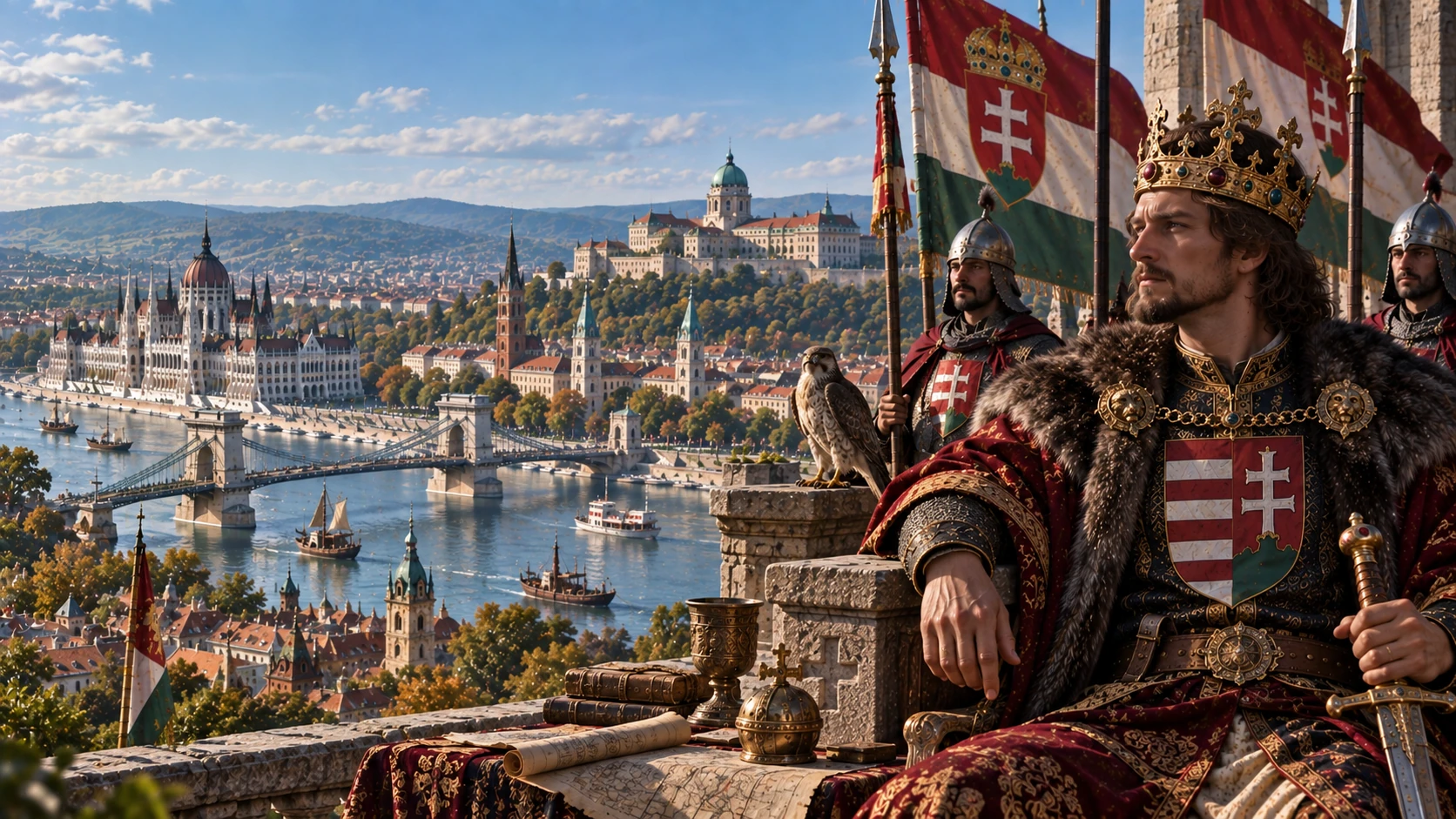
THE KINGDOM OF HUNGARY: A THOUSAND YEARS AT THE HEART OF EUROPE
Hungary's history runs from Magyar state formation and Saint Stephen to the Ottoman frontier, Habsburg rule, Austria-Hungary and the kingless kingdom of 1920–1946.
The Kingdom of Hungary was one of Central Europe's most durable political traditions, but it was never politically unchanged for a thousand years. It began as a Christian kingdom formed from Magyar-led state building in the Carpathian Basin, became a medieval regional power, divided after the Ottoman victory at Mohács, and was later transformed under Habsburg rule and within Austria-Hungary. After the First World War, a Hungarian state still called a kingdom existed from 1920 to 1946 without a king. Each period had different borders, institutions and relationships with neighboring peoples.
Hungary's location helps explain this changing history. The basin sits between Central Europe, the Balkans and the routes toward the Black Sea, with the Danube linking regions that were often rivals. Control of the plain could bring wealth and strategic influence, but it also exposed the kingdom to steppe migrations, Mongol armies, Habsburg competition and Ottoman expansion.
MAGYAR ARRIVAL AND THE RISE OF A CHRISTIAN KINGDOM
Magyar-speaking groups entered the Carpathian Basin in the late ninth century, traditionally dated to around 895. They joined a landscape already inhabited by Slavic, Avar, Germanic and other communities and shaped by the legacies of the Roman frontier. The settlement was not the creation of an empty homeland. It involved warfare, alliances, migration and the gradual formation of a ruling federation that extended authority across the basin.
Prince Géza, who ruled in the later tenth century, began redirecting the dynasty toward Latin Christianity and diplomatic ties with neighboring Christian powers. His son Stephen defeated rival claimants and consolidated authority. Stephen's coronation took place around Christmas 1000 or on 1 January 1001, depending on calendar and interpretation. The ceremony represented Hungary's entry into the Western Christian political order, while Stephen's laws, dioceses, counties and royal officials turned a federation into a more centralized kingdom. Hungarian National Museum: Stephen I's coin and state formation
Stephen I created bishoprics and archbishoprics, supported monasteries and required local communities to participate in the Christian institutional order. Conversion was uneven and could be coercive, but the kingdom incorporated older customs and regional elites rather than erasing them. The Árpád dynasty that followed Stephen ruled until 1301, with periods of succession conflict, territorial expansion and negotiation with nobles and church authorities.
COUNTIES, THE CROWN AND THE GOLDEN BULL
Medieval Hungary was governed through royal counties, castles and a network of officials who collected revenues, administered justice and organized military service. Counties were not identical to modern administrative districts. Their boundaries and powers changed, and noble families, churches and towns gained privileges that limited direct royal control. The Holy Crown became a powerful symbol of the kingdom's continuity, even as the practical balance between king, nobility and estates shifted.
King Andrew II's extensive grants to nobles and military orders contributed to political conflict. In 1222, pressure from the nobility produced the Golden Bull, a charter that confirmed privileges, limited some royal actions and included a resistance clause. It was not a modern constitution or a declaration of equal rights, but it became an important statement about lawful kingship and the political standing of the nobility.
MONGOL INVASION AND BÉLA IV'S RECONSTRUCTION
Mongol armies invaded Hungary in 1241. King Béla IV's forces were defeated at the Battle of Mohi on 11 April, and the invaders devastated large areas through raids, massacres and the destruction of settlements. The scale of demographic loss varied by region and remains debated; it is safer to describe the invasion as a catastrophic rupture than to repeat one fixed national percentage. The Mongols withdrew in 1242 after the death of Ögedei Khan and the resulting succession crisis. Hungarian Institute of National Archaeology: the 1241 campaign
Béla IV returned to a damaged kingdom and pursued reconstruction. He encouraged towns, invited settlers, reorganized royal revenues and required stronger fortifications. Stone castles replaced or supplemented many vulnerable earth-and-timber defenses. This rebuilding changed the political geography of Hungary and earned Béla the description of a second founder, although recovery was uneven and social costs remained high.
ANGEVINS, SIGISMUND AND MATTHIAS CORVINUS
After the Árpád line ended in 1301, the Angevin Charles I Robert defeated rival claimants and restored royal authority. His son Louis I expanded Hungary's influence toward the Balkans, Poland and the Adriatic while supporting towns, mining and coinage. The Angevin period made Hungary a major regional power, but its rulers governed through alliances and personal unions rather than a single centralized empire.
Sigismund of Luxembourg, king from 1387 and later Holy Roman Emperor, faced Ottoman pressure, noble politics and conflicts within the region. He supported defensive reforms and the Council of Constance, yet his reign also showed how Hungary's frontier position connected domestic government to wider European diplomacy. Royal authority depended on estates, magnates, towns and church institutions.
Matthias Corvinus, king from 1458 to 1490, strengthened royal finances and courts, promoted Renaissance culture and maintained the Black Army, a large professional mercenary force funded through taxation and royal revenues. He campaigned in Bohemia and Austria as well as against Ottoman forces. The Black Army gave Matthias leverage, but its cost and the succession problem after his death limited the durability of his centralization. Hungarian National Museum: medieval Hungary
THE OTTOMAN FRONTIER AND MOHÁCS
From the fourteenth century, Ottoman expansion transformed Hungary's strategic position. Fortresses, border commanders and seasonal campaigns shaped life in the south, while Hungary's rulers sought support from the papacy, Central European monarchies and neighboring elites. The frontier was violent, but it was also a zone of trade, diplomacy, migration and cultural exchange.
On 29 August 1526, Sultan Süleyman I's army defeated the forces of the young King Louis II at Mohács. Louis died while fleeing the battlefield, and the defeat opened a succession crisis. One faction elected John Szapolyai, while another supported the Habsburg Ferdinand. The Ottoman victory did not instantly erase the Kingdom of Hungary, but it broke the old political balance and made competing claims dependent on foreign military power.
THREE HUNGARIES AFTER 1526
Over the following decades, the historic kingdom's lands were divided into three political zones. Royal Hungary, ruled by the Habsburgs from centers such as Pressburg, retained much of the west and north and became a frontier defense system within the Habsburg Monarchy. The central plain and Buda were incorporated into the Ottoman Empire as provinces governed through Ottoman institutions. In the east, the Eastern Hungarian Kingdom developed into the Principality of Transylvania, an autonomous polity that paid tribute to the Ottoman sultan while preserving its own estates and diplomacy.
This division was not a neat ethnic partition and its borders shifted repeatedly. Hungarian, German, Slovak, Croatian, Romanian, Serbian, Ruthenian, Jewish, Muslim and other communities lived across the zones. Ottoman-Habsburg wars, local uprisings and negotiated truces repeatedly changed who collected taxes and held fortresses. Transylvania could oppose the Habsburgs while also defending its autonomy from Ottoman pressure, making it a political actor rather than a simple Ottoman province.
Habsburg and Ottoman armies fought over the region for more than a century. Buda was recaptured by Habsburg forces and their allies in 1686, and the Great Turkish War shifted the balance. The Treaty of Karlowitz in 1699 confirmed major Ottoman losses, though military and political consolidation continued. Much of historic Hungary then came under Habsburg rule, alongside territories with different legal and religious arrangements.
HUNGARY UNDER THE HABSBURGS
Habsburg Hungary was not simply Austria under another name. Hungarian estates, counties and laws retained distinct roles, while the crown negotiated taxation, military recruitment and religious policy with the Diet. Royal administration expanded and Catholic institutions gained influence, but Protestant communities remained important. Frontier military districts had their own structures, and resettlement after Ottoman wars altered the region's languages and demographics.
The eighteenth century brought reconstruction, centralization and disputes over the privileges of the nobility. Reformers in the nineteenth century argued for representative government, economic modernization and the greater use of Hungarian in public life. These demands connected Hungary to European liberal and national movements while also producing tensions with Croat, Slovak, Romanian, Serbian and other communities within the lands of the crown.
1848, COMPROMISE AND AUSTRIA-HUNGARY
The revolution of 1848 began with demands for constitutional government, press freedom, a responsible ministry and the end of feudal obligations. The Hungarian government fought the Habsburg court and revolutionary opponents, while nationalities within the kingdom pursued their own political claims. Habsburg, Russian and Croatian forces helped defeat the revolution in 1849. The aftermath brought repression and renewed centralization.
The Austro-Hungarian Compromise of 1867 created a dual monarchy. The emperor of Austria was also king of Hungary, but Austria and Hungary had separate parliaments and governments, joined by common foreign affairs, defense and selected financial arrangements. Hungary experienced rapid industrialization, railway building and urban growth, especially in Budapest. The system expanded Hungarian state institutions while leaving unresolved conflicts over language, representation and nationality. Austria-Hungary was not the medieval Kingdom of Hungary restored unchanged; it was a nineteenth-century constitutional arrangement.
WORLD WAR I AND THE KINGDOM WITHOUT A KING
The First World War exhausted Austria-Hungary. Military defeat, national movements and political collapse ended the dual monarchy in 1918. The historic lands of the Hungarian crown were contested by successor states, and the Treaty of Trianon in 1920 confirmed major territorial changes. These borders became central to later Hungarian politics, but they should not be treated as a simple measure of one timeless national territory.
In 1920, Hungary's parliament restored the legal form of a kingdom while leaving the throne vacant. Miklós Horthy became regent. This was a monarchy without a king, a constitutional and political arrangement whose meaning remains debated by legal historians. Charles IV attempted to return in 1921, but the effort failed, and legislation barred a Habsburg restoration. The interwar state was territorially smaller, authoritarian in important respects and governed through institutions that were neither the medieval kingdom nor Austria-Hungary. Hungarian Academy repository: state form from 1920 to 1944
During the Second World War, Hungary aligned with the Axis and later faced German occupation in 1944, followed by Soviet military dominance. The Arrow Cross dictatorship and the Holocaust devastated Hungarian Jewish communities, while wartime and postwar expulsions and border changes transformed society. The kingdom's institutions survived formally through the war but lost political independence and legitimacy.
On 1 February 1946, Hungary became a republic and the Kingdom of Hungary ended. The abolition closed a constitutional era that had included the medieval crown, Habsburg rule, Austria-Hungary and the interwar regency, but it did not erase the cultural memory attached to Saint Stephen, the Holy Crown, Mohács, 1848 and Budapest.
LEGACY
The Kingdom of Hungary's legacy is a layered history rather than a single national storyline. Medieval counties, the crown and Christian institutions shaped later constitutional language. Ottoman and Habsburg centuries left architecture, religious communities and mixed regional identities. The 1848 revolution remains a symbol of constitutional aspiration, while the Compromise of 1867 represents both modernization and the limits of imperial compromise.
Hungarian history also belongs to the wider history of European state formation. Like the Kingdom of England, Hungary changed through conquest, dynastic succession, negotiated privileges and constitutional crises. Its borders and political names changed repeatedly, while language, institutions and cultural memory connected different eras. The most accurate account therefore distinguishes the medieval kingdom, Habsburg Hungary, Austria-Hungary and the kingless kingdom of 1920–1946 rather than treating them as one unchanged state.
FREQUENTLY ASKED QUESTIONS
**When was the Christian Kingdom of Hungary formed?**
Stephen I was crowned around Christmas 1000 or on 1 January 1001. His government organized counties, dioceses and royal institutions that established a Christian kingdom in the Carpathian Basin.
**What was the Golden Bull of 1222?**
The Golden Bull was a charter issued under Andrew II that confirmed noble privileges and placed limits on some royal actions. It was an important medieval constitutional text, not a modern democratic constitution.
**What happened at Mohács in 1526?**
The Ottoman army defeated Hungary on 29 August 1526. King Louis II died while fleeing, and rival claimants then drew the Habsburgs and Ottomans deeper into Hungarian succession politics.
**What were the three parts of Hungary after Mohács?**
Royal Hungary was ruled by the Habsburgs, central Hungary including Buda was governed by the Ottoman Empire, and the Eastern Hungarian Kingdom developed into the Ottoman-aligned Principality of Transylvania.
**Was Hungary still a kingdom between 1920 and 1946?**
Yes. Parliament restored the kingdom's legal form in 1920, but no king was enthroned. Regent Miklós Horthy governed until 1944, and the monarchy was abolished when Hungary became a republic on 1 February 1946.
> Hungary's thousand-year history is a succession of different kingdoms and constitutional orders shaped by the Danube, the steppe and the Ottoman frontier.
FAQ
Frequently Asked Questions
When was the Christian Kingdom of Hungary formed?
Stephen I was crowned around Christmas 1000 or on 1 January 1001. His government organized counties, dioceses and royal institutions that established a Christian kingdom.
What was the Golden Bull of 1222?
The Golden Bull confirmed noble privileges and limited some royal actions. It was an important medieval constitutional text, not a modern democratic constitution.
What happened at Mohács in 1526?
The Ottoman army defeated Hungary on 29 August 1526. King Louis II died while fleeing, and rival claimants drew the Habsburgs and Ottomans deeper into Hungarian politics.
What were the three parts of Hungary after Mohács?
Royal Hungary was Habsburg ruled, central Hungary including Buda was Ottoman governed, and the Eastern Hungarian Kingdom developed into the Principality of Transylvania.
Was Hungary still a kingdom between 1920 and 1946?
Yes. The legal form of a kingdom was restored in 1920, but no king was enthroned. Regent Miklós Horthy governed until 1944, and the monarchy ended when Hungary became a republic in 1946.
PRESDA Dispatch
Stay Informed. Stay Aware.
A sharp briefing across AI, gaming, sport, business, world affairs, paparazzi, and lifestyle.