THE OTTOMAN EMPIRE: 600 YEARS THAT CHANGED THE WORLD
From a small Anatolian frontier state to a three-continent empire, the Ottoman story reshaped war, trade, cities, law and politics across Europe, Asia and Africa.
The Ottoman Empire began as one small frontier principality in northwestern Anatolia.
By the height of its power, it ruled across parts of southeastern Europe, western Asia and North Africa.
Its armies took Constantinople, fought Habsburgs and Safavids, controlled major trade routes, governed diverse populations and shaped the politics of the Mediterranean, the Balkans and the Middle East for centuries.
The story is often reduced to a simple rise and fall.
That is too flat.
The Ottoman Empire expanded through military innovation, flexible administration, frontier politics and control of strategic cities. Later, it adapted under pressure from European rivals, Russia, nationalist movements, fiscal strain and the military demands of the modern age.
Its history includes conquest and culture, law and violence, tolerance and hierarchy, reform and collapse.
To understand the Ottoman Empire is to understand one of the central bridges between the medieval and modern worlds. For more PRESDA history features, read the history of chess and the history of Egyptian pyramids.
OSMAN I AND THE ANATOLIAN FRONTIER
The empire took its name from Osman I, leader of a small Turkish principality on the Byzantine frontier in Anatolia around the late 13th and early 14th centuries.
That frontier mattered.
Western Anatolia was a zone of shifting power after the weakening of Byzantine control and the fragmentation of Seljuk authority.
Small principalities competed, raided, allied, absorbed followers and expanded when opportunity appeared.
Osman's polity was not born as a world empire.
It began as a frontier power whose strength grew from military leadership, local alliances, religious legitimacy, warrior followings and the ability to turn border conflict into political expansion.
ORHAN, MURAD I AND EARLY EXPANSION
Osman's successors transformed a frontier principality into a durable state.
Under Orhan, the Ottomans captured Bursa, which became an early capital and symbol of settled rule.
The empire crossed into Europe in the 14th century and gained footholds in the Balkans.
Murad I continued expansion and strengthened institutions that allowed the Ottomans to govern beyond a narrow tribal base.
The early Ottoman state learned to combine military mobility with administration.
It incorporated local elites, used land grants and tax arrangements, developed military households and benefited from the fragmentation of neighboring powers.
By the time the Ottomans were firmly established in southeastern Europe, they were no longer simply one Anatolian principality among many.
They had become an expanding imperial power.
CONSTANTINOPLE 1453 AND MEHMED THE CONQUEROR
The defining Ottoman breakthrough came in 1453.
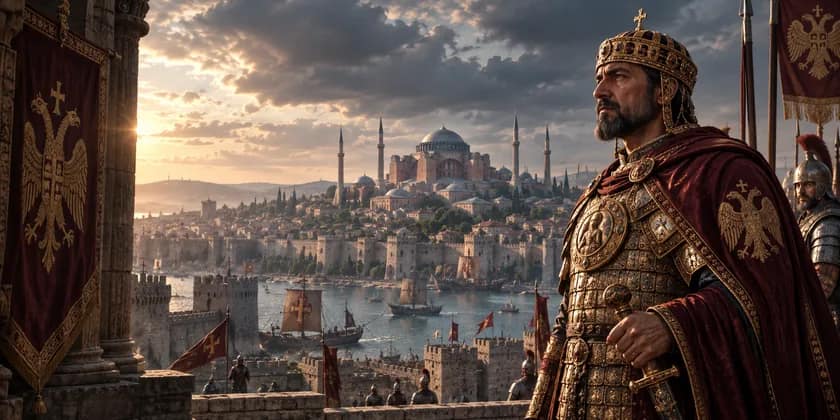
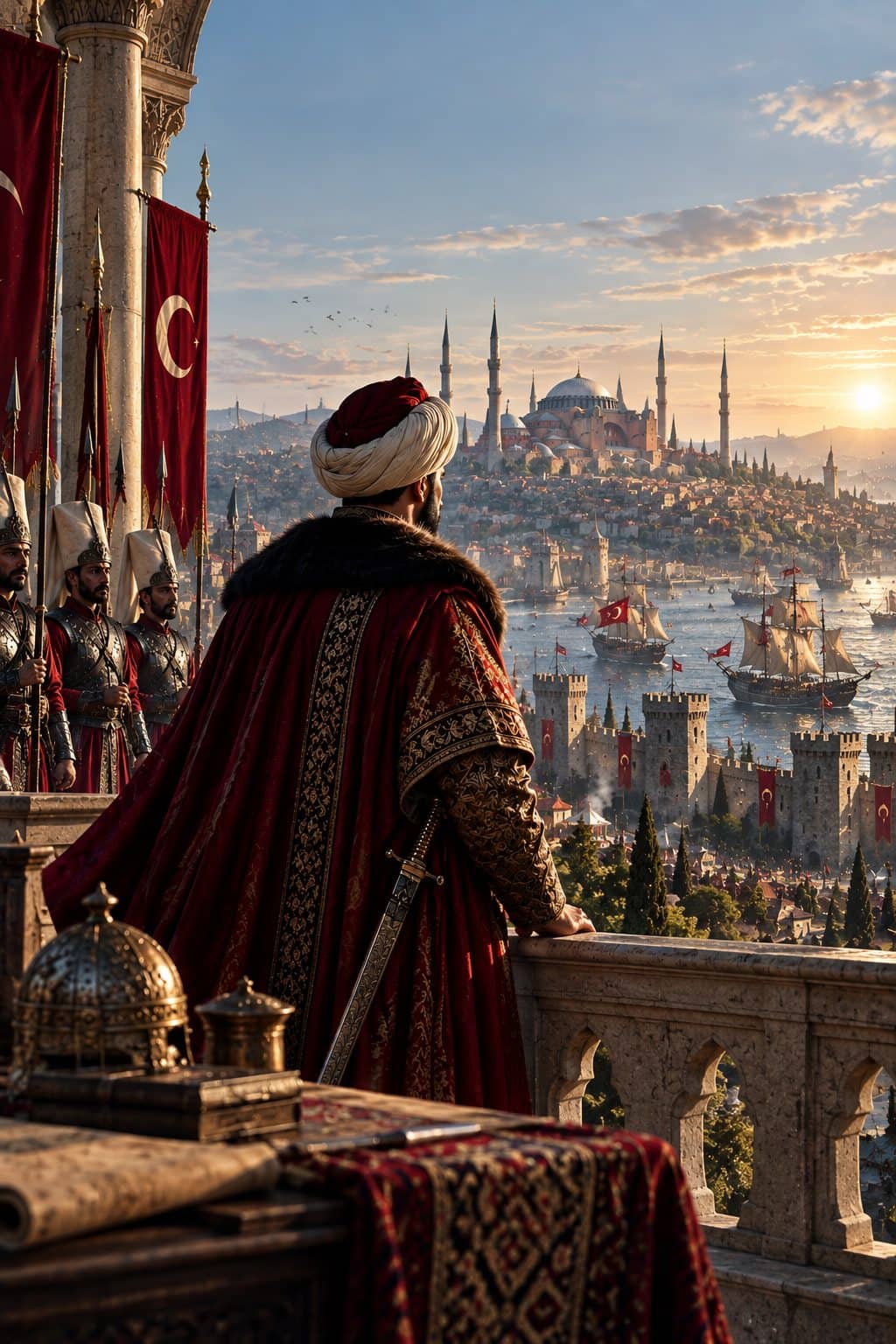
Sultan Mehmed II captured Constantinople, the capital of the Byzantine Empire.
The conquest transformed Ottoman prestige and geography.
Constantinople became Istanbul, the imperial capital and one of the great cities of the early modern world.
Mehmed did not merely take a city.
He took a symbol.
The conquest linked the Ottoman dynasty with Roman and Islamic imperial traditions and placed the empire at the meeting point of the Black Sea, the Mediterranean, Anatolia and the Balkans.
Ottoman artillery played a major role in the siege, but the victory also required logistics, naval pressure, manpower, political will and the ability to coordinate a difficult military operation around one of the world's most formidable urban defenses.
After 1453, the Ottoman Empire could no longer be understood as regional.
It had become a world power.
EXPANSION ACROSS THREE CONTINENTS
In the centuries after Constantinople, Ottoman power expanded across southeastern Europe, Anatolia, the eastern Mediterranean, the Arab lands and North Africa.
The empire's reach was not uniform everywhere.
Some regions were governed as provinces.
Some retained local elites under Ottoman sovereignty.
Some sat in zones of military pressure, tribute, diplomacy and contested influence.
This flexibility helped the empire survive for centuries.
Ottoman authority could be direct, negotiated, military, fiscal or symbolic depending on the region and period.
The empire's great challenge was also its strength: it governed enormous diversity.
Languages, religions, legal traditions, cities, tribes, ports and agricultural regions all had to be fitted into an imperial system.
SELIM I AND THE EASTERN TURN
Sultan Selim I dramatically expanded Ottoman power in the early 16th century.
His reign brought conflict with the Safavid Empire and then the conquest of the Mamluk Sultanate.
The Ottoman victory over the Mamluks added Syria, Egypt and the Hijaz to Ottoman rule.
This changed the empire's character.
The Ottomans now controlled major Arab lands and the holy cities of Mecca and Medina through their authority over the Hijaz.
Egypt gave the empire enormous strategic and economic weight.
The eastern Mediterranean, Red Sea and pilgrimage routes became increasingly tied to Ottoman imperial politics.
Selim's conquests helped turn the Ottoman state into the dominant Muslim empire of its age.
SULEIMAN THE MAGNIFICENT
Suleiman I ruled from 1520 to 1566 and became one of the most famous Ottoman sultans.
In Europe, he is often remembered as Suleiman the Magnificent.
In Ottoman memory, he is also associated with law and imperial order.
His reign saw major campaigns in Hungary, pressure against the Habsburgs, Mediterranean conflict and intense rivalry with Safavid Iran.
Ottoman naval power expanded under figures such as Barbarossa Hayreddin Pasha.
The empire's architecture, law, literature, administration and court culture reached extraordinary levels of refinement.
But Suleiman's reign should not be treated as a simple peak after which everything declined.
It was a high point, certainly.
It was also one chapter in a much longer imperial history of adaptation, strain and reinvention.
OTTOMAN ADMINISTRATION AND TRADE
The Ottoman Empire endured because it was more than an army.
It was an administrative system.
The central government managed provinces, tax flows, courts, land tenure, military obligations and religious institutions across huge distances.
Ottoman law combined sultanic regulation with Islamic legal traditions and local practice.
Merchants moved through cities, ports and caravan routes that connected the Balkans, Anatolia, Syria, Egypt, the Black Sea and the wider Mediterranean.
Istanbul became a political capital, a commercial hub and a symbol of imperial order.
The empire benefited from controlling crossroads.
But control of crossroads also meant constant exposure to military rivals, trade shifts and the pressures of global economic change.
JANISSARIES, DEVSHIRME AND MILITARY ORGANIZATION
The Janissaries became one of the most famous military institutions in Ottoman history.
They were elite infantry troops tied to the sultan's household and became important users of firearms in Ottoman warfare.
Their history was connected with the devshirme system, in which Christian boys from parts of the empire were recruited, converted to Islam and trained for military or administrative service.
That system should not be romanticized.
It was an imperial recruitment system built inside a hierarchical empire, and it involved coercion even when some individuals later rose to positions of power.
The Janissaries were formidable, but they were not invincible.
Their importance changed over time.
As military technology, state finance and politics evolved, the corps became deeply entangled in imperial power struggles and reform conflicts.
Ottoman strength came not only from Janissaries but from artillery, cavalry, naval forces, provincial troops, logistics and the ability to mobilize resources across multiple regions.
WHY THE OTTOMAN SYSTEM SUCCEEDED
The Ottoman system succeeded for several reasons.
It emerged in a frontier zone where military opportunity and political flexibility mattered.
It absorbed people and institutions from conquered lands rather than relying on one narrow ethnic base.
It used Istanbul as a powerful imperial center.
It developed military and administrative structures that could coordinate campaigns and taxation across distance.
It controlled key routes between Europe, Asia and the Mediterranean.
It also tolerated a measure of religious and communal diversity under hierarchy, taxation and imperial authority.
The empire's durability came from adaptation as much as conquest.
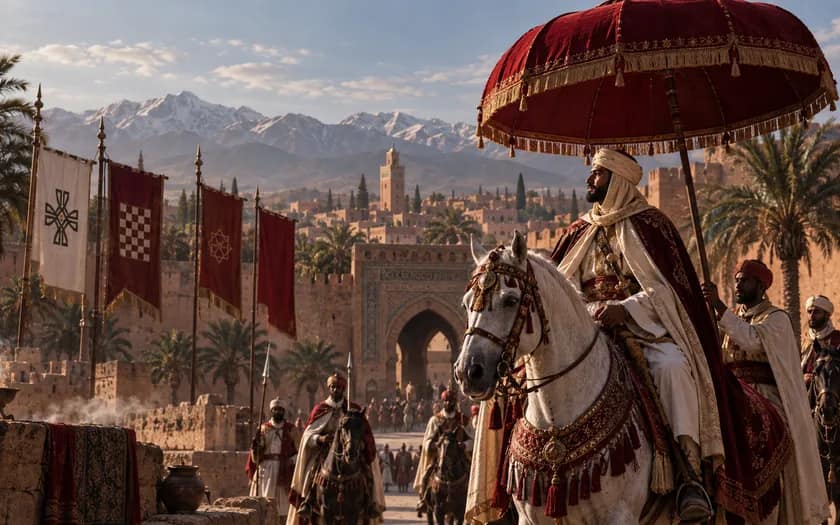
WHY MOROCCO NEVER BECAME AN OTTOMAN PROVINCE
Ottoman power extended across much of North Africa, especially through Algeria, Tunisia, Tripoli and Egypt.
Morocco was different.
It was not permanently incorporated as an Ottoman province.
That does not mean Ottoman forces never entered Morocco or that Ottoman influence was absent.
The western Maghreb became a contested zone of diplomacy, military intervention, rivalry and religious-political legitimacy.
The Saadian dynasty in Morocco resisted Ottoman supremacy while also operating in a world shaped by Ottoman power, Iberian pressure and trans-Saharan politics.
During Suleiman the Magnificent's reign, Ottoman-Saadian rivalry became especially sharp.
The key sequence runs through three connected moments: Mohammed al-Shaykh's resistance, his assassination in 1557 and the Ottoman-Saadian confrontation at Wadi al-Laban in 1558.
THE ASSASSINATION OF MOHAMMED AL-SHAYKH
Saadian Sultan Mohammed al-Shaykh opposed Ottoman supremacy in the Maghreb.
In 1557, according to historical accounts, Ottoman-linked agents posing as deserters entered his service and gained access to his entourage or guard.
On 23 October 1557, Mohammed al-Shaykh was assassinated and beheaded.
His head was sent to Sultan Suleiman in Istanbul.
Authoritative historical accounts state that it was publicly displayed there.
PRESDA does not state as certain that it was hung on a specific Istanbul gate because that exact detail requires stronger direct sourcing than the broader historical account.
The assassination did not make Morocco an Ottoman province.
Instead, it intensified the struggle between Ottoman Algeria and the Saadian state.
THE BATTLE OF WADI AL-LABAN
The confrontation continued in 1558.
Hasan Pasha of Ottoman Algeria advanced into Morocco and confronted the Saadian forces of Sultan Abdallah al-Ghalib at Wadi al-Laban, north of Fez.
The result should be described carefully.
Historical interpretations differ over whether the battle itself was a decisive Saadian victory or an inconclusive engagement.
What matters for the larger political outcome is clear: the Ottoman force ultimately withdrew, and Morocco remained outside permanent Ottoman rule.
The sequence is therefore best understood as resistance, assassination, confrontation and withdrawal.
Morocco was not untouched by Ottoman power.
But it did not become a regular Ottoman province.
SEVENTEENTH AND EIGHTEENTH CENTURY ADAPTATION
Older histories often described Ottoman history after Suleiman as a long, continuous decline.
Modern scholarship treats that model with caution.
The empire faced real problems: costly wars, fiscal pressure, provincial power struggles, military change and competition with European states and Russia.
But it also adapted.
Provincial notables gained influence.
Military structures changed.
Tax farming expanded.
Diplomacy became more important.
The empire survived crises that might have destroyed a less flexible state.
The better question is not why decline began after one great ruler.
It is how the empire kept reinventing itself under changing conditions.
EUROPEAN AND RUSSIAN COMPETITION
From the 17th century onward, the Ottoman Empire faced intensifying pressure from Habsburg Austria, Russia and other European powers.
Wars shifted borders and exposed weaknesses in military organization, finance and diplomacy.
Russia's expansion toward the Black Sea and the Balkans became especially important.
European states also changed rapidly through fiscal reform, naval expansion, colonial wealth, industrialization and new military systems.
The Ottomans were not passive.
They negotiated, fought, reformed and adapted.
But the strategic environment became harsher.
NATIONALISM AND TERRITORIAL LOSSES
The 19th century brought another challenge: nationalism.
Communities within the empire increasingly imagined political futures outside Ottoman rule.
Greek independence, Balkan nationalism, European intervention and wars with Russia and other powers weakened imperial authority.
Territorial losses were not caused by one factor.
They came from military defeat, great-power politics, local revolts, economic pressures and the spread of new political ideas.
The empire remained important.
But its room for maneuver narrowed.
TANZIMAT REFORMS
The Tanzimat reforms of the 19th century were an attempt to modernize and centralize the empire.
Reformers sought to reorganize administration, law, taxation, military service and the relationship between the state and its subjects.
The goal was not simply to imitate Europe.
It was to preserve the empire by making it more governable and competitive.
The reforms produced important changes but also tensions.
Centralization could upset provincial elites.
New legal promises could collide with older hierarchies.
Financial dependence on European creditors increased vulnerability.
Reform kept the empire alive, but it could not remove every structural pressure.
WORLD WAR I AND THE END OF THE EMPIRE
The Ottoman Empire entered World War I on the side of the Central Powers.
The war was catastrophic.
It brought military campaigns across multiple fronts, economic hardship, displacement and enormous human suffering.
After defeat, the empire faced occupation, partition plans and political crisis.
The Turkish War of Independence transformed the political future of Anatolia.
The Ottoman Sultanate was abolished in 1922.
The Republic of Turkey was proclaimed in 1923.
The Ottoman imperial order had ended.
But its legacy did not disappear.
WHY THE OTTOMAN EMPIRE FELL
No serious account can reduce the fall of the Ottoman Empire to one cause.
The empire faced military competition from European states and Russia.
It struggled with fiscal pressure and debt.
It lost territories through war, revolt and diplomacy.
Nationalist movements challenged imperial identity.
Reforms changed the state but also revealed the scale of its difficulties.
World War I finally broke the imperial system.
The empire's end was therefore not simply a story of weakness.
It was the result of long-term pressure, uneven modernization, great-power competition, internal diversity, war and the limits of imperial government in a nationalist age.
THE OTTOMAN LEGACY
The Ottoman legacy remains visible across Istanbul, the Balkans, the Middle East, North Africa and the eastern Mediterranean.
It survives in architecture, food, music, law, urban memory, religious institutions, borders, archives and political debates.
For some, the empire represents grandeur and cosmopolitan rule.
For others, it represents conquest, hierarchy and imperial domination.
Both views contain part of the truth.
The Ottoman Empire was not a mythic golden age.
It was not a simple failure story either.
It was a vast human political system that lasted more than six centuries, changed repeatedly and shaped the world around it.
Its rise showed what frontier power, military organization and administrative flexibility could achieve.
Its fall showed how even durable empires can be overwhelmed by modern war, nationalism, debt, rival states and internal strain.
Six hundred years is a long time for any empire to survive.
The Ottoman Empire survived because it could adapt.
It ended when adaptation was no longer enough.
FAQ
Frequently Asked Questions
When did the Ottoman Empire begin and end?
The Ottoman state emerged around the late 13th and early 14th centuries under Osman I. The Ottoman Sultanate was abolished in 1922, and the Republic of Turkey was proclaimed in 1923.
Who captured Constantinople in 1453?
Sultan Mehmed II, known as Mehmed the Conqueror, captured Constantinople in 1453 and transformed it into the Ottoman imperial capital.
What were the Janissaries?
The Janissaries were elite infantry troops tied to the Ottoman sultan's household. Their history was connected with the devshirme recruitment system and later with major political and military struggles inside the empire.
Why was Suleiman the Magnificent important?
Suleiman I ruled from 1520 to 1566 and is remembered for military campaigns, imperial law, architecture, court culture and Ottoman power across Europe and the Mediterranean.
Was Morocco part of the Ottoman Empire?
Morocco was not permanently incorporated as an Ottoman province. Ottoman forces and influence reached the western Maghreb, but Saadian resistance and later developments kept Morocco outside regular Ottoman sovereignty.
What happened to Mohammed al-Shaykh?
Saadian Sultan Mohammed al-Shaykh was assassinated and beheaded on 23 October 1557 by Ottoman-linked agents according to historical accounts. His head was sent to Sultan Suleiman in Istanbul.
Why did the Ottoman Empire fall?
The empire fell because of long-term military, fiscal, political and territorial pressures, nationalism, great-power competition, uneven reform and the final shock of World War I.
PRESDA Dispatch
Stay Informed. Stay Aware.
A sharp briefing across AI, gaming, sport, business, world affairs, paparazzi, and lifestyle.