THE HISTORY OF CHESS: HOW A GAME OF WAR CONQUERED THE WORLD
Born from an ancient battlefield game, transformed across empires and perfected over centuries, chess became one of humanity's most enduring tests of strategy and intelligence.
For roughly fifteen centuries, two armies have faced each other across a board.
Kings.
Soldiers.
Cavalry.
Battles.
Sacrifices.
Victory.
But nobody dies.
Chess is one of humanity's most enduring strategy games, a contest simple enough to learn yet complex enough to occupy a lifetime.
Today, it is played in schools, parks, professional tournaments and on millions of phones and computers around the world.
Its greatest players have become international icons.
Its positions have challenged mathematicians and computer scientists.
And eventually, chess became one of the great battlegrounds between human intelligence and machines.
But chess did not begin with Magnus Carlsen, Bobby Fischer or even the modern rules.
Its story begins roughly 1,500 years ago.
In India. For more PRESDA history features, read the history of Egyptian pyramids and the history of horses in human civilization.
INDIA AND THE BIRTH OF CHATURANGA
The precise origin of chess remains debated in some details, but the strongest historical consensus places an important direct ancestor of modern chess in India around the sixth century CE.
The game was known as Chaturanga.
Its name referred to divisions of an army.
The board represented a battlefield.
Different pieces reflected military forces such as infantry, cavalry, elephants and chariots, alongside the king.
The pieces did not all move exactly as their modern descendants do.
The modern queen did not yet dominate the board.
The bishop did not yet sweep across long diagonals.
Chess was still evolving.
But the central idea was already recognizable: two opposing forces, a king to protect and strategy deciding the battle.
Chess began as a representation of war.
Then the game travelled west.
FROM INDIA TO PERSIA
Chaturanga reached Sasanian Persia, where it evolved into the game known as Shatranj.
Persia left a permanent linguistic mark on chess.
The Persian word Shah means king.
Expressions surrounding threats to the king travelled across languages as the game spread.
The phrase associated with checkmate ultimately reflects Persian linguistic roots commonly connected with shah mat.
Chess vocabulary itself therefore preserves traces of the civilizations through which the game travelled.
But Persia would not be the final destination.
CHESS AND THE ISLAMIC GOLDEN AGE
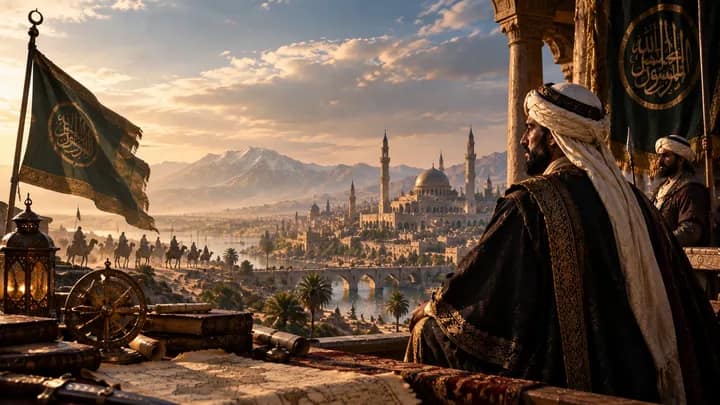
Following the Islamic conquest of Persia, Shatranj spread widely across the Islamic world.
The game became known from Baghdad and other intellectual centers to North Africa and Al-Andalus.
It was not merely played.
It was studied.
Strong players analyzed positions, composed chess problems and wrote about strategy centuries before modern tournament chess existed.
Among the important names preserved in the history of early chess are al-Adli and al-Suli.
They belonged to a sophisticated culture of competitive Shatranj.
Chess travelled through merchants, scholars, courts and expanding cultural networks.
Through the Islamic world and other routes, it reached increasingly large parts of Europe.
The game had crossed civilizations.
But Europe would eventually transform its rules.
MEDIEVAL CHESS WAS DIFFERENT
A medieval chess player would recognize today's board.
But the game itself could feel surprisingly different.
Some pieces were considerably weaker.
The ancestor of the modern queen had limited movement.
The predecessor of the bishop also moved differently.
Games could therefore develop more slowly.
For centuries, chess continued evolving through local traditions and changing rules.
Then, around the late 15th century, something dramatic happened.
Chess accelerated.
THE QUEEN BECOMES THE MOST POWERFUL PIECE
European chess underwent major rule changes around the end of the 15th century.
The queen gained the ability to move across ranks, files and diagonals.
The bishop gained long-range diagonal movement.
These changes transformed the game.
Attacks could develop faster.
Tactics became more violent.
Kings became vulnerable much earlier.
The game moved significantly closer to the chess we recognize today.
The transformation of the queen is particularly remarkable.
An earlier relatively limited piece became the strongest piece on the board.
Historians have discussed whether the political prominence of powerful European queens, including Isabella I of Castile, influenced this change.
Such cultural explanations remain debated and should not be presented as established fact.
What is certain is that the new queen changed chess permanently.
CHESS BECOMES A SCIENCE
Once the modern rules became established, players increasingly began analyzing chess systematically.
Openings were studied.
Tactical patterns recorded.
Endgames analyzed.
Books circulated.
Chess clubs emerged.
Coffeehouses became places where strong players could meet.
By the 18th and 19th centuries, chess was becoming an organized intellectual competition.
And then came one of its first international superstars.
PAUL MORPHY: THE FIRST GREAT GENIUS
American prodigy Paul Morphy became one of the most celebrated chess players of the 19th century.
Born in New Orleans in 1837, Morphy demonstrated extraordinary talent at a young age.
During his brief competitive career, he defeated many of the strongest players in the United States and Europe.
Morphy's games became famous for rapid development, open lines, sacrifices and devastating attacks against exposed kings.
His career at the highest level was remarkably short.
His influence was not.
More than a century later, chess students still study Morphy because his games demonstrate principles that remain fundamental: develop pieces quickly, control important central squares, open lines and do not leave the king vulnerable.
Morphy became a legend before an official World Chess Championship even existed.
THE FIRST INTERNATIONAL TOURNAMENT
London, 1851.
The Great Exhibition brought international attention to Britain.
Chess organizers used the occasion to stage what is generally recognized as the first major international chess tournament.
The German master Adolf Anderssen emerged victorious.
The era became famous for aggressive, tactical chess.
Sacrifices were celebrated.
Attack often dominated defense.
Anderssen's famous Immortal Game against Lionel Kieseritzky, played in London in 1851, became one of the best-known attacking games in chess history.
But chess theory was about to become more systematic.
THE FIRST OFFICIAL WORLD CHAMPION
In 1886, Wilhelm Steinitz faced Johannes Zukertort in a match recognized as the first official World Chess Championship.
Steinitz won.
He became the first official World Chess Champion.
His importance extended beyond the title.
Steinitz helped develop ideas about positional chess.
Not every attack should begin immediately.
Small advantages matter.
Pawn structures matter.
Weak squares matter.
Defense matters.
Chess was becoming less about spectacular attacks alone and more about understanding the position itself.
JOSE RAUL CAPABLANCA: THE HUMAN CHESS MACHINE
Cuban genius Jose Raul Capablanca became World Champion in 1921.
His chess often looked effortless.
He possessed exceptional positional understanding and endgame technique.
Complicated positions could become strangely simple in his hands.
Capablanca became associated with the idea of the Human Chess Machine.
The nickname feels especially remarkable today.
Because machines would eventually become chess's strongest players.
But before that happened, another generation of human legends would transform the game.
MIKHAIL TAL: THE MAGICIAN FROM RIGA
If Capablanca represented clarity, Mikhail Tal represented controlled chaos.
The Latvian-born Soviet grandmaster became World Champion in 1960.
Tal was famous for extraordinary attacks.
Pieces disappeared.
Kings became exposed.
Positions became incredibly complicated.
Some sacrifices were objectively sound.
Others forced opponents into such difficult practical decisions that perfect calculation became almost impossible over the board.
His attacking imagination earned him one of chess's greatest nicknames: The Magician from Riga.
Tal's games remain among the most entertaining attacking masterpieces ever played.
THE SOVIET CHESS MACHINE
During the 20th century, the Soviet Union turned chess into a national institution.
Chess received enormous cultural prestige.
Strong players were trained systematically.
Coaches, clubs and schools developed talent.
Soviet players came to dominate the World Championship.
Mikhail Botvinnik.
Vasily Smyslov.
Mikhail Tal.
Tigran Petrosian.
Boris Spassky.
Later Anatoly Karpov and Garry Kasparov would continue the tradition.
Chess became more than a board game.
During the Cold War, it could also symbolize intellectual prestige.
Then one American player challenged the entire system.
BOBBY FISCHER: THE MAN WHO CHALLENGED AN EMPIRE
Bobby Fischer became a chess prodigy while still a child.
In 1958, at age 15, he became a grandmaster.
His obsession with chess was extraordinary.
Opening preparation.
Calculation.
Endgames.
Competitive intensity.
By the early 1970s, Fischer had become the strongest challenger to Soviet dominance.
Then came Reykjavik.
1972.
Bobby Fischer of the United States against Boris Spassky of the Soviet Union.
The World Chess Championship became an international media event.
It was chess.
But it was also the Cold War.
The American challenger against the Soviet champion.
Millions of people who rarely followed chess suddenly paid attention.
Fischer won the match and became World Champion.
Decades of Soviet control of the title had been interrupted.
Chess had one of the most famous champions in its history.
ANATOLY KARPOV: THE MASTER OF CONTROL
Fischer did not defend his title in 1975.
Anatoly Karpov became World Champion.
His style was different from the spectacular attacks associated with players such as Tal.
Karpov could gradually restrict an opponent.
A slightly weak pawn.
A bad piece.
A small positional disadvantage.
Then another.
Eventually the opponent could find themselves with almost no useful move.
Karpov dominated elite chess for years.
Then a young challenger arrived.
And their rivalry became one of the greatest in chess history.
GARRY KASPAROV: THE DOMINATOR
Garry Kasparov became World Champion in 1985 after defeating Karpov.
He was only 22.
Kasparov combined enormous tactical power with deep opening preparation and relentless competitive energy.
His rivalry with Karpov produced multiple World Championship matches and became one of chess's defining battles.
Kasparov remained at or near the top of world chess for an extraordinary period.
But his name would eventually become associated with another opponent.
An opponent that did not breathe.
HUMAN VS MACHINE
Computers had been connected with chess research for decades.
Chess provided an ideal challenge for computer science.
The rules were clear.
The goal was objective.
But the number of possible positions was enormous.
As computing power increased, chess programs became stronger.
Then IBM built Deep Blue.
In 1996, Kasparov defeated Deep Blue in a match.
IBM returned with an upgraded system.
In 1997, they played again.
This time, Deep Blue won the six-game match.
The reigning World Chess Champion had lost a match to a computer under tournament conditions.
It became one of the defining moments in the history of artificial intelligence.
The machine had entered humanity's great strategy game.
And won.
VISWANATHAN ANAND: THE GLOBAL CHAMPION
Chess had ancient roots in India.
Centuries later, Viswanathan Anand helped transform modern India into one of the world's great chess nations.
Anand became India's first grandmaster in 1988.
His speed of calculation earned him the nickname The Lightning Kid.
He later became one of the strongest players of his generation and held the undisputed World Chess Championship from 2007 until 2013.
His influence extended far beyond his own titles.
Anand inspired generations of Indian players.
India subsequently developed into one of the deepest chess nations in the world.
The ancient journey had come full circle.
MAGNUS CARLSEN: THE MODERN ERA
In 2013, Norwegian grandmaster Magnus Carlsen defeated Anand and became World Chess Champion.
Carlsen represented a new generation.
He had grown up with databases.
Computer engines.
Online chess.
Instant access to millions of historical games.
But his greatest strength was not simply memorizing computer preparation.
Carlsen became famous for winning positions that other grandmasters considered nearly equal.
Tiny advantages.
Long endgames.
Constant pressure.
Eventually, a mistake.
Carlsen reached a classical rating of 2882, the highest published rating in chess history.
He successfully defended the World Championship multiple times before choosing not to defend the classical title again after the 2021 championship cycle.
His era demonstrated how dramatically elite chess had changed.
Modern champions did not compete against computers.
They trained with them.
FROM DEEP BLUE TO ARTIFICIAL INTELLIGENCE
After Deep Blue, chess engines became dramatically stronger.
Programs such as Stockfish reached levels far beyond human capability.
Then another important moment arrived.
AlphaZero.
Developed by DeepMind, AlphaZero learned chess through self-play after being given the rules rather than relying on a traditional human opening library in the same way conventional chess systems had.
Its games attracted enormous attention because of their dynamic style.
Computers had once tried to imitate strong human chess.
Now humans were studying ideas produced by machines.
But something unexpected happened.
Computers did not destroy chess.
They helped humans understand it more deeply.
THE INTERNET CHANGES CHESS AGAIN
For most of history, finding an opponent required another person in the same physical place.
A home.
A park.
A cafe.
A chess club.
A tournament.
The internet removed that limitation.
Today, someone in Morocco can open a phone and within seconds play an opponent in India, Norway, Brazil, the United States or Japan.
Online platforms created enormous global chess communities.
Streaming transformed elite players into entertainers.
YouTube created millions of chess lessons.
Fast formats such as blitz and bullet became major spectator experiences.
The game adapted perfectly to the digital world.
A board invented more than a thousand years ago suddenly belonged on smartphones.
WHY HAS CHESS SURVIVED FOR 1,500 YEARS?
Chess has no graphics that need upgrading.
No expensive equipment.
No cinematic storyline.
No annual sequel.
The board contains only 64 squares.
At the beginning, there are only 32 pieces.
The rules can be learned relatively quickly.
And yet the possibilities are enormous.
Every move changes what can happen next.
A small decision on move ten can determine what becomes possible on move forty.
Players must calculate.
Remember.
Plan.
Adapt.
Recognize patterns.
Manage time.
Understand risk.
And predict another human mind.
The board never changes.
The possibilities do.
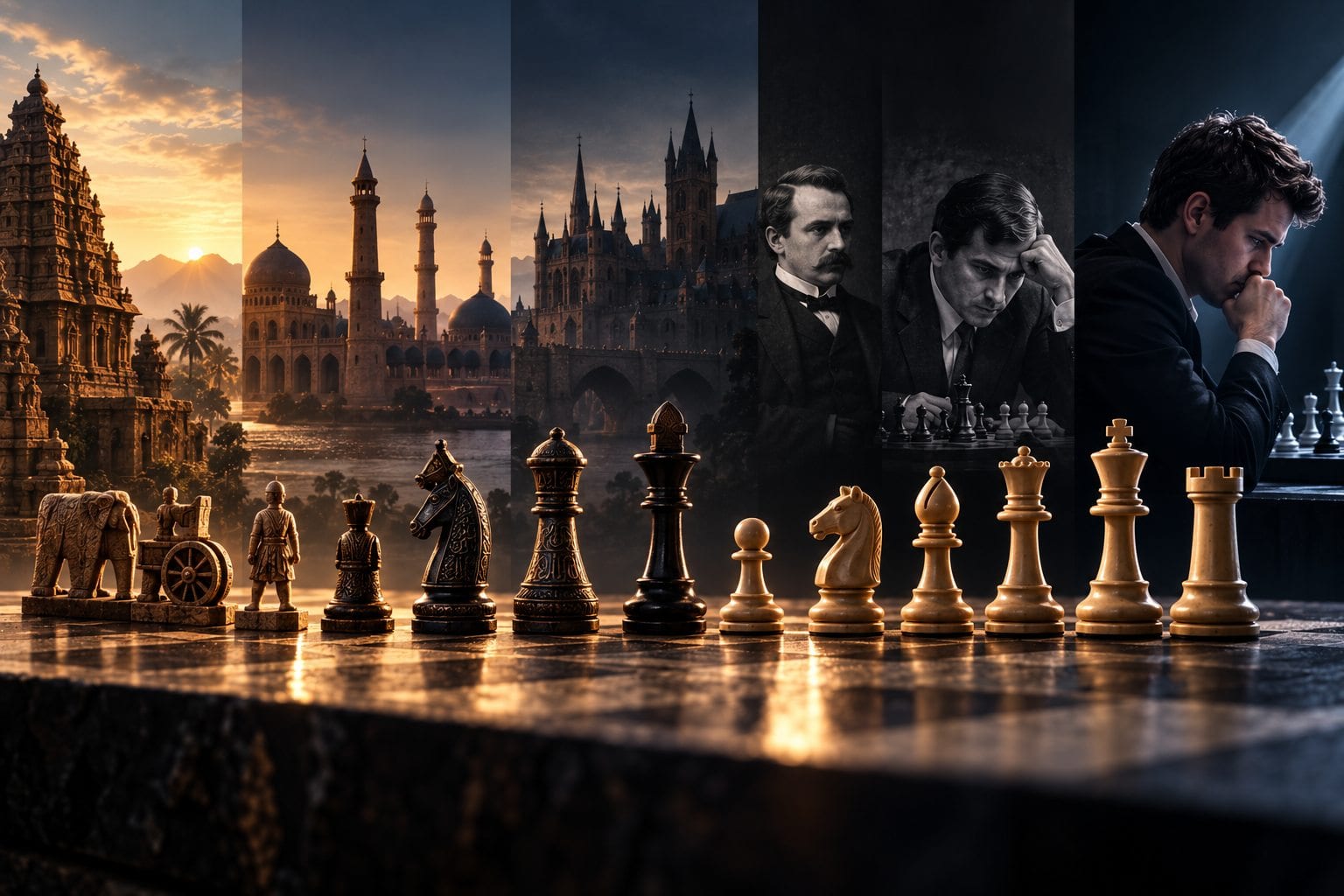
A GAME THAT TRAVELLED THROUGH CIVILIZATIONS
Chess was not created in its final form by one person on one day.
Civilizations kept changing it.
India gave the game one of its most important direct ancestors.
Persia transformed it and left traces in its language.
The Islamic world studied and spread Shatranj across enormous cultural networks.
Europe transformed the rules into modern chess.
International tournaments turned chess into organized competition.
World Champions transformed it into professional sport.
The Soviet Union built an extraordinary chess culture.
Fischer made a chess match a global Cold War event.
Kasparov confronted the computer.
Anand inspired a new chess generation in India.
Carlsen became the champion of the internet and engine era.
Computers surpassed humans.
The internet connected everyone.
And yet the king still moves one square.
The knight still jumps.
The rook still moves in straight lines.
And every game still ends around the same ancient objective.
Checkmate.
THE LEGENDS WHO CHANGED CHESS
Across generations, different champions represented different ideas about how chess should be played.
Paul Morphy showed the destructive power of rapid development and open lines.
Wilhelm Steinitz helped establish positional principles.
Jose Raul Capablanca demonstrated extraordinary simplicity and endgame precision.
Mikhail Tal transformed the board into tactical chaos.
Bobby Fischer challenged Soviet dominance.
Anatoly Karpov mastered positional restriction.
Garry Kasparov combined preparation, calculation and aggression.
Viswanathan Anand helped globalize elite chess and inspired modern India.
Magnus Carlsen demonstrated the extraordinary value of small advantages and universal technique.
Different centuries.
Different countries.
Different styles.
The same 64 squares.
FROM MORPHY TO MAGNUS
Paul Morphy.
Wilhelm Steinitz.
Emanuel Lasker.
Jose Raul Capablanca.
Alexander Alekhine.
Mikhail Botvinnik.
Mikhail Tal.
Bobby Fischer.
Anatoly Karpov.
Garry Kasparov.
Viswanathan Anand.
Magnus Carlsen.
Each inherited a game shaped by previous generations.
Each left something for the next.
THE BATTLEFIELD OF THE MIND
For roughly fifteen centuries, kingdoms have risen and disappeared.
Empires collapsed.
Technologies transformed civilization.
Humans went from horses to automobiles.
From handwritten letters to instant communication.
From mechanical calculators to artificial intelligence.
Yet somewhere in the world tonight, two people will sit across the same 64 squares and begin another battle.
No armies.
No blood.
Just two minds and 32 pieces.
Chess began as a representation of war.
It survived because the real battlefield was always the human mind.
FAQ
Frequently Asked Questions
Where did chess originate?
The strongest historical consensus places an important direct ancestor of chess, Chaturanga, in India around the sixth century CE, before the game spread to Persia and later across the Islamic world and Europe.
Who invented chess?
Chess was not invented in its final modern form by one known person. It developed across centuries from earlier games, especially Chaturanga and Shatranj, as different cultures changed the pieces, rules and style of play.
What is Chaturanga?
Chaturanga was an ancient Indian battlefield game and a major ancestor of modern chess. Its pieces reflected divisions of an army, including infantry, cavalry, elephants and chariots.
What is Shatranj?
Shatranj was the Persian and later Islamic-world form of chess that developed from earlier Indian traditions and helped transmit the game, its strategy and some of its vocabulary across civilizations.
When did chess get modern rules?
Many key modern rules emerged in Europe around the late 15th century, including the far more powerful queen and long-range bishop, which made the game faster and tactically sharper.
Why was Kasparov vs Deep Blue important?
IBM's Deep Blue defeated Garry Kasparov in a six-game match in 1997, marking a major public milestone in computer chess and the wider history of artificial intelligence.
Did computers ruin chess?
No. Chess engines surpassed human playing strength, but they also transformed training, analysis and online learning. Modern players use engines to understand positions more deeply.
PRESDA Dispatch
Stay Informed. Stay Aware.
A sharp briefing across AI, gaming, sport, business, world affairs, paparazzi, and lifestyle.