BOBBY FISCHER: THE CHESS LEGEND WHO DEFIED AMERICA AND FOUND REFUGE IN ICELAND
From the 1972 chess crown to US sanctions, detention in Japan and Icelandic citizenship: the documented life and complicated legacy of Bobby Fischer.
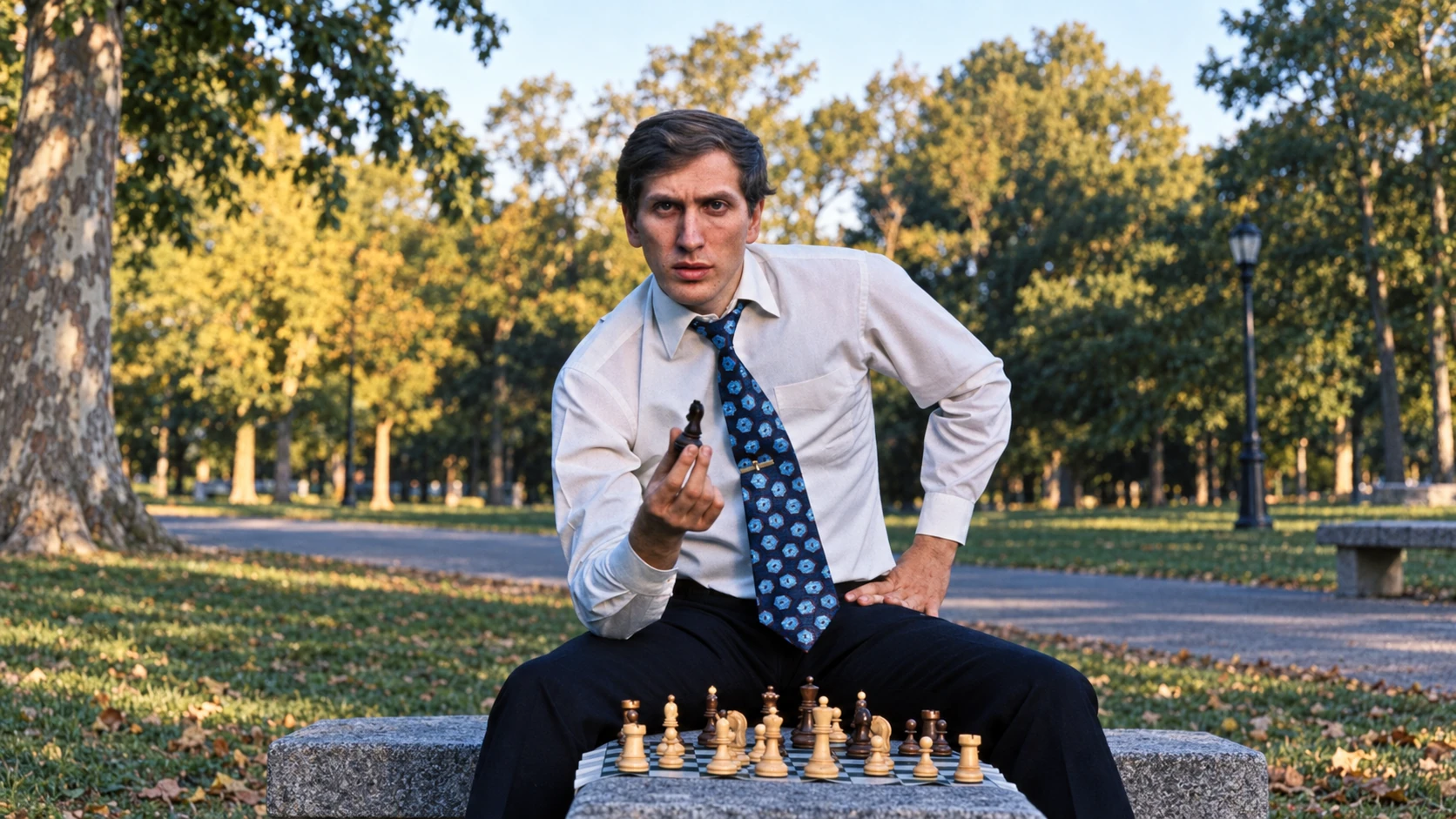
AI-generated artistic reconstruction supplied for this article. This imagined park scene is not an authentic photograph of Bobby Fischer.
On March 24, 2005, Bobby Fischer reached Iceland with a new nationality and an unresolved past. The country where he had defeated Boris Spassky in 1972 now offered something more basic than a world championship: somewhere he could legally go. Behind him lay more than eight months in Japanese immigration detention. Ahead lay a short final chapter in Reykjavík, far from the American celebrations that had once made him a Cold War hero.
The reversal was extraordinary, but its legal machinery was specific. Fischer faced a US sanctions prosecution over a paid chess match in Yugoslavia, and Japan detained him after his American passport was revoked. Iceland’s intervention changed his destination; it did not erase the American case. His story asks how a sporting achievement can bind a person to a country long after public admiration has become profoundly complicated. Iceland Review: arrival in Iceland
Brooklyn: a talent built through work
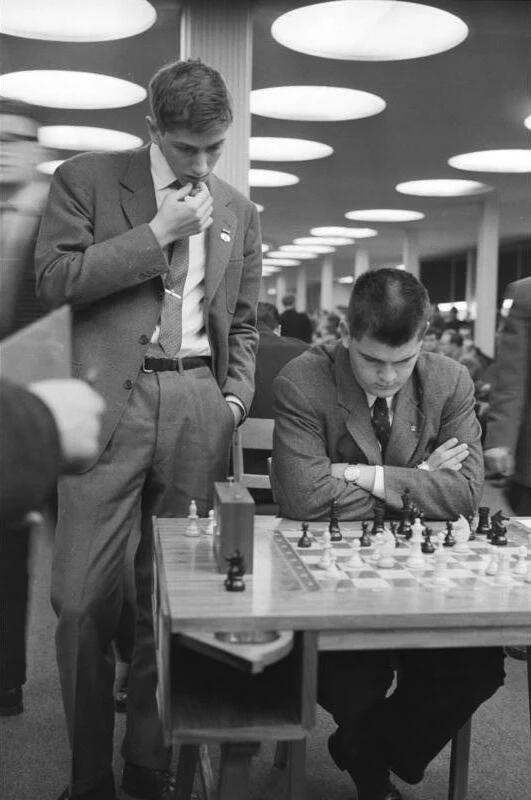
Fischer observes William Lombardy’s game at the Leipzig Chess Olympiad, October 1960. Photograph by Ulrich Kohls.
Bundesarchiv, Bild 183-76052-0053 / Kohls, Ulrich / CC BY-SA 3.0 DE
CC BY-SA 3.0 de. Resized and converted to WebP by PRESDA without further cropping or color alteration. This resized image remains available under CC BY-SA 3.0 de.
Robert James Fischer was born in Chicago on March 9, 1943, and grew up mainly in Brooklyn, raised by his mother, Regina, alongside his sister, Joan. He learned chess at six. The familiar image of an isolated prodigy captures only part of the story: clubs, opponents, books and adults who took his ability seriously helped turn fascination into strength. Biography: Bobby Fischer
Carmine Nigro encouraged his early development; Jack Collins later offered a home filled with chess literature and strong players. The World Chess Hall of Fame preserves materials from that circle. They reveal a practical apprenticeship: studying positions, testing ideas and returning to the board. Extraordinary calculation did not remove the need for extraordinary preparation. World Chess Hall of Fame: Fischer collection
At thirteen, Fischer defeated Donald Byrne in a 1956 encounter remembered as the Game of the Century. His queen sacrifice was not an act of theatrical recklessness: coordinated pieces gave him more than the apparently superior piece he surrendered. He won the 1957–58 US Championship at fourteen and became a grandmaster in 1958, then the youngest ever. The achievement was precocity made visible through results, not a retrospective legend. World Chess Hall of Fame: early career exhibits
The road to Reykjavík
Fischer eventually won all eight US Championships he entered, including an extraordinary eleven wins from eleven games in 1963–64. His ambition stretched beyond national dominance. The world title belonged to a succession of Soviet champions, supported by a formidable chess culture. His challenge had to survive a qualifying system before it could become a geopolitical spectacle. World Chess Hall of Fame: Fischer collection
In the 1971 Candidates matches he defeated Mark Taimanov 6–0 and Bent Larsen 6–0, then overcame former world champion Tigran Petrosian 6½–2½. Those scores explain the anticipation better than any adjective. Against elite opposition, consecutive wins are exceptionally difficult because even a drawn game interrupts the sequence. Fischer arrived as a challenger whose results had already unsettled expectations. FIDE: Fischer’s championship record
1972: victory on the world’s stage
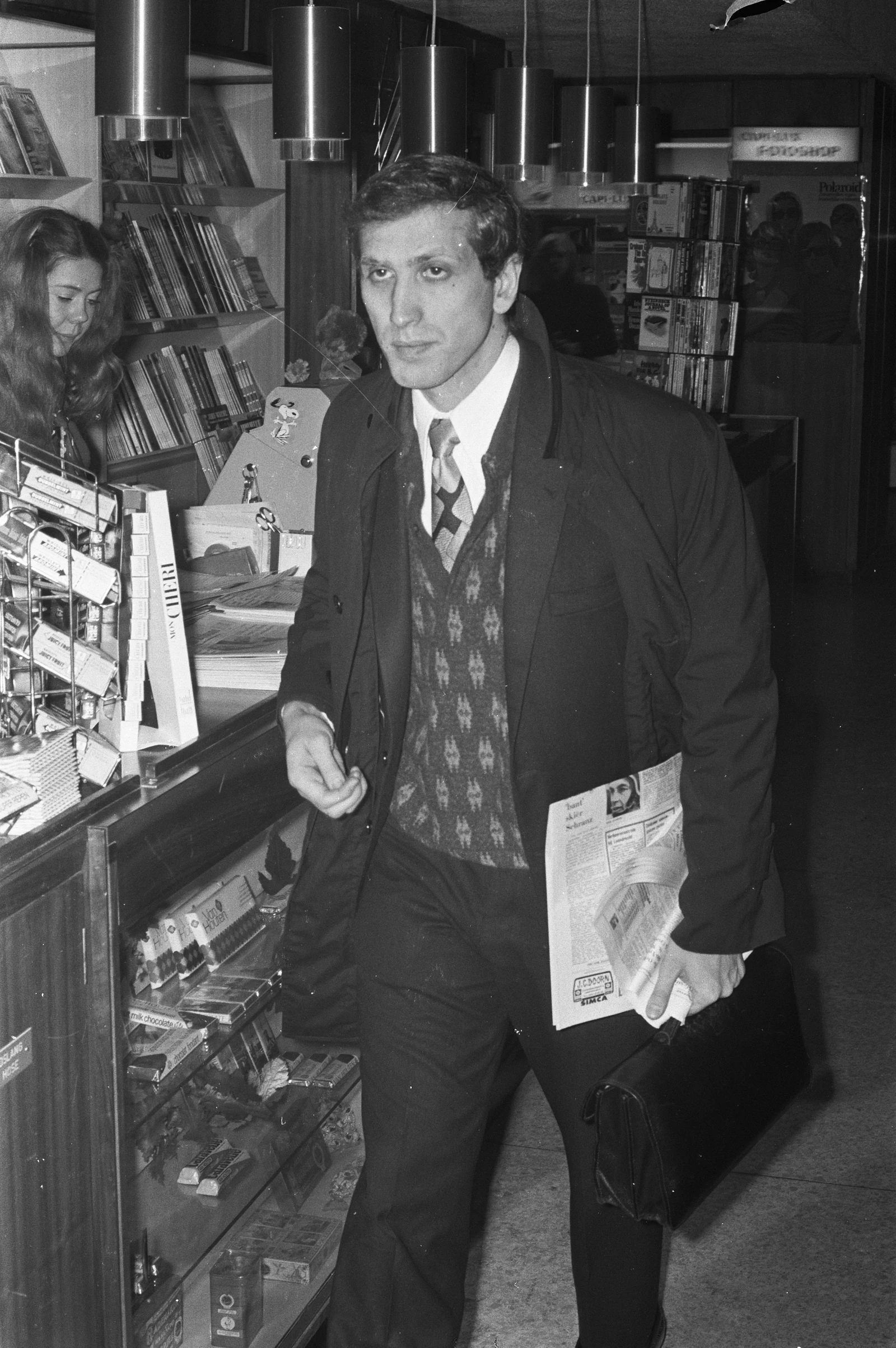
Fischer in Amsterdam on January 31, 1972, during a visit for championship negotiations with FIDE president Max Euwe. This photograph predates his victory in Iceland.
W. Punt / Anefo / Nationaal Archief, 925-3509 / CC0
CC0. Resized and converted to WebP by PRESDA without further cropping or color alteration.
The match in Reykjavík became a Cold War drama, but Spassky was a person across the board, not simply an emblem of the Soviet state. Fischer lost the first game and forfeited the second amid disputes over playing conditions and cameras. The contest could have collapsed before its great chess had properly begun. Spassky’s willingness to continue was part of the history, too. Chess.com: match and career record
Fischer recovered and won 12½–8½, securing the title on September 1, 1972. A match score counts a win as one point and a draw as half a point; it is not a count of decisive games alone. His victory ended the Soviet succession that had controlled the championship since 1948. Iceland had hosted an event whose significance travelled far beyond chess clubs. FIDE: Fischer’s championship record
For newcomers, the fascination was national rivalry. For players, it was the quality and breadth of Fischer’s technique: opening preparation, positional clarity and the pressure of endgames in which small advantages could become decisive. The achievement belongs within the longer evolution explored in PRESDA’s history of chess, rather than outside it as an inexplicable miracle.
The champion who stopped competing
The expected reign never materialized. Fischer did not resume regular competition after Reykjavík. In 1975, disagreements with FIDE over the conditions for a defense against Anatoly Karpov ended with Fischer losing the title by default. Karpov became champion without their playing the match. That administrative outcome should not be confused with Fischer losing a contest at the board. US Chess: 1975 contemporary reporting
Withdrawal created a peculiar kind of fame. Every subsequent champion could be compared with a player who was no longer available to be tested. The imagined Fischer of another tournament or another decade became impossible to defeat because he existed outside results. His absence encouraged mythology, but it cannot answer the sporting question of how he would have performed against later rivals.
Yugoslavia, 1992: a comeback with legal consequences
Twenty years after Reykjavík, Fischer agreed to face Spassky again. Their 1992 match took place in Sveti Stefan and Belgrade, within the Federal Republic of Yugoslavia, then comprising Serbia and Montenegro. It was not a FIDE world championship, whatever its promotional claims. Fischer won ten games to Spassky’s five, with fifteen draws, in a contest offering a total prize fund of $5 million. Mark Weeks: 1992 match record
The political setting made the contract consequential. During the wars accompanying Yugoslavia’s breakup, international sanctions targeted Serbia and Montenegro. US Executive Order 12810, issued June 5, 1992, restricted commercial dealings. Being an American citizen abroad did not put Fischer beyond the reach of those restrictions. US National Archives: 1992 executive orders
An August 21 Treasury warning stated that playing under the sponsorship agreement would support commercial activity and export services in violation of the sanctions. Fischer proceeded. A federal indictment followed, and an arrest warrant was issued on December 15, 1992. The documents reproduced by ChessBase identify a commercial-contract allegation, not a prosecution for playing chess badly, criticizing Washington or holding offensive opinions. ChessBase: Treasury warning and court documents
An indictment is an accusation, not a conviction. Fischer did not return to face trial, so a narrative that describes him as having served an American sentence is wrong. Equally misleading is the suggestion that an ordinary sporting invitation had no legal context. He had received a warning, and his decision exposed him to prosecution. The dispute combined celebrity, sanctions law and a refusal to accept institutional authority.
Exile and the limits of admiration
Fischer spent subsequent years abroad, including periods in Hungary, the Philippines and Japan. Meanwhile his public interventions increasingly overshadowed his chess. He made antisemitic statements and praised the September 11, 2001 attacks. These were not harmless eccentricities or simply strong criticism of American foreign policy. Their targets and substance require plain description, without repeating the abuse. TIME: Fischer’s public legacy
His Jewish family background does not make antisemitism less real, and his chess ability does not excuse it. Nor should journalists diagnose a dead person from interviews or use illness as an explanation for prejudice. The documented statements can be assessed on their own. Admiration for his games and condemnation of his words are compatible judgments, not a contradiction that a biography must resolve in his favor.
The legal chronology also matters morally. The sanctions case dated from 1992, well before his 2001 broadcast remarks. Public outrage and the prosecution belong to the same life, but they are not interchangeable explanations. Treating every confrontation as persecution would conceal choices he made; treating every act of assistance as approval of those choices would conceal what humanitarian help can mean.
Japan, 2004: a passport becomes a barrier
In July 2004, Fischer was detained at Narita Airport while attempting to leave Japan. American authorities had revoked his passport in December 2003. His camp disputed whether he had received proper notification. Japanese immigration proceedings exposed him to removal to the United States, where the outstanding case awaited him. A passport dispute had turned years of living abroad into an immediate crisis. ChessBase: passport and immigration documents
The distinctions are important. Revoking a passport does not itself strip someone of citizenship. Immigration detention is not a conviction on a foreign criminal charge. And deportation proceedings are not automatically identical to a completed extradition process. Contemporary headlines sometimes compressed those questions into one dramatic word; the documents describe separate actions by separate governments.
Miyoko Watai, the Japanese chess player who was central to his life, and an international network of supporters sought a way out. In Iceland, friends remembered both the 1972 visitor and the person now facing prolonged detention. Their efforts moved from expressions of solidarity to the difficult practical question: which country could receive him on documents Japan would recognize? ChessBase: citizenship campaign
March 2005: Iceland opens the door
On March 21, 2005, the Alþingi passed legislation granting Robert James Fischer Icelandic citizenship. The recorded vote was forty in favor, none against and two abstentions. This was an exceptional parliamentary intervention, not merely an invitation from a chess club. Contemporary ChessBase coverage reproduces the act and summarizes BBC reporting that Japan would not send him to the US if Iceland granted citizenship. ChessBase: citizenship act and contemporary reporting
The solution was concrete: a new nationality and travel documents made Iceland an available destination. On March 24 he left Japan and arrived in Reykjavík. His reception showed how deeply the championship remained part of Icelandic public memory. The same place could remember a sporting triumph while helping a man whose later statements had made him difficult to defend in other respects. Iceland Review: arrival in Iceland
Citizenship did not constitute an American pardon or a judicial finding that the sanctions charge was invalid. It resolved where he could go from Japan. The distinction makes Iceland’s role more understandable, not less dramatic: a small state used an ordinary power of sovereignty, granting nationality, to change the outcome of an extraordinary personal impasse.
Reykjavík and the final years
Fischer spent his remaining years in Iceland, with a circle of friends and supporters rather than a renewed tournament career. Accounts of this period must be handled carefully: recollections by people close to him are valuable, but they are perspectives, not unrestricted access to his inner life. Refuge provided a home; it did not require the past to become simple or harmonious.
He died in Reykjavík on January 17, 2008, aged sixty-four. Contemporary reports identified kidney failure. There is no need to embellish that fact with a speculative account of his mental state or to turn medical decisions into a final contest of will. ChessBase’s account of his last weeks documents the illness through those around him. ChessBase: Fischer’s final weeks
A quiet grave, an unsettled legacy
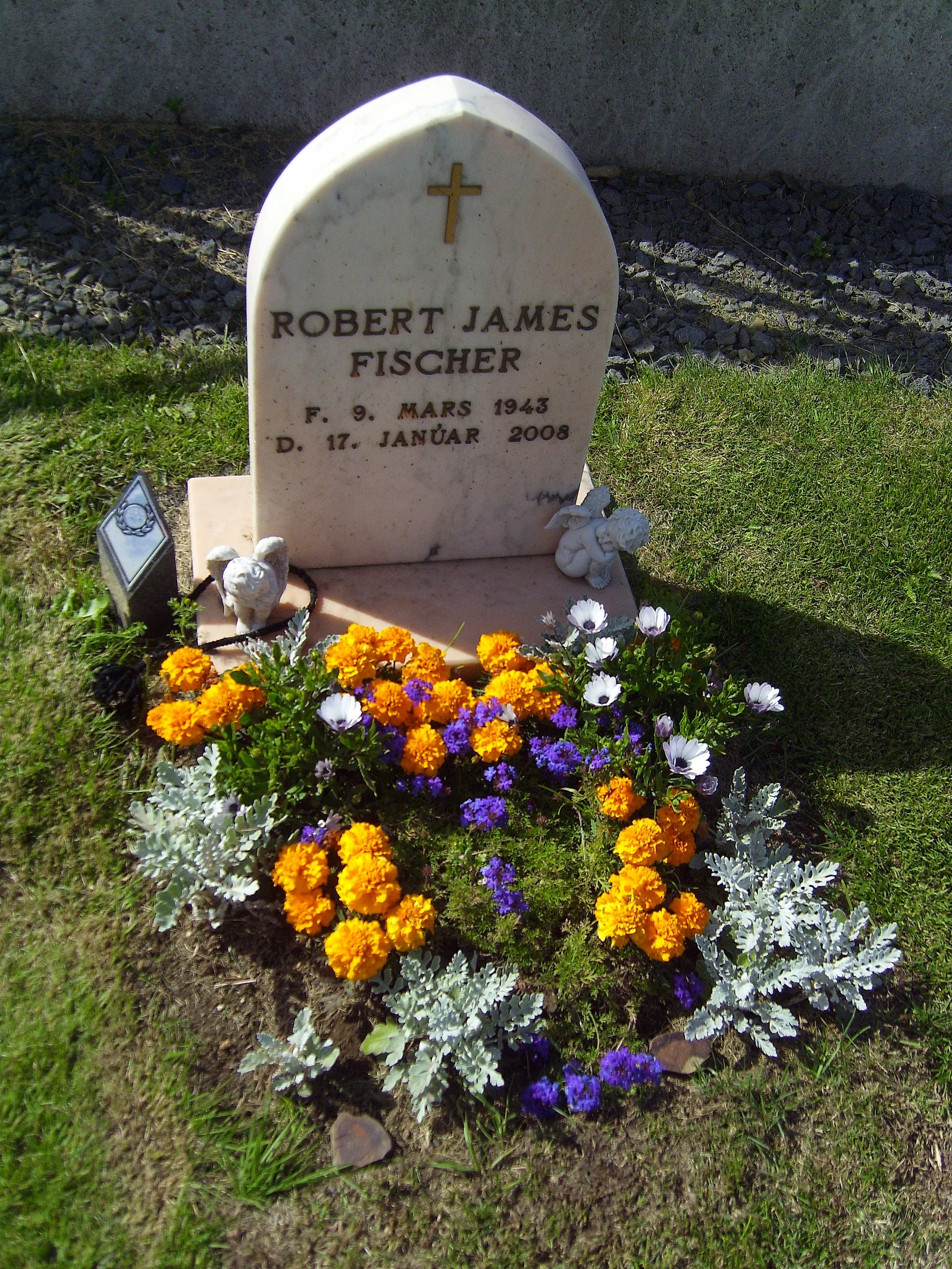
Fischer’s grave in the Laugardælir churchyard near Selfoss, photographed by AxelBoldt on July 21, 2009. This is a later photograph of the grave, not an image of the 2008 funeral.
AxelBoldt / Wikimedia Commons / Public domain
Public domain. Resized and converted to WebP by PRESDA without further cropping or color alteration.
On January 21, he was buried in a private ceremony at Laugardælir, near Selfoss. Reuters’ contemporary dispatch, preserved in ChessBase’s coverage, described a small gathering that included Watai and close friends. The quiet burial stood far from the crowds and national symbolism of 1972. The grave photograph shown here was taken in 2009, not during the funeral. Reuters burial report, reproduced by ChessBase
His games remain available to be examined move by move. My 60 Memorable Games, published in 1969, offers another kind of record: analysis that includes difficult struggles rather than only a procession of victories. The enduring value is instructional. A reader can disagree with the author’s opinions and still learn why a particular square, exchange or pawn ending matters. World Chess Hall of Fame: Fischer collection
The broader legacy includes Fischer random chess, commonly called Chess960, which varies the initial back-rank arrangement under defined rules, and his advocacy of time increments that add thinking time during play. Those ideas address practical problems: memorized openings and games distorted by desperate time shortage. They extend his influence beyond the frozen image of one championship. FIDE: history of Chess960 Mark Weeks: 1992 match and clock
Iceland did not settle the argument about Bobby Fischer. It gave him a place to live and, eventually, a place to be buried. The chessboard preserves what can be demonstrated; biography must also preserve what cannot be excused. To remember him honestly is to hold both records open: the extraordinary competitor who changed his game, and the difficult man whose final freedom depended on people willing to help him without making his every belief their own.
FAQ
Frequently Asked Questions
What is this PRESDA article about?
From the 1972 chess crown to US sanctions, detention in Japan and Icelandic citizenship: the documented life and complicated legacy of Bobby Fischer.
Which category does this story belong to?
This story is part of PRESDA's Sport coverage.
Who published this article?
BOBBY FISCHER: THE CHESS LEGEND WHO DEFIED AMERICA AND FOUND REFUGE IN ICELAND was published by PRESDA Editorial on PRESDA.
PRESDA Dispatch
Stay Informed. Stay Aware.
A sharp briefing across AI, gaming, sport, business, world affairs, paparazzi, and lifestyle.