FORMULA 1 RETURNS TO AFRICA WITH HISTORIC RWANDA DEAL
Formula 1 confirms a ten-year Rwanda agreement. Explore Bugesera’s proposed circuit, Africa’s racing history and the questions beyond the announcement.
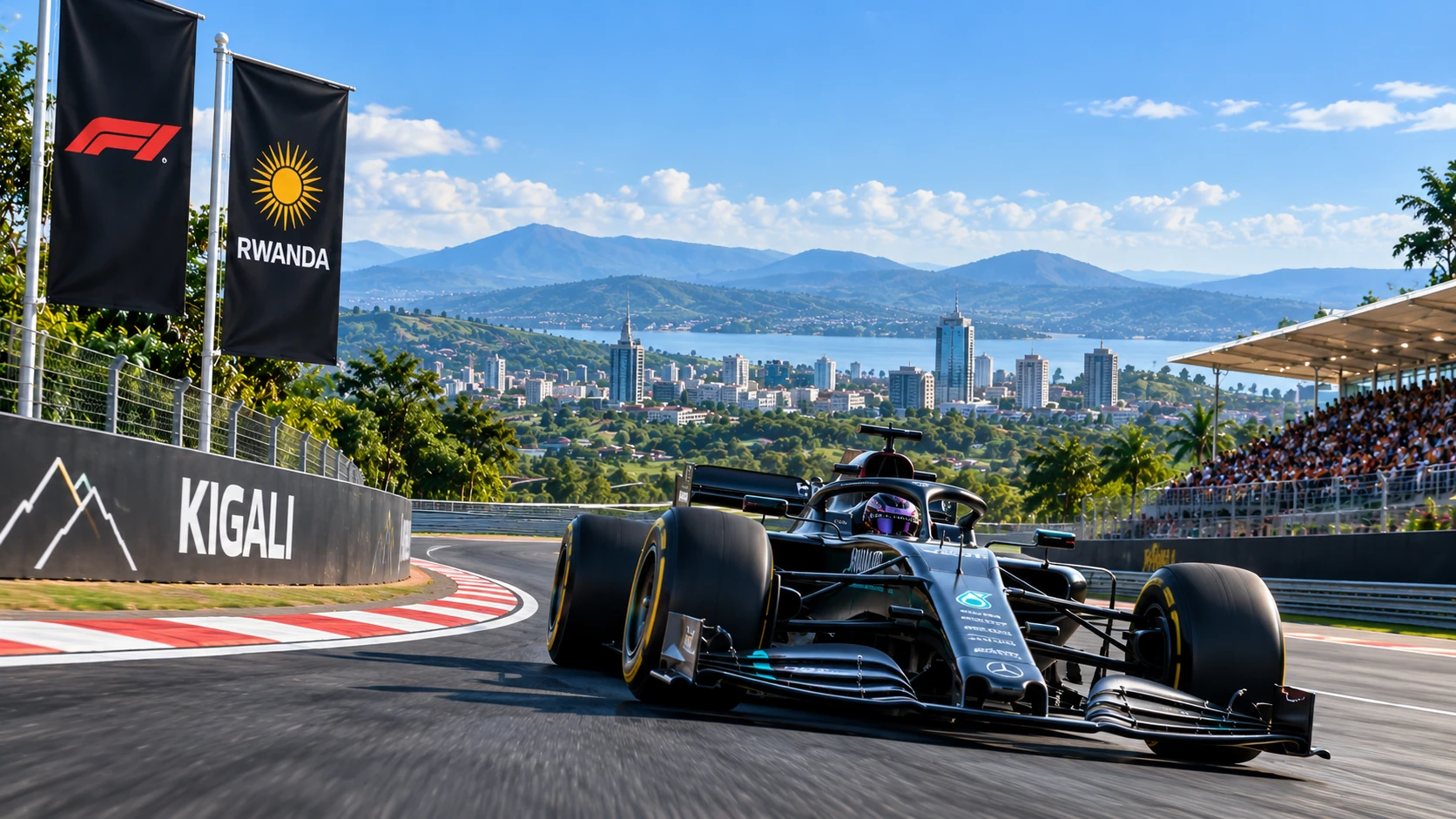
AI-generated editorial illustration of an imagined race in Rwanda, not a real circuit photograph or approved design.
For more than three decades, an African fan could follow Formula 1 around the world without seeing the championship come home. On October 13, 2026, that absence acquired a route toward an ending: Formula 1 announced a ten-year agreement for an African Grand Prix in Rwanda. The debut is envisaged for the early 2030s, after a new circuit is completed. No inaugural race date has been confirmed. Formula 1 announcement
The distinction matters. This is a signed agreement about a future event, not a race already added to an imminent season. Between the ceremony in Kigali and the first start lie construction, safety requirements and the practical work of receiving a global championship. The historical promise is real; the delivery remains ahead.
An agreement, not yet a starting grid
The official event name is the Formula 1 African Grand Prix, presented by Visit Rwanda. The announcement links the circuit to a broader development led by the Rwanda Development Board. Stefano Domenicali presented the return as an opportunity for tourism, investment and skills; President Paul Kagame emphasized benefits beyond a single weekend. These are the partners’ stated objectives, not independently established economic outcomes. Official agreement
The FIA’s announcement also records Mohammed Ben Sulayem’s commitment to work with the commercial rights holder and local partners as the circuit is developed to international standards. A venue designed to meet FIA Grade 1 requirements should not be described as already certified. The distinction between an intended standard and a completed approval is essential when reporting a circuit that has yet to host a race. FIA statement
Bugesera: a landscape becomes a racing proposition
The proposed site is in Bugesera, approximately 40 kilometres south of Kigali, close to the new international airport development. Formula 1’s location briefing places the project outside the capital rather than on a downtown street circuit. Access will be part of the sporting product: getting spectators, teams and equipment to the venue matters as much as the view from a grandstand. Formula 1 location briefing
F1’s design report identifies Alex Wurz and Carsten Tilke as the principal designers. Their proposed anti-clockwise circuit measures about six kilometres, with 17 corners and 197 metres of elevation change across a lap. Hills, a lake, banking and cambered corners inform the concept. The full layout had not been released in that report. These are published plans, not measurements of a finished track. Formula 1 design report
The same report describes a karting facility, driving experiences and off-road courses alongside the main venue, with paddock architecture drawing on local forms. Such features suggest an ambition to make the site useful beyond Formula 1. They do not establish how frequently it will be used, what participation will cost or which programs will be available to local young people. Circuit development plans
Reuters reports that Rwanda Development Board chief executive Jean-Guy Afrika described a capacity of 100,000 and a venue capable of hosting concerts and exhibitions. He indicated that financing would probably be private, with government coordination. Capacity is a planning claim, not attendance; an indicated financing approach is not a published, fully funded budget. Reuters, syndicated by Boursorama
From Casablanca to Kyalami, and a long silence
Africa’s championship history did not begin with this announcement. Morocco hosted the 1958 Grand Prix near Casablanca, on the Ain-Diab course. South Africa subsequently became the continent’s familiar F1 destination, with its last championship race held at Kyalami in 1993. Rwanda would become the third African country to host a World Championship round. The word ‘return’ therefore carries a precise historical meaning. Formula 1 historical context
A gap of that length changes who remembers a sport in person. For many supporters, an African Grand Prix has existed only in old footage or as a recurring possibility. A new race can alter that relationship, but one event cannot represent every country, language and motorsport community on a continent. The African name is an invitation to participation, not proof that participation will be equally accessible.
Hamilton’s campaign, and the question of access
Lewis Hamilton has repeatedly advocated a race in Africa. Reuters records his renewed support in Singapore shortly before the announcement. His campaigning helped keep the subject in public view, but the reporting does not establish that he alone secured the agreement. Nor does an early-2030s target confirm which drivers will compete in the inaugural race. Reuters: Hamilton and the agreement
The more lasting question is who can enter the sport around it. A Grand Prix can create roles for technicians, marshals, hospitality workers and suppliers, yet those possibilities need training, recruitment and local access. A child seeing a car nearby is a powerful image. A young person gaining a usable qualification or a sustained job is a different, measurable achievement. Both deserve attention, without confusing inspiration with a guaranteed career.
Tourism and investment: the test beyond race week
The economic case has several moving parts. Visitors may buy rooms, meals and transport; businesses may seek contracts; a televised event may increase familiarity with Rwanda. But gross visitor spending is not the same as public profit. Construction, maintenance, transport, security and any public commitments must be considered alongside revenues. PRESDA is not assigning a return-on-investment figure where a transparent project budget and assumptions have not been established.
A useful assessment would ask how much spending stays with local firms, how many jobs continue after construction and whether the venue remains active between major events. It would also distinguish new visitors from travelers who would have come anyway. Those are questions for later evidence, not reasons to dismiss the ambition. They are how an ambitious promise can eventually be tested.
Local access belongs in that calculation. Ticket prices, regional travel costs and transport arrangements will shape who can attend. As of October 14, 2026, the announcements reviewed here do not provide a confirmed inaugural race date or a complete public ticketing plan. Readers should not treat the illustration, proposed capacity or early-decade target as an invitation to book a specific race weekend. Official timing
The controversy cannot be left outside the gates
Reuters places the deal alongside criticism of Kagame’s treatment of opponents and allegations concerning support for M23 in neighboring Democratic Republic of Congo. AP also reports concern that global sport can improve a government’s image while human-rights questions remain unresolved, often described as sportswashing. Those concerns are part of the story, not a verdict on Rwandan fans or their entitlement to enjoy motorsport. Reuters context Associated Press
The partners’ development case and scrutiny of political conduct must be assessed on their own evidence. A spectacular event would not, by itself, answer human-rights criticism. Equally, criticism of a government should not erase the ambitions of residents, businesses or athletes. Responsible coverage can hold both propositions without reducing the country to a promotional slogan or a single controversy.
What must happen before the lights go out
The next meaningful milestones are concrete: a completed venue, the necessary approvals, a confirmed calendar slot and clear arrangements for spectators and communities. Published project updates should distinguish design revisions from finished work, projected jobs from actual employment and commercial commitments from public costs. The ten-year term describes the agreement’s horizon; it does not remove the need to scrutinize each step.
The supplied hero is an AI-generated editorial illustration. Its lake, skyline, spectators and racing car are an imagined scene, not a photograph of Bugesera, an approved circuit rendering or evidence that racing has begun. The official announcement is the news; the image conveys the aspiration.
The agreement changes Africa’s place in Formula 1’s plans. Whether it changes the everyday opportunities available around the circuit will be the deeper test. The first starting lights, when their date is finally confirmed, will mark a sporting return. The real legacy will be judged after the grandstands empty: by what the venue makes possible, who benefits and whether the promises made in Kigali survive contact with ordinary life.
FAQ
Frequently Asked Questions
What is this PRESDA article about?
Formula 1 confirms a ten-year Rwanda agreement. Explore Bugesera’s proposed circuit, Africa’s racing history and the questions beyond the announcement.
Which category does this story belong to?
This story is part of PRESDA's Sport coverage.
Who published this article?
FORMULA 1 RETURNS TO AFRICA WITH HISTORIC RWANDA DEAL was published by PRESDA Editorial on PRESDA.
PRESDA Dispatch
Stay Informed. Stay Aware.
A sharp briefing across AI, gaming, sport, business, world affairs, paparazzi, and lifestyle.