Saudi Arabia 2034: How the Kingdom Is Building for the World Cup
The World Cup is confirmed. Delivering its stadiums, transport and accommodation is a changing national project, with NEOM now at the centre of new questions.
Saudi Arabia is preparing to host the 2034 FIFA World Cup with a bid built around 15 stadiums in five host cities: Riyadh, Jeddah, Al Khobar, Abha and NEOM. FIFA confirmed the hosting award on December 11, 2024. The award is settled; the original venue designs, delivery dates and transport promises are not all completed or unchanged. FIFA: 2034 hosting decision and bid documents
The most consequential new development concerns NEOM. Reuters reported on October 4, 2026, citing two sources, that its stadium plans had been shelved indefinitely. The hosting authority emphasized construction progress elsewhere without answering the agency's questions about NEOM. That makes this a story about both building and revising a World Cup programme. Reuters via WHBL: NEOM stadium report, October 4, 2026
THE ORIGINAL PLAN: 15 STADIUMS, FIVE HOST CITIES
Riyadh accounts for eight venues in the submitted plan, Jeddah for four, and Al Khobar, Abha and NEOM for one each. The bid combined four existing venues requiring refurbishment with three new venues then under construction and eight planned new builds. Those categories describe the 2024 submission, not a live October 2026 inventory. Saudi 2034 bid book: stadiums, timing, accommodation and transport
The table reproduces the bid book's stadium overview, printed pages 48–49. Capacities are proposed gross tournament capacities, not current seats available for sale. They should not be mixed with everyday league configurations or promotional round numbers. The NEOM entry remains here to explain the original plan, with its reported suspension discussed below. Saudi 2034 bid book: stadiums, timing, accommodation and transport
| Venue in the 2024 bid | Host city | Proposed gross seats |
|---|---|---|
| King Salman International Stadium | Riyadh | 92,760 |
| King Fahad Sports City Stadium | Riyadh | 70,200 |
| Prince Mohammed bin Salman Stadium | Riyadh | 46,979 |
| New Murabba Stadium | Riyadh | 46,010 |
| ROSHN Stadium | Riyadh | 46,000 |
| Prince Faisal bin Fahad Sports City Stadium | Riyadh | 46,865 |
| South Riyadh Stadium | Riyadh | 47,060 |
| King Saud University Stadium | Riyadh | 46,319 |
| King Abdullah Sports City Stadium | Jeddah | 58,432 |
| Qiddiya Coast Stadium | Jeddah | 46,096 |
| Jeddah Central Development Stadium | Jeddah | 45,794 |
| King Abdullah Economic City Stadium | Jeddah | 45,700 |
| Aramco Stadium | Al Khobar | 46,096 |
| King Khalid University Stadium | Abha | 45,428 |
| NEOM Stadium | NEOM | 46,010 |
RIYADH: THE LARGEST SHARE OF THE BUILD
King Salman International Stadium is the proposed centrepiece, with 92,760 gross seats in the bid and a planned role hosting the opening match and final. The original completion target was 2029. A Ministry of Sport notice dated November 25, 2025, invited contractors to prequalify for main construction works, with a February 16, 2026 application deadline. This documents procurement; it does not establish that the stadium is finished or that the original timetable is guaranteed. Saudi 2034 bid book: stadiums, timing, accommodation and transportSaudi Ministry of Sport: King Salman stadium procurement
Prince Mohammed bin Salman Stadium is planned at Qiddiya, on the Tuwaiq cliffs outside central Riyadh. Its 46,979-seat bid configuration is distinct from larger capacities promoted for concerts. There is evidence beyond architectural renderings: contractor FCC reported construction milestones at Qiddiya Stadium in its first-quarter 2026 results. That supports work underway, without providing a verified percentage complete. Saudi 2034 bid book: stadiums, timing, accommodation and transportFCC: Qiddiya construction milestones, first quarter 2026
The capital's programme also includes refurbishment at King Fahad Sports City and King Saud University, alongside Prince Faisal bin Fahad Sports City, New Murabba, ROSHN and South Riyadh stadium projects. These are separate venues, not alternative names for one development. Even capacity specifications require dates: the bid lists ROSHN at 46,000, while PIF's current project page says 45,000 planned seats. PRESDA retains the bid figure in the table and identifies the later specification separately rather than pretending they match. Saudi 2034 bid book: stadiums, timing, accommodation and transportPIF: ROSHN stadium project specifications
For residents, the intended changes extend to stadium precincts, public spaces, access roads and links to expanding residential and entertainment districts. The practical test is whether those connections work on an ordinary day as well as on a match night. A stadium can be structurally complete while its surrounding transport arrangements remain unfinished.
JEDDAH, AL KHOBAR AND ABHA
Jeddah's plan combines an established landmark, King Abdullah Sports City Stadium, with Jeddah Central Development Stadium, Qiddiya Coast Stadium and King Abdullah Economic City Stadium. The bid associates the new venues with wider coastal and urban developments. It describes Jeddah Central as under construction at submission, targeting 2027, while the other two new projects had 2032 targets. These are dated bid milestones, not independently certified completion forecasts. Saudi 2034 bid book: stadiums, timing, accommodation and transport
Al Khobar has a more immediate construction marker. Aramco's official announcement describes approximately 47,000 seats, a 2026 completion target and a future home for Al-Qadsiah. That general project capacity differs from the bid's 46,096 gross seats. Reuters reported on October 4 that completion was expected by year-end and the first match in January. Until opening is verified, it remains a venue approaching delivery, not an already operating World Cup stadium. Aramco: stadium construction and 2026 targetReuters via WHBL: NEOM stadium report, October 4, 2026
In Abha, the proposal expands King Khalid University Stadium to 45,428 gross seats for the tournament. The bid also describes airport expansion, road access and bus provision. The mountainous Aseer setting gives the host plan a different geography from Riyadh or the coasts, but does not remove the need to coordinate beds, airport arrivals and the final journey to the stadium. Saudi 2034 bid book: stadiums, timing, accommodation and transport
NEOM: WHAT HAS CHANGED, AND WHAT IS STILL UNCONFIRMED?
The original concept put a 46,010-seat stadium more than 350 metres above ground within The Line, with a 2032 completion target. It depended on an exceptionally ambitious surrounding urban project. It was never an existing elevated stadium awaiting minor upgrades. Saudi 2034 bid book: stadiums, timing, accommodation and transport
Reuters' October 4 report describes indefinite shelving, citing two informed sources. MEED Projects lists it on hold without a completion date. NEOM and the government media office did not respond; the hosting authority cited progress elsewhere but did not address NEOM or costs. This is attributed reporting, not a published FIFA removal or an official permanent-cancellation notice. The reviewed sources establish no approved replacement venue. Reuters via WHBL: NEOM stadium report, October 4, 2026
The distinction matters because changing one stadium can affect the wider plan: team accommodation, local transport and fan facilities were designed around host locations. PRESDA analysis: a revised venue list would need to show how those functions are reassigned, not simply substitute one rendering for another. The original five-city map should therefore be read alongside the latest reporting, not as proof that every element remains on its original schedule.
AIRPORTS, METRO, RAIL AND ROADS
Riyadh already has a substantial operating transport asset. Saudi Press Agency reported that the Orange Line began running on January 5, 2025, completing operation of all six metro lines. This is delivered infrastructure. Dedicated stadium connections, event service frequencies, crowd-management arrangements and the complete 2034 journey plan are separate questions. Saudi Press Agency: all six Riyadh metro lines, January 5, 2025
King Salman International Airport is a major planned expansion of Riyadh's aviation capacity. Its current official website states a target of up to 100 million passengers a year by 2030 and reports the start of third-runway construction in December 2025. The 100 million figure is a future annual capacity target, not passengers already handled, World Cup visitors or the older 120 million ambition still repeated in some summaries. King Salman International Airport: current development targets
The bid envisages airport growth across the host network, including Jeddah and Abha, and extensive reliance on domestic aviation for intercity movement. Existing rail adds useful links: Saudi Arabia Railways identifies Haramain services connecting Makkah and Madinah through Jeddah, King Abdulaziz International Airport and King Abdullah Economic City. This western corridor is not a completed high-speed network joining all five proposed hosts. Saudi 2034 bid book: stadiums, timing, accommodation and transportSaudi Arabia Railways: operating rail network
Roads, intercity coaches, local buses and the last stretch on foot are equally important. The bid includes proposed rail expansion and city-level transport improvements, but a proposed connection should not be described as operational. PRESDA analysis: coordinated tickets, accessible vehicles, shaded queues and realistic transfer times will matter more to a travelling supporter than a national infrastructure headline.
HOTELS, FAN ZONES AND THE 48-TEAM CHALLENGE
The official tournament concept promises more than 230,000 room keys, 134 training sites and two proposed FIFA Fan Festival locations per host city. These are event-planning commitments, not a count of verified, bookable rooms today. Room keys measure accommodation units, not guests or beds; training sites are not additional match stadiums. Proposed fan sites include King Salman Park and Qiddiya festival grounds in Riyadh, and Khuzam Park and the waterfront in Jeddah. Saudi 2034: tournament concept and legacy plansSaudi 2034 bid book: stadiums, timing, accommodation and transport
Hosting 48 teams alone puts national coordination at the centre of delivery. Teams require secure hotels, training pitches, medical services and reliable travel while supporters, broadcasters and officials use the same cities. The bid also includes ten additional host locations for team base camps. Those locations extend the operational footprint without becoming extra match-host cities. Saudi 2034 bid book: stadiums, timing, accommodation and transport
In a June 2026 Reuters interview, Sports Minister Prince Abdulaziz bin Turki Al Faisal described studying the 48-team tournament in North America and coordinating facilities, connectivity and training sites through the World Cup Authority. That is a statement of the government's approach, not evidence that every link has been completed. Reuters: sports minister on logistics and coordination, June 2026
WILL THE 2034 WORLD CUP BE PLAYED IN WINTER?
A cooler-season tournament is a credible possibility, but the sources reviewed do not establish final FIFA dates. Saudi summer temperatures can exceed 40°C, affecting spectators and outdoor work as well as players. AP has described the complications around Ramadan, the Asian Games and the international sporting calendar. A specific winter month should not be presented as confirmed. AP: timing and climate questions for 2034
Cooling a seating bowl cannot by itself solve heat exposure at training grounds, fan zones, bus stops or construction sites. Scheduling must also accommodate international qualification, club seasons, broadcasting and religious observances. The bid's event-timing chapter leaves the selection of the optimum period to collaboration with FIFA and relevant stakeholders. Saudi 2034 bid book: stadiums, timing, accommodation and transport
VISION 2030, COSTS AND DELIVERY PRESSURE
The official rationale places the World Cup within Vision 2030: tourism, entertainment, domestic football and economic diversification. Airports and urban districts therefore serve wider goals than a single tournament. Their entire budgets cannot automatically be added together and called the cost of the World Cup. Nor do forecast tourism gains establish that a particular venue will pay for itself after 2034. Saudi 2034: tournament concept and legacy plans
MEED Projects data supplied to Reuters values the stadium and related training-facility programme it tracks at $22.7 billion, including a $2.5 billion NEOM stadium estimate. These are project estimates, not an audited final bill or all national infrastructure spending. The report gives 2026–2033 completion expectations for the other tracked stadiums and facilities. Reuters via WHBL: NEOM stadium report, October 4, 2026
PRESDA analysis: the delivery challenge is a chain of dependencies. Design revisions can change procurement; construction delays can compress testing; unfinished roads or hotels can undermine a ready stadium. Worker protection, heat safety, environmental performance and transparent oversight belong in that assessment. A credible delivery programme needs evidence of compliance and operational readiness, not only expenditure or striking architecture.
By 2034, the intended visible changes range from new Riyadh arenas and airport facilities to Jeddah waterfront developments, Al Khobar's club stadium and expanded facilities in Abha. Which elements arrive in their original form remains a live question. As with the competition to stage the 2030 World Cup final, the meaningful comparison is between documented delivery and future promises. Saudi Arabia has the tournament; building a reliable national hosting system is the work still ahead.
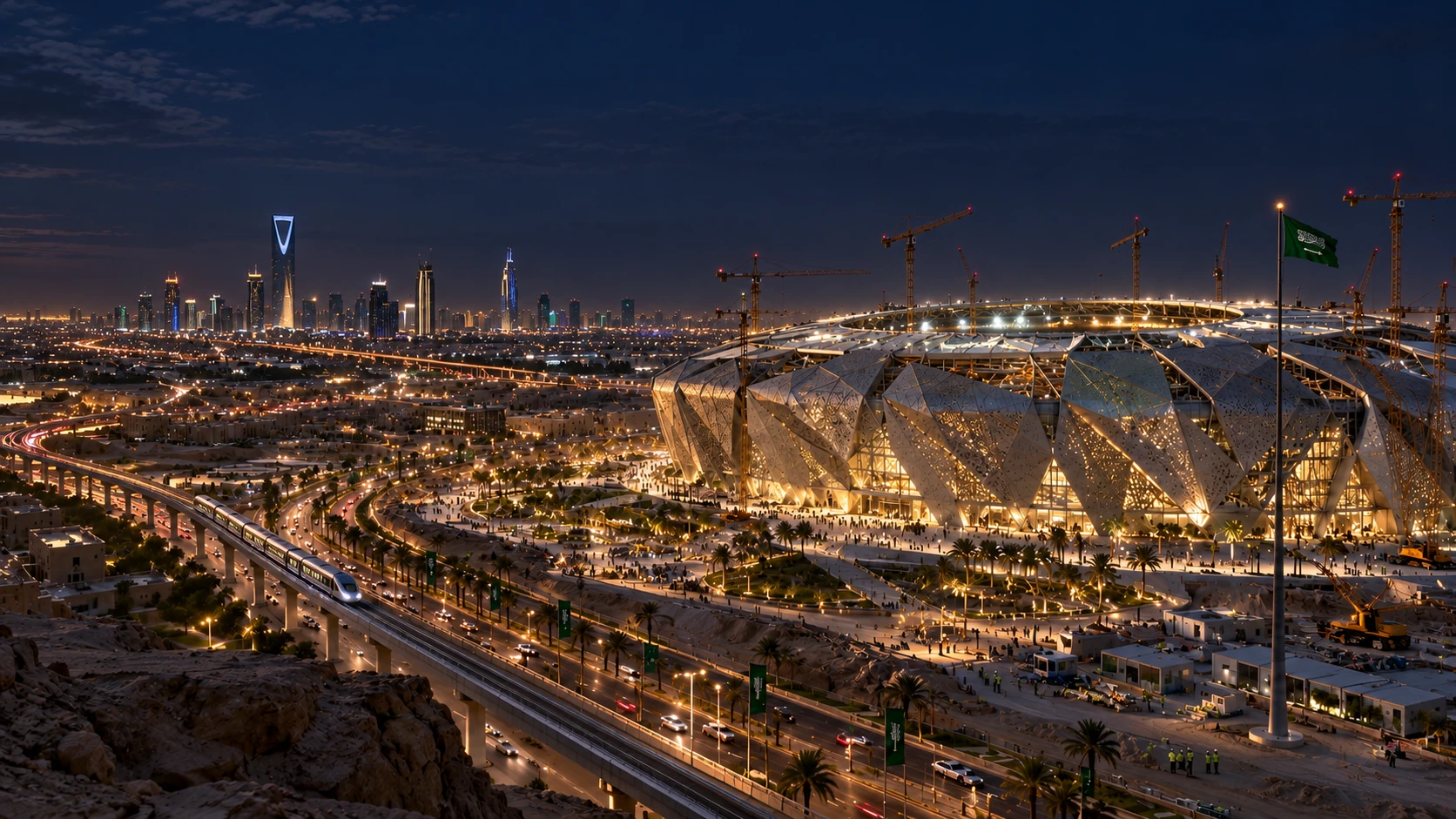
Editorial note: the hero is an AI-generated editorial illustration of a Riyadh stadium scene, not a documentary photograph or an approved architectural rendering of a specific venue. Sources checked on October 5, 2026. Stadium capacities in the table retain the 2024 bid-book definitions.
FAQ
Frequently Asked Questions
How many stadiums are in Saudi Arabia’s 2034 bid?
The original bid proposes 15 stadiums: eight in Riyadh, four in Jeddah and one each in Al Khobar, Abha and NEOM. It is a dated plan, not proof that all venues are complete.
Has NEOM Stadium been officially cancelled?
Reuters reported indefinite shelving on October 4, 2026, citing two sources. The reviewed material does not establish a formal FIFA removal, permanent official cancellation or approved replacement.
Will the 2034 World Cup take place in winter?
A cooler-season tournament is possible because of summer heat, but the reviewed sources do not establish final FIFA dates.
Are the stadium capacity figures current capacities?
No. The table reproduces proposed gross tournament capacities from the 2024 bid. Current project announcements and ordinary operating configurations can differ.
PRESDA Dispatch
Stay Informed. Stay Aware.
A sharp briefing across AI, gaming, sport, business, world affairs, paparazzi, and lifestyle.