THE HORSE: THE ANIMAL THAT CHANGED HUMAN HISTORY
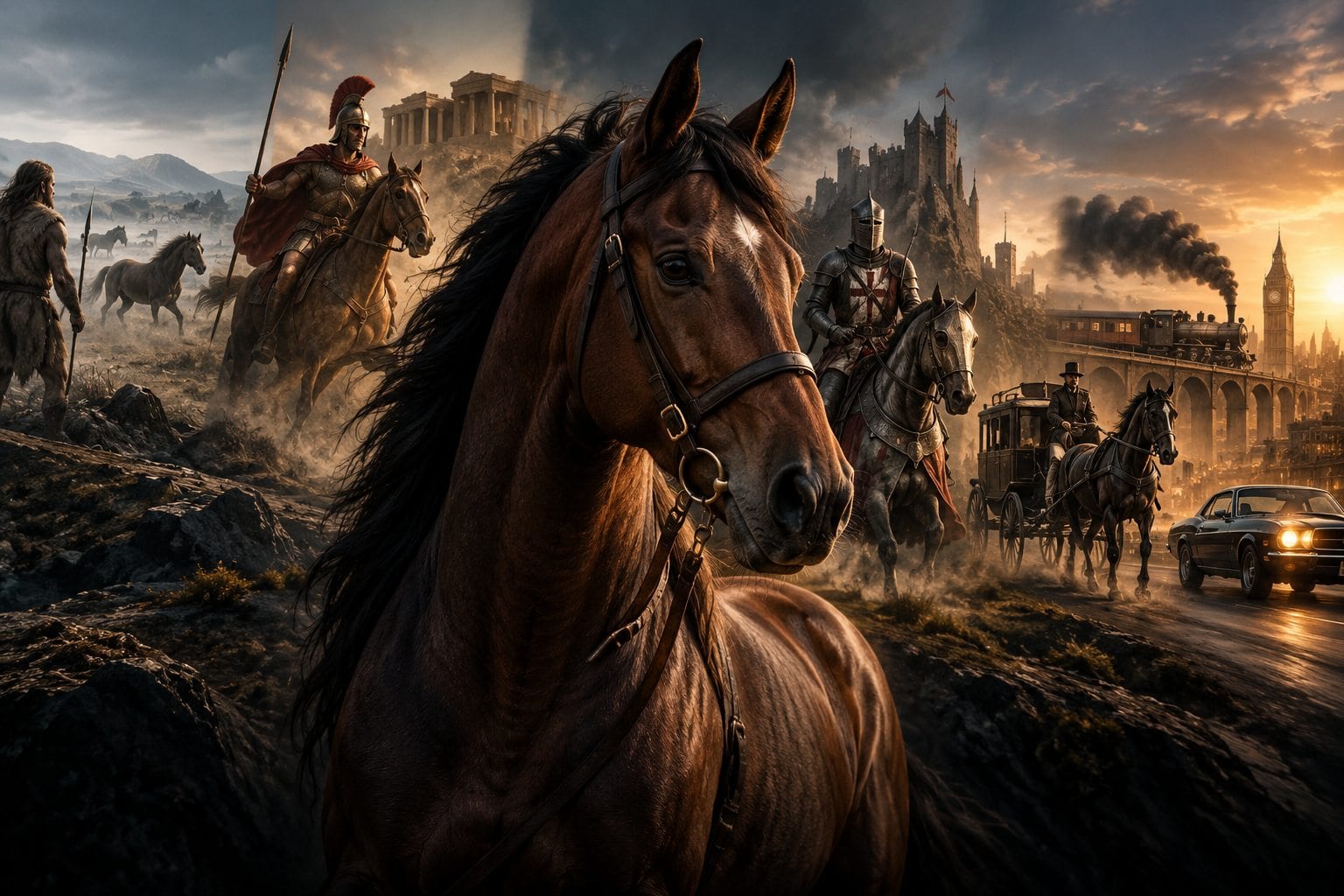
For thousands of years, horses carried humans across continents, transformed warfare, connected civilizations and worked the land. Before engines moved the world, the horse did.
Today, the horse is often associated with sport, racing, farms or tradition.
For most of human history, however, it represented something much greater.
It was transportation.
It was agricultural power.
It was military technology.
It carried messages, merchants, kings and soldiers. It pulled plows, wagons, artillery and carriages. It allowed humans to move farther and faster than their own bodies could ever carry them.
Long before railways, automobiles or airplanes connected the world, another technology dramatically expanded the range of human movement: the horse.
The relationship became so important that even after machines replaced horses in much of everyday life, we continued measuring engines using a word inherited from them: horsepower.
But the story begins thousands of years before civilization learned to ride. For more PRESDA history and science features, read the real history of coffee and Galileo and the Church.
BEFORE THE HORSE CARRIED HUMANS
Humans and horses did not begin as partners.
For prehistoric people, wild horses were animals of the landscape, and often prey.
They appear repeatedly in prehistoric art, including famous cave paintings across Europe.
For thousands of years, humans hunted horses before eventually developing relationships involving management, breeding and transportation.
Exactly when and where horse domestication began has been one of archaeology's more complicated questions.
For years, one famous answer dominated the story: Botai.
THE BOTAI MYSTERY
The Botai culture of what is now northern Kazakhstan, dating to roughly the fourth millennium BCE, became famous for archaeological evidence that appeared to suggest exceptionally early horse domestication.
Researchers found enormous quantities of horse remains and evidence interpreted as horse management.
For a time, Botai was frequently presented as the birthplace of the domestic horse.
Then ancient DNA complicated the story.
Genetic research showed that the Botai horses were not the main ancestors of today's domestic horses.
Later archaeological reassessment also challenged some evidence once interpreted as proof that Botai horses were bridled for riding.
This is one reason the history of horses is such a fascinating example of modern archaeology: DNA can rewrite history.
A REVOLUTION AROUND 4,200 YEARS AGO
In 2021, researchers analyzing 273 ancient horse genomes identified the Western Eurasian steppes, particularly the lower Volga-Don region, as the homeland of the lineage that eventually became dominant among modern domestic horses.
Then something extraordinary happened.
Beginning around 2200 BCE, this horse lineage expanded rapidly across Eurasia.
Within centuries, it replaced many existing local horse populations.
Further Nature genomic research published in 2024 reinforced the picture of a major expansion of domestic horses roughly 4,200 years ago.
This was not simply another domesticated animal spreading.
It was a new form of mobility.
And mobility changes civilizations.
WHEN HUMANS LEARNED TO MOVE FASTER
Imagine the world before mechanized transportation.
A person walking can only travel so far while carrying supplies.
A horse changes the equation.
People and goods can travel farther.
Messages can arrive faster.
Herders can control larger territories.
Communities separated by enormous distances become easier to connect.
Armies can move differently.
Trade networks expand.
The horse effectively changed the geography of human possibility.
For the first time, distance itself became a little less powerful.
THE CHARIOT CHANGED WAR
One of the earliest dramatic combinations of horses and technology was the spoke-wheeled chariot.
Archaeological and genetic evidence connects the rapid spread of the dominant domestic horse lineage with the emergence and expansion of chariot technology during the early second millennium BCE.
Chariots became symbols of military and political power across parts of the ancient world.
They appear in histories associated with civilizations from Egypt and the Near East to Eurasia.
But eventually another development became even more transformative.
Instead of standing behind horses, humans increasingly fought from their backs.
CAVALRY: SPEED BECOMES A WEAPON
A mounted warrior possesses an enormous advantage in mobility.
Cavalry could scout territory, pursue enemies, carry information and strike rapidly.
Different societies developed radically different traditions around mounted warfare.
Persian forces used cavalry extensively.
Steppe peoples developed exceptional riding cultures.
Mounted archers combined speed with ranged weapons.
European societies eventually developed heavily equipped mounted warriors.
Across North Africa and the Middle East, horses became deeply connected with warfare, prestige and political power.
The horse was not simply carrying the weapon.
The horse was part of the weapon system.
THE MONGOLS AND THE POWER OF MOBILITY
Few civilizations demonstrate the military importance of horses more dramatically than the Mongols.
Mongol forces were built around mobility.
Warriors could travel with multiple horses and switch mounts, allowing armies to maintain extraordinary movement across vast territories.
Mounted archery, communication, discipline and logistics combined with that mobility to create one of history's most formidable military systems.
During the 13th century, the Mongol Empire expanded across enormous portions of Eurasia.
Horses alone did not create that empire.
Strategy, leadership, organization, intelligence and political circumstances mattered enormously.
But without horses, the Mongol military system as we know it would have been impossible.
THE HORSE IN THE ARAB AND ISLAMIC WORLD
The horse also acquired enormous cultural importance across Arab societies.
Arabian horses became renowned for endurance and distinctive breeding traditions.
But the relationship went far beyond warfare.
Horses became associated with prestige, poetry, horsemanship, breeding knowledge and cultural identity.
That heritage remains visible today.
In Morocco, for example, Tbourida recreates historical Arab-Amazigh equestrian military displays.
UNESCO inscribed Tbourida on the Representative List of the Intangible Cultural Heritage of Humanity in 2021.
Oman's traditional Horse and Camel Ardhah similarly preserves generations of horsemanship and equestrian culture.
Thousands of years after horses became transportation technology, they remain cultural symbols.
THE MEDIEVAL HORSE
In medieval societies, not every horse served the same purpose.
Different animals could be bred or selected for transportation, agricultural work, carrying loads or warfare.
The mounted knight became one of the most recognizable symbols of medieval Europe.
Armor.
Lance.
Horse.
Together they created an image that survives throughout modern popular culture.
But focusing only on knights hides something arguably more important.
Most horses were not legendary warhorses.
They were workers.
THE MACHINE BEFORE THE MACHINE
Before tractors, horses worked agricultural land.
Before trucks, they moved goods.
Before automobiles, they pulled carriages.
Before motorized buses, horse-drawn vehicles transported urban passengers.
Before modern delivery fleets, horses carried mail and merchandise.
They worked in mines.
They pulled canal boats.
They powered machinery.
They transported construction materials.
For ordinary people, the historical importance of the horse was often less glamorous than cavalry charges.
Horses supplied civilization with mobile muscle.
An animal could convert grass and grain into usable mechanical work.
For centuries, that was extraordinarily valuable.
THEN THE HORSE CROSSED AN OCEAN AGAIN
The history of horses in the Americas contains one of the great turns in the story.
The evolutionary history of horses has deep roots in North America.
Yet horses disappeared from the continent thousands of years ago.
When Europeans crossed the Atlantic, they brought horses back.
Horses had been absent from North America for thousands of years before their reintroduction following European contact.
So, in a strange historical circle, the horse returned to a continent where its distant ancestors had once evolved.
HORSES TRANSFORMED INDIGENOUS LIFE
After their reintroduction, horses spread far beyond European settlements.
For numerous Indigenous peoples, particularly across the North American Plains, horses transformed mobility, hunting, trade and warfare.
Communities adapted the animal to existing cultures rather than simply copying European practices.
New equestrian traditions emerged.
Distances that once demanded long journeys on foot became easier to cross.
Bison hunting could change dramatically.
Political and military relationships between communities changed as access to horses expanded.
The arrival of the horse therefore was not merely a European transportation story.
It became an Indigenous one too.
HORSES, EMPIRES AND A DARKER HISTORY
The horse's history is not purely heroic.
Greater mobility could connect societies.
It could also help conquer them.
Horses carried invading armies.
They supported colonial expansion.
Cavalry could give mounted forces enormous advantages over populations without comparable mobility.
Horses transported soldiers involved in wars, forced displacement and imperial campaigns.
Technology itself is rarely moral.
What matters is what humans do with it.
The horse amplified human capability.
And human capability has always been used for both construction and destruction.
THE HORSE CONNECTED THE WORLD
Long before electronic communication, information had to physically travel.
Someone had to carry it.
A horse could dramatically increase the speed at which messages crossed land.
Empires developed networks of mounted couriers and relay systems.
Fresh horses could be stationed along routes, allowing messages to continue without requiring one exhausted animal to complete the entire journey.
Trade benefited too.
Merchants, officials and travelers could move between communities more efficiently.
For thousands of years, the speed of information was partly determined by the speed of an animal.
Today, a message crosses Earth almost instantly.
For much of history, news had hooves.
WHY DO CARS STILL HAVE HORSEPOWER?
Then came the machine.
During the Industrial Revolution, steam engines began replacing forms of animal and human power.
But inventors faced a marketing problem.
How do you explain the power of a new machine to people who understand horses better than engines?
Scottish engineer James Watt helped popularize the unit known as horsepower while promoting improved steam engines in the late eighteenth century.
The idea allowed potential customers to compare mechanical output with something familiar: the work of horses.
The exact technical definitions later became standardized and vary slightly between measurement systems.
But the cultural legacy remains extraordinary.
More than two centuries later, you can walk into a dealership and hear that a modern automobile produces hundreds of horses.
The animal survived inside the language of the machine that replaced it.
THEN CAME THE RAILWAY
Steam power changed transportation.
A locomotive could pull enormous loads without tiring like an animal.
Railways connected industrial cities.
Then came electric systems.
Internal-combustion engines.
Cars.
Trucks.
Buses.
Tractors.
By the twentieth century, machines increasingly replaced working horses across industrialized economies.
A relationship central to civilization for thousands of years began changing within generations.
Cities once filled with horses became cities built around automobiles.
Agriculture mechanized.
Armies motorized.
Transportation accelerated beyond anything a horse could provide.
The age of horsepower became the age of engines.
BUT THE HORSE NEVER DISAPPEARED
The horse lost much of its economic dominance.
It did not lose its relationship with humans.
Today horses remain central to racing, equestrian sports, ranching, tourism, ceremonial traditions and recreational riding.
Mounted police units still operate in some cities.
Working horses remain important in certain rural communities.
Equestrian traditions remain elements of cultural identity across multiple countries.
The horse moved from being essential infrastructure toward something different: heritage, sport, companionship and culture.
THE LAST TRULY WILD HORSE
There is another remarkable chapter.
Przewalski's horse survived into the modern era as a genuinely wild horse lineage.
Its populations suffered catastrophic decline and disappeared from the wild during the twentieth century.
Conservation programs later bred animals in captivity and returned populations to protected landscapes.
Today, conservation programs continue tracking and protecting Przewalski's horses.
After humans spent thousands of years transforming horses, we are now also trying to protect their wild relatives.
AN ANIMAL THAT CHANGED HUMAN SCALE
It is difficult to imagine how revolutionary the horse once was because we live in a world of machines.
A car easily travels faster.
A tractor pulls more.
An aircraft crosses continents.
A smartphone sends information instantly.
But compare the horse not with today's technology.
Compare it with the human being before it.
Suddenly a person could travel farther.
Carry more.
Control larger herds.
Deliver messages faster.
Fight differently.
Trade across greater distances.
Cultivate land more efficiently.
Connect distant settlements.
The horse increased the physical scale at which humans could operate.
And that is why its history is really a history of technology.
The horse was one of humanity's greatest technologies before technology became mechanical.
BEFORE THE ENGINE, THERE WAS THE HORSE
For more than four thousand years, the history of civilization and the history of the horse became intertwined.
Horses carried warriors who built empires.
They carried merchants who connected markets.
They pulled farmers' tools that produced food.
They carried messages between distant cities.
They transformed societies on multiple continents.
And eventually, humans built machines powerful enough to replace them.
Yet even those machines inherited their name.
Horsepower.
Perhaps no other animal left such an obvious signature on the technology that made it obsolete.
Before highways, horses connected communities.
Before tanks, they carried armies.
Before tractors, they worked the land.
Before engines, they supplied power.
And before humanity learned to move at the speed of machines, civilization moved at the speed of a horse.
FAQ
Frequently Asked Questions
When were horses domesticated?
Current genomic evidence points to the rapid spread of the dominant modern domestic horse lineage around 2200 BCE, roughly 4,200 years ago, from the Western Eurasian steppes.
Where did modern domestic horses come from?
A major 2021 Nature study identified the lower Volga-Don region of the Western Eurasian steppes as the key homeland of the lineage that became dominant among modern domestic horses.
Were Botai horses the ancestors of today's domestic horses?
Ancient DNA and later reassessments indicate that Botai horses were not the main ancestors of today's domestic horses, which changed an earlier popular interpretation of horse domestication.
How did horses change warfare?
Horses changed warfare by increasing mobility, speed, scouting range, communication and shock power. Chariots and cavalry allowed armies to move and fight in ways foot soldiers could not match.
When did horses return to the Americas?
Horses evolved in North America but disappeared there thousands of years ago. They were reintroduced after European contact and later transformed mobility, trade, hunting and warfare for many Indigenous communities.
Why do engines still use horsepower?
James Watt helped popularize horsepower as a way to explain the output of steam engines to customers who understood the work of horses. The term survived as a familiar measure of mechanical power.
What is Przewalski's horse?
Przewalski's horse is a surviving wild horse lineage that disappeared from the wild in the twentieth century before conservation programs bred and reintroduced animals to protected landscapes.
PRESDA Dispatch
Stay Informed. Stay Aware.
A sharp briefing across AI, gaming, sport, business, world affairs, paparazzi, and lifestyle.