Galileo and the Church: The Trial That Changed Science
The true story of Galileo Galilei's conflict with the Catholic Church, his 1633 trial, heliocentrism, house arrest, and the Church's later reassessment.
Galileo Galilei is remembered as one of the central figures of the Scientific Revolution. But his observations of the heavens eventually placed him at the center of one of history's most famous conflicts between scientific inquiry, religious authority and the interpretation of evidence.
The Galileo and the Church story still matters because it shows how evidence, institutions and inherited worldviews can collide. For more PRESDA science context, read our guides to Jebel Irhoud and human origins and whether zodiac signs are scientifically proven.
A Universe With Earth At The Center
For centuries, European astronomy was dominated by a geocentric model in which Earth remained stationary while the heavens moved around it.
Nicolaus Copernicus challenged that picture in the 16th century by proposing a heliocentric system in which Earth and the other planets orbit the Sun.
Galileo did not invent heliocentrism, but his astronomical observations gave powerful support to a universe that could not easily be explained by the traditional model.
What Galileo Saw
Using improved telescopes beginning in 1609, Galileo observed mountains and irregularities on the Moon, moons orbiting Jupiter, the phases of Venus and other phenomena that challenged traditional ideas about the heavens.
The moons of Jupiter were particularly important: they demonstrated that not every celestial object revolved around Earth.
Venus supplied another crucial test. Its full sequence of phases contradicted the traditional Ptolemaic arrangement, in which Venus remained between Earth and the Sun. But this did not, by itself, prove that Earth moved: Tycho Brahe's alternative system also allowed Venus to orbit the Sun while the Sun orbited a stationary Earth. Museo Galileo's account of the observations explains why evidence against one model was not automatically proof of every part of another.
The Church And Heliocentrism
The controversy was more complicated than a simple battle between science and religion.
Some biblical passages were commonly interpreted at the time as consistent with a stationary Earth. Galileo argued that Scripture and the study of nature should not be treated as contradictory when biblical language was being interpreted outside its intended purpose.
In 1616, Church authorities rejected the physical interpretation of Copernican heliocentrism and Galileo was warned against defending it as established reality.
The Book That Triggered The Trial
In 1632 Galileo published Dialogue Concerning the Two Chief World Systems.
The book compared the traditional Ptolemaic system with the Copernican system and, despite its dialogue format, strongly favored the latter.
The Inquisition subsequently ordered Galileo to Rome.
The Trial Of 1633
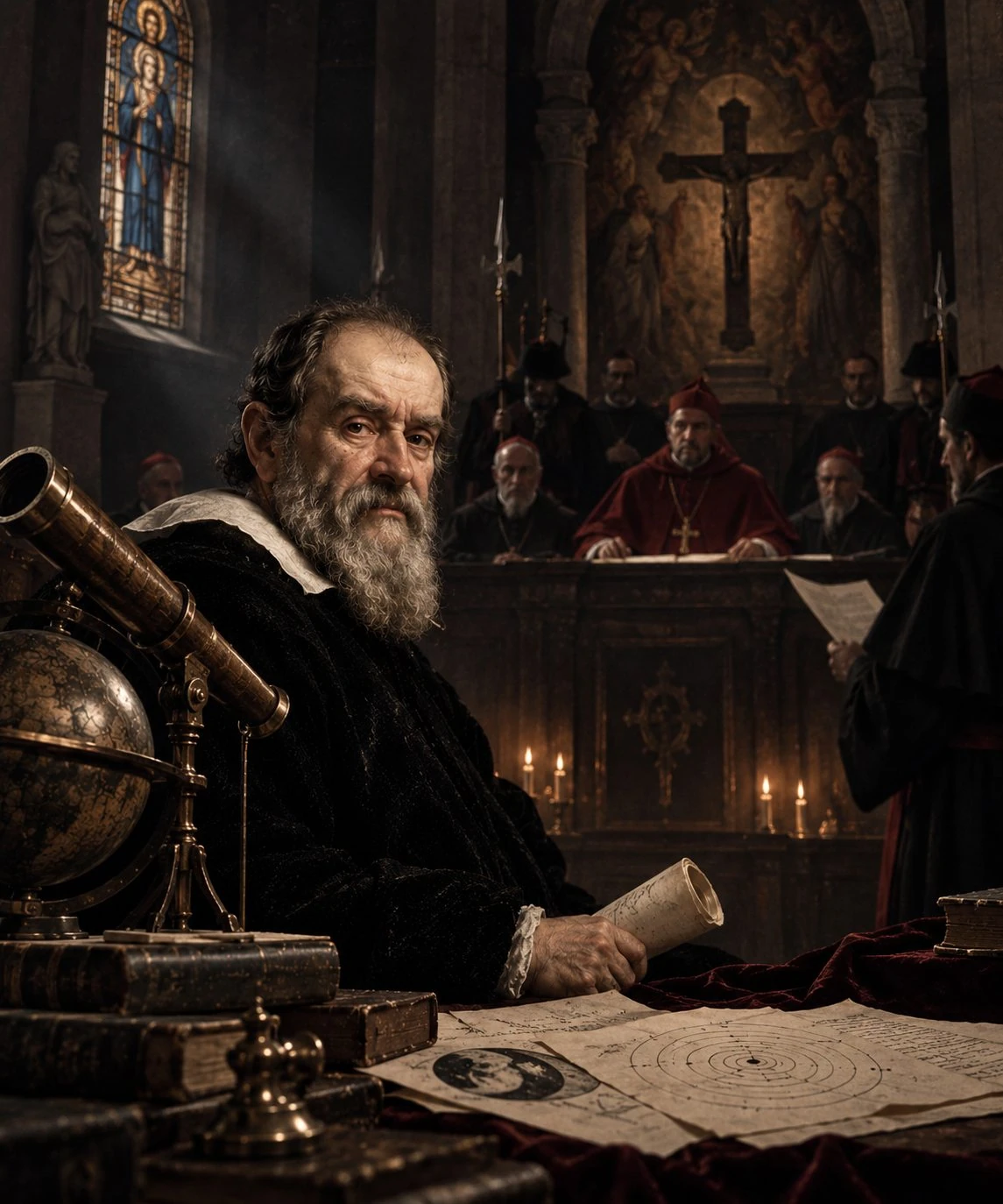
Galileo appeared before the Roman Inquisition in 1633.
The central issue was not simply that he had discussed astronomy. Authorities believed he had defended the motion of Earth after the earlier restrictions placed on Copernican teaching.
The earlier restriction itself needs care. Cardinal Bellarmine had warned Galileo in 1616 not to hold or defend the Copernican doctrine. A record of a broader injunction became important at the 1633 trial, but historians debate its status and the proceedings surrounding it. The Stanford Encyclopedia of Philosophy distinguishes those disputed procedural details from the documented verdict. This helps explain why the affair cannot be reduced to a single forbidden observation.
On June 22, 1633, Galileo was found vehemently suspect of heresy.
He was required to formally renounce the condemned propositions.
His sentence of imprisonment was commuted to house arrest, under which he spent the remainder of his life.
Did Galileo Say And Yet It Moves?
One of the most famous stories claims that after renouncing heliocentrism Galileo whispered: And yet it moves.
The phrase became a symbol of scientific resistance to authority.
However, historians do not have reliable contemporary evidence that Galileo actually said it. Treat it as a later legend, not established fact.
Science Continued Under House Arrest
The trial did not end Galileo's intellectual work.
While under house arrest he completed Discourses and Mathematical Demonstrations Relating to Two New Sciences, published in 1638.
The work examined motion and mechanics and became an important contribution to the development of modern physics.
Galileo died in 1642.
What Happened Centuries Later?
The Church's treatment of Galileo was reassessed over time.
In 1992 Pope John Paul II addressed the Galileo case after years of study by a papal commission.
He acknowledged errors surrounding the historical controversy and discussed how theologians of Galileo's era had failed to adequately distinguish questions of physical science from particular interpretations of Scripture.
The episode had become one of history's most enduring examples of what can happen when institutions treat questions about the natural world as already settled.
The Trial That Changed Science
Galileo's story is more complicated than the popular image of one scientist fighting an entire religion.
It involved science, theology, institutional authority, personalities, politics and the standards of evidence available in the 17th century.
But its legacy remains powerful.
Scientific claims ultimately have to survive observation, measurement and evidence.
Authority can delay an idea.
It cannot determine how nature works.
FAQ
Frequently Asked Questions
Why was Galileo accused of heresy?
Galileo was judged by Church authorities to have defended the motion of Earth after earlier restrictions on presenting Copernican heliocentrism as physical reality. In 1633 he was found vehemently suspect of heresy.
Did Galileo invent heliocentrism?
No. Nicolaus Copernicus had proposed a heliocentric model in the 16th century. Galileo's telescope observations gave important support to ideas that challenged the traditional geocentric system.
What happened to Galileo after the trial?
Galileo formally renounced the condemned propositions, and his sentence was commuted to house arrest. He spent the rest of his life under restrictions and continued important scientific work.
Did Galileo really say And yet it moves?
Historians do not have reliable contemporary evidence that Galileo said the phrase after his renunciation. It is best treated as a later legend rather than established fact.
How did the Church later reassess Galileo?
In 1992 Pope John Paul II addressed the Galileo case after a papal commission studied the controversy, acknowledging errors in how the historical conflict had been handled.
PRESDA Dispatch
Stay Informed. Stay Aware.
A sharp briefing across AI, gaming, sport, business, world affairs, paparazzi, and lifestyle.