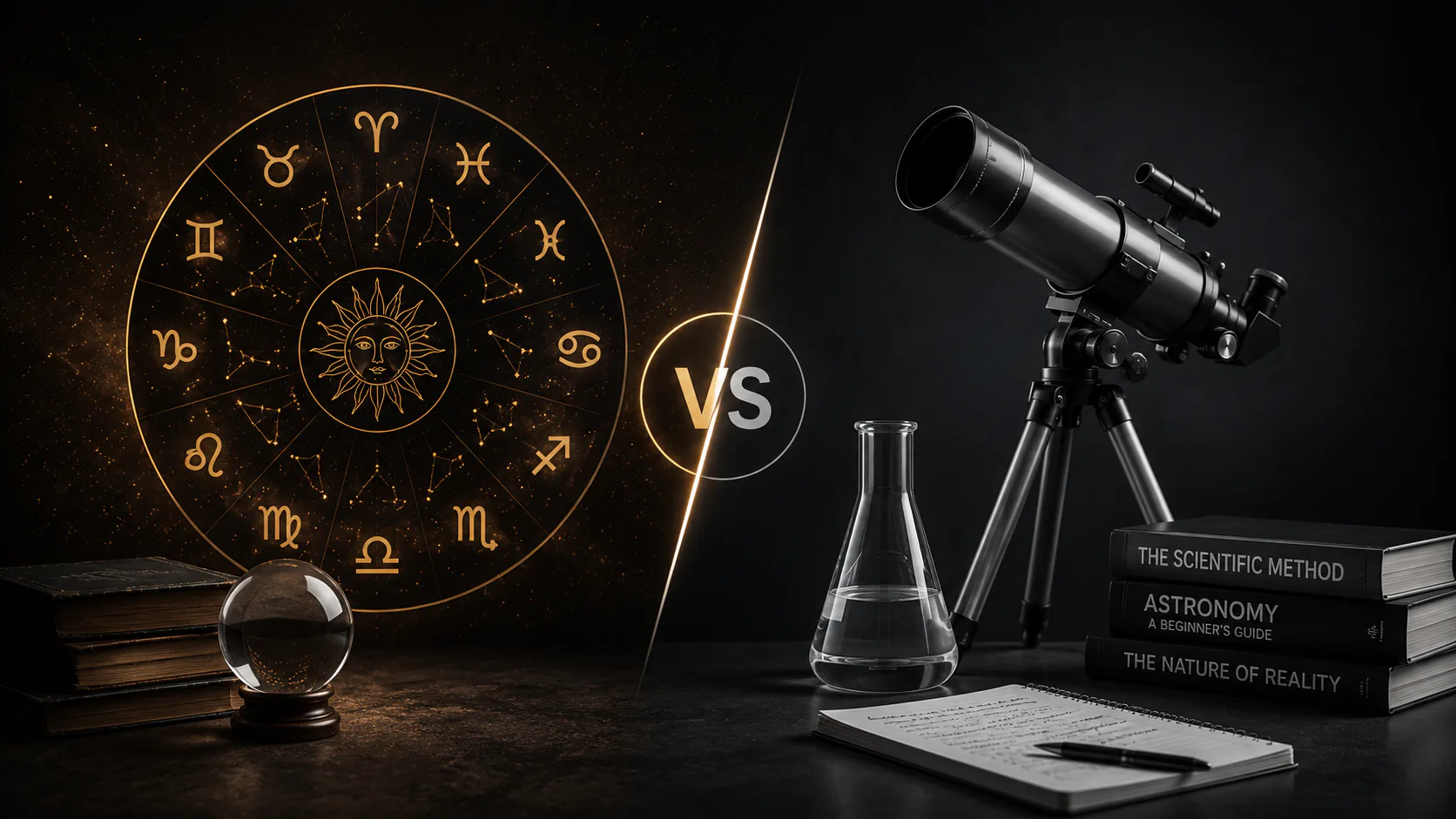
Are Zodiac Signs Real? Astrology, Personality And Science Explained
Are zodiac signs real? Culturally, yes. Scientifically, astrology has not shown reliable evidence that birth signs predict personality or future events.
Are zodiac signs real? In a cultural sense, yes: zodiac signs are real symbols that many people use to talk about identity, relationships and meaning. In a scientific sense, no reliable evidence shows that zodiac signs or birth charts can predict personality, behavior or future events better than chance.
That distinction matters. Astrology can feel meaningful without being scientifically proven. A horoscope may help someone reflect, laugh, connect with friends or describe a mood. But when the question becomes is astrology real as a testable explanation for personality or destiny, the scientific evidence is weak.
Are Zodiac Signs Real? The Short Answer
Zodiac signs are real as a historical and cultural system. They are not supported as a scientific system for predicting who someone is or what will happen to them. NASA explains that astrology is not astronomy, and astronomy is the science that studies stars, planets, galaxies and the physical universe.
The reason the answer can feel complicated is that people often use the word real in different ways. A tradition can be real. A belief can be real to the people who practice it. A symbol can have real emotional and social meaning. But scientific reality asks a narrower question: can the claim be tested, repeated and supported by evidence?
Astrology Vs Astronomy
Astrology and astronomy share ancient roots in sky watching, but they are not the same discipline. Astronomy studies celestial objects through observation, mathematics, physics and testable prediction. Astrology interprets celestial positions as meaningful for human personality, relationships and life events.
NASA's educational material makes the distinction clearly: astronomy is science, while astrology is not the same thing. Modern astronomy can predict eclipses, planetary orbits and stellar behavior because those claims are grounded in measurable physical processes. Astrology's personality and fate claims have not shown the same evidential support.
What Astrology Claims About Personality
Most popular astrology begins with sun signs: Aries, Taurus, Gemini and the rest of the twelve zodiac signs. A person born under one sign may be described as confident, sensitive, analytical, adventurous or intense. More detailed astrology adds moon signs, rising signs, houses, aspects and transits.
The scientific question is not whether those descriptions feel interesting. It is whether zodiac signs affect personality in a measurable way. For astrology to be scientifically proven, astrologers would need to predict traits, behavior or outcomes reliably under controlled conditions, and those results would need to replicate across independent studies.
Is Astrology Scientifically Proven?
No. Astrology is not scientifically proven as a method for predicting personality or future events. One of the most cited tests is Sean Carlson's double-blind study published in Nature in 1985. The study tested whether astrologers could match birth charts to psychological profiles better than chance. The results did not support the astrologers' claims.
Other academic reviews have reached similar conclusions: astrology has cultural importance, but its central predictive claims have not performed like reliable scientific claims. That does not require mocking believers. It simply means astrology should not be treated as evidence-based psychology, medicine, financial advice or decision science.
Scientific Testing Of Astrology
Scientific testing matters because astrology makes claims that can be checked. If birth charts reveal personality accurately, astrologers should be able to match charts to people more reliably than random guessing. If horoscopes predict events, those predictions should be specific enough to test and should outperform chance.
The difficulty for astrology is that many horoscopes are broad, flexible and hard to falsify. A statement such as 'you may face an important decision soon' can fit many people in many weeks. Science works best with claims that can be wrong. The more elastic a claim becomes, the harder it is to verify.
Do Zodiac Signs Affect Personality?
Current scientific evidence does not show that zodiac signs affect personality in a reliable way. Personality research usually studies traits through psychology, genetics, development, culture, environment and lived experience. The position of the Sun or planets at birth has not been shown to determine character.
That does not mean people are foolish for recognizing themselves in a sign description. Many descriptions use ordinary human tensions: confidence and doubt, independence and connection, ambition and fear, sensitivity and resilience. Most people can see parts of themselves in that language.
The Barnum And Forer Effect
The Barnum effect, also called the Forer effect, helps explain why astrology can feel personally accurate. In 1949, psychologist Bertram R. Forer gave students what they believed was a personalized personality analysis. In reality, each student received the same general description. Many rated it as highly accurate.
The lesson is not that people are gullible in a simplistic way. It is that human beings are pattern-seeking and meaning-making. When a statement is flattering, balanced and emotionally broad, it can feel tailored even when it applies to many people.
Why Horoscopes Can Feel Accurate
Horoscopes can feel accurate for several reasons. Confirmation bias makes people remember the prediction that seemed to fit and forget the many that did not. Vague language allows one sentence to cover many possible situations. Social sharing reinforces the parts that feel funny, intimate or identity-based.
Astrology also gives people a vocabulary. Saying 'I'm such a Virgo' or 'that is Leo energy' can be a playful way to talk about habits, relationships and moods. The language may be socially useful even when the underlying claim is not scientifically proven.
Why People Believe In Astrology
People believe in astrology for emotional, cultural and practical reasons. It offers structure during uncertainty. It turns the sky into a story. It can make relationships feel easier to discuss. It can also provide comfort when life feels random or hard to control.
There is a long history behind that appeal. Astrology developed from ancient attempts to connect celestial order with earthly events. Britannica traces its historical role across ancient and later cultures, while modern astrology has adapted to newspapers, apps, social media and influencer culture.
Cultural Meaning Without Scientific Proof
A neutral view can hold two ideas at once: astrology is not scientifically proven, and astrology can still be culturally meaningful. Many people use zodiac signs for entertainment, self-reflection or social bonding rather than strict prediction.
The boundary is important. Astrology becomes risky when it replaces evidence-based decisions about health, money, safety, relationships or mental health. As entertainment or symbolic reflection, it may be harmless or even socially useful. As a scientific authority, it is not supported by strong evidence.
Astrology Vs Science
Final Verdict
So, are zodiac signs real? They are real cultural symbols, but they are not scientifically proven tools for predicting personality or the future. Astrology's power comes from history, language, identity, confirmation bias, the Barnum effect and the human desire for meaning.
The night sky can still inspire wonder without becoming a map of destiny. Science does not make the universe less beautiful. It simply asks a different question: what can be tested, measured and shown to be true?
For related questions about evidence, read Galileo's observations and the Church controversy, James Randi and the testing of paranormal claims and the wider Science coverage.
FAQ
Frequently Asked Questions
Are zodiac signs real?
Zodiac signs are real as cultural and historical symbols. Scientifically, there is no reliable evidence that zodiac signs predict personality, behavior or future events.
Is astrology scientifically proven?
No. Astrology has not been scientifically proven as a reliable method for predicting personality or events. Controlled tests, including Sean Carlson's Nature study, have not supported its core predictive claims.
Do zodiac signs affect personality?
Current scientific evidence does not show that zodiac signs affect personality. Personality is better studied through psychology, development, genetics, culture, environment and lived experience.
What is the difference between astrology and astronomy?
Astronomy is the science of stars, planets, galaxies and the physical universe. Astrology is a symbolic belief system that links celestial positions to human traits and events.
Why do horoscopes feel accurate?
Horoscopes often feel accurate because of broad wording, confirmation bias, social reinforcement and the Barnum or Forer effect, where general personality statements feel personally tailored.
Is it wrong to enjoy astrology?
No. Many people enjoy astrology as entertainment, culture or self-reflection. The key is not to confuse it with evidence-based science, medicine, finance or professional advice.
PRESDA Dispatch
Stay Informed. Stay Aware.
A sharp briefing across AI, gaming, sport, business, world affairs, paparazzi, and lifestyle.