NASA AIMS TO RETURN TO THE MOON AFTER 56 YEARS: ARTEMIS 2028
Artemis II is complete. NASA targets a 2027 orbital test and a 2028 lunar landing. Explore the crews, spacecraft, south pole science, costs and risks.
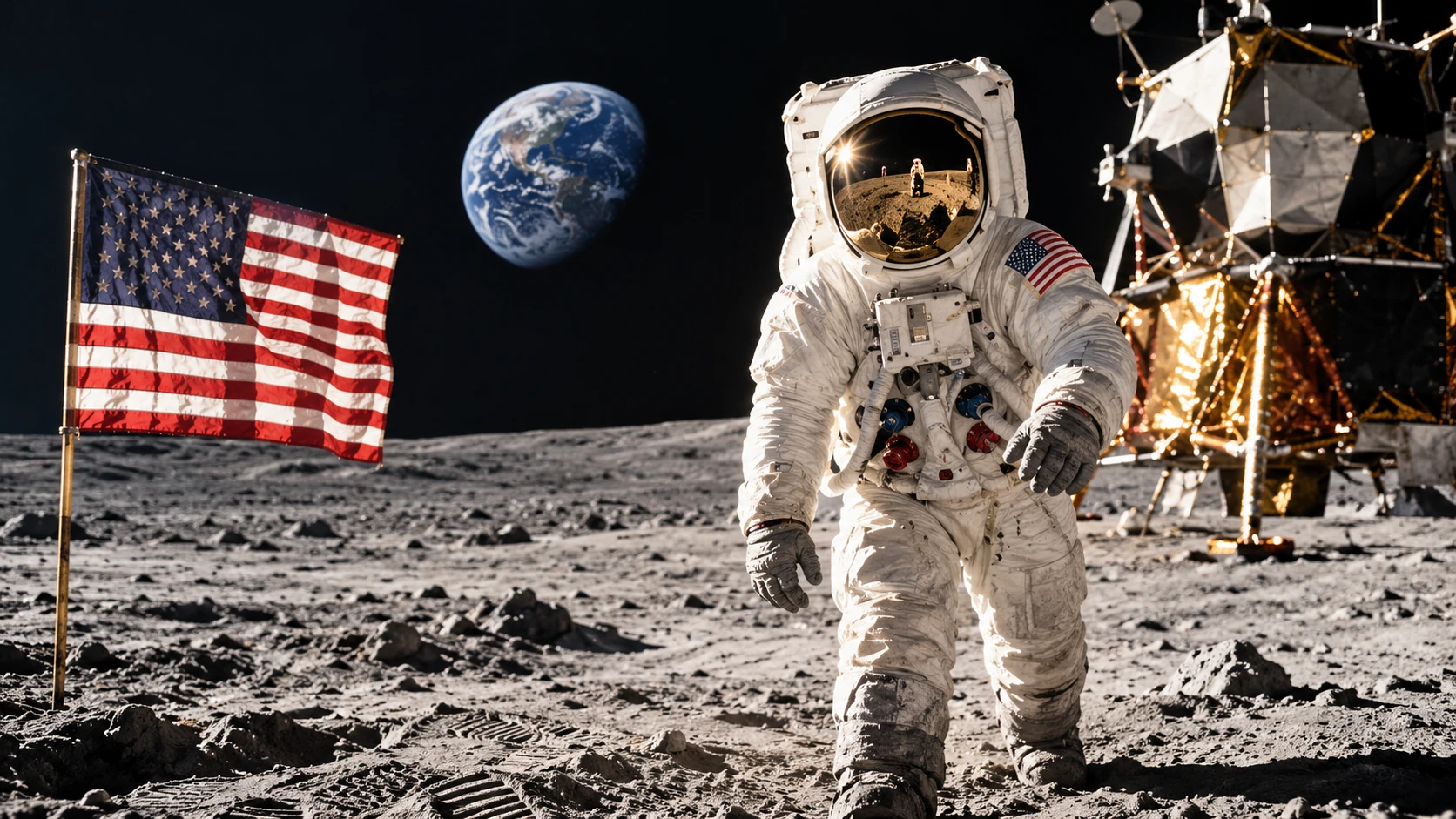
AI-generated editorial illustration supplied for PRESDA. This imagined crew portrait is not an authentic NASA photograph and does not represent an official mission assignment.
NASA is targeting early 2028 for Artemis IV, the mission intended to return astronauts to the lunar surface. As of October 18, 2026, that is a planning target, not a guaranteed landing date. Artemis II has already carried people around the Moon and home; Artemis III is now planned as a 2027 demonstration in Earth orbit. Confusing those three missions turns a demanding development programme into a misleading countdown. NASA’s current Artemis schedule
The headline’s 56 years means the calendar-year difference between Apollo 17 in 1972 and the 2028 target. It does not mean that humans have remained close to Earth throughout that interval: Artemis II’s 2026 lunar flyby has already changed that. The unfinished task is a crewed surface landing, followed by a safe ascent and return. The distinction matters because flying past a world and living briefly on it require different machines, procedures and margins for failure.
The long interval after Apollo 17
In December 1972, Eugene Cernan and Harrison Schmitt explored Taurus-Littrow while Ronald Evans orbited above them. Apollo 17 was the last of six successful Apollo landing expeditions. The programme ended amid budget constraints and changing political priorities; planned later flights were cancelled. The end of the visits was not evidence that earlier landings were impossible. Hardware production, specialist teams and funding do not remain available indefinitely simply because an engineering feat has been achieved. NASA on the cancelled Apollo missions
Apollo left a scientific record that remains open to investigation. Readers seeking the historical evidence, including samples, tracking and photographs, can explore our examination of the Moon landing conspiracy claims. Artemis asks a different question: can a new network of public agencies and commercial suppliers make lunar operations repeatable, rather than repeat a single spectacular visit?
Artemis I: proving the integrated system
Artemis I launched on November 16, 2022, and returned on December 11. The uncrewed flight tested the Space Launch System rocket, Orion spacecraft and supporting ground operations together on a journey around the Moon. It established that this combination could leave Earth, operate in deep space and bring Orion home. It did not test a lunar landing or carry astronauts. NASA’s Artemis I mission
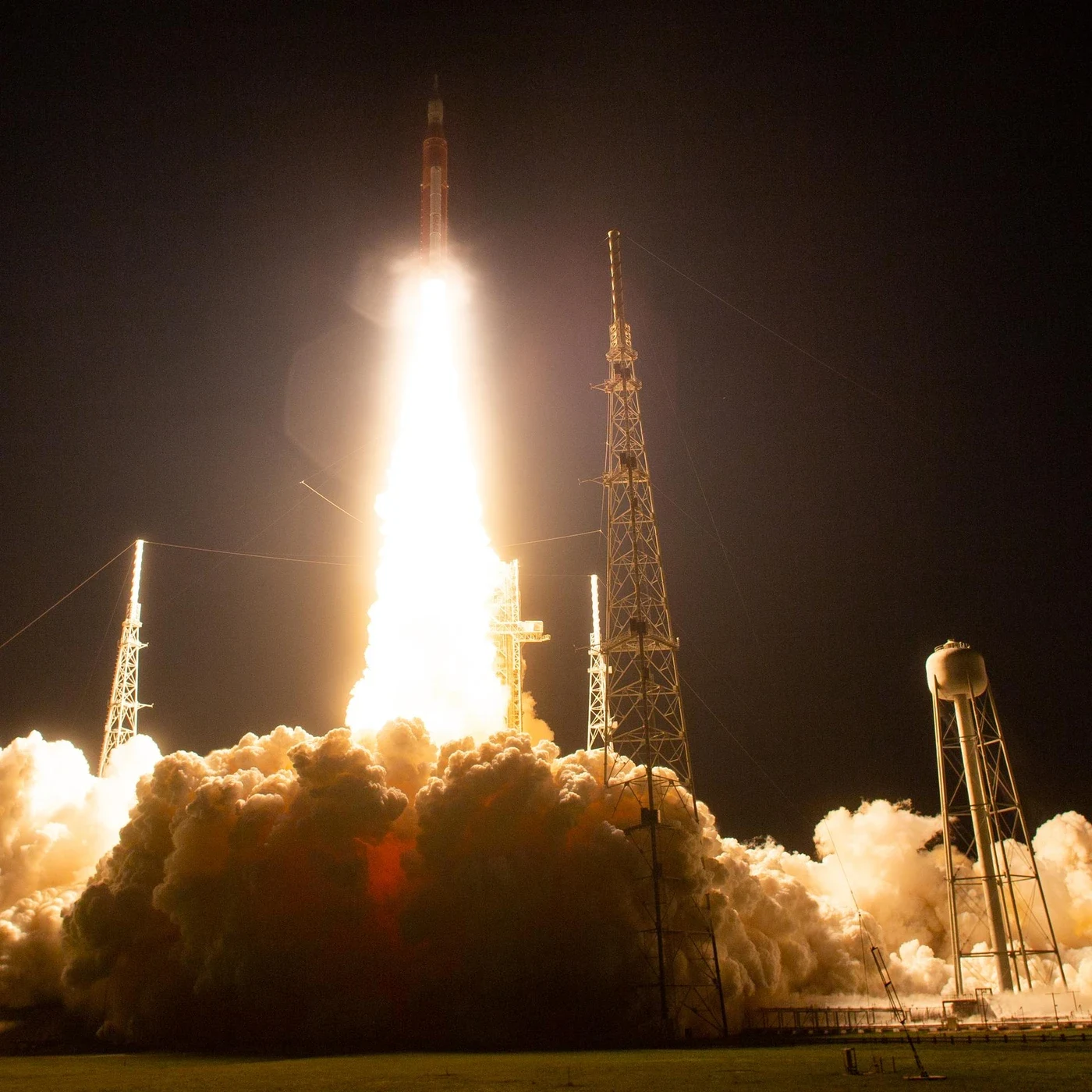
Artemis I launches from Kennedy Space Center on November 16, 2022.
NASA editorial reuse. Resized and converted to WebP by PRESDA. Full composition preserved. Reuse follows the individual license stated here.
Success did not mean that every component behaved exactly as expected. Orion’s heat shield lost more charred material than anticipated, prompting investigation and testing. For Artemis II, NASA adjusted the reentry trajectory to reduce time in the temperature range associated with the earlier behaviour. Flight tests are valuable precisely because they reveal problems before those problems are assumed away. NASA’s heat-shield assessment
Artemis II: a completed crewed lunar flyby
Artemis II launched on April 1, 2026, and splashed down on April 10. NASA astronauts Reid Wiseman, Victor Glover and Christina Koch flew with Canadian Space Agency astronaut Jeremy Hansen. NASA lists a mission duration of nine days, one hour and 32 minutes. This was Orion’s first crewed flight and a test of human operations beyond Earth orbit, not a Moon landing. NASA’s Artemis II record

Recovery operations after Artemis II’s Pacific splashdown, April 10, 2026. U.S. Navy divers and recovery personnel assist the returning crew.
NASA editorial reuse. Resized and converted to WebP by PRESDA. Full composition preserved. Reuse follows the individual license stated here.
The mission produced more than proof that four people could make the journey. NASA’s October 7 preliminary lunar science report describes observations of five impact flashes and subtle variations in surface colour. Such observations help researchers compare human perception with instrument data and prepare crews for difficult lunar lighting. These are preliminary scientific findings, not discoveries of accessible ice reserves or proof that a base can already be supplied locally. Preliminary lunar science report
On October 15, NASA reported that further analysis confirmed the Artemis II heat shield performed as expected, with reduced cracking and char loss relative to Artemis I. This is an important completed result. It does not certify the separate landers, surface suits or every future mission configuration. A safe return validates what actually flew under its particular conditions. Post-flight engineering findings
Artemis III in 2027: rehearsal in Earth orbit
Under NASA’s revised plan, Artemis III will demonstrate critical systems in low Earth orbit. Orion is intended to practise rendezvous and docking with one or both commercial landing systems being developed by SpaceX and Blue Origin. NASA has also described evaluating spacesuit and lander interfaces. These remain planned tests, not completed capabilities. Older articles describing Artemis III as the first lunar landing reflect an earlier schedule. Current mission overview Preliminary test objectives
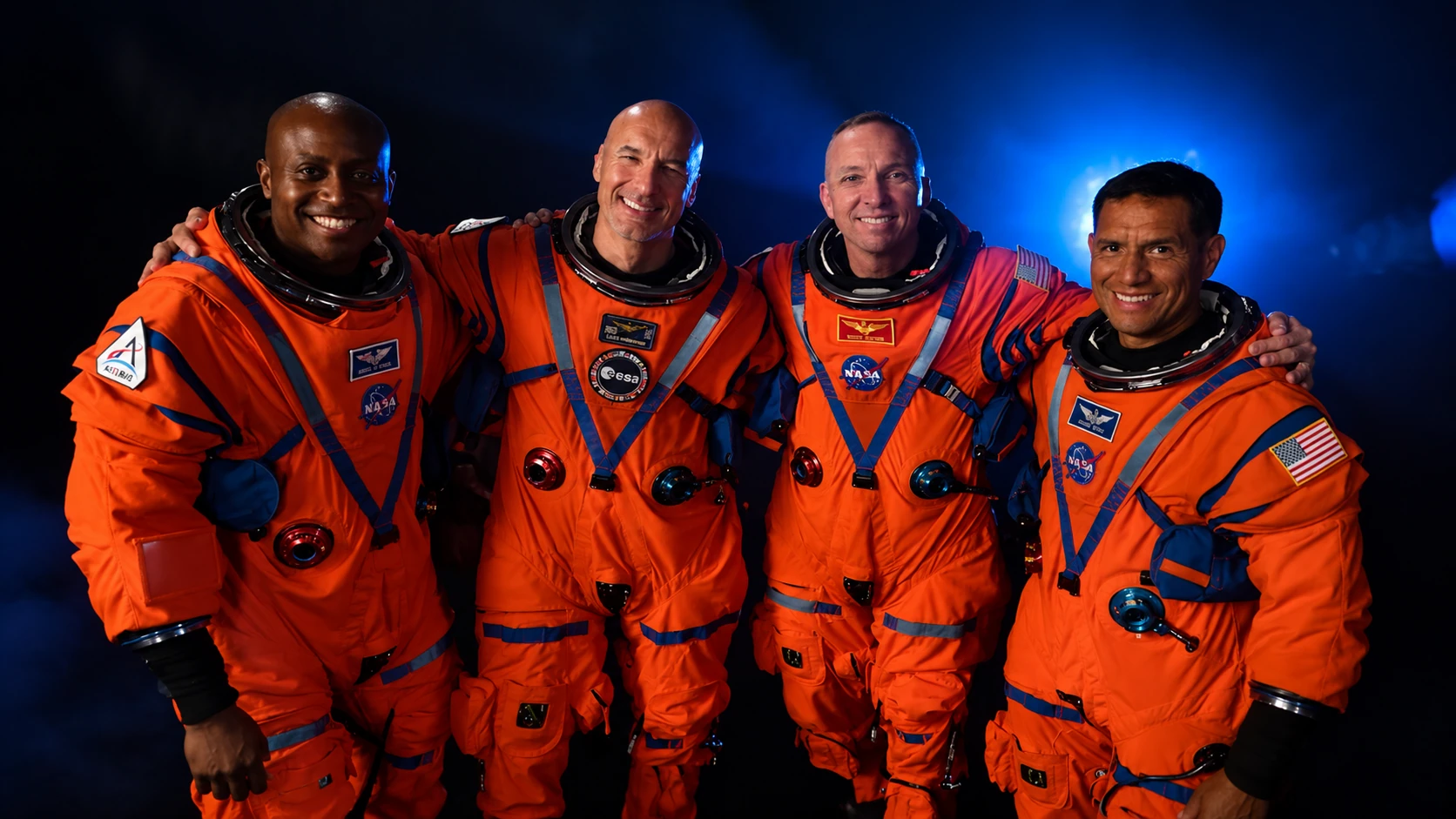
The announced crew is commander Randy Bresnik, pilot Luca Parmitano of ESA, and NASA mission specialists Andre Douglas and Frank Rubio. They are assigned to Artemis III’s demonstration, not automatically to the 2028 landing. The supplied opening artwork is labeled as an AI illustration; it must not be mistaken for an official crew photograph or evidence of a completed flight. NASA’s Artemis III crew
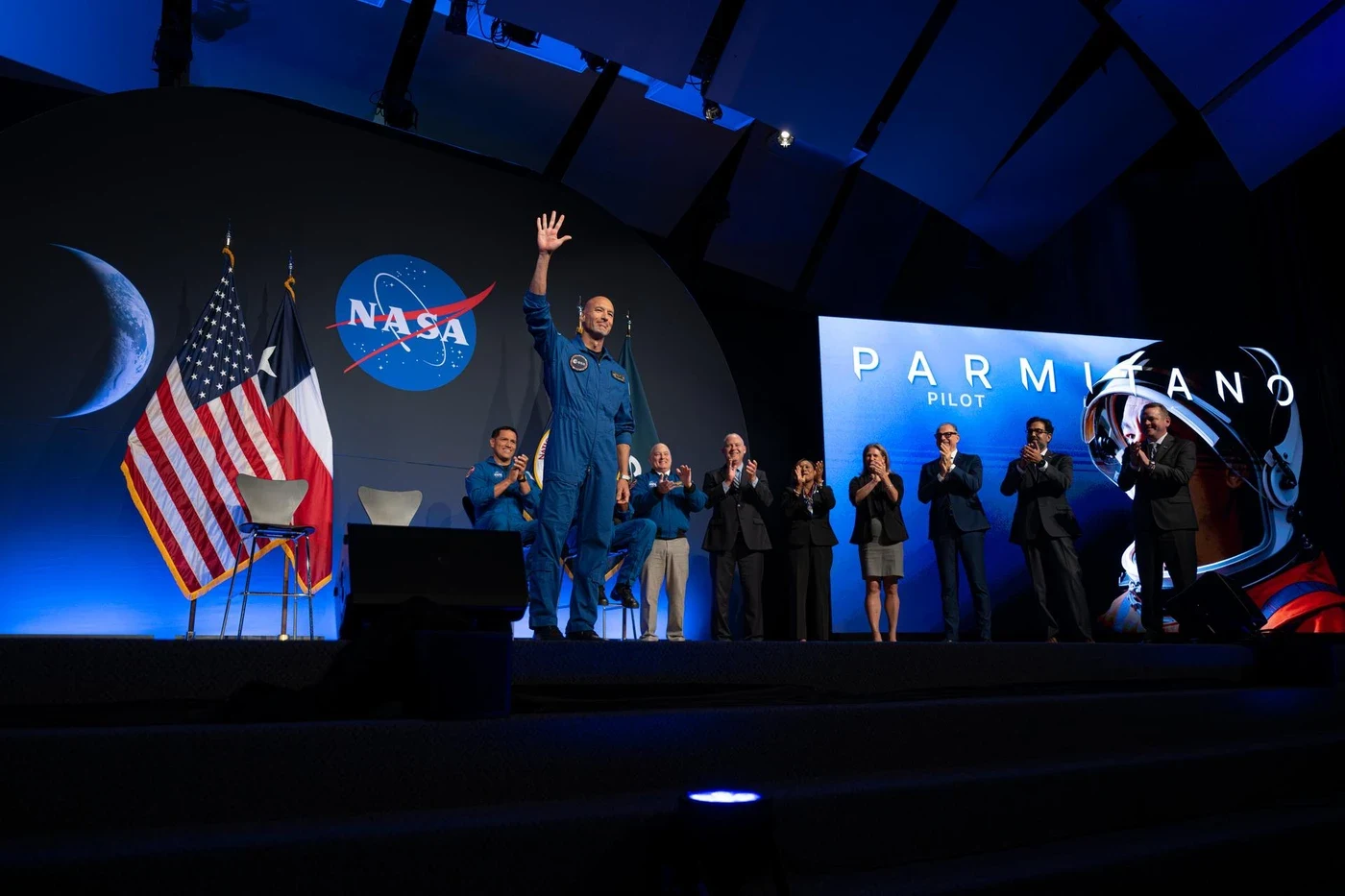
ESA astronaut Luca Parmitano at the Artemis III crew announcement in Houston, June 9, 2026.
NASA editorial reuse. Resized and converted to WebP by PRESDA. Full composition preserved. Reuse follows the individual license stated here.
Artemis IV in 2028: the landing target
NASA’s current Artemis IV page describes four astronauts travelling in Orion, with two descending in a human landing system to spend approximately a week near the lunar south pole. They would then return to lunar orbit and reunite with their colleagues for the journey to Earth. The page lists early 2028 as the launch target. Every future-tense step depends on readiness, not merely on reaching a calendar date. NASA’s Artemis IV plan
A landing requires several chains of events to succeed together: launch, transit, rendezvous, docking, transfer, descent, surface operations, ascent and reentry. A delay in an essential lander or suit can move the entire mission even if Orion and SLS are ready. The responsible way to read the schedule is as a sequence of milestones that must earn the next step.
Orion, SLS and the international partnership
SLS launches Orion and its crew; Orion provides their transport and return capsule. It is not the vehicle that lands on the Moon. ESA supplies Orion’s European Service Module, which provides propulsion, electricity, thermal control, air and water. That division of labour makes Europe part of the spacecraft’s working infrastructure, not simply a passenger on an American project. ESA’s Orion overview
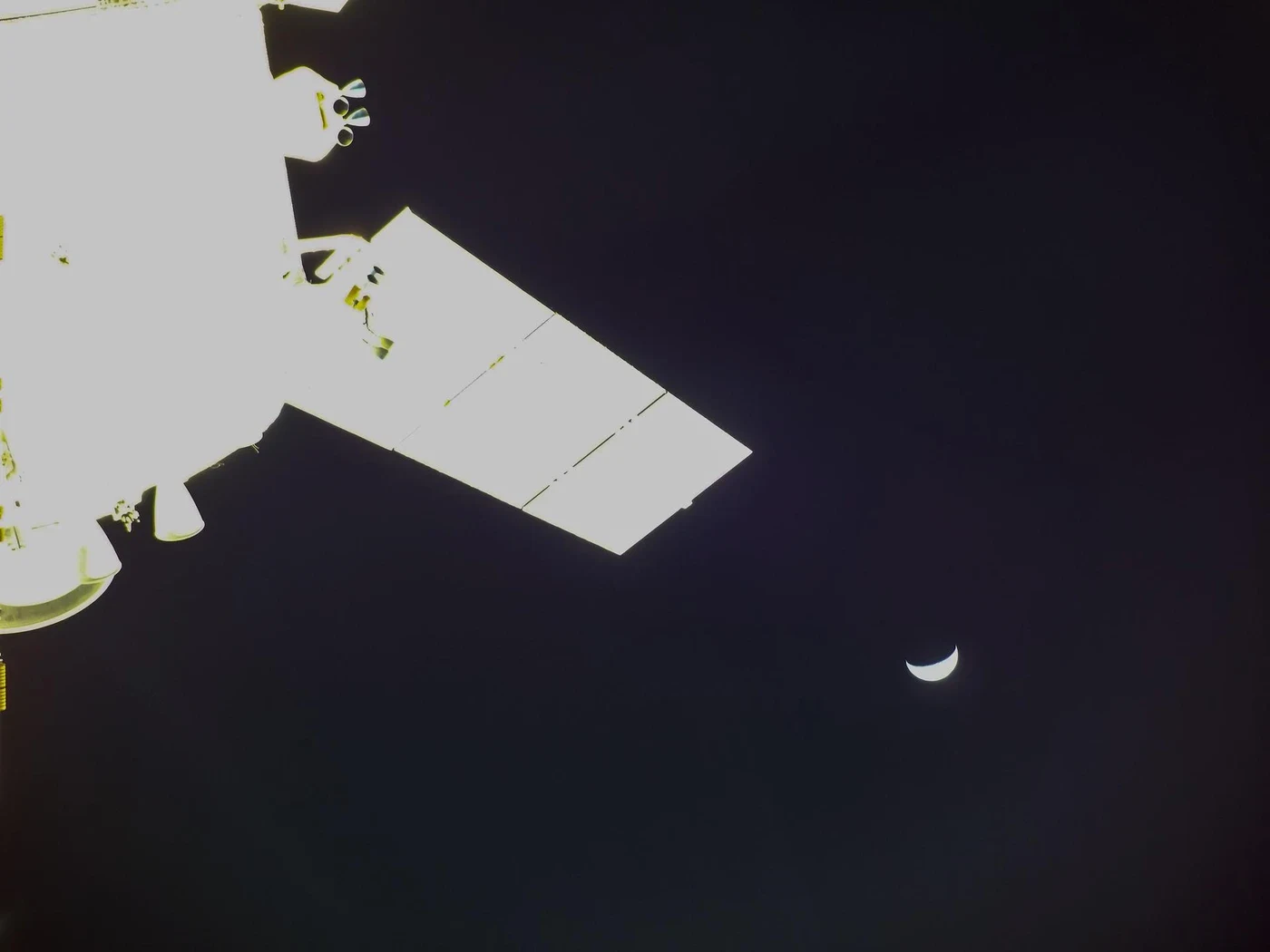
Orion and a crescent Moon, photographed by a solar-array camera on December 2, 2022, during Artemis I.
NASA editorial reuse. Resized and converted to WebP by PRESDA. Full composition preserved. Reuse follows the individual license stated here.
The wider programme combines NASA operations, international contributions and industrial contracts. SpaceX and Blue Origin are developing human landing systems, while Axiom Space is developing the lunar surface suit identified in NASA’s Artemis IV plan. An orange launch-and-entry suit is not that surface exploration suit: moonwalking requires mobility, thermal protection, life support and resistance to abrasive dust. Pictures of astronauts wearing one type of equipment should not be used to imply another has been flight-certified. NASA’s surface mission and suit description
Why the lunar south pole?
Apollo explored sites away from the poles. The south polar region offers a different scientific environment, with ancient terrain and areas of permanent shadow that can preserve volatile substances. Sunlight arrives at low angles, producing deep shadows and difficult visual navigation. Places with useful illumination may lie near extremely cold dark terrain, but this does not make the region uniformly sunny or easy to traverse. NASA’s polar environment guide
Evidence from lunar missions supports the presence of water ice in permanently shadowed regions. Ice could preserve clues to the history of water in the Solar System; eventually, extracted water might support drinking supplies or be processed into oxygen and hydrogen. But evidence of ice is not a proven mine. Its concentration, accessibility, extraction energy and the reliability of machinery in severe cold must be established. NASA on lunar water and ice
A base is a programme, not a landing photograph
NASA’s Moon Base initiative aims at sustained activity near the south pole, requiring power, communications, mobility, habitats and supplies. In 2026 the agency shifted its emphasis toward surface infrastructure; the Government Accountability Office reported NASA’s intention to pause Gateway’s initial capability. Older diagrams that present the original Gateway sequence as an unchanged requirement therefore need to be read in their historical context. NASA’s Moon Base initiative GAO’s 2026 project assessment
Sustained exploration would mean maintaining equipment, coping with dust, replacing failed parts and supporting successive crews. Local resources might eventually reduce what must be launched from Earth, but that is a technology and logistics objective. A successful first landing would not, by itself, establish a self-sufficient settlement.
NASA and China: competing ambitions
China is also pursuing a crewed lunar landing. A May 2026 government report reiterated a target of 2030, alongside its robotic lunar programme. Earlier official plans describe the Long March 10 rocket, a crewed spacecraft, a lander and surface equipment. These are stated objectives, not a guaranteed arrival date, just as NASA’s 2028 target is not a completed achievement. China’s 2026 announcement Official crewed mission outline
Competition can intensify funding and political attention, but it cannot substitute for testing. A meaningful comparison asks what each programme has demonstrated, what hardware remains to qualify and how missions will be supported after the first landing. Declaring a winner from two target years confuses ambition with execution. Scientific discovery also depends on what is measured and shared, not solely on which flag arrives first.
The cost and the risks behind the date
NASA’s inspector general reported in March 2026 that the Human Landing System programme had obligated $6.9 billion since its inception in 2019 and estimated spending of $18.3 billion through fiscal year 2030. These figures concern the lander programme, not the total cost of Artemis and not the price of one landing. The audit identified schedule and crew-safety concerns, including challenges associated with lander development and the absence of a rescue capability for certain emergencies. NASA OIG audit
Complex systems must work together in places where repair and evacuation are difficult. Propellant management, docking, landing precision, life support and ascent are not interchangeable milestones. Radiation, dust and extreme temperatures add environmental risks. SpaceX’s architecture also requires demanding orbital propellant operations. The schedule depends on demonstrations that resolve these issues, as well as stable funding and production. A contract award or a successful test of one subsystem is not certification of the complete mission.
What returning would mean
Artemis is intended to develop experience for longer journeys, including eventual human missions to Mars. Lunar operations can teach lessons about autonomous work, equipment maintenance, habitats and the use of local resources. The Moon is not a full rehearsal of Mars: distance, communications delay, atmosphere and return options differ. Learning at one destination can reduce uncertainty without eliminating the next destination’s risks. NASA’s Moon-to-Mars programme
The most useful question for 2028 is therefore not whether a promise sounds bold enough. It is whether completed tests, reliable equipment and operational readiness support the next flight. Artemis I and II are achievements on the record. Artemis III and IV are the next intended steps. Keeping those categories separate allows the ambition to remain inspiring without turning a target into a certainty.
FAQ
Frequently Asked Questions
What is this PRESDA article about?
Artemis II is complete. NASA targets a 2027 orbital test and a 2028 lunar landing. Explore the crews, spacecraft, south pole science, costs and risks.
Which category does this story belong to?
This story is part of PRESDA's Science coverage.
Who published this article?
NASA AIMS TO RETURN TO THE MOON AFTER 56 YEARS: ARTEMIS 2028 was published by PRESDA Editorial on PRESDA.
PRESDA Dispatch
Stay Informed. Stay Aware.
A sharp briefing across AI, gaming, sport, business, world affairs, paparazzi, and lifestyle.