DID NASA REALLY LAND ON THE MOON? THE CONSPIRACY EXPLAINED
Examine Apollo’s Moon landings, the flag, stars, shadows and radiation claims, and the evidence from lunar samples, tracking and surface instruments.
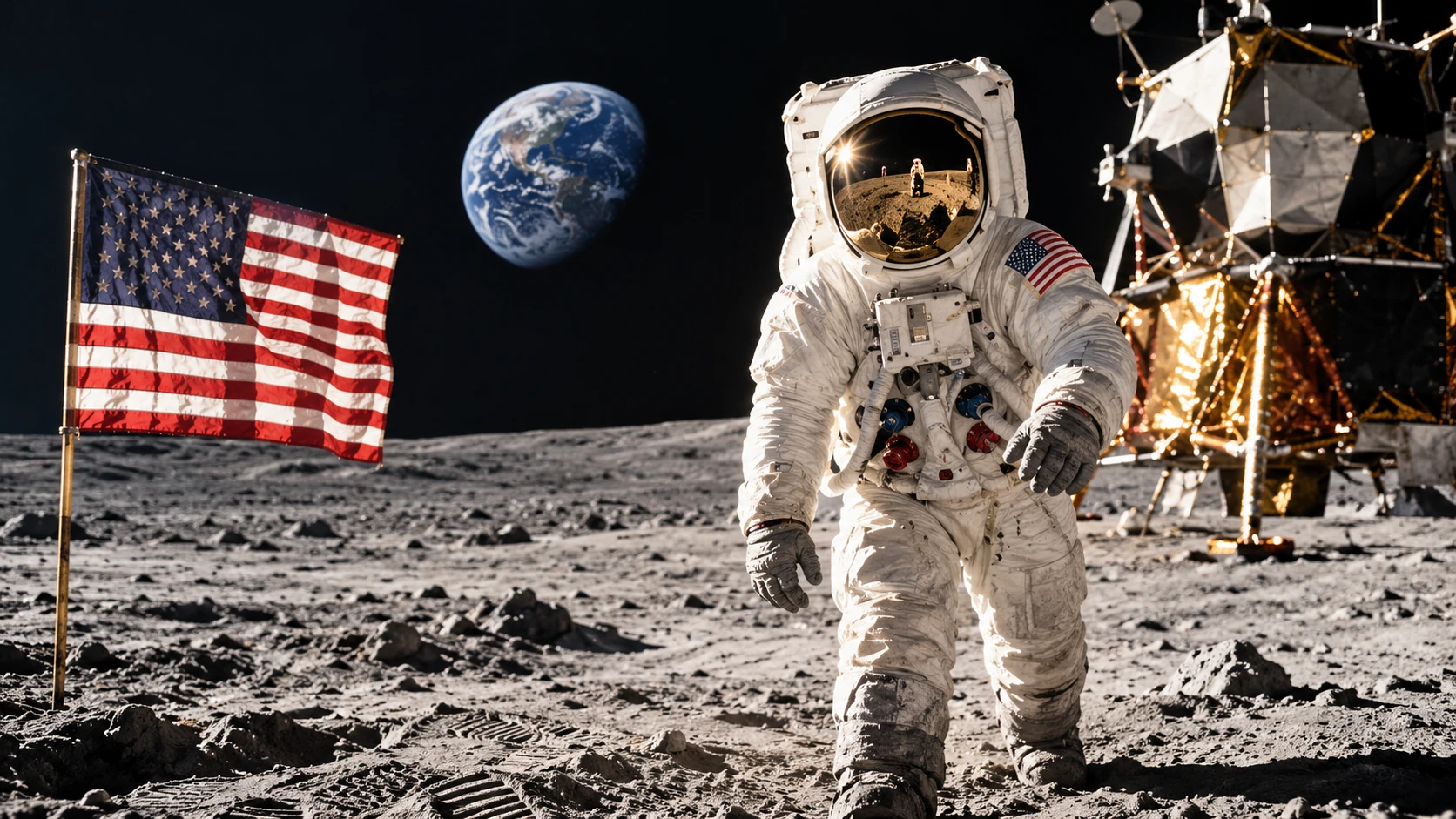
AI-generated editorial illustration supplied for PRESDA. This imagined scene is not a NASA photograph or scientific evidence; Earth’s scale, reflections and composition are artistic choices.
Yes. NASA astronauts landed on the Moon, and the case does not rest on a grainy television broadcast or an instruction to trust a government agency. It rests on converging evidence: lunar material studied in laboratories, observations of the missions, instruments left on the surface and later orbital photographs. The hoax theory has never supplied a competing explanation that accounts for that record.
Yet the questions can sound reasonable when a photograph is detached from its context. Why is the sky black without stars? Why does a flag appear to wave where there is no wind? Understanding Apollo means putting those images back into a physical world: sunlight without an atmosphere, unfamiliar terrain, camera exposures and spacecraft built around severe constraints.
A promise made in the Cold War
The Moon was a scientific destination and a geopolitical stage. Soviet successes, including Sputnik in 1957 and Yuri Gagarin’s orbital flight in 1961, challenged American prestige. On May 25, 1961, President John F. Kennedy asked Congress to commit to landing a man on the Moon and returning him safely before the decade ended. This was the congressional pledge, distinct from his better-known Rice University speech in 1962. Kennedy’s address
Apollo turned that deadline into a vast engineering programme. Its history included tests, failures and the deaths of three astronauts in the Apollo 1 ground-test fire. The political incentive to succeed was enormous. But an incentive is not evidence of a deception: a historical claim must still explain the physical record. Smithsonian’s account of the international response shows how an American achievement also became a moment experienced far beyond the United States. Smithsonian
Apollo 11: what happened on July 20, 1969?
Apollo 11 launched on July 16 with Neil Armstrong, Buzz Aldrin and Michael Collins. On July 20, Armstrong and Aldrin landed the lunar module Eagle in the Sea of Tranquility while Collins remained in lunar orbit. Armstrong’s first step followed on July 21 in Coordinated Universal Time, still July 20 in the United States. The landing and the first step are separate events, which explains apparently conflicting anniversary dates. The crew returned to Earth on July 24. NASA mission overview
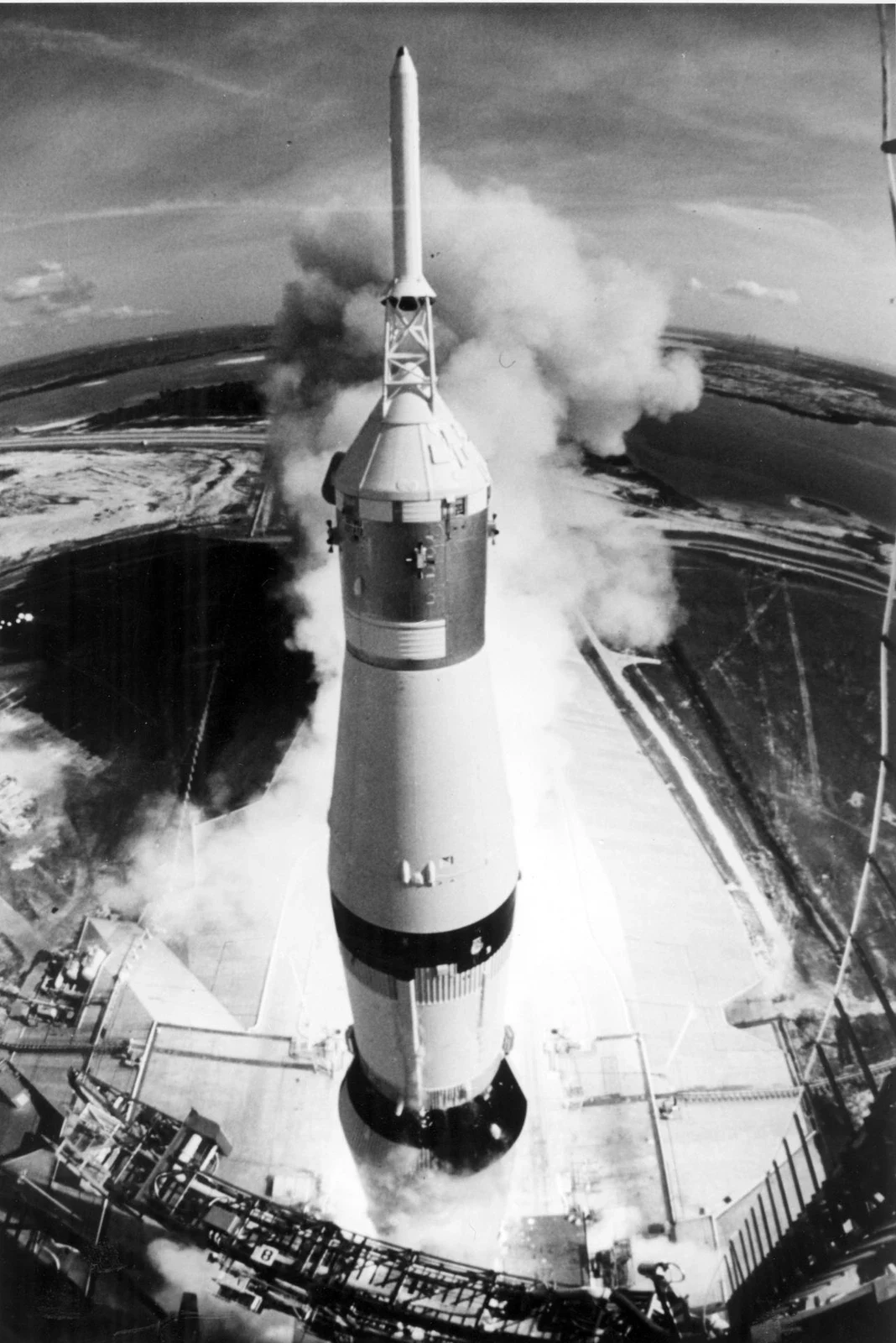
Apollo 11’s Saturn V lifts off on July 16, 1969, photographed by a fisheye camera on the launch tower. NASA/MSFC, 7012482.
NASA editorial reuse. Resized and converted to WebP by PRESDA. Full composition preserved. Reuse follows the individual license stated here.
The astronauts photographed their surroundings, collected samples and deployed experiments. None of these activities should be assessed solely through a dramatic image. Mission reports, recordings, sample catalogues and instrument measurements allow different parts of the story to be compared. That ability to cross-check is the strength of the evidence, not the fame of the people involved.
How the hoax story took hold
Bill Kaysing’s 1976 book We Never Went to the Moon helped establish the modern hoax narrative. Kaysing had worked as a technical writer at Rocketdyne; he was not an Apollo astronaut. His allegations repackaged technical questions as signs of a hidden production. Later television and internet circulation gave the claims audiences far beyond the original book. Historian Peter Knight places their appeal within a broader culture of distrust, sharpened by Vietnam and Watergate. University of Manchester
There is evidence of substantial public doubt, but no single reliable worldwide count of believers. A University of New Hampshire study reported that 12 percent of respondents in its POLES 2021 survey agreed that NASA astronauts had not really landed on the Moon. The online survey involved 1,134 US adults in summer and autumn 2021, with demographic sampling and weighting. It measures responses in a particular population and period, not the beliefs of humanity or a timeless trend. Survey and methodology
Claim: the flag is waving in a breeze
The flag needed a horizontal support because the Moon has essentially no atmosphere to hold fabric out. Wrinkles and an incompletely extended support gave it an undulating shape. Movement while the astronauts handled the pole came from their hands, not wind. A still photograph records a shape, not its cause; a ripple frozen in fabric is not evidence of a breeze. NASA’s history of the lunar flag
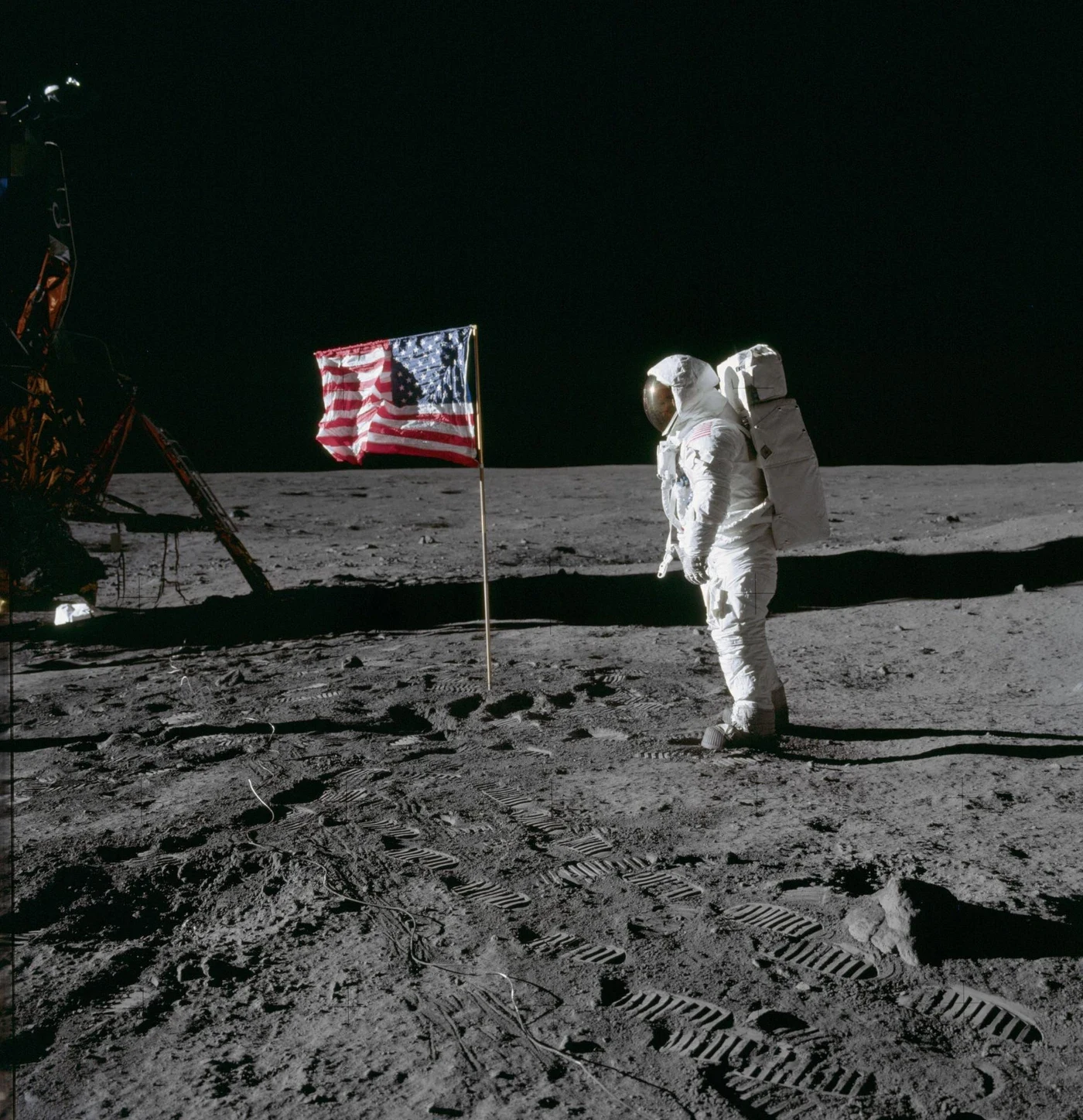
Buzz Aldrin beside the deployed flag during Apollo 11’s lunar excursion, July 1969. Photograph by Neil Armstrong, NASA, AS11-40-5875.
NASA / Neil Armstrong / as11-40-5875
NASA editorial reuse. Resized and converted to WebP by PRESDA. Full composition preserved. Reuse follows the individual license stated here.
Claim: the missing stars expose a studio
The surface and spacesuits were brightly sunlit. Exposures suitable for those subjects did not record much fainter stars. A black lunar sky results from the lack of atmospheric scattering, not necessarily darkness at ground level. The stars were present; these photographs were not exposed to show them. Royal Museums Greenwich
Claim: odd shadows require several spotlights
Uneven ground and perspective change the apparent directions and lengths of shadows in a two-dimensional image. Sunlight reflected from the surface and equipment can illuminate an astronaut standing in shadow. Non-parallel-looking lines do not, by themselves, demonstrate multiple studio lamps. The relevant test is whether lighting and terrain explain the whole scene. Royal Museums Greenwich
Claim: the Van Allen belts made survival impossible
The radiation belts are a real hazard, not an impenetrable wall. Biological risk depends on the radiation encountered, shielding and exposure time. Apollo trajectories and the time spent crossing the belts mattered; crew dosimeters measured exposure. The astronauts did not remain within the belts for the duration of their lunar missions. NASA’s radiation documentation treats exposure as an engineering and medical problem, not something that did not exist. Apollo radiation record
This does not make deep-space radiation harmless. Solar particle events and prolonged exposure are serious concerns for exploration. The correct conclusion is that Apollo’s measured exposures were compatible with survival, not that every journey beyond Earth is safe. Confusing a manageable risk on a particular mission with an absolute prohibition is the central error in this claim.
Claim: the lander should have blasted a huge crater
A landing engine is not a bomb striking the ground. Near touchdown it operated under different conditions from a launch engine on Earth, and its exhaust expanded into a vacuum. The observed result was surface disturbance and outward erosion rather than a dramatic excavated pit. Apollo 11’s mission report explicitly describes a slightly etched area beneath the engine and no erosion crater. The absence was documented, not concealed. Apollo 11 mission report
The physical question is how a particular plume interacts with soil, at a particular thrust and height. Expecting a cinematic blast crater substitutes intuition for that problem. NASA’s later plume research continues to examine erosion because dust and ejecta remain practical hazards for lunar landings. Engineering study
Evidence you can study: lunar samples
Six Apollo landing missions returned approximately 382 kilograms of rocks and soil. Their mineralogy, ages, impact history and exposure to an airless environment have supported decades of research. NASA’s sample collections preserve identifiers and geological context, allowing material to be studied beyond the original mission teams. NASA lunar sample collection
A rock is not a signed witness statement. Robotic missions can also return lunar samples, as the Soviet Luna programme demonstrated. The force of Apollo’s collection lies in its quantity, variety, documented collection sites and consistency with other lunar science, considered alongside the rest of the mission record. No single photograph or specimen has to carry the entire historical argument. NASA’s scientific response to hoax claims
Laser reflectors: strong evidence, with a limit
Apollo 11, 14 and 15 left laser retroreflector arrays. Observatories send pulses toward them and time the returning light to measure the Earth-Moon distance. The University of California San Diego’s APOLLO project documents this continuing research. These are repeatable measurements, not simply memories of a broadcast. UC San Diego lunar laser ranging
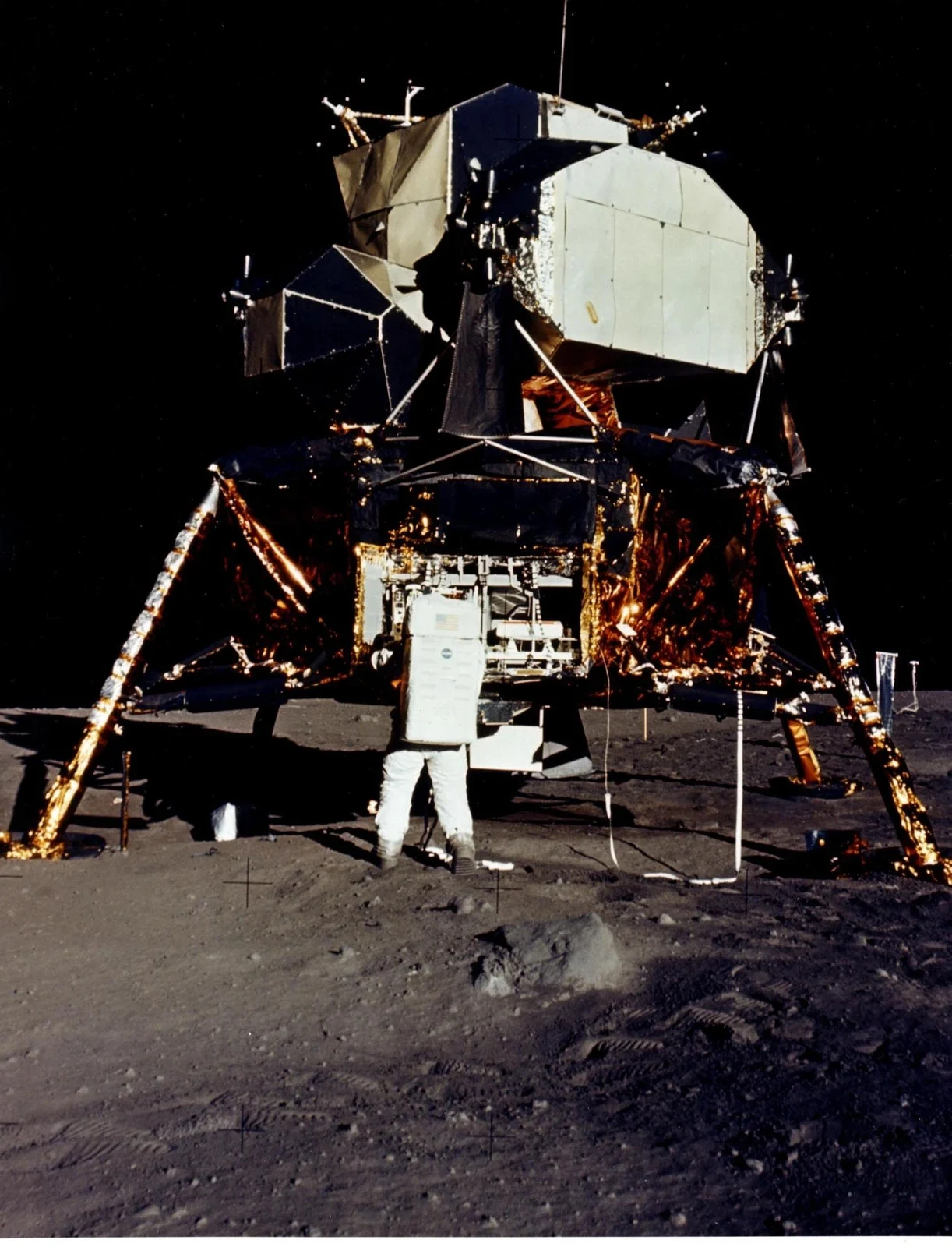
Aldrin removes scientific experiment packages from Eagle during Apollo 11, July 1969. NASA, AS11-40-5927. This shows equipment deployment, not a close-up of a reflector in operation.
NASA editorial reuse. Resized and converted to WebP by PRESDA. Full composition preserved. Reuse follows the individual license stated here.
However, Soviet Lunokhod rovers also carried reflectors. Detecting a reflector proves that suitable equipment is present, not that a human necessarily placed it there. Honest reporting makes this limitation explicit. The arrays strengthen the combined evidence for Apollo; they are not a standalone logical proof of human footsteps.
Photographs from orbit and independent tracking
NASA’s Lunar Reconnaissance Orbiter has photographed the Apollo landing sites, including descent stages and trails of disturbed soil. These images provide later observations that can be compared with surface maps and mission records. They show equipment and activity traces, not close-up portraits of individual bootprints. LRO is itself a NASA mission, so its images should not be mislabeled as evidence from an independent national agency. Apollo 11 site from orbit
Independent contemporary observation is a different line of evidence. Britain’s Jodrell Bank tracked Apollo 11 and the Soviet Luna 15 mission; the observatory preserves recordings from that period. Radio tracking provided information about spacecraft movement beyond what viewers saw on television. International participation in NASA’s communications network also mattered, although a network partner and an independent observer are not identical roles. Jodrell Bank’s account
What about Soviet monitoring?
The Soviet Union was an active lunar competitor with its own tracking capability, not an uninformed spectator. Its response belongs in the historical picture, but the familiar argument that it would have exposed a hoax is contextual reasoning rather than a physical measurement. Apollo 11’s contemporary communications record includes news of Premier Alexei Kosygin’s congratulations. That is documented recognition; it should not be inflated into an invented, comprehensive Soviet audit of every American transmission. Apollo 11 communications transcript
A persuasive account distinguishes what records establish from what seems plausible. Soviet recognition is consistent with the landings. Jodrell Bank’s observations are evidence of actual tracking. Samples, surface instruments and orbital photographs add other tests. Their convergence is much more informative than speculation about what a rival government might have done.
All six successful crewed landings
Apollo 11 landed on July 20, 1969, in the Sea of Tranquility. Apollo 12 followed on November 19, 1969, in the Ocean of Storms. Apollo 14 landed at Fra Mauro on February 5, 1971; Apollo 15 near Hadley Rille on July 30, 1971; Apollo 16 in the Descartes region on April 20, 1972; and Apollo 17 at Taurus-Littrow on December 11, 1972. These are landing dates, not launch dates. Twelve astronauts walked on the Moon across those six expeditions. NASA landing chronology
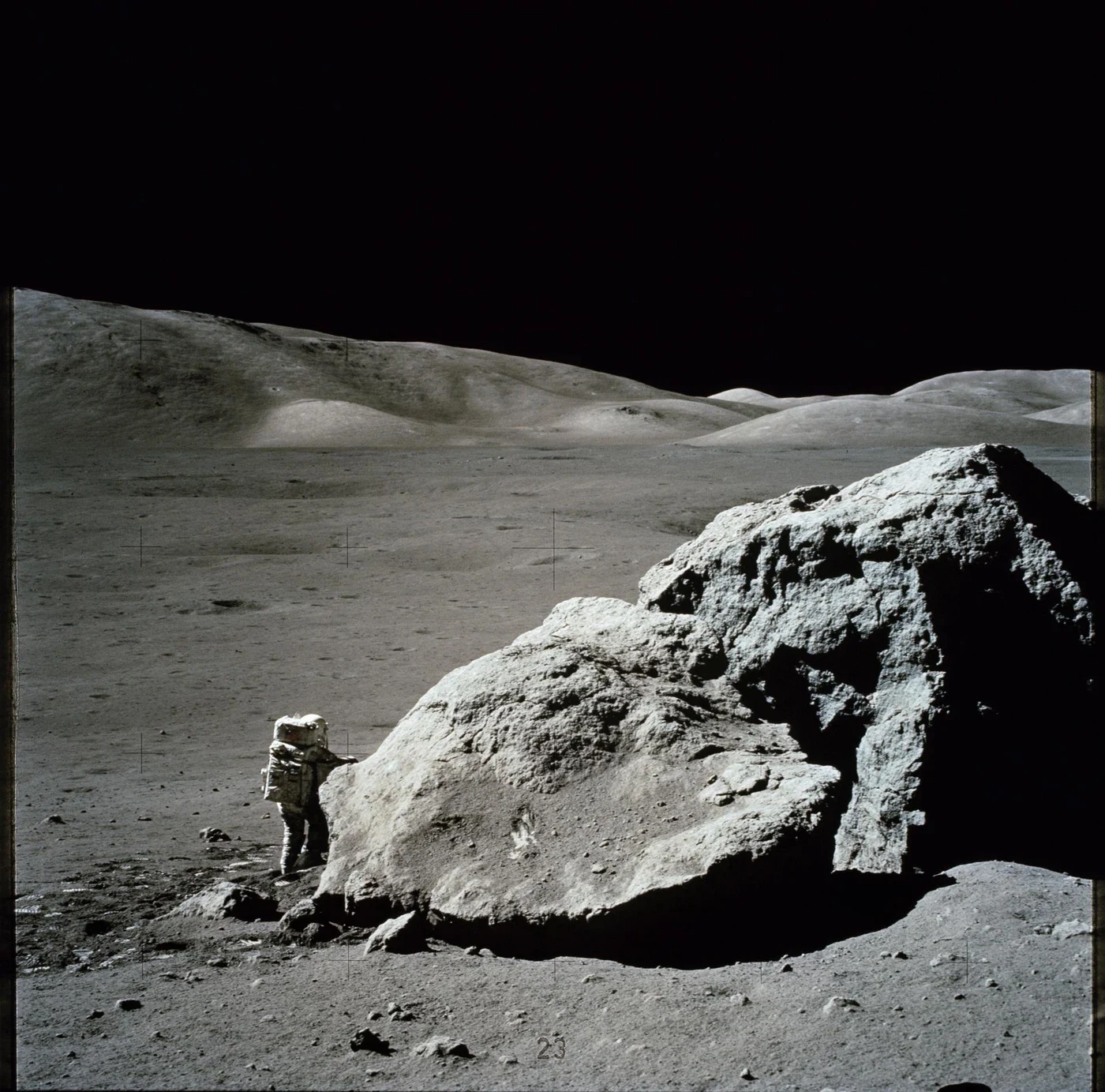
Geologist Harrison Schmitt beside a split boulder at Taurus-Littrow during Apollo 17, December 13, 1972. Photograph by Eugene Cernan, NASA, AS17-140-21497.
NASA / Eugene Cernan / as17-140-21497
NASA editorial reuse. Resized and converted to WebP by PRESDA. Full composition preserved. Reuse follows the individual license stated here.
Apollo 13 did not land: an in-flight emergency forced its crew to return. Including that failure matters. Apollo was a sequence of difficult missions with different outcomes, not one immaculate television spectacle. Later landings expanded fieldwork, and Apollo 17 included geologist Harrison Schmitt. The programme’s scientific reach is clearer when it is viewed as an evolving series rather than a single flag-planting scene.
Why did the visits stop?
The last Apollo landing was not evidence that the earlier ones were impossible. Budgets and political priorities changed after the initial goal had been achieved. NASA cancelled planned later missions while other programmes competed for resources. Hardware, industrial capacity, trained teams and sustained funding are needed to repeat a feat; knowing that it can be done does not preserve all of those conditions indefinitely. NASA’s history of the cancellations
Apollo’s end is therefore a question about institutions and choices as much as technology. A programme can succeed and still lose the support needed to continue at its previous scale. The gap after Apollo cannot erase the material it returned or the observations made while it flew.
Why the conspiracy survives
Research on conspiracy beliefs identifies motives involving understanding, control and social belonging. These are tendencies studied across groups, not diagnoses of every person who asks a question. A striking anomaly can feel more compelling than a long technical explanation, especially when institutional distrust is already present. Douglas, Sutton and Cichocka’s research review
Online circulation also strips images of provenance: a training photograph, illustration or edited clip may acquire a false caption. The AI-generated hero above is deliberately labeled because an attractive reconstruction is not historical evidence. Our archival photographs below retain their NASA identifiers and credits so readers can inspect their origins. The distinction is part of the story, not a decorative footnote.
Good skepticism asks what would change a conclusion. It compares explanations against all the evidence, rather than treating every correction as another layer of the supposed cover-up. Apollo’s record withstands that scrutiny. The extraordinary fact is not a hidden film set: it is that people crossed the distance, worked on the lunar surface and returned with evidence that others could examine.
FAQ
Frequently Asked Questions
What is this PRESDA article about?
Examine Apollo’s Moon landings, the flag, stars, shadows and radiation claims, and the evidence from lunar samples, tracking and surface instruments.
Which category does this story belong to?
This story is part of PRESDA's Science coverage.
Who published this article?
DID NASA REALLY LAND ON THE MOON? THE CONSPIRACY EXPLAINED was published by PRESDA Editorial on PRESDA.
PRESDA Dispatch
Stay Informed. Stay Aware.
A sharp briefing across AI, gaming, sport, business, world affairs, paparazzi, and lifestyle.