FÉLICETTE: THE FRENCH CAT WHO WENT TO SPACE AND FACED A TRAGIC END
The true story of Félicette’s 1963 suborbital flight, safe return and later euthanasia, with the science, ethical questions and legacy explained.
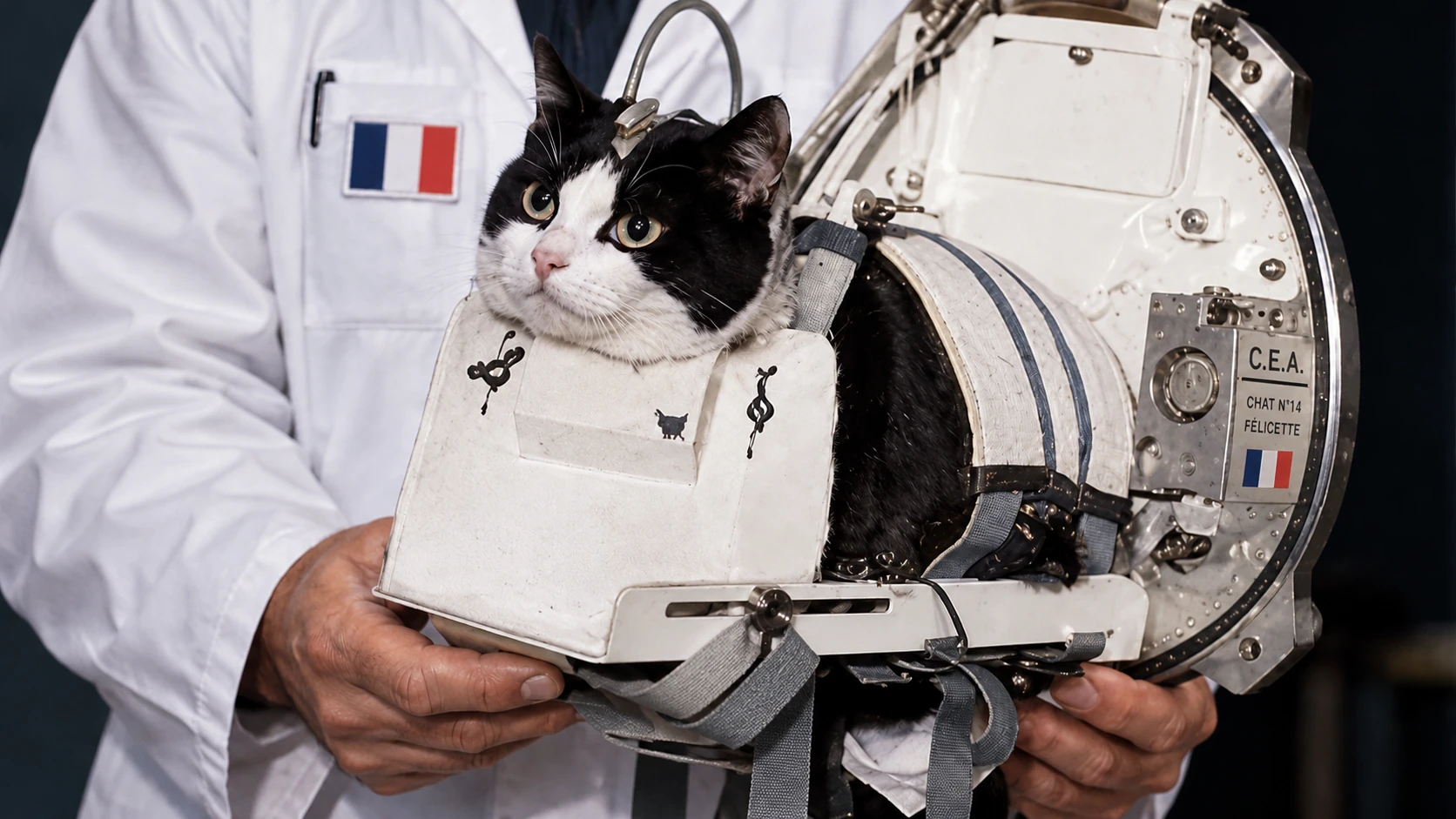
AI-assisted historical reconstruction supplied for PRESDA. Not an authentic photograph of Félicette. The equipment and markings are imagined, not a technical record.
The parachute brought her back. That is what makes Félicette’s story so difficult to finish with the familiar language of triumph. On 18 October 1963, a French rocket carried a small cat above the atmosphere and returned her alive to the Algerian desert. The danger of the flight had passed. The experiment had not.
Afterward, she was euthanized so researchers could examine her brain. Her story joins an achievement in space medicine to a decision on the ground: survival did not mean retirement. Félicette was the first cat to reach space and return alive, not an animal that circled Earth. Remembering that distinction preserves both the engineering accomplishment and the uncomfortable ending. Smithsonian: Félicette’s story and memorial
A French story inside the Space Race
The early Space Race is often narrated through American and Soviet milestones. France was building a different route into space, combining military expertise, atmospheric research and national ambitions. CNES, its national space agency, was created on 19 December 1961. In 1965, the Diamant launcher would make France the third country to place a satellite in orbit using its own rocket. Félicette’s journey belonged to the earlier experimental phase. CNES: the agency’s history
Sounding rockets offered short journeys beyond the lower atmosphere without the machinery necessary for sustained orbit. Hervé Moulin’s history, published by ESA, places the Véronique program within this developing scientific infrastructure. France’s first biological rocket experiment carried the rat Hector on 22 February 1961. The feline flight followed a program already asking how living bodies responded to launch and weightlessness. ESA: France in space, 1959–1979
The geography matters too. Félicette flew from Hammaguir in Algeria, not from metropolitan France or the later launch center in French Guiana. The mission connected a French laboratory to a Saharan launch range. Calling it simply a Parisian adventure erases the place where the rocket actually rose and where the recovery took place.
Before a name, C 341
Accounts commonly describe Félicette as a former Paris stray. Her precise early biography is less secure than her flight record: there is no dependable basis for inventing a birth date, an owner or a picturesque rescue scene. She entered a French research program and was known before the flight as C 341. Later retellings should not fill the gaps with a fictional life on the streets.
She was among fourteen cats prepared for spaceflight. Selection and training involved confinement, exposure to noise and centrifuge sessions. These were animals being conditioned to tolerate experimental conditions, not volunteers learning a profession. The word “training” can sound reassuring; it should not conceal restraint or the absence of any choice. Space.com: the feline training program
At CERMA, the French aeronautical medical research center, investigators were interested in nervous-system activity under unusual physical conditions. Implanted electrodes allowed them to record electrical signals from the brain. Félicette’s small size suited the rocket’s limited payload, while researchers already had experience interpreting feline neurophysiology. The scientific rationale was specific, even though the popular memory became simply “a cat in space.” Air & Cosmos: historical account of the experiment
Eighteen October 1963: up, then home
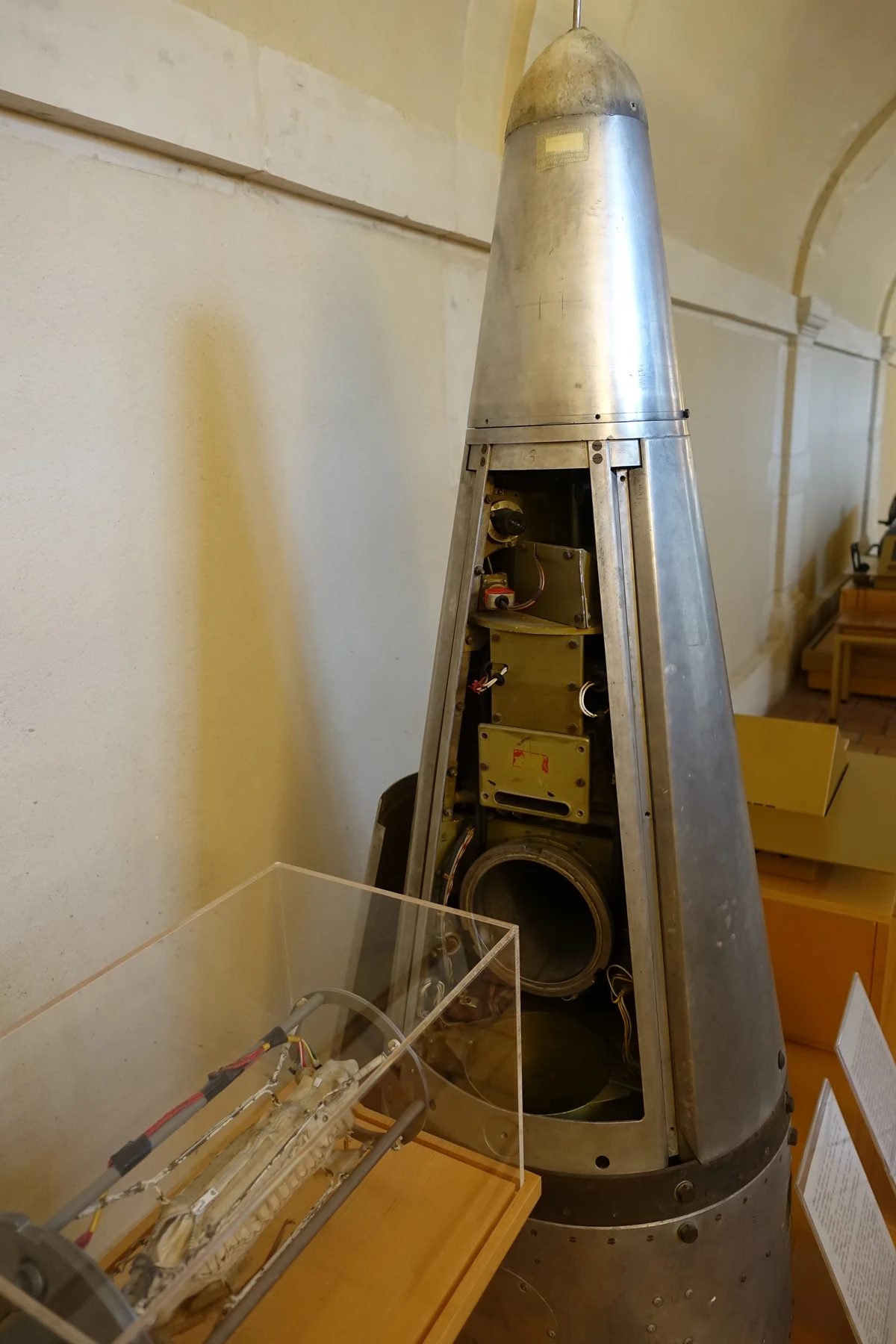
A Véronique rocket habitat displayed at the Musée du Service de Santé des Armées, Paris, photographed on 5 February 2017. Authentic museum photograph of research hardware; the source does not establish that this particular artifact flew with Félicette.
Guilhem Vellut / Wikimedia Commons
CC BY 2.0. Resized and converted to WebP by PRESDA. Full composition preserved. Reuse follows the individual license stated here.
NASA’s historical chronology identifies the launcher as Véronique AGI 47 and confirms the successful parachute recovery. This was a suborbital mission: the rocket carried its passenger high above Earth, but did not give the capsule the sideways speed required to remain in orbit. The flight’s trajectory returned it to the ground. NASA: animals in space
Published summaries differ over the precise maximum altitude and elapsed flight time. The defensible description is a brief journey to roughly 150 kilometers, including several minutes of weightlessness. Quoting an exact second from one account and an exact altitude from another would create an appearance of certainty that the accessible records do not support.
Weightlessness does not mean that gravity disappears. During the unpowered part of such a trajectory, the capsule and its contents fall together. The support forces normally felt as weight become very small. ESA explains the same principle through parabolic flight: it is free fall, not escape from Earth’s gravity, that produces the floating condition. That distinction helps explain why even a short flight could provide an experimental window. ESA: how microgravity is created
What scientists were measuring
The mission included neurological recording and responses to stimulation, alongside physiological monitoring. Its purpose was to observe selected functions during acceleration and weightlessness, rather than to understand the animal’s thoughts. The historical account describes brain signals transmitted to the ground and no major dysfunction in the structures studied during the experiment. Those findings must remain bounded by the short observation period and the measurements actually made. Air & Cosmos: neurological measurements
An electrical trace is evidence of activity, not a complete portrait of well-being. It cannot tell a reader exactly what Félicette experienced, and it does not justify describing her as fearless or happy. Equally, interpreting her flight as scientifically meaningless would require evidence beyond our discomfort with its methods. Measurement and moral judgment answer different questions; serious history needs room for both.
The mission also did not establish that humans could enter space for the first time. Yuri Gagarin had orbited Earth on 12 April 1961, more than two years earlier. Félicette belonged to continuing physiological research, not a final test that unlocked the first human launch. ESA: Yuri Gagarin’s flight
The death that followed survival
Félicette was subsequently euthanized for a post-mortem examination of her brain. Smithsonian’s account places this a few months after her return. Popular summaries often give two months; an exact death date is not securely established by the sources used here. The essential fact is clear: she did not die during launch, from a failed parachute or while lost in orbit. Smithsonian: post-flight examination
“Euthanized” describes how her death is recorded, but it can blur its purpose for a modern reader. This was reported as the killing of a surviving research animal for examination, not simply the relief of a documented terminal illness. There is no need to invent a last embrace, a scientist’s private remorse or the cat’s final sensations. The verified sequence is already disturbing enough.
A successful return is ordinarily the emotional resolution of a space story. Here it was a stage in an experimental procedure. That reversal is the heart of Félicette’s history: the apparatus designed to preserve a living passenger worked, yet preserving her life beyond the research program was not the outcome.
Laika, Ham and different kinds of survival
Laika’s 1957 mission aboard Sputnik 2 was orbital and had no return plan. She died within hours. Félicette’s mission was suborbital, with recovery built into it. The contrast matters: these animals did not share an identical journey or fate. PRESDA’s account of Laika’s flight and its aftermath examines the earlier Soviet mission in detail.
NASA’s chronology also records the chimpanzee Ham’s successful recovery after a suborbital flight in January 1961. A second French cat was launched on 24 October 1963, but that mission failed to achieve a successful recovery. Thus “the only cat ever launched” is a misleading shortcut. Félicette’s distinction is her pioneering flight and return alive. Animal spaceflight contains multiple outcomes, not one uniform story of either sacrifice or rescue. NASA: mission chronology
An ethical question that outlasted the rocket
Explaining the researchers’ objectives does not settle whether their methods were justified. A useful ethical assessment asks what knowledge was expected, whether another method could answer the question, how suffering was limited and what would happen to the animal afterward. These questions concern the design of the experiment, not merely the emotional response to its most recognizable participant.
The principles now known as the 3Rs were first proposed in 1959: replacement, reduction and refinement. They seek alternatives to animal use, scientifically sound limits on numbers and less pain or distress where animals are used. Their existence before Félicette’s flight is a reminder that concern for experimental animals is not an invention of the social-media age. It does not, by itself, prove which safeguards governed this particular French mission. NC3Rs: origins and meaning of the 3Rs
Today, NC3Rs describes approaches including human tissues, cell systems and computational models. No single substitute reproduces every interaction inside a living organism, and suitability depends on the research question. The responsible goal is to demonstrate which methods are necessary and reliable, not to assume either that animals are always indispensable or that every replacement is already adequate. Our investigation into animal testing and its scientific and ethical costs explores that tension. NC3Rs: replacement, reduction and refinement
Recovering a name from the margins
In 2017, Matthew Serge Guy launched a crowdfunding campaign for a memorial. A bronze sculpture by Gill Parker was unveiled at the International Space University near Strasbourg in December 2019. It depicts Félicette above a globe, looking upward. The commemoration gave a visible place to a story that had often been overshadowed by better-known American and Soviet animal missions. Space.com: the memorial’s unveiling
Recognition brings another responsibility: distinguishing the animal from the imagery built around her. CNES preserves a documentary record featuring Félicette alongside other research animals. Such archives are valuable precisely because they can be identified and contextualized. The reconstructed hero at the top of this article is an illustration, not evidence of her actual harness, capsule or appearance during preparation. CNES archive: animals in space
Félicette does not need invented heroism to deserve remembrance. She survived a real journey across the boundary of space, and people then made a decision that ended her life. Holding those facts together gives her history its force. Scientific progress can be real, and the cost paid by a living subject can remain a question that progress alone does not answer.
FAQ
Frequently Asked Questions
What is this PRESDA article about?
The true story of Félicette’s 1963 suborbital flight, safe return and later euthanasia, with the science, ethical questions and legacy explained.
Which category does this story belong to?
This story is part of PRESDA's Science coverage.
Who published this article?
FÉLICETTE: THE FRENCH CAT WHO WENT TO SPACE AND FACED A TRAGIC END was published by PRESDA Editorial on PRESDA.
PRESDA Dispatch
Stay Informed. Stay Aware.
A sharp briefing across AI, gaming, sport, business, world affairs, paparazzi, and lifestyle.