WINTER: THE DOLPHIN WHO LEARNED TO SWIM WITH A PROSTHETIC TAIL
Winter’s rescue, prosthetic tail and rehabilitation: the real story behind Dolphin Tale, her impact on disabled people and her death in 2021.
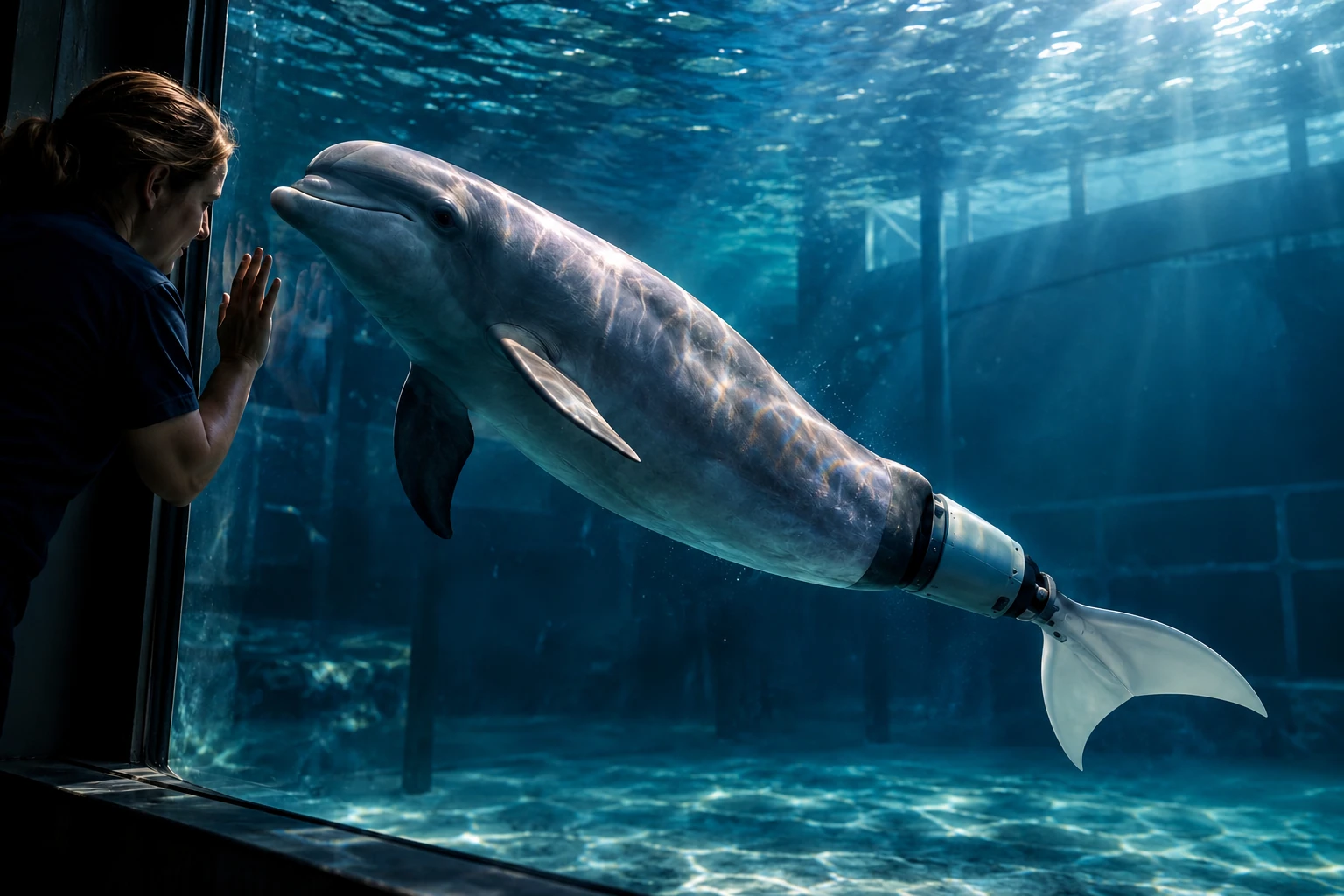
AI-generated editorial illustration supplied for PRESDA. This imagined scene is not a photograph of Winter or an accurate technical depiction of her prosthesis.
Winter's story began with a piece of rope. Long before the film cameras, the visitors and the artificial tail, a very young dolphin became entangled in fishing gear in a Florida lagoon. The injury would permanently change her body. What followed was not a single miraculous operation, but years of nursing, observation, engineering and adaptation.
Winter became famous as the dolphin who swam with a prosthetic tail. The fuller story is more interesting: she first learned to move without one. Her caregivers and prosthetists then tried to make that movement healthier. Her life offers a remarkable example of rehabilitation across species, and a reminder that the most meaningful technologies often begin with a difficult, very particular need.
A rescue in Mosquito Lagoon
On 10 December 2005, Winter was rescued from Mosquito Lagoon on Florida's Atlantic coast. Clearwater Marine Aquarium estimates that the female Atlantic bottlenose dolphin was about two months old. Crab-trap rope had constricted her tail, disrupting its blood supply. She was taken to the aquarium, where keeping a vulnerable calf alive became the immediate priority. Clearwater Marine Aquarium: Winter's history
The real rescue involved fisherman Jim Savage, whose encounter with the stranded animal later became part of the aquarium's public history. A retrospective marking the rescue anniversary brought him back into Winter's story. There was no fictional child hero at the center of that original encounter. The rescue belongs to the people who found her and the professionals who undertook her care. CMA: the fisherman and the rescue anniversary
Removing an entanglement does not necessarily reverse its damage. Tissue deprived of circulation may already be beyond recovery. Winter's flukes deteriorated and were lost, leaving her without the normal propulsive end of her body. Her survival therefore presented a second challenge: how could an animal built around that swimming apparatus live with its absence?
Swimming after the loss
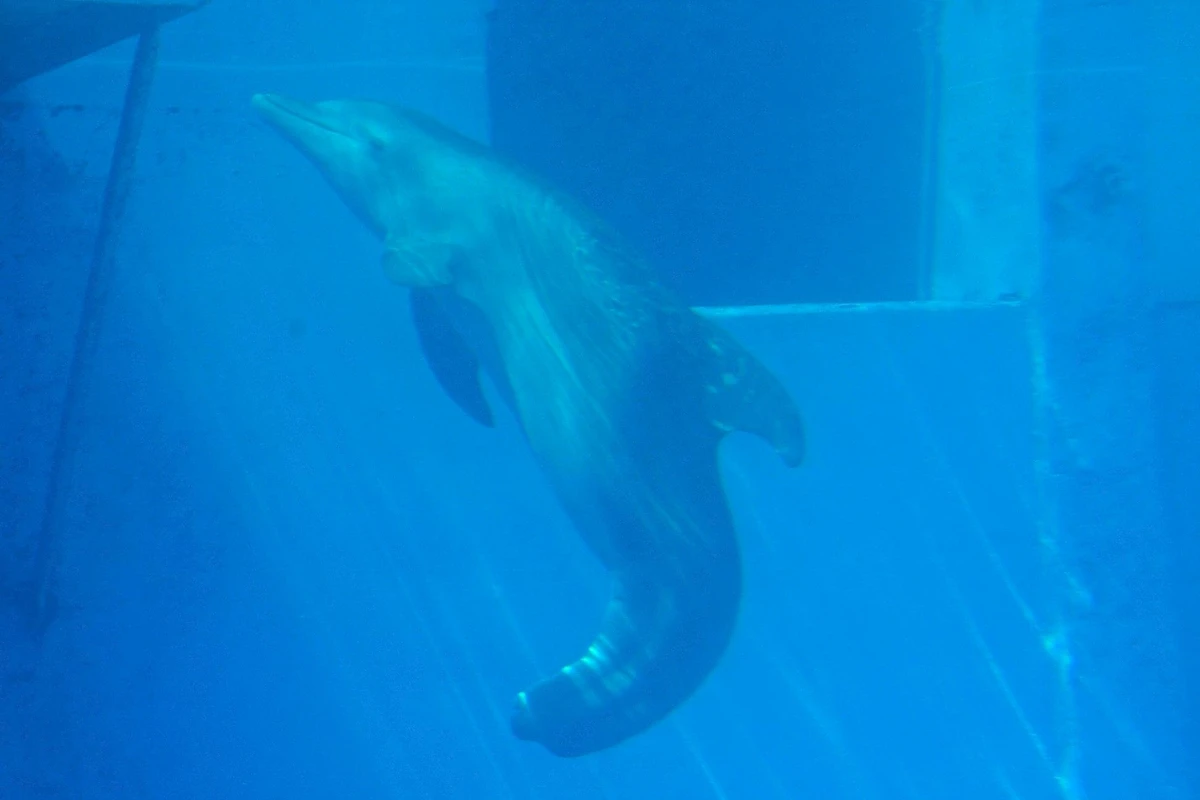
The real Winter without her prosthetic tail, photographed on 29 August 2011. Her ability to swim without the device is an essential part of her rehabilitation story.
CC BY-SA 2.0. Resized and converted to WebP by PRESDA. Full composition preserved. These image versions retain the stated ShareAlike license.
A dolphin's tail is not simply a decorative fin. Its paired flukes work with the muscular tail region, or peduncle, to generate propulsion through an up-and-down movement. Winter had lost the flukes and the joint region associated with them. The aquarium's account identifies veterinarian Mike Walsh, its animal-care team and Hanger's specialists among the people involved in responding to her unusual condition. CMA: anatomy and rehabilitation
Winter adapted by moving her body from side to side. This kept her mobile, but an alternative movement is not automatically a harmless one. Hanger's contemporary account describes concerns that her compensatory swimming was inefficient and could damage her spine. The aim of a prosthesis was therefore not to turn an immobile dolphin into a swimming one. It was to encourage a movement closer to the normal vertical pattern. Hanger: the rehabilitation challenge
That distinction changes the familiar story. Adaptation and medical assistance were complementary, not competing explanations. Winter's own movements showed that she could live with a changed body; they also revealed problems that equipment and supervised exercise might address. Rehabilitation began by observing what the patient already did, rather than assuming what a replacement part ought to accomplish.
Building a tail for a moving body
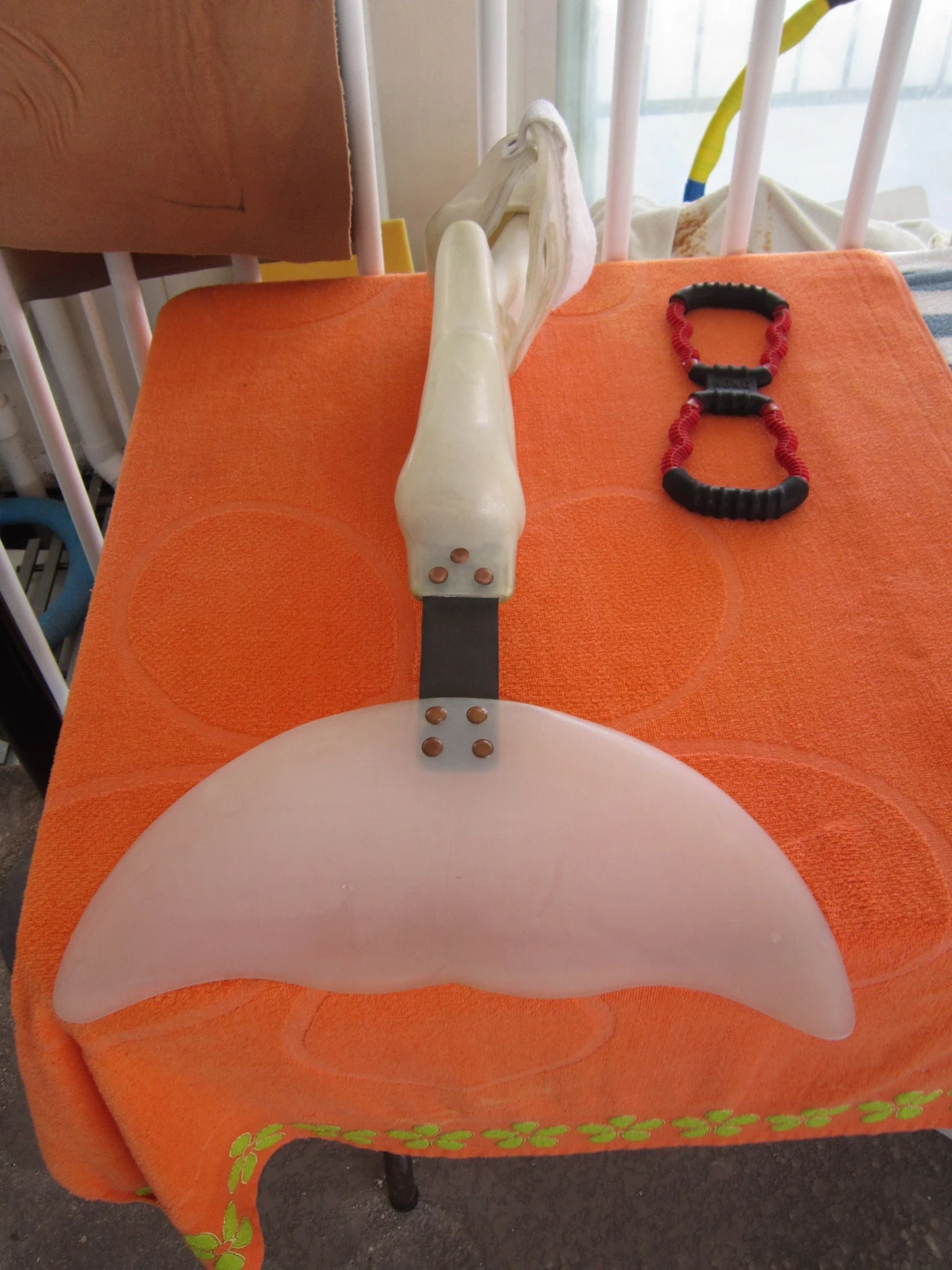
Winter’s prosthetic tail photographed on 3 December 2011, as identified in the photographer’s record. The external socket and artificial flukes are visible; this is an authentic photograph, not the imagined device in the hero illustration.
CC BY-SA 4.0. Resized and converted to WebP by PRESDA. Full composition preserved. These image versions retain the stated ShareAlike license.
Prosthetist Kevin Carroll contacted the aquarium in 2006. With colleague Dan Strzempka, he worked on a device for an animal unlike their usual human patients. Hanger describes a development process lasting roughly eighteen months. A dolphin's flexible body, aquatic environment and sensitive skin demanded more than a smaller version of a familiar artificial limb. Hanger Clinic: development of Winter's tail
One central problem was the interface: the place where the device met living tissue. An artificial fluke would be useless if its attachment slipped, restricted movement or injured the skin beneath it. The team developed a soft liner known as WintersGel to cushion that contact and help secure the socket. Hanger reports that this material subsequently found applications in human prosthetic care. That is an account of technology transfer, not proof that one liner is best for every patient.
The authentic photograph here shows the physical arrangement clearly: a socket-like upper section connected to artificial flukes by a narrower central element. It is an external device, not a surgically implanted replacement tail. Its value lay in how its shape, attachment and flexibility worked together with the dolphin's remaining body. The dramatic visual resemblance to a tail is only the beginning of the engineering question.
Rehabilitation was a continuing relationship
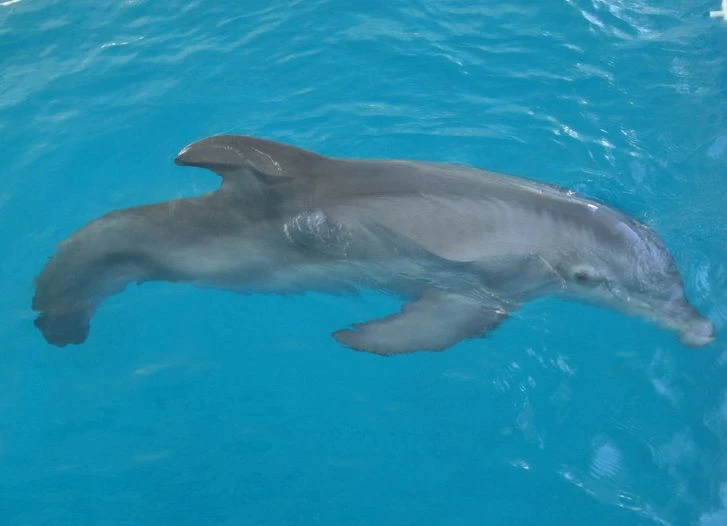
Winter near the surface, photographed on 3 December 2011. This image documents her altered body and swimming; it does not show a clinical rehabilitation session.
CC BY-SA 4.0. Resized and converted to WebP by PRESDA. Full composition preserved. These image versions retain the stated ShareAlike license.
The device was not worn continuously. Whale and Dolphin Conservation's account of Winter's life notes that she used it on occasions and could swim without it. Its role should be understood as part of managed care, not as an all-day mechanical cure. Nor did the prosthesis make her a candidate for an ordinary independent life in the sea. Whale and Dolphin Conservation: Winter's life
For any prosthetic system, a successful fitting is not the end of rehabilitation. Comfort, movement and the condition of the contact surface all matter. With an animal, caregivers must interpret behavior rather than rely on a spoken description of pain or pressure. A photograph of a device being used cannot establish all of those outcomes. Good reporting must distinguish an impressive demonstration from evidence of lasting benefit.
The wider history of prosthetics helps explain why Winter's story resonated beyond an aquarium. Smithsonian's account of inventor Van Phillips describes how his own limb loss helped drive the development of the Flex-Foot artificial limb. Different bodies and activities require different designs. Winter's tail belongs in that broader history of solving functional problems, rather than in a fantasy of universally interchangeable replacement parts. Smithsonian: Van Phillips and prosthetic innovation
The people who saw themselves in Winter
For some visitors, the most important feature was not the engineering. It was seeing another living being move through the world with a conspicuously different body. Johns Hopkins All Children's Hospital recalled introducing patients to Winter's story in 2011, including an opportunity to handle an outgrown prosthetic tail. The hospital later hosted visits connected with the films and the aquarium. Johns Hopkins Medicine: Winter's impact on patients
One documented encounter involved Hassan and Hussein Benhaffaf, Irish twins who had been separated after being born conjoined. ABC News reported their meeting with Winter in 2014. Carroll also worked with the boys, creating a concrete connection between the dolphin's prosthetic story and human rehabilitation. Their visit was a personal event, not a clinical experiment measuring the effects of inspiration. ABC News: the Benhaffaf twins meet Winter
Such stories deserve respect without becoming demands placed on disabled people. Nobody owes the public exceptional courage, athletic achievement or a cheerful response to loss. A useful prosthesis, accessible care and the freedom to live an ordinary life matter independently of whether a story inspires an audience. Winter could offer companionship in imagination without becoming a prescription for how a person should feel.
Dolphin Tale: the real animal and the invented story
Dolphin Tale opened in 2011, bringing Winter's story to a much larger audience. Winter appeared as herself, an unusual connection between a dramatized film and the animal behind it. The National Wildlife Federation's educational material uses the production to introduce marine science and the real dolphin. It should not, however, be read as a documentary record of every scene. National Wildlife Federation: Dolphin Tale educator guide
The children Sawyer and Hazel were fictional characters. Reporting on the sequel explicitly distinguishes those inventions from Winter's real history. The Atlanta Journal-Constitution: the film's fictional children
Morgan Freeman's prosthetist character drew on the work of Carroll and Strzempka, according to Hanger. A film can compress multiple people, repeated trials and long periods of care into a few recognizable relationships. That compression makes a story easier to follow, but it must not erase the real collaboration. The prosthesis was the result of sustained work, not a sudden solution produced at the perfect dramatic moment. Hanger Clinic: the people behind the film
Fame and the responsibilities of care
Winter's public life connected a local rescue to audiences far beyond Florida. Yet fame does not settle the ethical questions surrounding an animal in human care. A nonreleasable rescued dolphin presents different circumstances from an animal captured to supply entertainment. In either case, welfare must be evaluated through the animal's needs, not simply through visitor affection or ticket sales.
The distinction also matters when comparing rehabilitation with animal testing and its ethical costs. Winter's injury was not deliberately inflicted to create a research subject. The engineering responded to an existing injury. That difference does not remove the obligation to assess burdens, benefits and alternatives; it explains why the purpose of an intervention belongs at the center of the discussion.
There is a similarly revealing contrast with Laika's one-way space mission. Both animals became symbols of human technology, but the circumstances and aims were profoundly different. Public memory should preserve those differences. An animal's value cannot be reduced to the scientific lesson, the film or the metaphor people construct around it.
Her final illness in November 2021
In November 2021, the aquarium reported that Winter was unwell and had lost her appetite. Initial assessments pointed to gastrointestinal problems. Her condition worsened despite treatment. On 11 November, at approximately 8 p.m., she died while the team was preparing for a procedure and attempting to stabilize her. She was sixteen. CMA: medical updates and death announcement
The aquarium subsequently reported that preliminary necropsy findings indicated intestinal torsion, a twisting of the intestine. That finding is more specific than the early public descriptions of infection or gastrointestinal abnormalities. The timeline matters: suspicions during treatment and findings after death are different kinds of information. Her death should not be rewritten as proof that the prosthetic tail failed, or that determination alone could have prevented a medical emergency.
Grief for a widely known animal is real, but precision remains a form of respect. We do not need to invent Winter's final thoughts or assign her a human understanding of the people around her. The documented effort to care for her, and the loss felt by those who did, are sufficient.
A legacy that begins before the rescue
In 2025, Clearwater Marine Aquarium unveiled an exhibit called Tales of Winter the Dolphin. Its announcement describes mementos, film material and representations of the equipment associated with her life. That continuing commemoration shows how thoroughly one rescued animal entered public culture. It also makes careful labeling essential: a replica, a film prop and an authentic medical object are not the same thing. CMA: Tales of Winter exhibit
The conservation lesson reaches beyond any display. NOAA identifies fishing gear and marine debris as sources of dangerous dolphin entanglement. Its guidance asks people who find an entangled dolphin to report it, keep their distance and leave intervention to trained, authorized responders. Winter's exceptional survival should not obscure the animals that are never found or cannot be saved. Prevention matters more than the hope of another celebrated rescue. NOAA Fisheries: dolphin entanglement response
Winter did not recover the body she had before the rope. What she gained was a life supported by adaptation, skilled care and a device designed around her needs. That is a more enduring story than a technological miracle. It asks what becomes possible when ingenuity serves a vulnerable patient, and what responsibility remains to prevent the injury in the first place.
FAQ
Frequently Asked Questions
What is this PRESDA article about?
Winter’s rescue, prosthetic tail and rehabilitation: the real story behind Dolphin Tale, her impact on disabled people and her death in 2021.
Which category does this story belong to?
This story is part of PRESDA's Science coverage.
Who published this article?
WINTER: THE DOLPHIN WHO LEARNED TO SWIM WITH A PROSTHETIC TAIL was published by PRESDA Editorial on PRESDA.
PRESDA Dispatch
Stay Informed. Stay Aware.
A sharp briefing across AI, gaming, sport, business, world affairs, paparazzi, and lifestyle.