LAIKA: THE SOVIET DOG WHO WENT TO SPACE AND NEVER RETURNED
From Moscow’s streets to Sputnik 2: Laika’s 1957 mission, fatal overheating, concealed death and the scientific and ethical legacy of a flight without return.
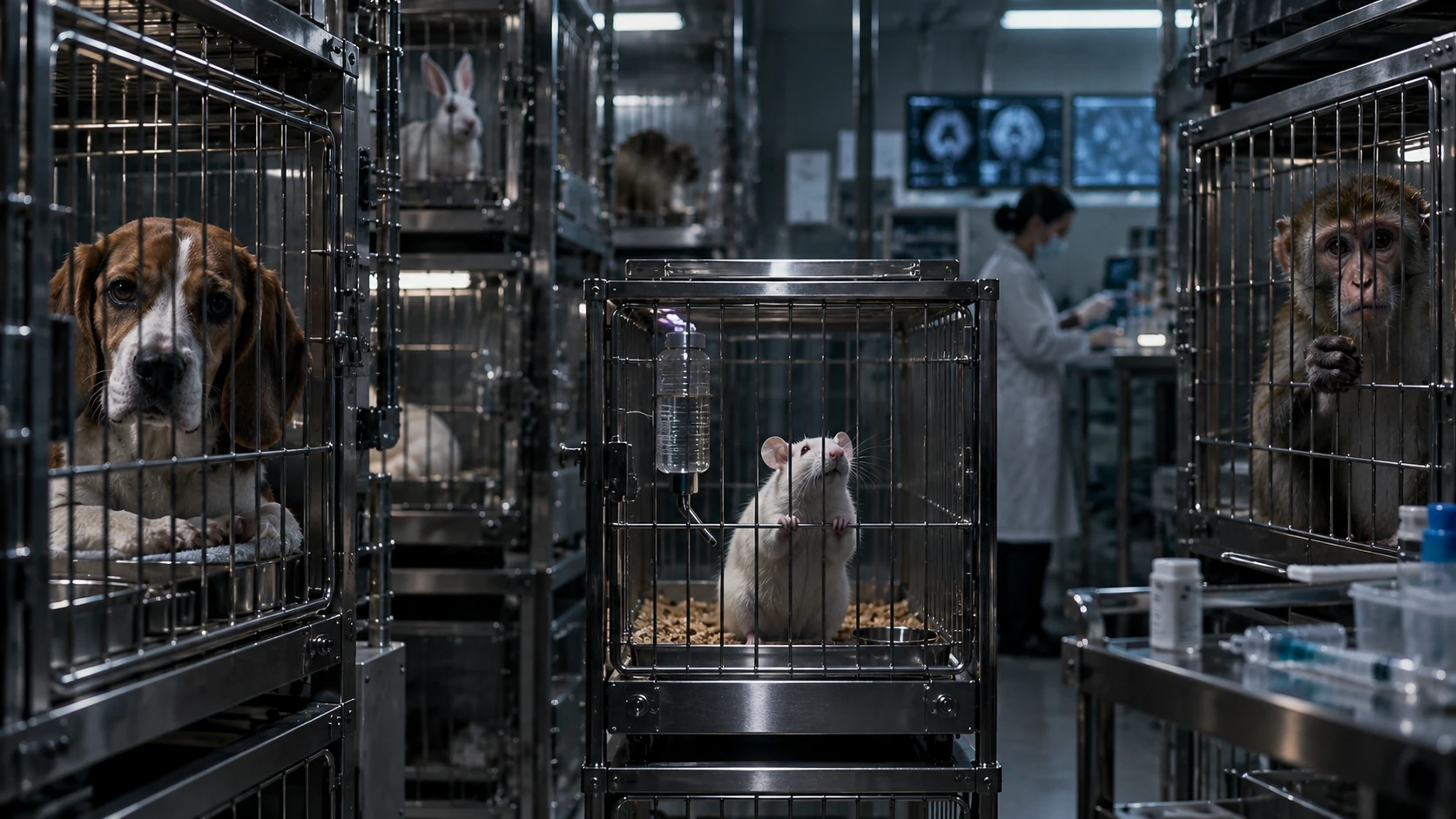
AI-generated artistic reconstruction supplied for PRESDA. This is not an archival photograph of Laika, her equipment or Sputnik 2.
Before a human being circled Earth, a dog did. On 3 November 1957, Laika left the Soviet launch site at Baikonur inside Sputnik 2. The mission made her the first animal to orbit our planet. It also placed her in a spacecraft that had no means of bringing her home. Those two facts belong together: the achievement and the decision that made her death inevitable.
Laika was not the first animal in space. Earlier rocket flights had carried animals above the atmosphere on suborbital trajectories. Orbit was a different challenge: remaining in continuous free fall around Earth, rather than rising and descending along a brief arc. Her journey offered evidence about life in that new environment, while leaving an ethical question that technical success could not resolve. NASA: animals in space
From Moscow's streets to a research program
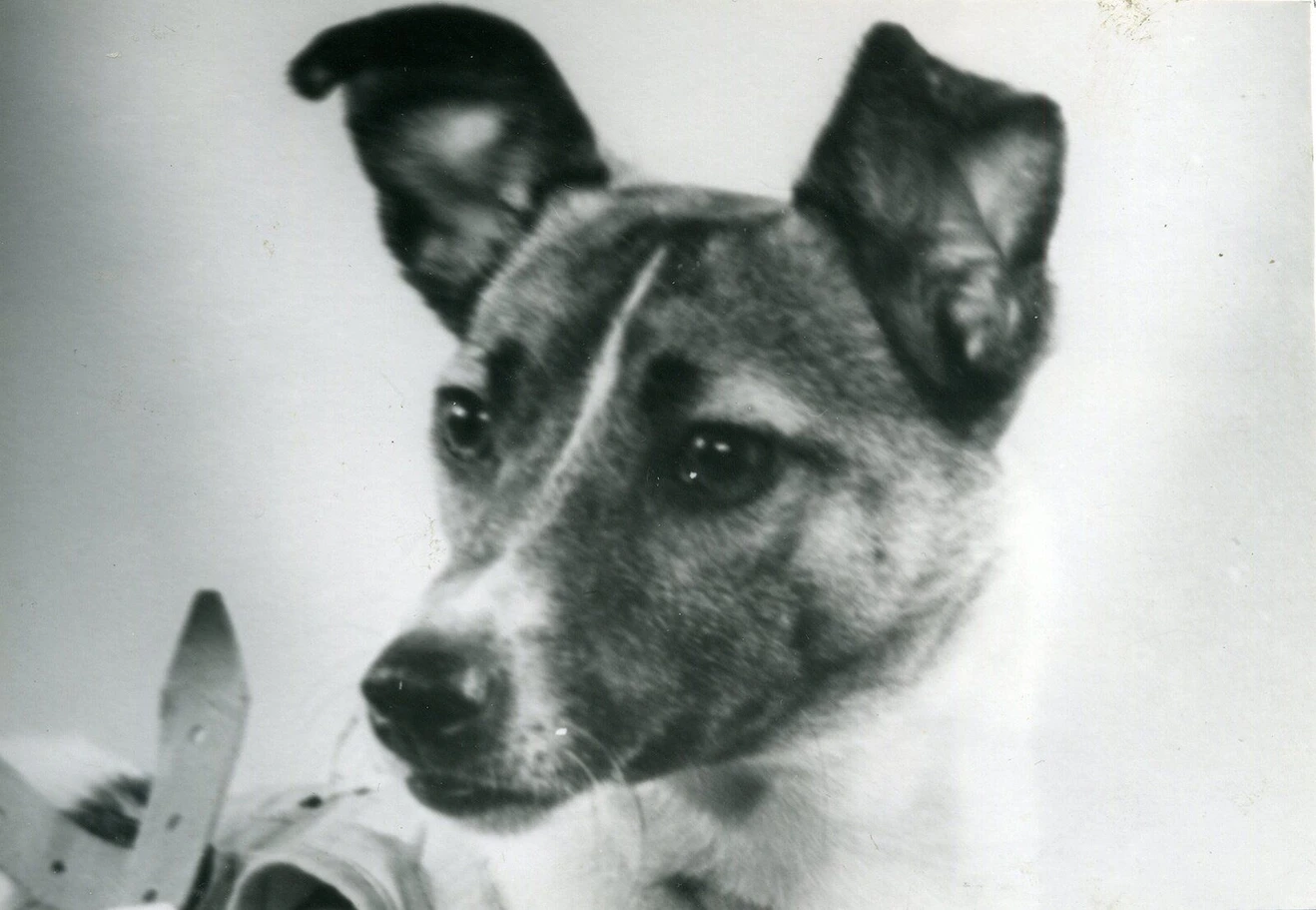
Laika before her 1957 flight, in a photograph preserved by the Museum of Cosmonautics and Moscow Main Archive. This portrait does not show her in orbit.
Museum of Cosmonautics / Moscow Main Archive / Mos.ru
CC BY 4.0. Resized and converted to WebP by PRESDA. Full composition preserved.
Laika came from Moscow's population of stray dogs. The surviving story begins with that broad fact, not with a reliably documented birthplace or a detailed account of her life on the streets. Popular retellings often supply a complete personality and an imagined understanding of her fate. Neither can be recovered from the record. She was a living animal selected by people for an experiment she could not comprehend or consent to.
Soviet researchers had already used dogs in high-altitude rocket experiments. Small animals suited cramped capsules, and females were easier to accommodate with the program's waste-collection arrangements. NASA's historical survey describes the preference for dogs over monkeys partly in terms of how they behaved during flight. These were practical experimental choices, not evidence that hardship made a stray immune to fear or suffering. NASA: the early animal-flight programs
The dog also appears in accounts as Kudryavka, often translated as “Little Curly.” Laika became the name known around the world. Training involved confinement in small spaces and exposure to conditions intended to prepare dogs for launch, including noise and changes in pressure. Researchers monitored bodily responses and used equipment to collect waste. Preparation could make measurement possible; it could not make the experience voluntary. Smithsonian: selection and preparation
A second satellite, a political deadline
Only a month earlier, on 4 October 1957, the Soviet Union had launched Sputnik 1. Its radio signal demonstrated that a human-made object was circling Earth. The event was simultaneously a scientific milestone and an assertion of technological power. In the Cold War, the rocket capable of placing a satellite in orbit also carried obvious implications for military reach. ESA: Sputnik and the space age
Sputnik 2 followed with extraordinary speed. NASA's retrospective describes a hastily assembled mission intended to amplify the propaganda success of the first satellite. The approaching anniversary of the Bolshevik Revolution added political significance to the timing. A living passenger would make the new achievement immediately understandable far beyond scientific circles. NASA: the first animal in orbit
That timetable matters because it separates two questions often blurred in commemorations: whether an experiment could be launched, and whether it had been designed around the survival of its passenger. Laika's mission answered the first. A successful recovery was never an available outcome. The absence of a return system was not an emergency discovered after she reached orbit.
Inside Sputnik 2
Sputnik 2 was much larger than its predecessor, with a mass of about 508 kilograms. It carried instruments as well as the animal compartment, and remained attached to its rocket stage in orbit. Its biological equipment had to sustain a small enclosed environment while recording the responses of a living body. NASA: Sputnik mission chronology
A historical technical account reproduced in NASA's collection Exploring the Unknown describes Laika's capsule as containing air-regeneration and temperature-regulation equipment, feeding arrangements, sanitation and medical instrumentation. These systems addressed connected problems: providing breathable air, handling waste, maintaining an acceptable environment and transmitting useful information. A sealed compartment is not automatically a safe one. Heat management is as fundamental to survival as an oxygen supply. NASA historical documents, volume VI, p. 312
The medical measurements were intended to distinguish the stresses of launch from the effects of orbital flight. Heart activity and breathing could reveal whether an animal remained alive and how its body responded. Yet telemetry is a record of selected signals, not a window onto everything an animal experiences. Physiological observations cannot tell us Laika's thoughts, and they should not be rewritten as a sentimental eyewitness narrative.
Launch, orbit and fatal heat
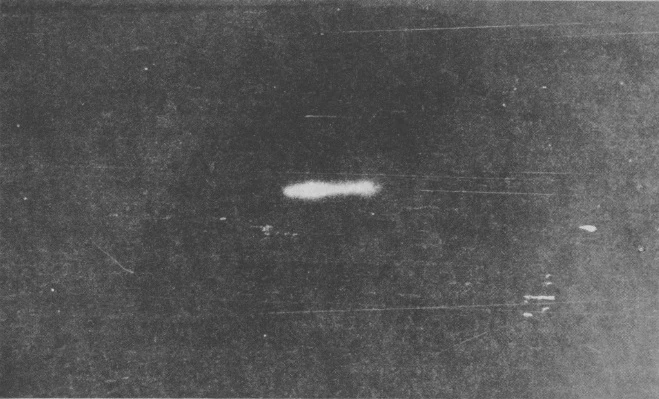
Sputnik 2 photographed from Patrick Air Force Base, Florida, in March 1958. The satellite was still orbiting months after Laika had died; this is not a photograph of a living animal in flight.
U.S. Air Force / Air Force Missile Test Center, Patrick AFB
Public domain. Resized and converted to WebP by PRESDA. Full composition preserved.
Sputnik 2 lifted off on 3 November 1957. Laika survived the ascent and entered orbit. For the first time, an animal was traveling repeatedly around Earth. This demonstrated something important but limited: a mammal could survive launch into orbit and remain alive there for a time. It did not establish that prolonged spaceflight was safe, or that a complete mission including return had been solved.
The compartment overheated. Later accounts placed Laika's death within the first hours, rather than after several days as many early reports suggested. NASA's modern summary describes her survival as likely lasting only a few hours. The distinction is essential: Sputnik 2 continued circling Earth long after its passenger had died. The lifetime of the satellite must not be confused with the lifetime of the animal inside it. NASA: mission outcome
There was no recovery capsule capable of returning her safely. Even had the thermal system worked longer, the mission offered no route home. Batteries and instruments could continue functioning without changing that fact. On 14 April 1958, Sputnik 2 reentered the atmosphere and burned up. An orbital object had disappeared; the life it carried had ended months before. NASA: Sputnik 2's final date
How the public story changed
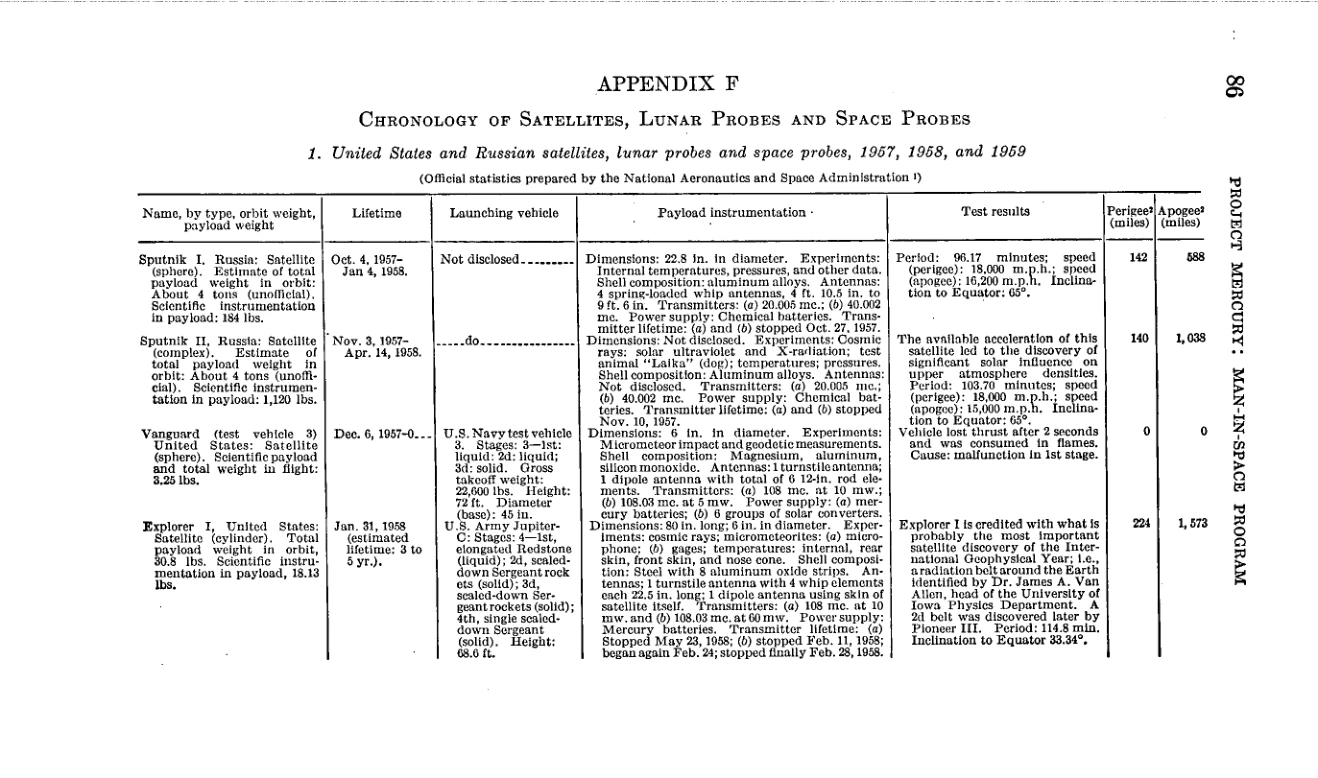
NASA’s satellite chronology in a 1959 U.S. Senate report, page 86. Its Sputnik II row records the spacecraft’s lifetime, not Laika’s survival. This is a period American summary, not a Soviet flight log. Rotated for readability.
NASA / U.S. Senate, Report 1014 (1959), p. 86
Public domain. Resized and converted to WebP by PRESDA. Full composition preserved.
The uncertainty was not simply a misunderstanding caused by distant observers. Soviet public accounts concealed the early death and encouraged a much longer survival story. Later disclosures changed that narrative. Smithsonian's historical reporting notes that Oleg Gazenko acknowledged in 1993 that Laika died soon after launch. A 2002 presentation about the failed temperature control brought the account of death within hours to much wider attention. Smithsonian: later disclosures
Historian Anatoly Zak also examined a Soviet report dated 10 November 1957 that became public in 2011. It described rising temperature and a complicated sequence of physiological signals. Zak cautions that the surviving record is fragmentary and that apparently reported signals on the second day are difficult to reconcile with other evidence. The defensible conclusion is early fatal overheating, not an invented exact minute of death. Smithsonian Air & Space: Laika declassified
This is why an old newspaper or mission summary must be read in two ways. It can be excellent evidence of what the public was told at the time, while being unreliable evidence of what actually happened inside the spacecraft. Repeating a contemporary announcement without the later correction preserves the misinformation rather than the history. Conversely, acknowledging uncertainty over precise timing does not restore the discredited claim of a week-long survival.
Admiration, anger and a dog with a name
International reactions combined fascination with distress. Western newspapers coined canine variations on “Sputnik,” including “Muttnik,” while other reporting emphasized that the passenger could not return. TIME's retrospective documents how quickly celebration of the Soviet achievement met public sympathy for the dog. The technical contest between states had acquired a face that readers could recognize. TIME: contemporary press reactions
Animal-welfare organizations in Britain protested, and Smithsonian describes demonstrations by dog owners outside the United Nations in New York. Concern for Laika was therefore part of the event itself, not merely a judgment imposed decades later. People could admire a rocket's engineering while rejecting the treatment of its passenger. Smithsonian: animal-welfare objections
Her name also changed the moral scale of the story. “Biological payload” describes a mission function. “Laika” identifies the individual who bore its cost. Neither scientific terminology nor affectionate commemoration is sufficient on its own: one can hide the suffering in abstraction, while the other can turn an involuntary death into a comforting legend of willing sacrifice.
What science learned, and what it did not
Sputnik 2 contributed early observations of a living mammal during orbital flight. But the short survival, failing environmental control and absence of recovery sharply limited the experiment. A subject that cannot be examined after return cannot provide the same evidence as one brought back alive. Nor can a single animal establish the range of responses that another species, including humans, might show.
Subsequent missions pursued that missing return. In August 1960, Belka and Strelka traveled into orbit aboard the Soviet spacecraft commonly known as Sputnik 5 and returned alive. Their flight belonged to a broader experimental sequence, rather than being a simple repetition of Laika's. Human spaceflight required working together on launch, life support, communication, reentry and recovery. NASA: from animal flights toward human spaceflight
Recognizing a contribution does not require claiming that every decision was necessary. Scientific value and ethical justification are separate assessments. An experiment may produce information while remaining open to criticism over its design, urgency or unavoidable harm. Laika's story makes that distinction unusually visible because the inability to recover her was built into the mission before launch.
The ethical question that survived the spacecraft
The modern 3Rs framework asks researchers to replace animals where possible, reduce the number used and refine procedures to minimize suffering. Associated with William Russell and Rex Burch's 1959 work, it provides a later vocabulary for examining research choices. It should not be presented as a regulation already governing Sputnik 2 in 1957. NC3Rs: replacement, reduction and refinement
Applied as questions rather than a retrospective checklist, those principles sharpen the debate: what knowledge was sought, which alternatives existed, how much suffering was foreseeable, and what role did political urgency play? They also prevent a false choice between dismissing all animal research and accepting every experiment because it contributed to progress. Our investigation into animal testing and its scientific and ethical costs explores that wider tension.
Remembering Laika without rewriting her
Laika's place in space history is secure. She was the first animal in Earth orbit, a milestone between the first artificial satellite and the later flights that brought living passengers home. Remembering her accurately means preserving the boundary between that achievement and the unsupported idea that she knowingly gave her life for humanity.
The most moving account needs no invented farewell. A stray dog was taken into a research program, launched into orbit without a return system and died when her environment became unlivable. People learned from the mission; people also chose its conditions. Laika never came home. The responsibility for explaining why remains here on Earth.
FAQ
Frequently Asked Questions
What is this PRESDA article about?
From Moscow’s streets to Sputnik 2: Laika’s 1957 mission, fatal overheating, concealed death and the scientific and ethical legacy of a flight without return.
Which category does this story belong to?
This story is part of PRESDA's Science coverage.
Who published this article?
LAIKA: THE SOVIET DOG WHO WENT TO SPACE AND NEVER RETURNED was published by PRESDA Editorial on PRESDA.
PRESDA Dispatch
Stay Informed. Stay Aware.
A sharp briefing across AI, gaming, sport, business, world affairs, paparazzi, and lifestyle.