NIKOLA TESLA: THE GENIUS WHO HELPED ELECTRIFY THE WORLD
From Tesla’s induction motor and Niagara Falls to radio and Wardenclyffe: a documented biography with archival photographs and the facts behind the myths.
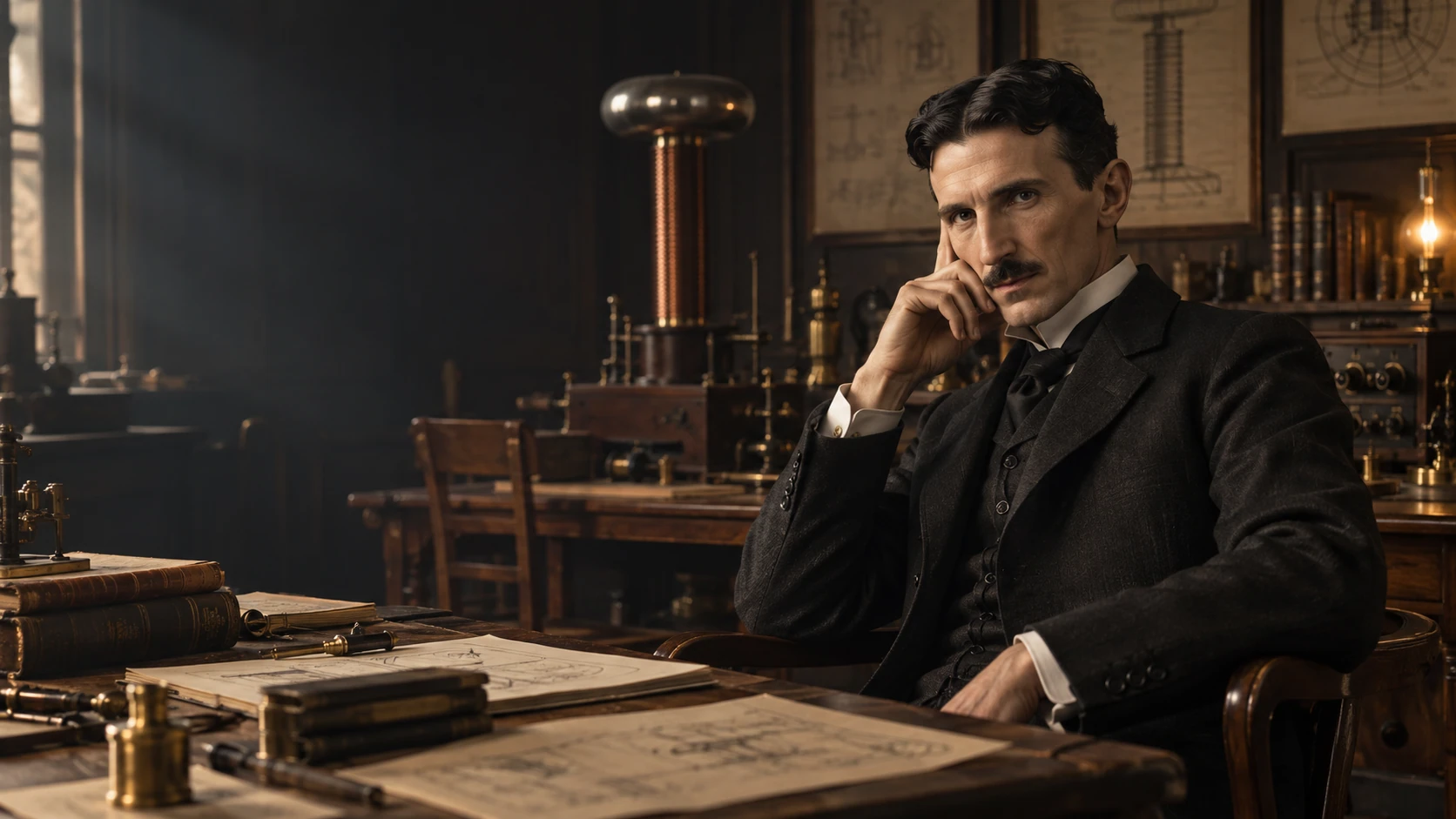
AI-generated artistic reconstruction of Tesla in an imagined laboratory. This hero is not an authentic historical photograph.
In an archival photograph from Colorado Springs, Nikola Tesla sits calmly beneath a storm of electrical sparks. A book rests in his hands; above him, white branches of light cut through the laboratory darkness. It is one of science’s unforgettable images, and also a lesson in how legends are made. The Colorado Springs portrait was a double exposure: Tesla and the discharges were photographed separately. The apparatus was real. The apparent indifference to danger was photographic theatre.
Tesla’s life deserves the same careful separation of achievement from spectacle. He helped make alternating-current motors and power systems commercially transformative, explored high-frequency electricity and demonstrated wireless control. He also pursued schemes that failed and made claims that experiments never established. His importance survives those distinctions. Indeed, it becomes more interesting when the magician gives way to the engineer.
A childhood before the electrical age
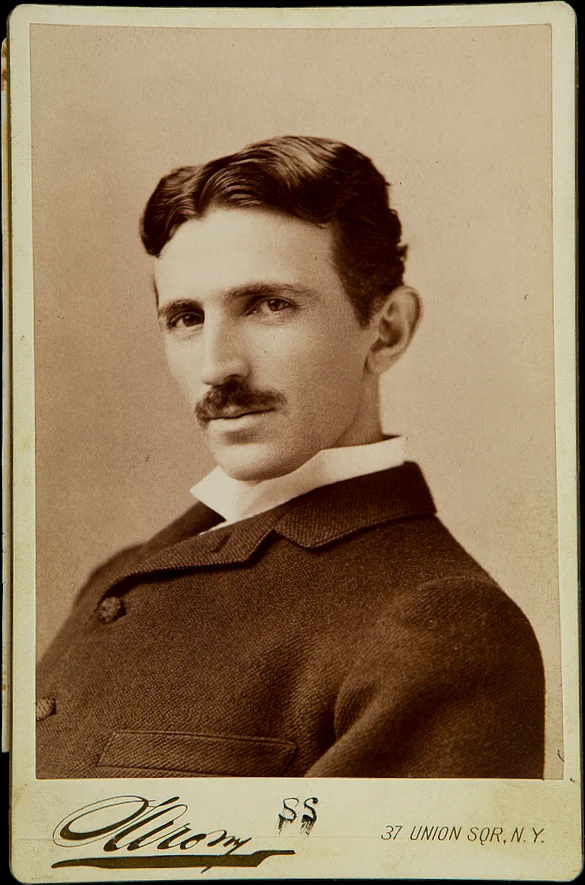
Nikola Tesla, photographed by Napoleon Sarony between 1890 and 1896. Albumen silver print on card.
Napoleon Sarony / Harvard Art Museums, via Wikimedia Commons
Public domain. Resized and converted to WebP by PRESDA without further cropping or color alteration.
Born on July 10, 1856, in Smiljan, then in the Austrian Empire and now in Croatia, Tesla grew up in a Serbian Orthodox family. His father, Milutin, was a priest; his mother, Đuka, made practical household implements despite lacking formal schooling. Tesla later credited her inventive abilities. This was a household in which intellectual ambition and manual ingenuity existed together, long before either became a marketable profession for its youngest son. Nikola Tesla Museum: family history
He studied in Karlovac and entered the technical college at Graz in 1875, but did not graduate. In Prague he attended lectures without completing a degree. The unfinished education matters: honorary distinctions awarded later should not be mistaken for qualifications earned as a student. His practical schooling continued in Budapest’s telephone business and in continental Europe’s expanding electrical industry. Tesla Memorial Center: chronology
In his later recollections, Tesla described visualizing mechanisms before constructing them. Such testimony offers insight into how he understood his own creativity, but it is not a laboratory measurement of a miraculous mind. His early career still involved the familiar work of engineering: repairing machines, understanding failures and finding people willing to finance another attempt.
New York, 1884: inside Edison’s world
Tesla arrived in the United States in 1884 after working for the Continental Edison organization in Europe. At Edison Machine Works in New York, he dealt with the machinery of direct-current power. Edison’s enterprise was building a complete commercial system, not merely a better lamp: generators, conductors, switches, meters and customers all had to work together. Smithsonian: Edison’s inventive life
Their association was brief. Tesla left and pursued independent work, including arc lighting, before obtaining support for his motor experiments. Popular biographies turn the departure into a perfect confrontation between exploitation and genius. Stories of an enormous promised bonus derive substantially from retrospective accounts; they should not be treated as a fully documented employment contract. The durable disagreement concerned engineering priorities, commercial incentives and what an electrical network ought to become.
Neither man can be reduced to the other’s opposite. Edison was an experimental system-builder whose businesses had invested in DC infrastructure. Tesla saw opportunities in currents that changed direction. The later struggle involved companies, patents, investors and public fears, extending far beyond one unhappy employment relationship.
The motor that made a magnetic field turn
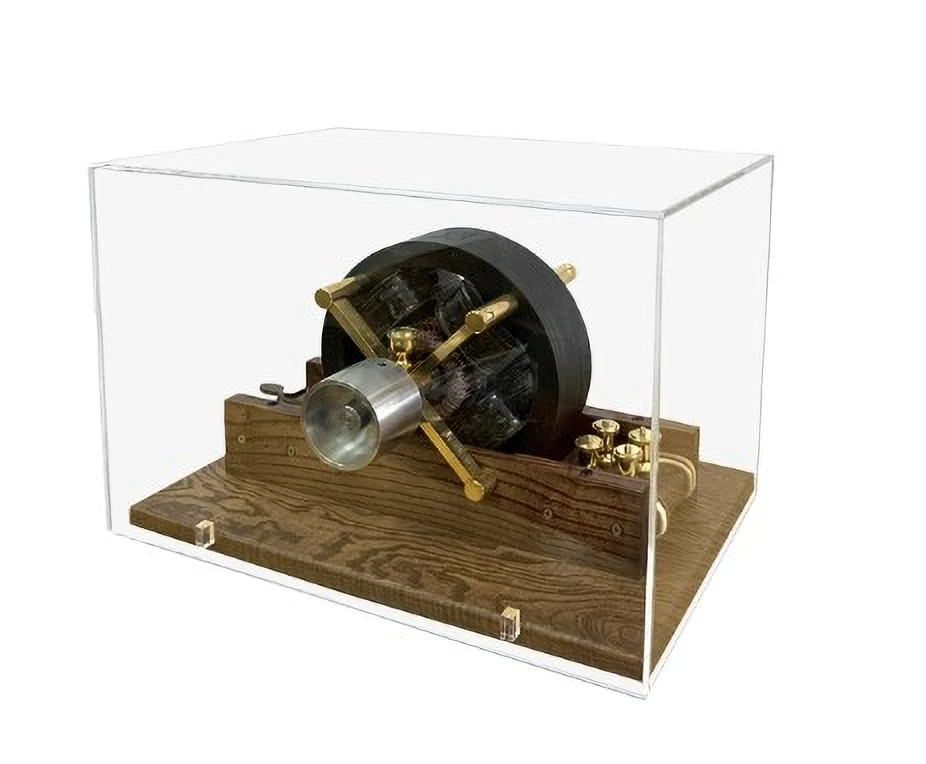
Museum photograph of an induction-motor model associated with Tesla’s 1888 work, identified by the Nikola Tesla Museum with patent 382,279. This is a photograph of a museum object, not a photograph taken in 1888; the record does not establish the date of this photograph.
Nikola Tesla Museum / Wikimedia Commons, CC BY-SA 4.0
CC BY-SA 4.0. Resized and converted to WebP by PRESDA without further cropping or color alteration. This resized image remains available under CC BY-SA 4.0.
An induction motor converts electrical energy into motion without needing a sliding electrical connection to supply current directly to its rotor. Alternating currents in stationary coils create a changing magnetic field. Arrange their timing appropriately and that field rotates; it induces currents in the rotor, and the interaction produces torque. The shaft follows the moving field, with the speed difference necessary for induction.
Tesla’s polyphase approach used alternating currents offset in time. Rather than asking one electrical pulse to do everything, it coordinated several phases into a rotating effect. His 1888 patents included motors and associated arrangements for distributing electrical power. The invention was therefore both a machine and part of a system. The patent drawings make the technical ambition more concrete than any claim that he simply “invented electricity.” US patent 381,968
He was not alone. Galileo Ferraris independently investigated rotating magnetic fields and spoke publicly about his motor work in March 1888, before Tesla’s May presentation to the American Institute of Electrical Engineers. Mikhail Dolivo-Dobrovolsky subsequently developed important three-phase machinery. Tesla’s contribution was exceptionally influential, but a history with several pioneers is more accurate than a contest with only one rightful winner. IEEE Spectrum: the 1888 motors
Westinghouse and the War of the Currents
George Westinghouse acquired rights to Tesla’s AC patents in 1888 and brought industrial resources to their development. The Smithsonian’s surviving Westinghouse induction motor helps connect the patents to manufactured equipment. A workable principle needed materials, production methods, dependable operation and a market. Tesla supplied crucial intellectual property; Westinghouse’s organization helped turn it into an electrical business. Smithsonian: Westinghouse induction motor
The advantage of AC distribution was especially powerful in an era before modern power electronics. Transformers could raise voltage for transmission and lower it near consumers. For the same delivered power, higher voltage means lower current; losses from resistance depend on current squared. Less energy could therefore disappear as heat along a transmission line. This was an economic argument expressed in copper, distance and fuel.
The War of the Currents also became a struggle over safety and public confidence. High-voltage electricity could kill, but theatrical demonstrations and publicity did not fairly establish that one entire system was safe and the other inherently unacceptable. The practical question was how to design, protect and operate a network. AC eventually dominated large-scale distribution; DC remained useful and now has important roles in electronics, batteries and high-voltage transmission. Technological victory rarely means the losing idea disappears.
Chicago’s lights, Niagara’s machines
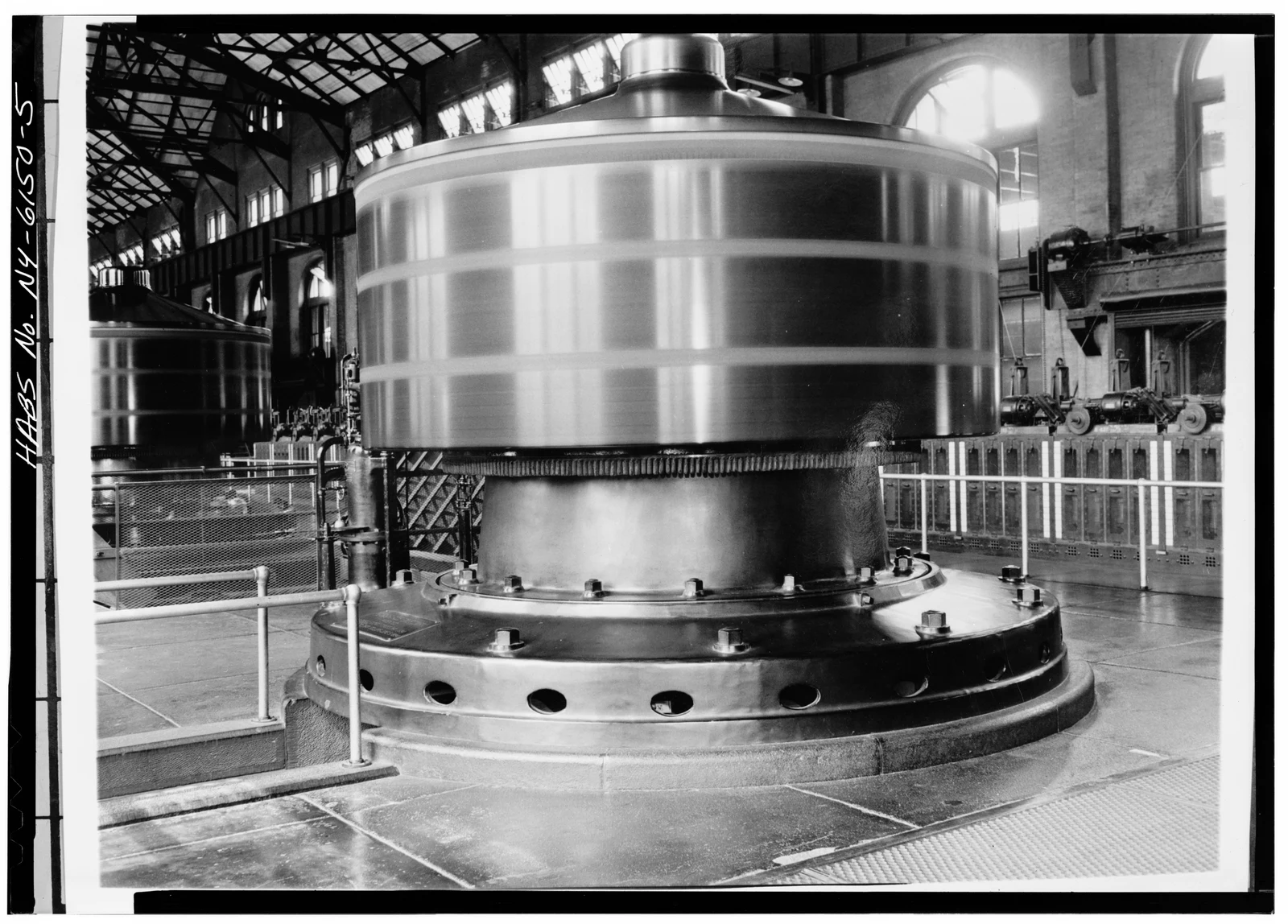
Generator at the Edward D. Adams Station, Niagara Falls. Archival copy photograph held by the Library of Congress; the original photographer and date are unknown. It is not presented as a photograph of the 1895 opening.
Historic American Buildings Survey / Library of Congress, HABS NY,32-NIAF,3-5; original photographer unknown
Public domain. Resized and converted to WebP by PRESDA without further cropping or color alteration.
At the 1893 World’s Columbian Exposition in Chicago, Westinghouse supplied an AC lighting system and exhibited Tesla’s polyphase technology. Electricity became a public spectacle as well as an industrial service. Smithsonian archival records preserve the company’s Tesla-system exhibit. The fair helped make an emerging infrastructure visible to audiences who might never read a patent. Smithsonian: 1893 polyphase exhibit
Niagara Falls offered a more demanding demonstration. The Adams generating plant began supplying local industry on August 26, 1895. Power reached Buffalo in 1896. Its achievement depended on turbines, generators, transformers, transmission equipment and coordinated engineering, rather than a single inventor standing beside a waterfall. Tesla’s patents were important to the polyphase system, but Westinghouse engineers, General Electric and other participants also shaped the project. IEEE: Adams generating plant IEEE: Lewis B. Stillwell
What changed was the geography of useful energy. Mechanical power no longer had to remain beside the waterwheel that produced it. Electricity could connect a generating site with factories elsewhere. Niagara did not create electrification from nothing; it demonstrated how ambitious interconnected systems could become. Tesla’s most enduring success was embedded in infrastructure that would eventually seem ordinary.
Coils, resonance and the laboratory as a stage
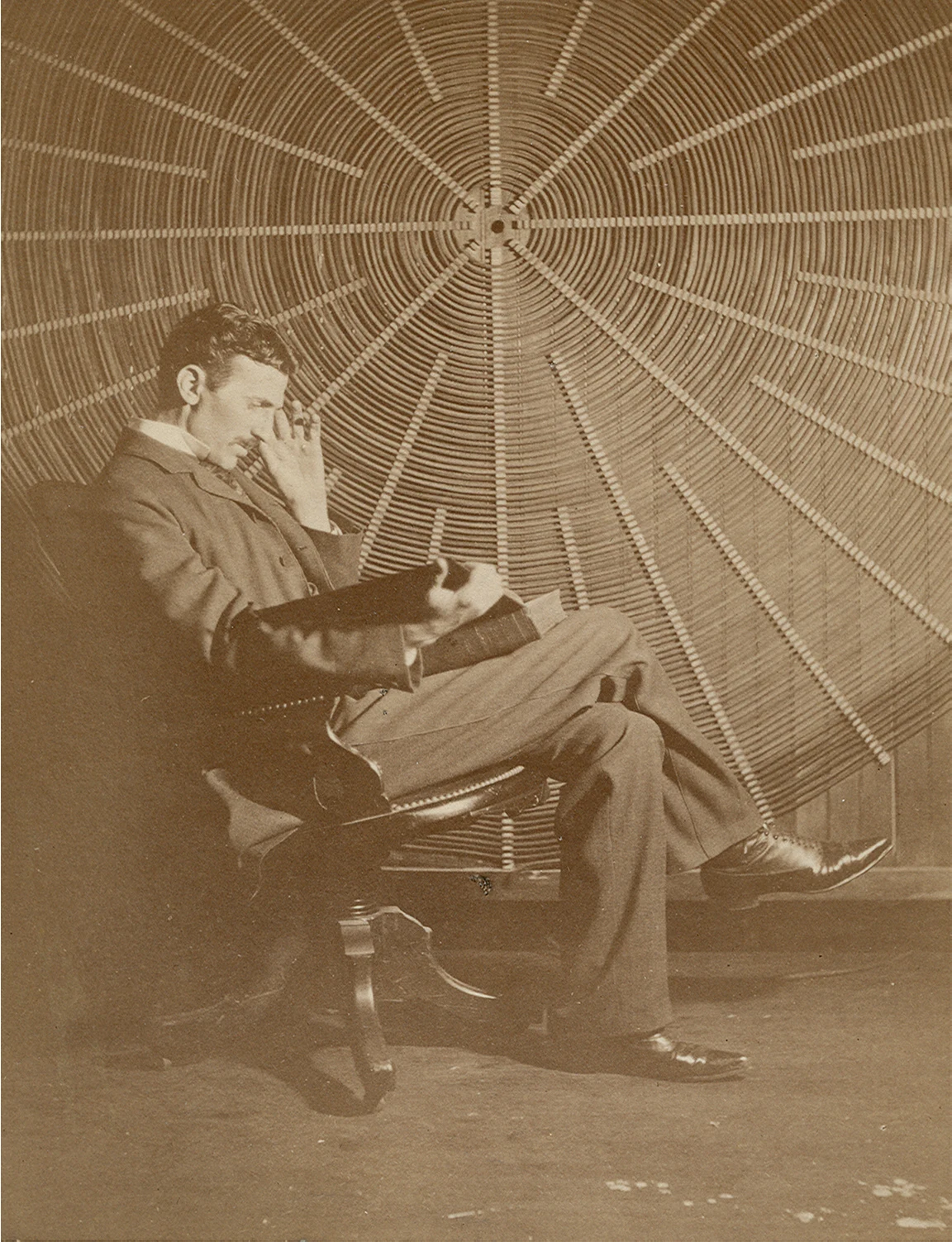
Tesla in his laboratory at 46 Houston Street, New York, 1896, as dated by the Nikola Tesla Museum. The spiral winding behind him is part of a high-frequency transformer.
Nikola Tesla Museum / Wikimedia Commons, CC BY-SA 4.0
CC BY-SA 4.0. Resized and converted to WebP by PRESDA without further cropping or color alteration. This resized image remains available under CC BY-SA 4.0.
During the 1890s, Tesla explored high-frequency and high-voltage electricity. His name became attached to the Tesla coil, a resonant transformer arrangement capable of producing striking electrical discharges. Resonance allows energy to accumulate through appropriately timed oscillations, rather like repeated pushes increasing a swing’s motion. It does not create energy. An external supply must provide what the device stores, transfers and loses. US patent 454,622
These experiments investigated lighting, insulation and electrical behavior beyond ordinary power frequencies. Demonstrations could be spectacular, but the spectacle is not a safe experiment for a visitor to repeat. High voltage and radio-frequency currents present serious hazards. Nor did every laboratory effect become a practical product: a glowing tube, a patent and a dependable public service answer different questions.
The archival photograph of Tesla in his New York laboratory shows him before a large spiral coil. It records real equipment, while also showing an inventor cultivating a public image. As our history of photography explains, an authentic photograph can still be staged, selectively framed or technically manipulated. Historical evidence needs interpretation as well as admiration. Photography and the construction of an image
Radio, remote control and a crowded invention
In 1898, Tesla demonstrated a remotely controlled boat and obtained a patent for controlling moving vessels without a physical connection. The idea separated the operator from the mechanism through transmitted signals. It was an important early demonstration of wireless control, not a modern autonomous robot: receiving instructions and independently deciding what to do are different capabilities. Tesla’s 1898 control patent
Radio emerged from many contributions, including electromagnetic theory, experimental detection, tuning, antennas and practical communications networks. Tesla’s high-frequency work belongs in that history alongside other pioneers, including Hertz, Lodge and Marconi. Claims that one individual invented every essential element conceal the cumulative nature of the technology.
The US Supreme Court’s 1943 Marconi decision is often presented as a declaration that Tesla alone invented radio. It was a patent judgment about particular claims and earlier work, including that of Tesla, Lodge and John Stone Stone. Invalidating claims in a disputed patent is not the same thing as awarding exclusive authorship of an entire technological field. Marconi Wireless Telegraph Co. v. United States, 1943
Colorado Springs: sparks and unanswered questions
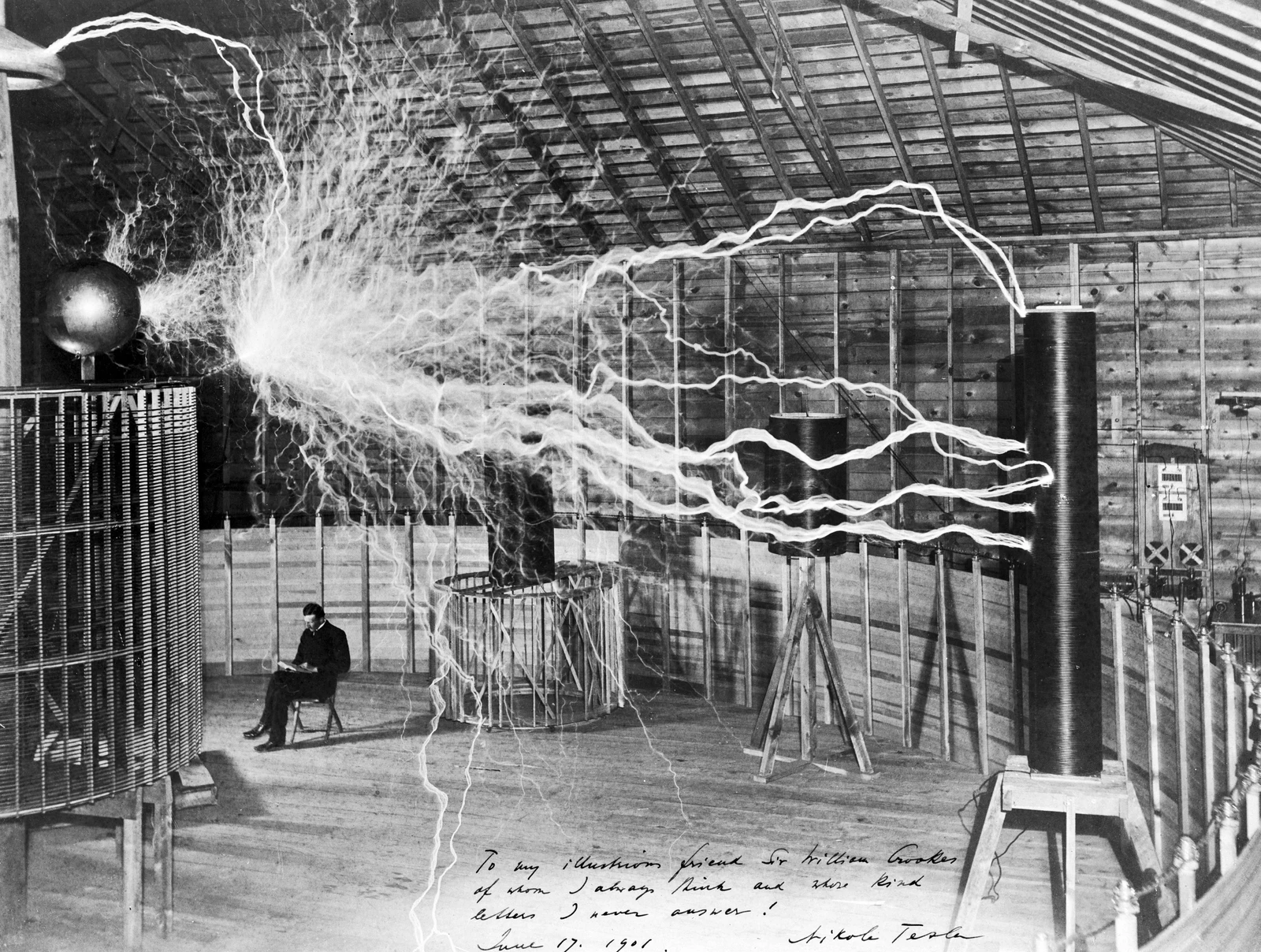
Colorado Springs, circa 1899. An authentic historical double exposure: the discharges and Tesla seated beside the magnifying transmitter were photographed separately. This inscribed print was sent to William Crookes in 1901.
Dickenson V. Alley / Wellcome Collection, M0014782, via Wikimedia Commons
Public domain. Resized and converted to WebP by PRESDA without further cropping or color alteration.
In 1899, Tesla established an experimental laboratory in Colorado Springs. Its large apparatus allowed him to explore electrical oscillations, discharges and wireless transmission on a scale difficult to accommodate in Manhattan. The famous photograph reproduced here comes from this period. Its double exposure combined the sparks with the seated inventor; he was not reading inside those active discharges. Wellcome archival photograph record
Tesla interpreted his observations as support for a much larger ambition: sending useful power across great distances without ordinary wires. The distinction between observation and inference is essential. Producing a discharge or lighting a nearby receiver does not demonstrate an efficient worldwide electricity network. Distance, coupling, losses, interference and safety become decisive when a laboratory effect is scaled up.
Wardenclyffe: a tower larger than its financing
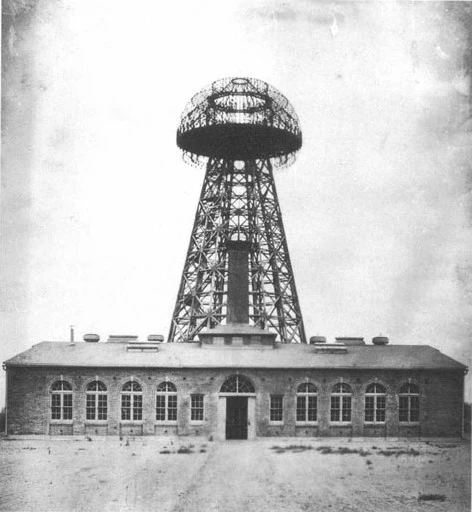
Wardenclyffe wireless station, dated 1904 in the image record and published in Popular Electricity in June 1911. The tower stands behind the laboratory, not on its roof. The Commons file has documented border cropping.
Unknown photographer / Popular Electricity, June 1911, via Wikimedia Commons
Public domain. Resized and converted to WebP by PRESDA without further cropping or color alteration.
Beginning in 1901, Tesla developed Wardenclyffe on Long Island with financial backing from J. P. Morgan. A tall tower rose behind a laboratory designed by Stanford White. Tesla envisaged global wireless communication and pursued the further ambition of transmitting electrical power. Information and power could travel through electromagnetic phenomena, but that did not make their engineering requirements interchangeable. Tesla Science Center: Wardenclyffe
The project ran into financial difficulties and never became the operating global system Tesla intended. The unfinished tower was demolished in 1917. Its failure is often recast as proof that financiers suppressed limitless free electricity. The surviving evidence does not establish a working device that supplied unlimited energy without an energy source. Financial collapse explains why construction stopped; it does not validate the proposed physics.
Wireless charging today shows that transferring power without a cable is possible over suitable distances and configurations. It does not retrospectively prove every part of Tesla’s planetary scheme. IEEE’s technical examination of wireless power emphasizes the difficulty of coupling energy efficiently between separated devices. A visionary question can inspire later research even when the original answer fails. IEEE Spectrum: wireless power and its limits
Patents, disappointment and the final years
Tesla continued working on inventions, including a turbine using closely spaced disks rather than conventional blades. His patents range across electrical and mechanical subjects. Their breadth is evidence of sustained inventiveness, but patent totals are easily distorted by counting the same invention separately in several countries. A patent protects defined claims; it does not certify commercial success or establish that a proposed machine met every advertised expectation. Nikola Tesla Museum: patent collection Tesla’s turbine patent
His later life combined recognition with shrinking resources. The American Institute of Electrical Engineers awarded him its Edison Medal in 1917, an awkward fact for a biography built entirely around lifelong rejection. He remained publicly known even as his finances deteriorated. He died in New York on January 7, 1943, aged 86. The distance between his ambitions and his circumstances was real; it need not be decorated with invented conversations or retrospective medical diagnoses. Smithsonian: Kenneth M. Swezey Papers
What survives when the myths fall away?
Did Tesla invent AC? No. His major achievement was developing important polyphase systems and induction motors within an already growing field. Did he discover free energy? No verified apparatus demonstrates energy creation without an input. Did he single-handedly invent radio or modern civilization? No. Those claims replace the history of shared discovery with a flattering but misleading shortcut.
His influence is nevertheless immense. Induction motors remain fundamental to industry, and polyphase power is central to electrical networks. Modern machines have benefited from generations of improvements in materials, control and manufacturing. Recognizing that development does not diminish Tesla; it explains how an invention becomes a legacy rather than an isolated museum piece.
The most revealing contrast is not between Tesla and Edison, or genius and money. It is between two ways of remembering invention. One seeks a hidden hero whose every claim must have been correct. The other follows ideas through experiments, failures, workshops and networks until they change daily life. Tesla helped electrify the world in that second, more difficult sense. The lights do not become less extraordinary when we understand the work behind them.
FAQ
Frequently Asked Questions
What is this PRESDA article about?
From Tesla’s induction motor and Niagara Falls to radio and Wardenclyffe: a documented biography with archival photographs and the facts behind the myths.
Which category does this story belong to?
This story is part of PRESDA's Science coverage.
Who published this article?
NIKOLA TESLA: THE GENIUS WHO HELPED ELECTRIFY THE WORLD was published by PRESDA Editorial on PRESDA.
PRESDA Dispatch
Stay Informed. Stay Aware.
A sharp briefing across AI, gaming, sport, business, world affairs, paparazzi, and lifestyle.