MEDICAL CANNABIS: THE SCIENCE BEHIND ITS BENEFITS AND RISKS
What THC and CBD can and cannot treat: approved medicines, clinical evidence, safety risks and Morocco’s cannabis regulation, reviewed in October 2026.
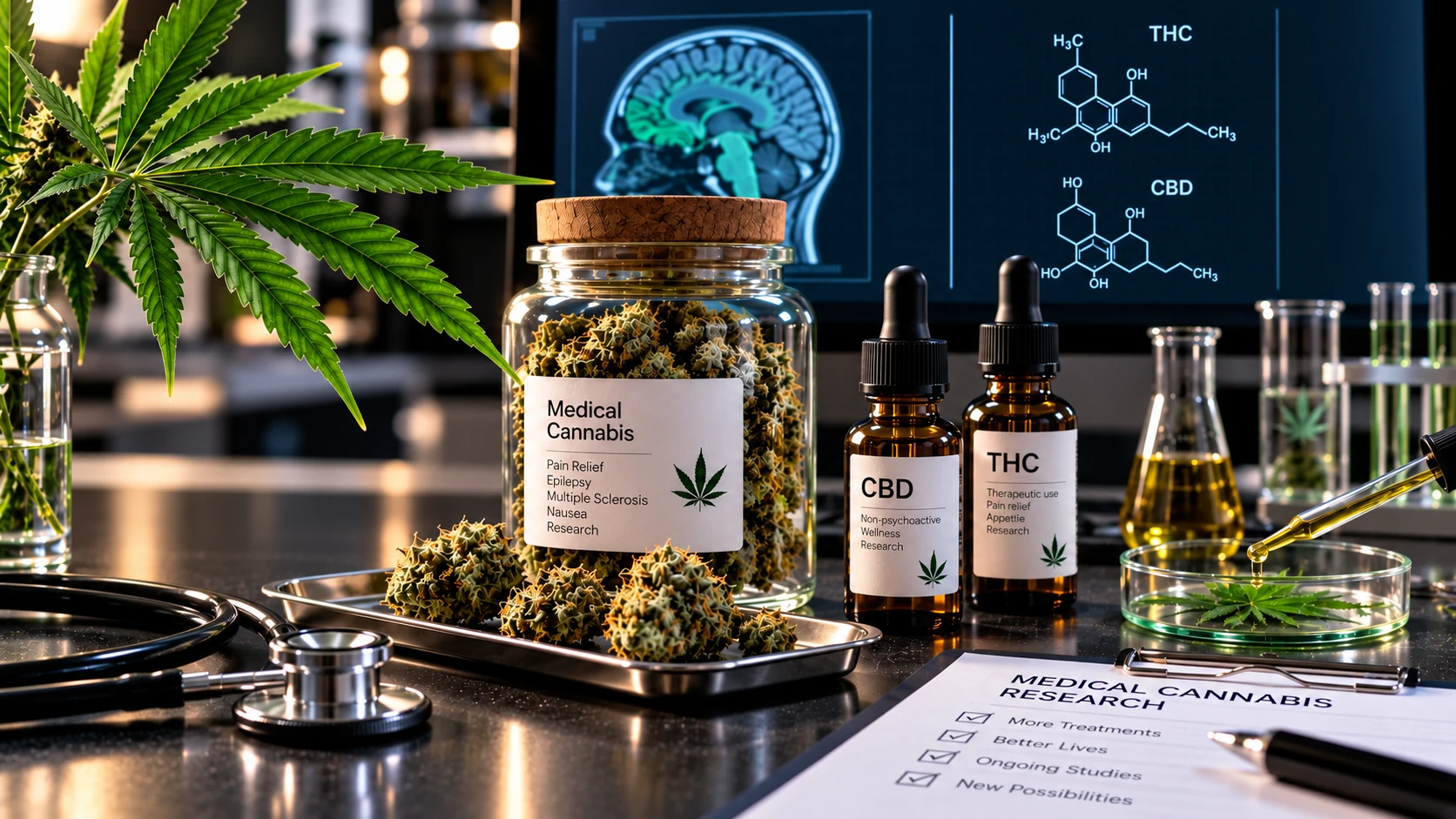
AI-generated editorial illustration. The imagined laboratory, product labels and chemical diagrams do not depict approved medicines or provide medical guidance.
A medicine cabinet can contain two bottles associated with the same plant and almost nothing else in common. One holds a precisely formulated prescription drug tested for a particular seizure disorder. The other is an oil sold with a broad promise of wellness. Calling both medical cannabis makes the story simpler. It also hides the distinctions on which safe treatment depends.
Medical cannabis is an umbrella term for cannabis or cannabinoid products used to treat symptoms or disease. It is not a single medicine. The strongest conclusions concern particular preparations for particular conditions; evidence for a purified molecule cannot automatically validate a flower, an edible or a different extract. The central question is therefore not whether cannabis works, but which product helps which patient, compared with what, and at what cost in adverse effects. NCCIH
An ancient remedy meets the clinical trial
Cannabis has a long medicinal history across societies. In 1839, William Brooke O’Shaughnessy helped introduce its use into Western medicine after working in India. That history deserves attention without becoming proof of effectiveness: traditional experience cannot determine the composition, optimal treatment or long-term safety of a modern preparation. The National Cancer Institute documents both this medical history and the subsequent restrictions that shaped research. National Cancer Institute
Today's scientific advance is the ability to separate questions once bundled together. Researchers can identify molecules, measure exposure, compare a defined treatment with placebo and track unwanted effects. The familiar plant has become a route into unfamiliar biology. Its political history still influences access and attitudes, but neither enthusiasm nor prohibition can substitute for a well-designed experiment.
THC, CBD and the body's own signalling network
The endocannabinoid system includes receptors, internally produced signalling molecules such as anandamide and 2-arachidonoylglycerol, and enzymes that make and break them down. CB1 and CB2 receptors participate in a network involved in nervous-system and immune functions. This is not a system waiting for cannabis: the body already uses its own chemical messages. Nature Reviews Neurology, 2020
THC, or delta-9-tetrahydrocannabinol, acts at cannabinoid receptors and produces the characteristic intoxication. CBD, or cannabidiol, has different pharmacology and does not produce that typical THC high. Calling CBD non-intoxicating is more useful than implying it is biologically inactive. Both the desired effect and an unwanted one arise from chemistry, not from whether the product looks natural. NCCIH
Receptors help explain why a drug could work; they do not prove that it does. A signalling system involved in pain, memory and stress can offer therapeutic targets while creating unwanted effects elsewhere. Modern research therefore asks whether useful actions can be separated from impairment. A plausible mechanism is the beginning of the investigation, not the end. Nature Reviews Neurology, 2020
Epilepsy: a specific success, not a universal cure
In a 2017 randomized trial involving 120 children and young adults with Dravet syndrome, cannabidiol was added to existing treatment. Median monthly convulsive seizures fell from 12.4 to 5.9 in the CBD group, compared with 14.9 to 14.1 with placebo. The difference was statistically significant. Diarrhea, sleepiness and abnormal liver-function tests were among the adverse events reported more frequently with CBD. Devinsky et al., 2017
This was a defined pharmaceutical preparation, a selected syndrome and a limited trial period, not a test of retail CBD oils for every form of epilepsy. The result showed that a cannabis-derived medicine could make a meaningful difference while still requiring monitoring. Families should not interpret it as a reason to replace prescribed antiseizure treatment with an unregulated product. Devinsky et al., 2017
The FDA-approved cannabidiol medicine Epidiolex treats seizures associated with Lennox-Gastaut syndrome, Dravet syndrome or tuberous sclerosis complex in patients aged one year and older. Its prescribing information includes liver monitoring and interaction warnings. Approval attaches to the medicine and its indications, not to everything containing CBD. FDA: Epidiolex, 2025
What the FDA has actually approved
The FDA distinguishes one approved cannabis-derived drug, Epidiolex, from three approved synthetic cannabis-related products: Marinol and Syndros contain dronabinol, a synthetic form of THC; Cesamet contains nabilone, a related synthetic compound. Dronabinol products and nabilone have indications for chemotherapy-related nausea and vomiting after inadequate response to conventional antiemetics. Dronabinol also has an indication for appetite loss associated with weight loss in AIDS. FDA
The agency has not approved the cannabis plant itself as a treatment. A dispensary authorization, a supplement label and a medicine's marketing approval answer different regulatory questions. Readers should also distinguish an approved drug from a treatment recommended or reimbursed in their own country, where rules and clinical pathways can differ. FDA
Chemotherapy nausea and the boundary around cancer
Cannabinoid medicines can have a place in managing nausea and vomiting that remain troublesome despite standard care. Much of the older trial evidence predates today's antiemetic combinations, so it should not be read as demonstrating superiority to every modern alternative. Relief of a treatment side effect is a valuable clinical outcome, but it is a different claim from treating the cancer itself. National Cancer Institute
Cannabis has not been established as a cancer cure. Laboratory findings involving cells or animals cannot demonstrate that a product prolongs human survival. ASCO's 2024 guideline recommends against using cannabis or cannabinoids as cancer-directed treatment outside a clinical trial. Replacing effective cancer care with an advertised oil risks losing time that cannot be recovered. ASCO, 2024
MS spasticity and chronic pain: benefits with limits
For multiple sclerosis, a 2022 Cochrane review found that nabiximols probably improves patient-reported spasticity in the short term. This standardized THC/CBD preparation is not equivalent to arbitrary cannabis products. The evidence was less certain for chronic neuropathic pain in MS, and unwanted nervous-system or psychiatric effects remained relevant. Symptom relief does not mean that the underlying disease has been reversed. Cochrane, 2022
Pain research is similarly dependent on formulation. AHRQ's 2025 systematic review found small improvements, mainly in neuropathic pain, with certain THC-containing preparations over one to six months, alongside increased dizziness, sedation and nausea. Evidence strength was low to moderate. A modest average benefit can matter to an individual, but it does not establish that everyone with back pain, arthritis or fibromyalgia will improve. AHRQ, 2025
The review also exposes the distance between a short trial and years of treatment. Long-term outcomes and comparisons between products remain incomplete. The right conversation includes function and adverse effects, not just a pain score: can someone move, work or sleep better without unacceptable impairment? A product's popularity cannot answer that question for a particular patient. AHRQ, 2025
Medical purpose does not erase dependence or mental-health risk
Repeated cannabis use can lead to cannabis use disorder, involving impaired control and continued use despite harm. Risk varies with exposure and vulnerability; it is not an inevitable outcome for every patient. Products with high THC concentrations deserve particular caution. A medical reason for starting does not make escalating use, cravings or disruption of daily life irrelevant. CDC
Cannabis can provoke anxiety and paranoid experiences. Frequent use has been associated with increased risk of psychosis, particularly among vulnerable people. Association does not mean every user will develop a disorder, nor that a single factor explains a person's illness. Individual and family psychiatric history belong in a prescribing discussion. Our investigation into paranoia and threat perception explores why such experiences require careful, non-stigmatizing interpretation. CDC
Pregnancy, interactions and the journey home
The FDA advises against cannabis, THC and CBD during pregnancy and breastfeeding. Uncertainty about some outcomes is not evidence of safety. Anyone taking a prescribed cannabinoid who is pregnant or planning pregnancy should discuss it promptly with the treating clinician, rather than abruptly stopping an essential seizure medicine. The decision concerns both exposure risks and the risks of uncontrolled illness. FDA
CBD can affect the way other medicines are processed and can cause liver injury. Sedation can become more problematic when combined with other sedating substances. A pharmacist or doctor needs the full list of prescriptions, supplements and cannabis products, not only the bottle labelled as medicine. Monitoring is part of treatment, not an optional afterthought. FDA
THC can impair reaction time, coordination and judgment. Having a prescription does not make impaired driving safe; alcohol can worsen impairment. The CDC also cautions that a measured THC concentration cannot reliably translate into an individual driver's degree of impairment. Planning transport is a practical part of a treatment discussion, rather than something to consider after feeling unwell. CDC
Why a legal product is not automatically a proven medicine
Medical and recreational use describe purposes and legal pathways, not two completely separate plants. Standardization, quality control, a defined indication and clinical follow-up are the important medical distinctions. A legal sale does not show that a product has passed a trial for a claimed benefit, and rules about possession do not necessarily authorize a therapeutic claim.
In 2020, the UN Commission on Narcotic Drugs removed cannabis and cannabis resin from Schedule IV of the 1961 convention, recognizing their therapeutic potential while retaining international control under Schedule I. WHO's explanation makes clear that this was a scheduling decision. It did not approve every cannabis treatment or impose worldwide recreational legalization. WHO, 2020
National systems remain different. Canada retains a medical-access pathway involving healthcare authorization alongside its broader cannabis framework. In England, the NHS describes prescription access as limited to selected circumstances. These examples illustrate why a headline saying cannabis is legal supplies too little information: the product, indication, prescriber, reimbursement and country all matter. Travellers must check destination rules rather than assume a domestic authorization travels with them. Health Canada NHS
Morocco: Law 13-21 and what changed in 2026
Morocco's Law 13-21 established a framework for lawful cannabis uses. ANRAC, the national regulatory agency, oversees activities directed toward medical, pharmaceutical and industrial purposes, including licensing and traceability across the supply chain. This regulated framework should not be confused with general authorization for recreational consumption, or with proof that every resulting product is an effective medicine. ANRAC: 13-21 ANRAC
Verified 2026 developments include ANRAC's documentation of a January 29 scientific symposium on CBD's clinical applications and therapeutic perspectives in Morocco, and a June 6 scientific day on therapeutic cannabis in Casablanca. These records establish scientific and professional engagement. They do not, by themselves, establish a new medicine approval, a completed clinical trial or an improvement in patient outcomes. ANRAC, 29/01/2026 ANRAC, 06/06/2026
For Morocco, the next questions are practical as well as scientific: which preparations meet pharmaceutical standards, which indications have adequate evidence, and how clinicians evaluate benefits and harms. Agricultural authorization, a commercial opportunity and a clinical recommendation should remain distinct. This feature's regulatory review is dated October 15, 2026; it does not turn an announced ambition into a verified medical result.
The next generation of evidence
Clinical development must establish a reproducible formulation, an appropriate comparator and outcomes that patients actually value. Longer follow-up is needed to understand sustained benefit and harms. Trials must also confront blinding: when a product has recognizable intoxicating effects, participants may guess their allocation, potentially influencing subjective reports. Registration or early-stage testing is not equivalent to a successful treatment. National Academies, 2017
Interest in cannabinoids beyond THC and CBD, and in modifying the body's own signalling, opens real research questions. It also invites premature promises. A useful future would offer better-defined medicines and more reliable choices, rather than an ever-expanding list of illnesses attached to a leaf. The scientific standard should remain the same for a plant extract and a laboratory molecule. Nature Reviews Neurology, 2020
The question worth taking to the clinic
The most useful questions are concrete: what exactly is in the product, what evidence supports it for this condition, what alternatives exist, what interactions matter, and what improvement would justify continuing? These are decisions to make with a qualified clinician. This article provides general information, not an individual prescription or a reason to change treatment without medical advice.
Cannabis is neither a miracle waiting to be liberated nor a subject science should refuse to study. Its most convincing medical story is narrower and more interesting: particular molecules can help particular people, and the same precision that reveals their benefits reveals their limits. Progress begins when hope is specific enough to be tested.
FAQ
Frequently Asked Questions
What is this PRESDA article about?
What THC and CBD can and cannot treat: approved medicines, clinical evidence, safety risks and Morocco’s cannabis regulation, reviewed in October 2026.
Which category does this story belong to?
This story is part of PRESDA's Science coverage.
Who published this article?
MEDICAL CANNABIS: THE SCIENCE BEHIND ITS BENEFITS AND RISKS was published by PRESDA Editorial on PRESDA.
PRESDA Dispatch
Stay Informed. Stay Aware.
A sharp briefing across AI, gaming, sport, business, world affairs, paparazzi, and lifestyle.