THE INVENTION OF PHOTOGRAPHY: FROM THE FIRST PHOTO TO THE DIGITAL AGE
From Niépce and Daguerre to film, smartphones and AI: the history of photography, with authentic archival images and clearly documented sources.
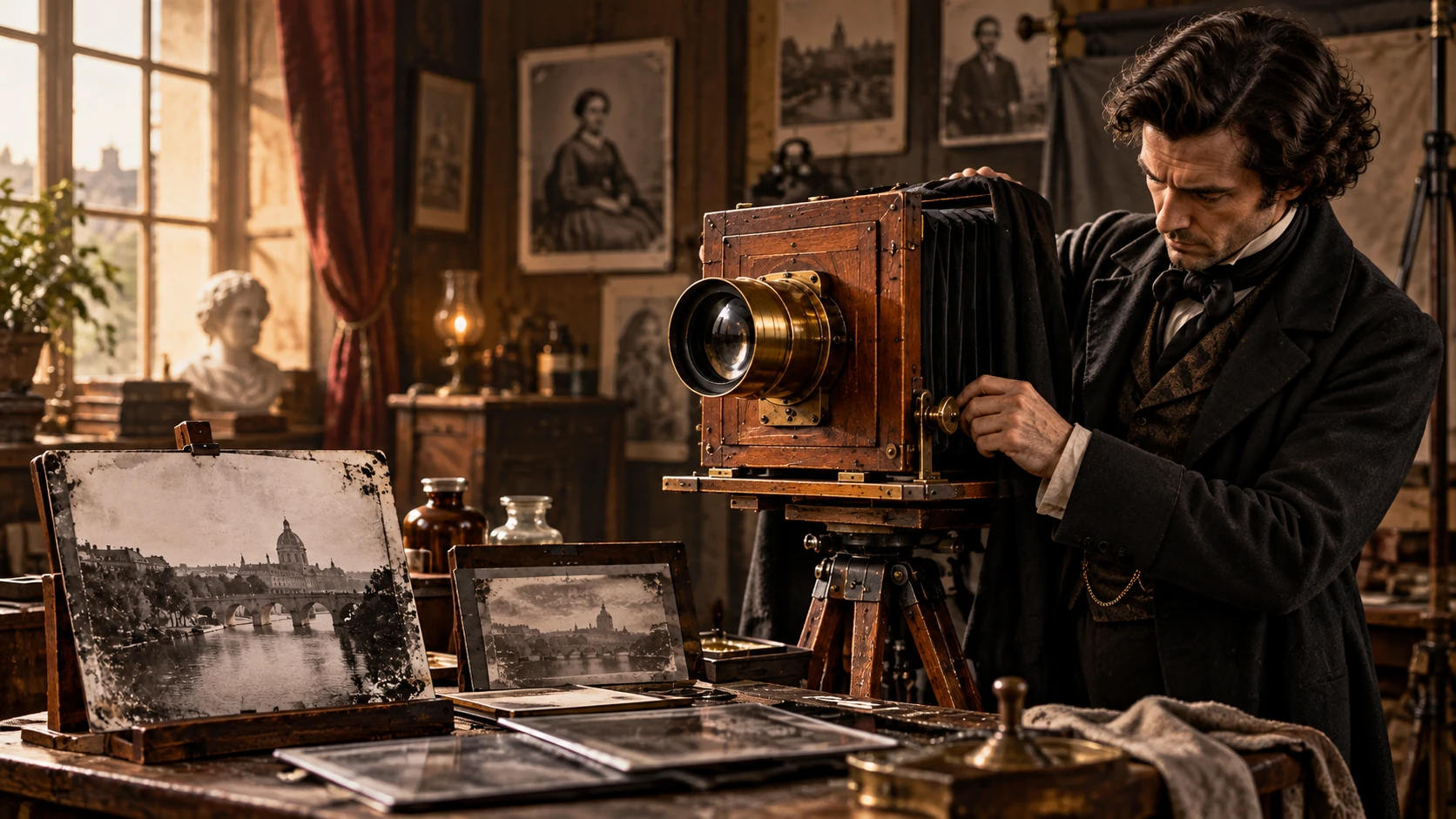
AI-generated artistic historical reconstruction. The photographer, studio and displayed prints are imagined, not an authentic historical photograph.
Before photography could stop time, it had to persuade light to leave something behind. A scene could already be projected inside a darkened room: rooftops, a passing figure, the movement of leaves. But the picture disappeared with the light. The extraordinary invention was not simply a camera. It was a way to make that fleeting encounter endure.
Photography emerged through several discoveries rather than one miraculous moment. Niépce preserved a camera image, Daguerre made astonishingly detailed metal pictures, and Talbot developed a reproducible negative. Film made pictures portable; electronics made them transmissible; software now helps construct them. This history is also a history of trust: what, exactly, does a picture prove?
Before the photograph: a room filled with light
Camera obscura means dark room. Light passing through a small opening projects an inverted view of the world onto the opposite surface. Lenses later improved brightness and focus; mirrors could redirect the projection. Artists used portable versions as drawing aids long before photographic chemistry existed. The optical image was real, but no recording had yet been made. National Science and Media Museum
The distinction matters. A camera is an instrument for forming an image; photography requires a sensitive surface and a way to preserve its response. Early experimenters faced two separate problems: obtaining a recognizable impression and preventing subsequent light from destroying it. A material that darkens in sunlight is promising, but a picture that keeps darkening cannot become a useful record.
Niépce was producing legible but temporary camera pictures in 1816. His experiments gradually led to heliography, or sun writing. The route from an optical curiosity to a durable object took years of testing chemicals and supports. Photography began as a negotiation between light, matter and time, not as an instantaneous capture. Harry Ransom Center
Niépce: the first surviving camera photograph, 1826/1827
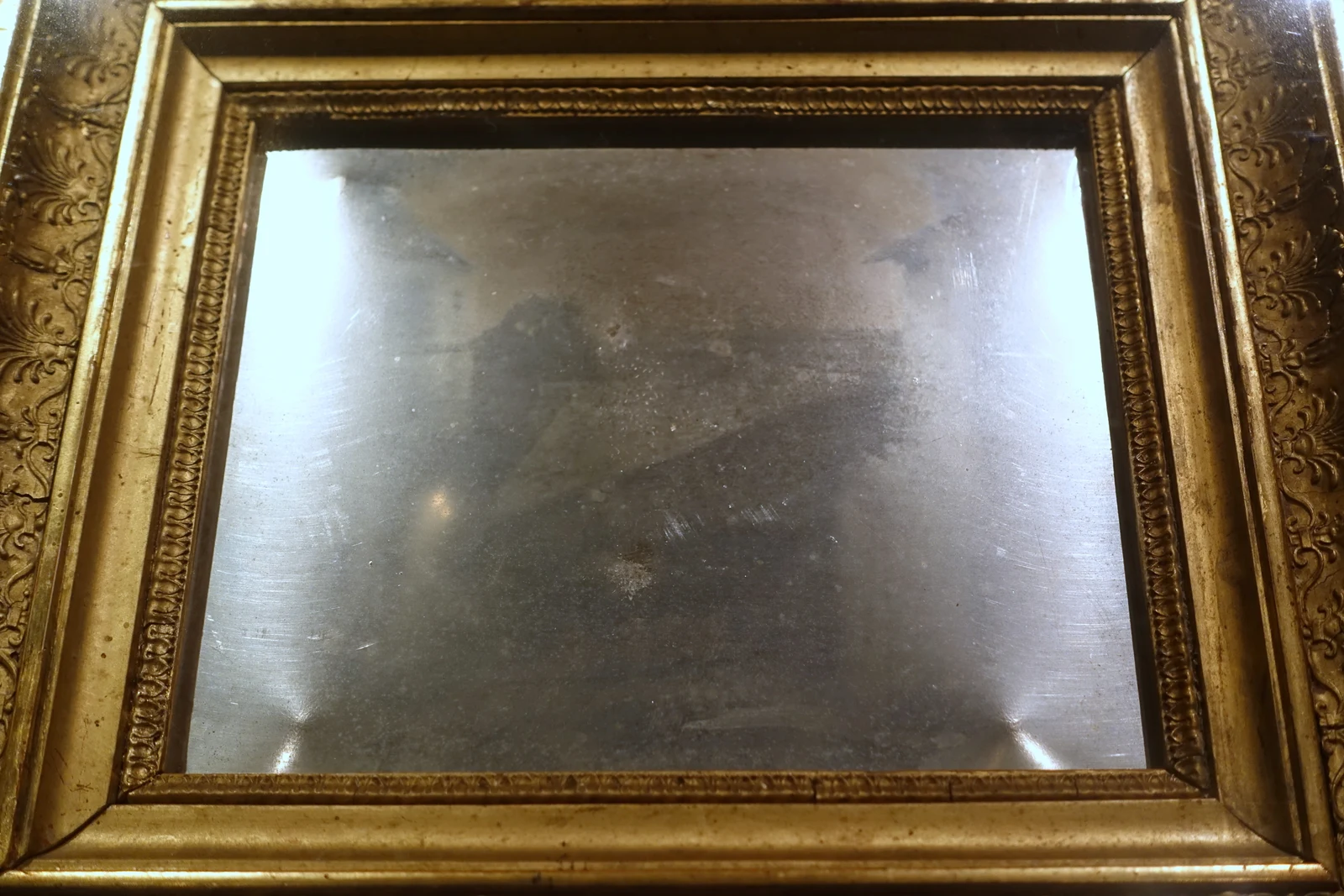
View from the Window at Le Gras, 1826/1827 (catalogued 1827 by the Harry Ransom Center). Modern photograph of the surviving plate, not a contrast-enhanced reconstruction.
Joseph Nicéphore Niépce / Harry Ransom Center; photograph: Daderot, 2015
CC0 1.0. Resized and converted to WebP by PRESDA without further cropping or color alteration.
View from the Window at Le Gras records the surroundings of Joseph Nicéphore Niépce's estate in Burgundy. Usually dated 1826 or 1827, it is catalogued as 1827 by the Harry Ransom Center, its present custodian. The careful description is the earliest surviving photograph made with a camera obscura, rather than the first image ever produced by light-sensitive chemistry. Harry Ransom Center
Niépce used a pewter plate coated with light-sensitive bitumen. Exposure hardened parts of that coating, allowing a lasting image to emerge. The Center describes an exposure lasting several days, so the familiar claim of an exactly eight-hour exposure should not be treated as settled. The image is faint and difficult to read: that physical fragility is part of its history, not a defect to replace with an invented view.
Look at the surviving plate and the distance to a smartphone feels immense. Yet the ambition is recognizable: preserve what is outside this window. The achievement was permanence. Sharpness, speed, affordability and easy duplication remained different problems, each demanding further invention.
Daguerre and the public breakthrough of 1839
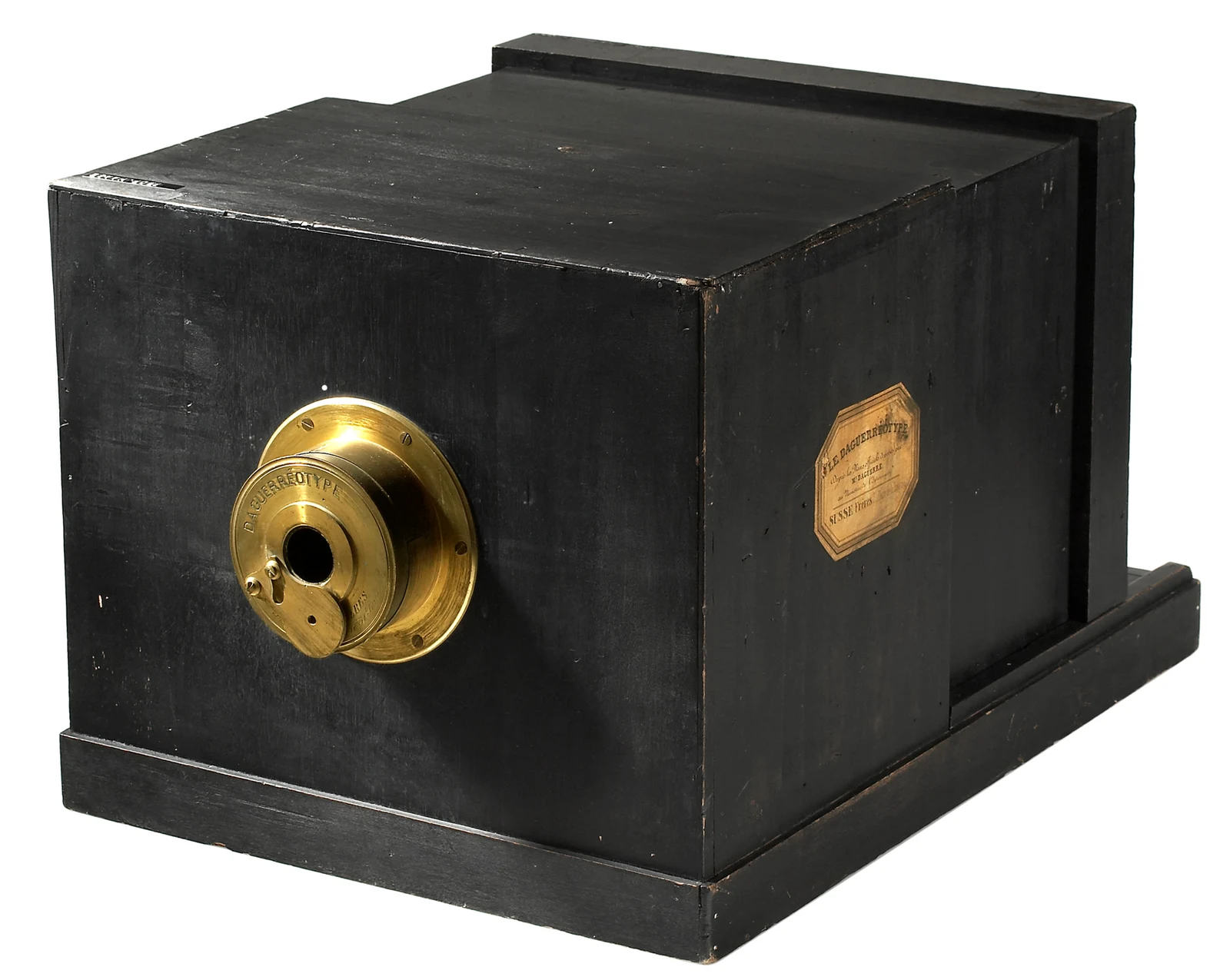
Susse Frères daguerreotype camera, 1839. Photographed in 2010 at WestLicht, Vienna; an authentic historical instrument, not an AI reconstruction.
Liudmila & Nelson, 2010 / Wikimedia Commons
Public-domain dedication by the photographer. Resized and converted to WebP by PRESDA without further cropping or color alteration.
Niépce partnered with Louis Daguerre in 1829 and died in 1833. Daguerre continued the research. His results were presented to the French Academy of Sciences on January 7, 1839; the process was publicly explained on August 19. Those dates describe different stages of the announcement, not competing dates for a single event. The Met
A daguerreotype is a unique image on silver-plated copper. Its detail could be extraordinary, but there was no negative from which to print an edition. The image was also a physical object whose appearance depended on viewing conditions. Daguerre's method joined optics with a complex chemical workflow, including mercury development, far from the effortless button press associated with photography today. The Met
The camera shown here is an authentic Susse Frères instrument from 1839, photographed much later. It helps correct a visual shortcut: early photographic equipment did not all resemble the bellows cameras familiar from period dramas. The illustrated studio at the top of this feature evokes an era; this surviving apparatus documents a particular technology.
Talbot's negative: one exposure, many pictures
In England, William Henry Fox Talbot pursued a different solution. His early paper negatives included a window at Lacock Abbey, dated to about 1835. Light and dark were reversed on the negative; printing through it onto another sensitive sheet restored the tonal relationship. The decisive advantage was reproducibility: one recorded scene could yield multiple positive prints. The Met
Talbot patented the calotype in 1841 after discovering how to develop a latent, initially invisible image. His photographically illustrated book The Pencil of Nature appeared in parts in 1844–1846. The negative-positive principle offered a route into books, archives and circulation that differed fundamentally from the singular metal daguerreotype. Neither approach should be reduced to a footnote in the other's story. The Met
Glass plates and the struggle for speed
Frederick Scott Archer published the wet-collodion process in 1851. Glass negatives brought fine detail and reproducible prints, but the plate had to be prepared and processed while wet. A photographer working outdoors needed more than a camera: the darkroom had to travel too. This practical burden shaped which places and moments could be recorded. US National Archives
Richard Leach Maddox's gelatin dry-plate work in 1871 helped open another path. Dry plates separated preparation from the moment of exposure, and subsequent improvements made photography more convenient. Smithsonian conservation histories trace how these plates became widely used before flexible film displaced them in everyday practice. Progress meant changing the entire workflow, not merely improving the lens. Smithsonian Archives
Kodak and the camera that entered everyday life
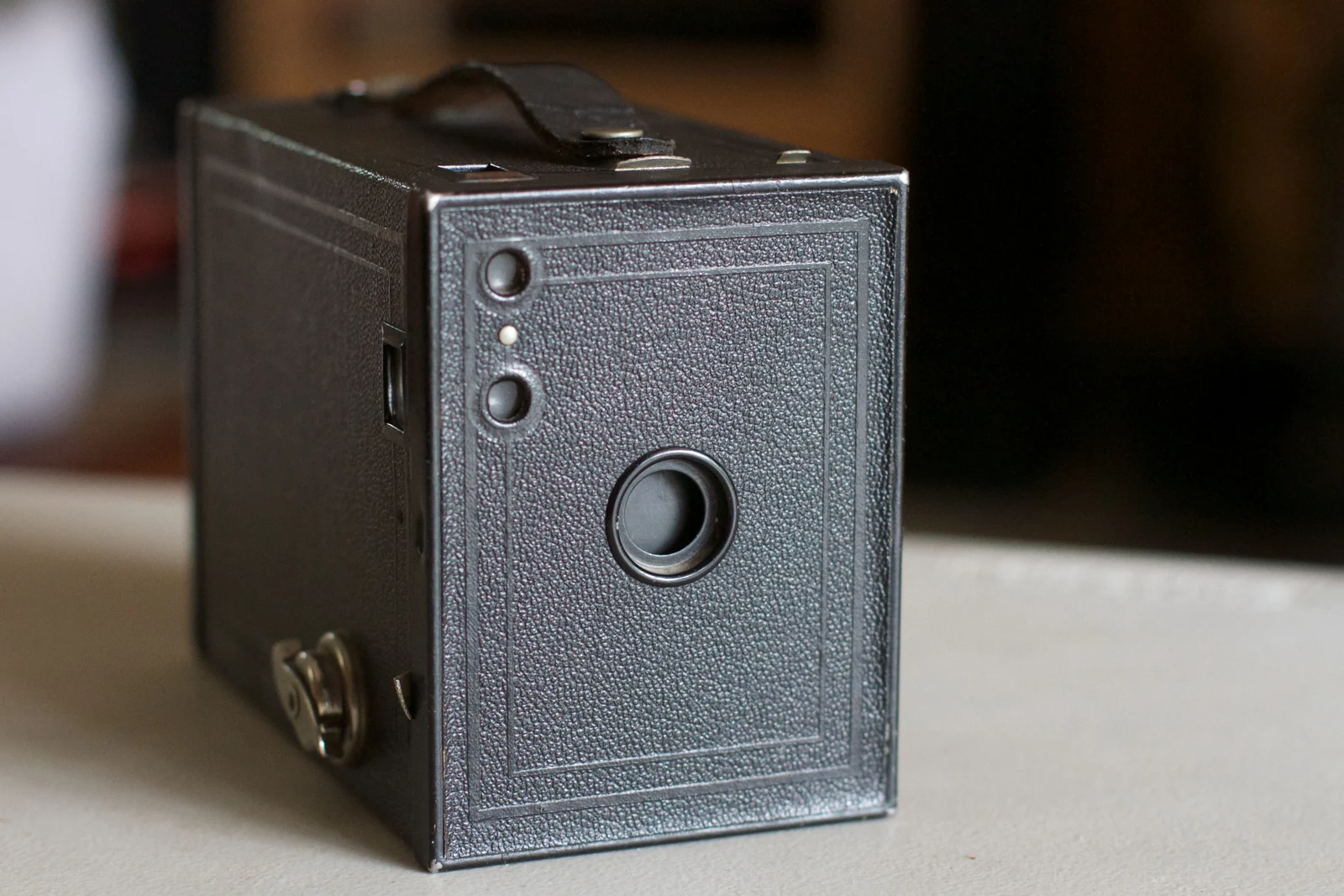
A later Kodak Brownie box camera, photographed in 2014. The Brownie range began in 1900; this is not the original 1888 Kodak or the first Brownie model.
Alan Levine (cogdogblog), 2014 / Wikimedia Commons
CC0 1.0. Resized and converted to WebP by PRESDA without further cropping or color alteration.
George Eastman's Kodak camera arrived in 1888 with a radical commercial proposition: customers could take pictures without mastering the processing. The original camera carried enough paper-based roll film for 100 exposures. It should not be confused with later transparent film or with the Brownie family introduced in 1900. George Eastman Museum Kodak
The transformation was organizational as well as technical. A convenient camera, standardized supplies and a processing service lowered the threshold for participation. The Eastman Museum emphasizes the original Kodak's simple controls and its appeal to novices. The Brownie shown here is a later box-camera example, not the original 1888 Kodak. George Eastman Museum
Family photography changed what seemed worth preserving. A formal portrait and a casual snapshot ask different things of memory. The first may announce who a person wishes to be; the second can preserve an ordinary afternoon. Neither is an unfiltered account of life. Every album also records decisions about who belonged inside the frame and which moments deserved to survive.
Color arrives in stages
Color photography did not begin with a single modern film. The Lumière brothers' Autochrome process, commercially introduced in 1907, used colored starch grains in a glass-plate system. Kodachrome followed in 1935, initially as movie film, with still-photography formats following. These were different technical solutions, not successive names for the same invention. Museum of Fine Arts Boston: CAMEO Nature, 1935
Color changed the expressive possibilities of the medium, but it also introduced preservation problems. Dyes, processing and storage influence how a color photograph ages. The Canadian Conservation Institute distinguishes multiple color processes and their vulnerabilities. A faded family print is therefore both a memory and a changing chemical object; today's scan records its current condition, not necessarily its original appearance. Canadian Conservation Institute
Film photography becomes a public witness
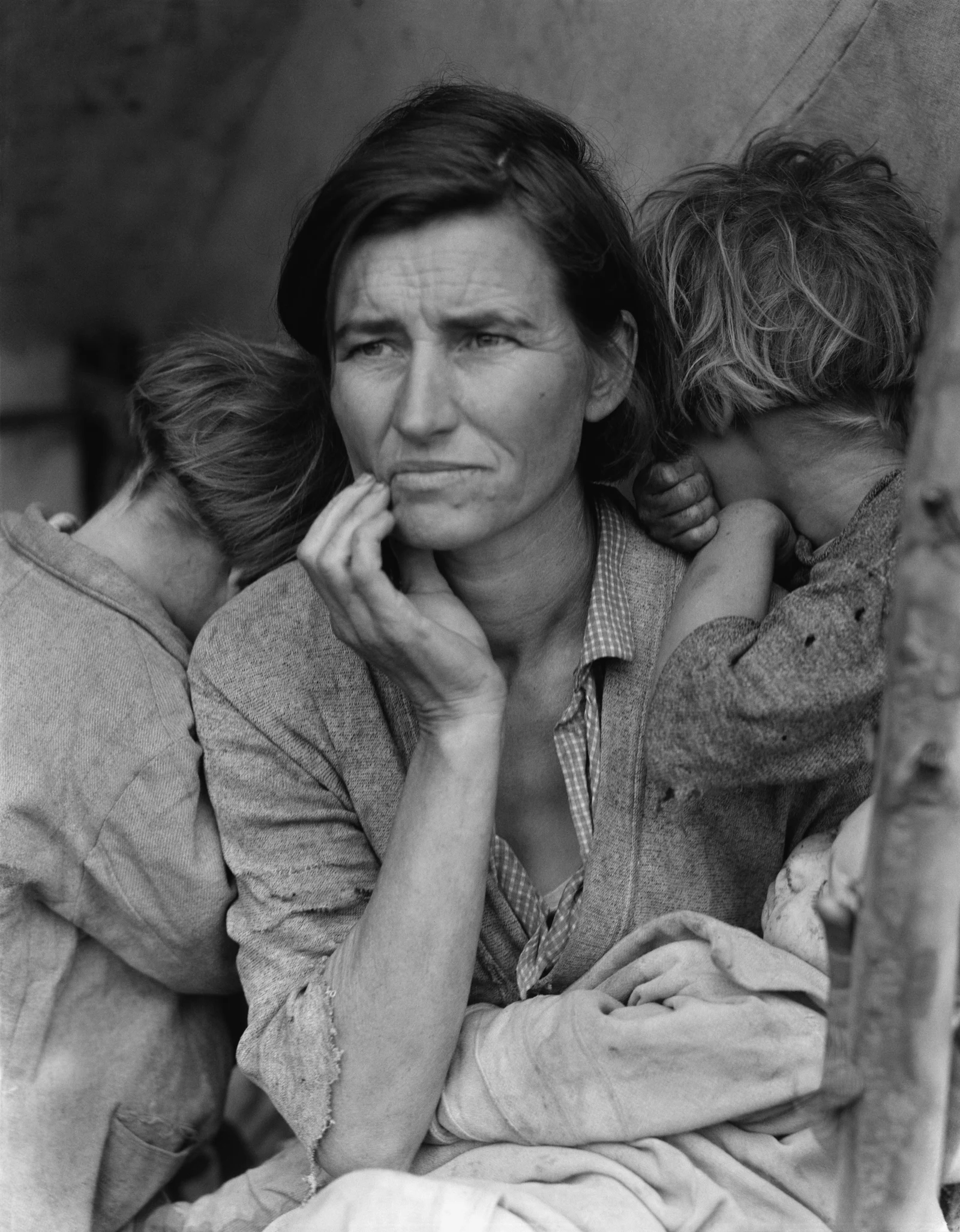
Migrant Mother, Nipomo, California, March 1936. Digitization from a nitrate film negative. The archival negative had a thumb retouched out in the 1930s; this Commons scan also has documented cleanup, slight rotation and border cropping.
Dorothea Lange, 1936 / Library of Congress, FSA/OWI, fsa.8b29516; scan preparation: Trialsanderrors
US public domain; Library of Congress: no known restrictions on publication. Resized and converted to WebP by PRESDA without further cropping or color alteration.
Dorothea Lange photographed Florence Owens Thompson and her children in Nipomo, California, in March 1936. The image known as Migrant Mother belongs to a sequence, not a single isolated encounter. The Library of Congress identifies the original medium as a 4-by-5-inch film negative. Its survival lets us examine both the famous picture and the choices surrounding it. Library of Congress
Here photography's social power becomes tangible. A face can make an economic crisis feel immediate in a way an aggregate figure cannot. Yet a photograph does not supply a complete biography, explain every cause of poverty or authorize every caption attached to it. Good photojournalism combines the visible record with reporting, context and care for the people represented.
That obligation remains familiar in an age of viral imagery. An authentic photograph can mislead if the date, place or explanation is wrong. Emotional force and evidential strength are not identical, a distinction that also matters when examining why unsupported theories feel persuasive.
A scientific instrument and an art form
Photography extended observation beyond unaided vision. Repeated exposures, magnification and controlled recording made pictures useful for comparison and measurement. Scientific value, however, depends on knowing how an image was made: exposure, scale, processing and selection can change what a viewer infers. A beautiful image and a reliable measurement may overlap, but they are not interchangeable.
Artists likewise challenged the idea that a camera merely copied. Alfred Stieglitz and the Photo-Secession, founded in 1902, argued for photography's artistic possibilities through exhibitions and publishing. Composition, printing and interpretation could matter as much as the subject. The debate was not resolved by a new mechanism; it required institutions to reconsider what artistic authorship meant. MoMA
Digital photography: light becomes data
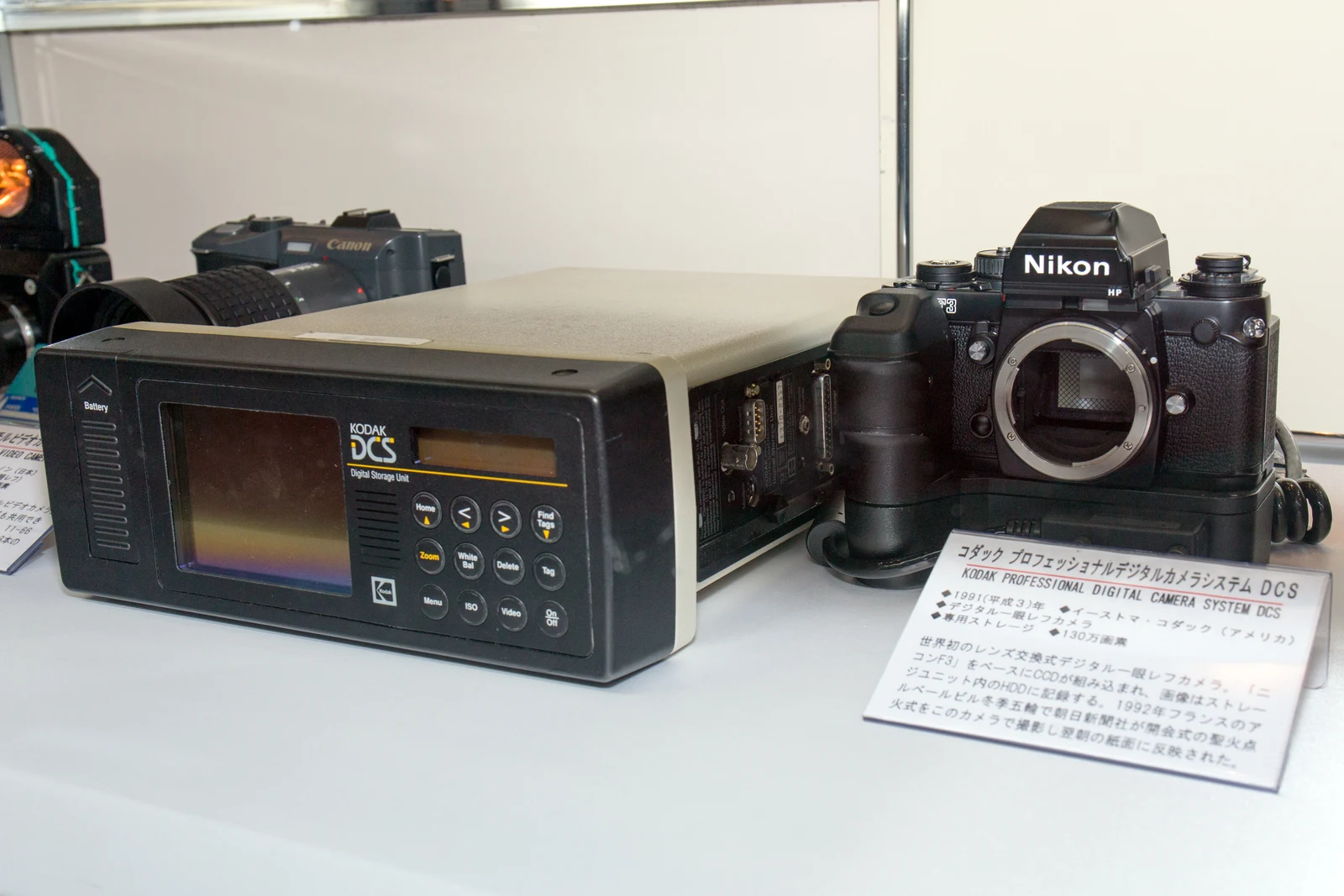
Kodak DCS system of 1991, with Nikon F3 and separate digital storage unit. Photographed at CP+ in Yokohama in 2014. This is not Sasson’s 1975 prototype.
Morio, 2014 / Wikimedia Commons
CC BY-SA 3.0. Resized and converted to WebP by PRESDA without further cropping or color alteration. This resized image remains available under CC BY-SA 3.0.
At Kodak, engineer Steven Sasson built an experimental digital camera in 1975, using a charge-coupled device to capture an electronic image. The National Inventors Hall of Fame dates the prototype to December. This was a research milestone, not the arrival of an inexpensive consumer camera. Turning a demonstration into a practical photographic system required further developments in storage, electronics and image handling. National Inventors Hall of Fame
Kodak introduced its Professional Digital Camera System in 1991, combining a Nikon F3 with a 1.3-megapixel sensor. The pictured camera and separate storage unit show how substantial an early professional system could be. Film and digital practices overlapped; there was no universal day on which photographers put away negatives. Kodak
Digital capture converts measurements of light into numerical information that software can process, store and transmit. Reviewing a result immediately changes the act of taking it: the photographer can adjust and try again. Copying becomes easy, but preservation does not become automatic. Files need organized storage and migration, just as physical photographs need appropriate care.
Smartphones and the photograph assembled by software
A smartphone photograph may combine several exposures rather than reproduce one untouched frame. In a 2016 research paper, Google's HDR+ team described aligning and merging a burst of short exposures to reduce noise and improve dynamic range. The result can retain information that a single small-camera exposure would struggle to capture. Hasinoff and colleagues, 2016
Computational photography makes the boundary between capture and processing more visible. Combining measured light from several frames differs from generating a scene that never existed, although both involve software. A convincing night photograph, an altered portrait and a synthetic historical illustration should not be treated as the same kind of evidence simply because all three arrive as image files.
AI and the future of photographic authenticity
Generative AI can produce the visual language of photography without a corresponding camera encounter. That capability is useful for clearly identified illustration, including this feature's imagined nineteenth-century studio. It becomes misleading when a plausible surface is presented as documentation. Historical equipment and archival photographs therefore need traceable sources, not just a convincing period atmosphere.
Content Credentials, based on C2PA standards, can attach cryptographically verifiable provenance information to media. They help describe origins and editing history; they do not certify that a depicted claim is true. Missing credentials likewise do not prove fabrication. Authentication is a chain of evidence involving source, context and provenance, rather than one badge or an intuitive judgment about how realistic a picture looks. C2PA
The oldest surviving camera photograph asks us to work hard to see a courtyard. A synthetic image can now offer effortless clarity about something that never happened. Between those extremes lies photography's enduring promise: a meaningful connection between an image and the world. Its future will depend not only on what cameras can show, but on how honestly we explain what we are looking at.
FAQ
Frequently Asked Questions
What is this PRESDA article about?
From Niépce and Daguerre to film, smartphones and AI: the history of photography, with authentic archival images and clearly documented sources.
Which category does this story belong to?
This story is part of PRESDA's Science coverage.
Who published this article?
THE INVENTION OF PHOTOGRAPHY: FROM THE FIRST PHOTO TO THE DIGITAL AGE was published by PRESDA Editorial on PRESDA.
PRESDA Dispatch
Stay Informed. Stay Aware.
A sharp briefing across AI, gaming, sport, business, world affairs, paparazzi, and lifestyle.