ARTIFICIAL WOMBS: THE FUTURE OF HUMAN BIRTH?
From CHOP’s lamb experiments to 2026 research, explore artificial womb science, extreme prematurity, medical risks and the limits of complete ectogenesis.
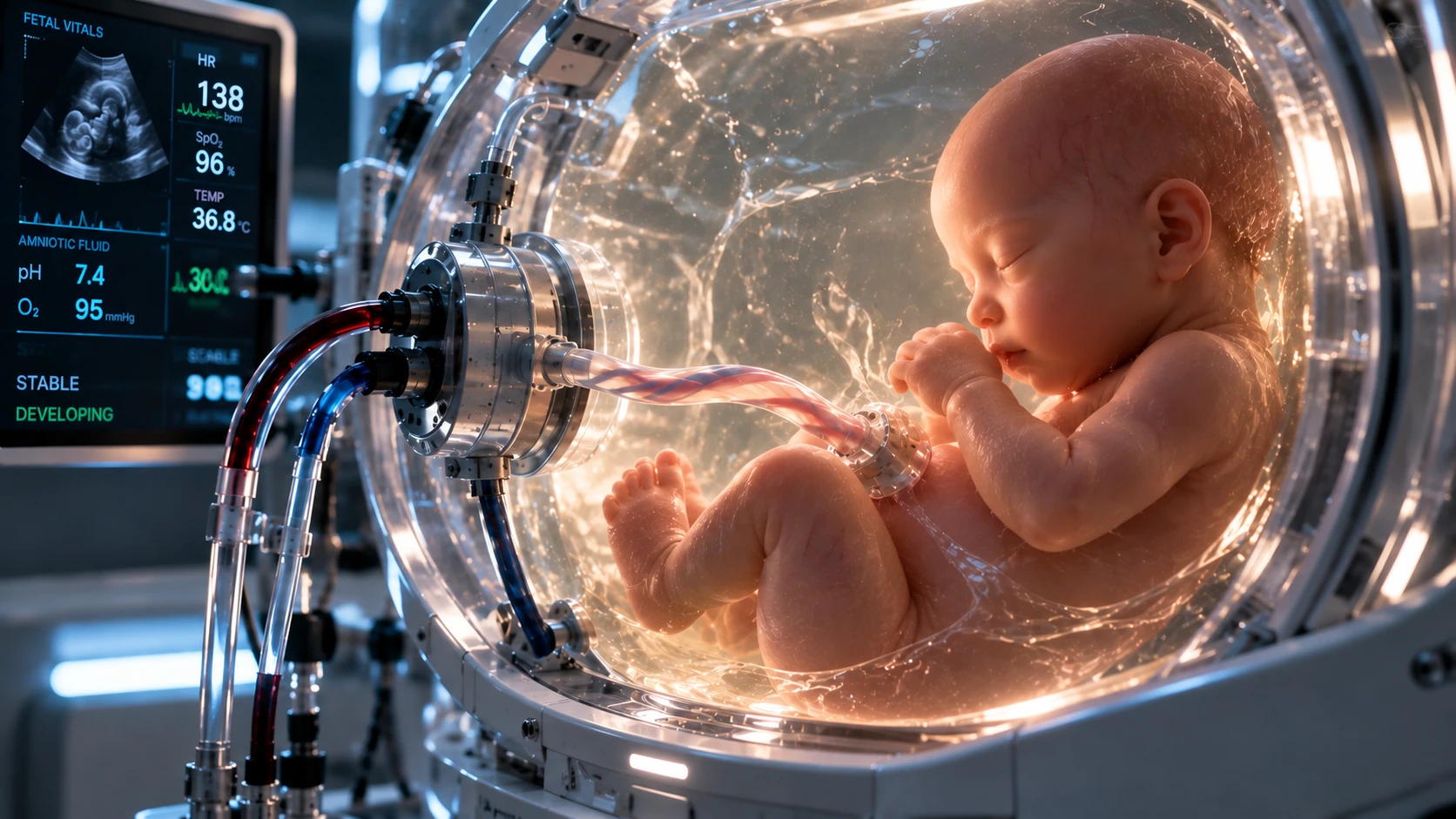
AI-generated conceptual editorial illustration, not a real artificial womb, human experiment or medically accurate display.
The most arresting image in artificial-womb research is not a baby growing from conception inside a glass capsule. It is a premature lamb, suspended in fluid, continuing to develop while its heart moves blood through an external circuit. The difference between those images is the difference between an experimental medical bridge and a technological fantasy. Understanding that gap makes the real science more remarkable, not less.
As reviewed for this feature on October 14, 2026, complete human gestation in an artificial womb has not been achieved. A January 2026 peer-reviewed review reports that no human trials had been conducted in its evidence base. Its literature search ended on August 27, 2025, so that statement is not a continuously updated registry of every subsequent study. The evidence cited here does not establish a human clinical trial or a treatment available to families. 2026 preclinical review
The immediate aim is time, not pregnancy on demand
An extremely premature baby can arrive before organs are ready for the transition to life outside the uterus. The proposed response is to preserve aspects of fetal physiology for a limited period, allowing further maturation before conventional neonatal care. The FDA describes this as a bridge from extreme prematurity toward later gestation. It is not a proposal to place a fertilized egg in a machine and collect a term newborn months later. FDA meeting summary
Partial ectogestation means continuing part of gestation outside the body after it has already begun inside it. Complete ectogenesis would require the entire process, including the early biological relationships involved in implantation and placental development. The two ideas are often illustrated with the same futuristic pod. They are not the same scientific achievement, and progress in one does not demonstrate that the other is close.
What the 2017 Biobag experiment actually showed
On April 25, 2017, Emily Partridge and colleagues at Children’s Hospital of Philadelphia published their landmark study in Nature Communications. Premature fetal lambs were supported for up to four weeks in a fluid-filled system connected through the umbilical vessels to an oxygenator. The investigators reported growth and measures of lung and brain maturation while fetal circulation was maintained. These were animals transferred during gestation, not embryos developed from conception outside a uterus. Partridge and colleagues, 2017
The lamb model was selected for developmental relevance, not because a sheep is a miniature human. The paper notes that developmentally comparable lambs were larger than extremely low-birthweight human infants. Its smaller, earlier lamb experiments encountered excessive blood flow and fluid accumulation, with shorter support periods. Those limitations matter: success under one set of physiological conditions does not prove safety under another. Original study and limitations
CHOP presented the research as a possible future way to reduce harm from extreme prematurity. Its announcement described a temperature-controlled, near-sterile environment and a system intended to support development rather than force immature lungs into immediate air breathing. The familiar name Biobag describes the enclosure; the innovation is the coordinated physiology around it. CHOP’s original explanation
How can a fetus receive oxygen without breathing air?
In the CHOP design, synthetic amniotic fluid surrounds the animal and is continuously exchanged. The fluid provides a protected environment and allows the lungs to remain fluid-filled. It is not the main route by which oxygen enters the blood. That task is performed by an external oxygenator connected to the umbilical circulation, exchanging oxygen and carbon dioxide across a membrane. CHOP: fluid and gas exchange
The EXTEND system uses a low-resistance circuit driven by the fetal heart rather than a mechanical blood pump. Blood passes through the external device and returns through the umbilical connection. A 2018 study examined how umbilical cannulation affects circuit flow. That engineering detail is central: a connection that looks straightforward in a diagram must preserve adequate circulation without imposing an unsafe load on a small heart. Umbilical circulation research
Oxygenation is only one requirement. Nutritional support, temperature, fluid balance and monitoring must work together. The placenta does more than exchange gases, so calling an oxygenator an artificial placenta should not imply that it reproduces every placental function. The research asks which functions can be replaced sufficiently for a limited period, not whether a complete pregnancy can be reduced to a bag, a tube and a screen.
Why this is different from an incubator
A conventional incubator helps care for a baby who has entered neonatal life; respiratory support can assist air-filled lungs. Artificial-womb approaches seek to delay some of that transition by maintaining a fetal-like environment and an external route for gas exchange. The FDA’s 2023 advisory discussion specifically concerned an alternative to existing intensive care for extremely premature infants. It was not a review of consumer reproductive machines. FDA meeting scope
This distinction explains both the hope and the difficulty. Researchers are not simply making an incubator warmer or more sophisticated. They are attempting to preserve a physiological state during an exceptionally vulnerable interval. If the system fails, the clinical team would need a viable rescue pathway. A future trial must therefore consider the transfer into the device and the eventual transfer out, not just the days spent inside it.
What has progressed by 2026, and what has not?
The January 9, 2026 Cureus review by Lubna Bashier and colleagues surveys preclinical systems, including different circuit approaches and animal models. It reports continuing problems such as clotting, bleeding, infection, cannulation failure and circulatory instability. Differences between studies prevented a quantitative meta-analysis. The review is a synthesis of prior work, not a new experiment or evidence that a human treatment has been demonstrated. 2026 review
A February 2026 ethical review in the Journal of Pediatric Surgery similarly discusses the move toward first-in-human studies as dependent on further preclinical investigation. Its discussion of FDA breakthrough designation must not be confused with marketing approval, completed trials or proof of clinical benefit. Regulatory attention means a technology is being examined; it does not mean the unanswered questions have been resolved. 2026 clinical ethics review
The evidence therefore supports a careful description of progress: increasingly developed experimental fetal-support systems, alongside unresolved translation to human care. It does not support a deadline for replacing pregnancy. Nor should a realistic-looking video, commercial claim or conceptual image be treated as a clinical result. A credible milestone needs a dated study, identifiable participants or animal model, methods, outcomes and a clear account of harms.
The hard part is safety over a lifetime
An appealing short-term result would not be enough. Researchers must ask whether oxygen delivery is stable, whether blood vessels tolerate the connection and whether infection or clotting can be controlled. They must also establish what happens after support ends. In its advisory summary, the FDA explicitly asked how animal studies could evaluate both immediate and longer-term outcomes despite differences between species. FDA: evidence requirements
Survival is essential, but it is not the only outcome that matters to a child and family. Future evaluation would need to follow development and health after discharge rather than stop at removal from a device. That does not mean promising a life without disability, or treating disabled lives as less valuable. It means judging an intervention by meaningful benefits and harms, with families involved in deciding which outcomes matter.
The transfer itself also affects the pregnant patient. A proposed procedure cannot be discussed only from the perspective of the fetus: the method of delivery, medical risks and consent must be addressed separately. It would be misleading to portray ectogestation as a simple, risk-free escape from pregnancy. The ethics review emphasizes the practical challenges around partial gestational support rather than allowing distant scenarios to replace immediate clinical questions. Clinical ethics
FDA oversight is a process, not a green light
The FDA Pediatric Advisory Committee met publicly on September 19, 2023 to examine development plans, safety and ethical issues for possible first-in-human studies. Its presentations included pediatric research safeguards, animal evidence and benefit-risk assessment. A meeting about how studies should be designed is not an announcement that those studies have begun. FDA presentations
A responsible first study would need clear eligibility, a defensible comparison with existing care, independent oversight, stopping rules and follow-up. Parents facing a frightening premature delivery must be able to understand that research is uncertain and that participation is not a guarantee of rescue. Consent must be more than a signature collected during a crisis. These are reasons to design research carefully, not reasons to confuse caution with indifference to suffering.
Motherhood, autonomy and the limits of an engineering answer
A 2026 Journal of Perinatology scoping review found ethical writing divided between near-term support for extreme prematurity and hypothetical complete ectogenesis. It identified themes including decision-making, moral and legal status, access, cultural perspectives and research ethics. That division helps explain why public discussion can move so quickly from a lamb experiment to claims about the end of motherhood. 2026 ethical scoping review
The deeper questions cannot be settled by a successful oxygenator. Who would decide whether to begin or stop support? How would families participate in care? Could access depend on wealth or geography? Could an option intended to expand choice become pressure to accept a particular procedure? These are ethical questions, not predictions that any one legal or social outcome is inevitable.
Reproductive rights require particular care in this debate. A future technology would not automatically resolve conflicts over bodily autonomy, legal parenthood or obligations toward a developing child. No universal legal conclusion follows from an animal study. Likewise, motherhood and parenthood are relationships of care, responsibility and identity as well as biological processes. A machine cannot tell society what those relationships should mean.
Artificial gestation is also distinct from choosing embryos or editing genes. Supporting development does not, by itself, select a child’s traits. For that separate set of questions, PRESDA’s Designer Babies investigation explains IVF, embryo selection and genetics. Keeping these technologies separate prevents several different scientific and ethical debates from becoming one misleading story.
The future must not eclipse care available now
WHO estimates that 13.4 million babies were born preterm in 2020. Its 2023 fact sheet emphasizes large inequalities in survival and the value of existing care, including warmth, feeding support, infection treatment and appropriate respiratory support. These figures describe global prematurity, not the number of babies who would qualify for an artificial-womb study. WHO: preterm birth
A future specialist technology might help a narrowly defined group while leaving many preventable deaths untouched. Investment in experimental support and investment in accessible maternity and neonatal services need not be enemies, but novelty should not make established needs invisible. The relevant question is not only what medicine can invent. It is also what care reaches the families who need it.
Could artificial wombs replace pregnancy?
There is no demonstrated route to complete human gestation in an artificial womb in the evidence examined here. Supporting a fetus after months of development inside the body is a different challenge from reproducing the entire sequence. It would be unjustified to turn partial success into a date for full ectogenesis, or to claim that pregnancy will inevitably become obsolete.
The supplied hero is an AI-generated conceptual editorial illustration, not a photograph of a human experiment, an approved medical device or a technically validated design. Its fetus, connections and displayed readings should not be interpreted as clinical evidence. The genuine research is less cinematic and more demanding: making many fragile systems work together, then proving that doing so helps patients.
The most consequential future may begin with a modest-sounding ambition: giving an extremely premature child more time to develop. If that becomes safe and effective in humans, it would be a major achievement without producing a single pregnancy from conception to birth outside the body. The science deserves hope proportionate to its evidence. Its promise is not that human care can be replaced, but that care might gain another way to protect a vulnerable beginning.
FAQ
Frequently Asked Questions
What is this PRESDA article about?
From CHOP’s lamb experiments to 2026 research, explore artificial womb science, extreme prematurity, medical risks and the limits of complete ectogenesis.
Which category does this story belong to?
This story is part of PRESDA's Science coverage.
Who published this article?
ARTIFICIAL WOMBS: THE FUTURE OF HUMAN BIRTH? was published by PRESDA Editorial on PRESDA.
PRESDA Dispatch
Stay Informed. Stay Aware.
A sharp briefing across AI, gaming, sport, business, world affairs, paparazzi, and lifestyle.