CROWS: THE BLACK BIRDS THAT OUTSMART HUMANS
A hooked wire, a remembered face, a carefully counted call: crow research reveals sophisticated minds built very differently from ours. The discoveries are remarkable without making birds superior to people.
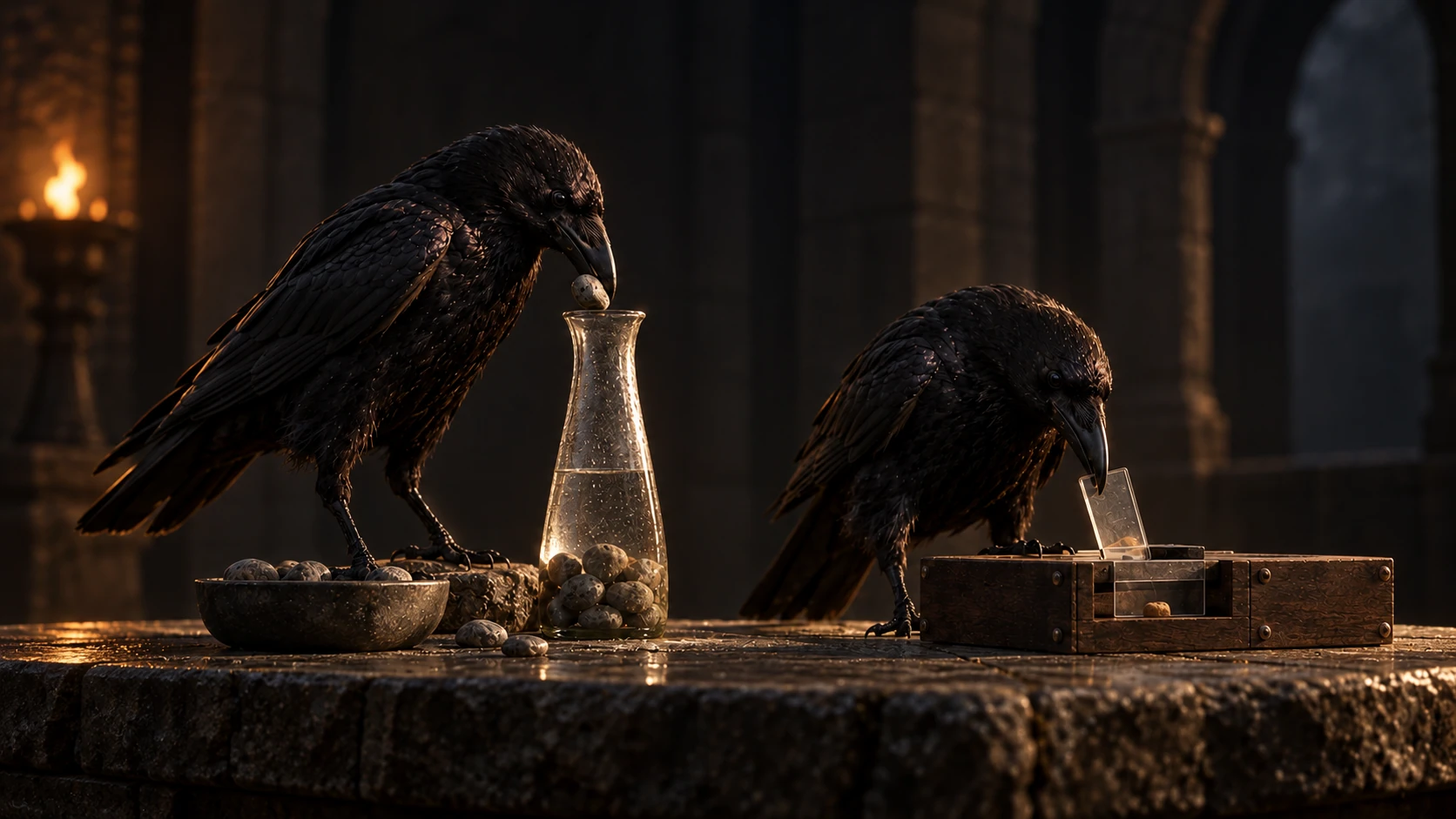
AI-generated artistic illustration of two corvids. Not documentary evidence of an experiment or a scientific guide to species identification.
In 2002, a New Caledonian crow named Betty confronted an unusually human problem: the useful object was out of reach, and the available equipment was wrong. Food sat inside a small bucket in a vertical tube. Betty bent a straight piece of wire into a hook and lifted the bucket. A bird had turned an inadequate object into a solution. The experiment became one of animal cognition’s defining images, partly because it made an old insult, birdbrain, suddenly sound absurd.
But the most interesting part of Betty’s story arrived later. Researchers found that wild members of her species also bend tools during normal manufacture. The achievement remained impressive; its interpretation became more complicated. That is the rhythm of good crow science: an astonishing performance, followed by a harder question about what produced it. Crows can surprise humans and solve demanding problems. They have not been shown to possess greater general intelligence than people. Our headline captures the surprise, not a scientific ranking. Tool-bending reassessment, 2016
First, which black bird are we talking about?
Crow is not a synonym for every clever black bird. Crows and ravens belong to the corvid family, alongside jays, magpies and others. New Caledonian crows, American crows and carrion crows are different species. An experiment with one cannot automatically establish what all the others can do. Ravens are close relatives, not older crows, and a raven experiment should never silently become evidence about a crow.
In North America, a common raven is generally larger than an American crow, with a heavier bill, shaggier throat and a more wedge-shaped tail in flight. American crows tend to show a fan-shaped tail and familiar cawing calls; common ravens often produce deeper croaks. These are identification clues for that comparison, not universal rules for every species worldwide. Cornell’s guide stresses the usefulness of voice alongside appearance. Cornell Lab identification guide
The beak as a workshop
New Caledonian crows extract food using tools made from plant material, including hooked sticks. Their bodies, movements and environment belong in the explanation: an animal that regularly probes hidden food encounters a different set of problems from one that grazes in an open field. Tool-making combines inherited tendencies, practice and opportunities to learn. It is neither a tiny human engineering degree nor a meaningless reflex. Betty’s wire hook sits within that richer natural history.
A 2018 study in Scientific Reports raised the difficulty. Researchers gave eight New Caledonian crows short components that could be joined into a longer implement. Four assembled functional compound tools. One bird, Mango, subsequently made tools containing three and four elements. These were unfamiliar constructions, not simply the usual twig with a different name. The study demonstrated flexible assembly, while its authors emphasized that the underlying mental processes remained unresolved. Compound-tool experiment, 2018
A successful puzzle tells us what the animal accomplished. It does not, by itself, tell us whether the solution was mentally simulated, discovered through exploration or strengthened by reward. Those possibilities can interact. Researchers therefore vary materials, distances and task demands, looking for transfer to new situations. A spectacular first attempt matters, but patterns across individuals and controlled conditions matter more than the most shareable video.
Aesop’s crow enters the laboratory
The ancient fable describes a thirsty crow dropping stones into a vessel until the water rises within reach. In 2014, Sarah Jelbert and colleagues tested six New Caledonian crows on water-displacement problems. Their reward was food floating in a tube. The birds favored useful choices in several tasks, including water over sand, sinking objects over floating ones, and solid objects over hollow ones. Their actions could change the height of the reward. Water-displacement study, PLOS ONE
Their success was incomplete. The birds failed the tube-width task and a counterintuitive problem involving a concealed connection between tubes. The authors described an incomplete understanding of displacement, not mastery of fluid mechanics. Comparisons with children concerned particular experimental tasks, not a crow’s overall mental age. Experience with the apparatus and feedback from a rising reward must also be considered before attributing an abstract theory of causation.
That distinction protects the discovery rather than diminishing it. Choosing objects that produce useful effects is already a substantial ability. The next question is whether a bird understands the relationship well enough to predict a result when familiar cues disappear. An animal can be competent without representing a problem in precisely the same way a scientist does. The fascination lies in discovering its route to the answer.
A face can become a lasting warning
American crows have provided unusually vivid evidence of memory in the wild. In work published in 2011, researchers wearing distinctive masks trapped, banded and released birds near Seattle. Later appearances of the associated mask provoked scolding. Responses spread to birds that had not been captured, including young birds learning from their parents. At one site, the response spread at least 1.2 kilometres over five years. Cornell, Marzluff and Pecoraro, 2011
The masks helped separate a recognizable face from the identity of the person wearing it. The experiment supports long-term threat recognition and social learning. It does not show that crows possess human moral judgments or a universal desire for revenge. Calling the response a grudge makes a memorable headline; remembering a danger cue explains the measured behavior more precisely. Nor does every crow necessarily retain every human face for the same length of time.
A social world beyond the puzzle box
American crows may remain in family groups, with offspring helping at later nests. Cooperation here is practical: other birds can contribute to raising young and responding to threats. That does not make crow society permanently harmonious. Food, breeding opportunities and safety create competing demands. Family life also supplies repeated opportunities to observe others, so intelligence is exercised in relationships as well as encounters with objects. Cornell Lab on cooperative breeding
Calls help maintain those relationships. Cornell describes distinct repertoires in American crows and common ravens, with sounds serving their complex social lives. An alarm call can recruit attention; other vocalizations occur in different interactions. Yet a varied repertoire is not evidence of human-style language, and a circulating online translation of a caw is not automatically scientific. Context, playback experiments and repeatable observations are needed to establish a signal’s function. Cornell Bird Academy
Counting calls, rather than reciting numbers
In Science in 2024, Diana Liao and colleagues reported that three trained carrion crows could produce one to four calls in response to visual or auditory cues. The birds then indicated that their sequence was finished. Features of the first call predicted the total number that would follow, supporting advance preparation of the response. This was controlled vocal production linked to quantity, a more specific and informative finding than simply declaring that crows can talk mathematics. Liao and colleagues, 2024
The birds had extensive training, and the experiment involved three individuals. It did not reveal crows reciting number words in the wild, nor demonstrate an unlimited counting system. Errors and preparation times help researchers distinguish possible mechanisms. Even within these boundaries, coordinating a planned number of vocal actions is striking. The result connects two capacities often studied separately: representing quantity and deliberately controlling a call.
Why gather around a dead crow?
A noisy gathering around a body looks startlingly familiar to human observers. In a 2015 Animal Behaviour study, Kaeli Swift and John Marzluff tested American crows’ responses to dead crows and associated threats. The birds mobbed, delayed approaching food in places associated with the event, and learned to recognize nearby humans as possible dangers. The experiments supported a role for learning about risk. They did not establish a funeral ritual equivalent to a human ceremony. Swift and Marzluff, 2015
Follow-up experiments published in 2018 found alarm calling and recruitment more typical than touching dead crows. That helps explain why gathering need not mean affectionate contact with a familiar companion. It also does not prove the absence of emotion. Grief, recognition, arousal and danger assessment are different questions, and behavior alone may not settle them. Scientists can identify what a response accomplishes more confidently than describe exactly what the bird feels. Controlled observations, 2018
Small brains, densely packed possibilities
Bird brains do not reproduce the layered mammalian neocortex. That difference once encouraged misleading assumptions about their limitations. A 2016 PNAS study counted neurons in a range of birds and found that parrots and songbirds pack many neurons into small brains. Large-brained corvids and parrots had forebrain neuron counts comparable to, or exceeding, those of some primates with substantially larger brains. Brain mass alone was an inadequate guide to computational resources. Olkowicz and colleagues, 2016
This does not mean a crow has the same brainpower as a person compressed into its skull. Neuron numbers, connections, organization and developmental experience all matter. Comparisons with primates identify convergent abilities on particular tasks, not a universal intelligence scoreboard. Evolution has produced more than one arrangement capable of sophisticated behavior. The valuable question is how different biological systems solve comparable problems, not which animal wins an imaginary examination.
In 2020, Andreas Nieder and colleagues recorded neural activity while crows reported whether they had detected visual stimuli. Later neuronal responses tracked the birds’ perceptual reports, rather than merely stimulus intensity. The Science paper interpreted this as a neural correlate of sensory consciousness. It was evidence about perception in a trained task, not direct access to a crow’s inner life or proof that its self-awareness matches ours. The interpretation of animal consciousness remains an active scientific debate. Sensory-consciousness study, 2020
The birds humans filled with meaning
Long before laboratories, people turned black corvids into figures of warning, knowledge and mystery. Such stories differ across traditions and often concern ravens rather than crows. The British Museum discusses an Anglo-Saxon brooch whose paired birds may depict the companions of Woden or Odin. The cautious identification matters: an interpretation of an object is not the same as a written label left by its maker. British Museum
At the Tower of London, the familiar story says the kingdom will fall if its ravens depart. Historic Royal Palaces explicitly presents this as legend and tradition. It is evidence of human cultural imagination, not avian prophecy. Likewise, Aesop’s clever bird belongs to literature even when it inspires a real experiment. Myth can frame a compelling question; it cannot supply the experiment’s answer. Historic Royal Palaces
Watching without inventing a mind
To appreciate a crow, begin with observation: identify the species, describe the action, and separate what happened from why you think it happened. A bird approaching a person may be responding to previous experience. A failed puzzle may reflect motivation, unfamiliar equipment or the task itself rather than a simple lack of intelligence. Conversely, one solved puzzle does not establish every capacity we associate with human thought. Good comparisons require fair opportunities and careful controls.
The scientific record is impressive precisely because it is specific. Some crows manufacture tools, recognize threatening faces, learn socially and control numerical sequences of calls. These findings come from different species and settings, and their limits are part of the story. For another example of a remarkable ability that needs careful interpretation, read our feature on the immortal jellyfish, or explore more PRESDA SCIENCE.
The next black bird on a fence need not defeat a human to deserve attention. Its world presents problems we barely notice, and its mind has evolved ways of negotiating them. Betty’s hook did not make people obsolete. It made our picture of intelligence less provincial. Perhaps the greatest trick crows perform is not outsmarting us, but persuading us to ask better questions about what thinking can be.
FAQ
Frequently Asked Questions
Are crows smarter than humans?
No research establishes general intellectual superiority over humans. Some crow species excel at particular tasks involving tools, memory and learning. Performance depends on species, experience and experimental design.
Do crows recognize human faces?
Experiments with masked researchers show that American crows can learn threatening facial cues and remember them over years. Other crows can acquire the response socially.
Do crows hold funerals?
Gatherings around dead crows are documented. Experiments support learning about danger, but do not establish human-like funeral rituals or settle whether birds experience grief.
Can crows count?
A 2024 study trained three carrion crows to produce one to four calls in response to cues. It demonstrated control of vocal quantity, not human number language or unlimited counting.
Are crows and ravens the same?
They are related corvids, not the same species. Common ravens are generally larger than American crows and differ in bill, throat feathers, tail shape and voice. Comparisons vary by species.
PRESDA Dispatch
Stay Informed. Stay Aware.
A sharp briefing across AI, gaming, sport, business, world affairs, paparazzi, and lifestyle.