THE IMMORTAL JELLYFISH: THE ANIMAL THAT CAN REVERSE ITS LIFE CYCLE
Explore how Turritopsis dohrnii returns from medusa to polyp, what genome studies reveal, and why biological immortality is not a human anti-aging treatment.
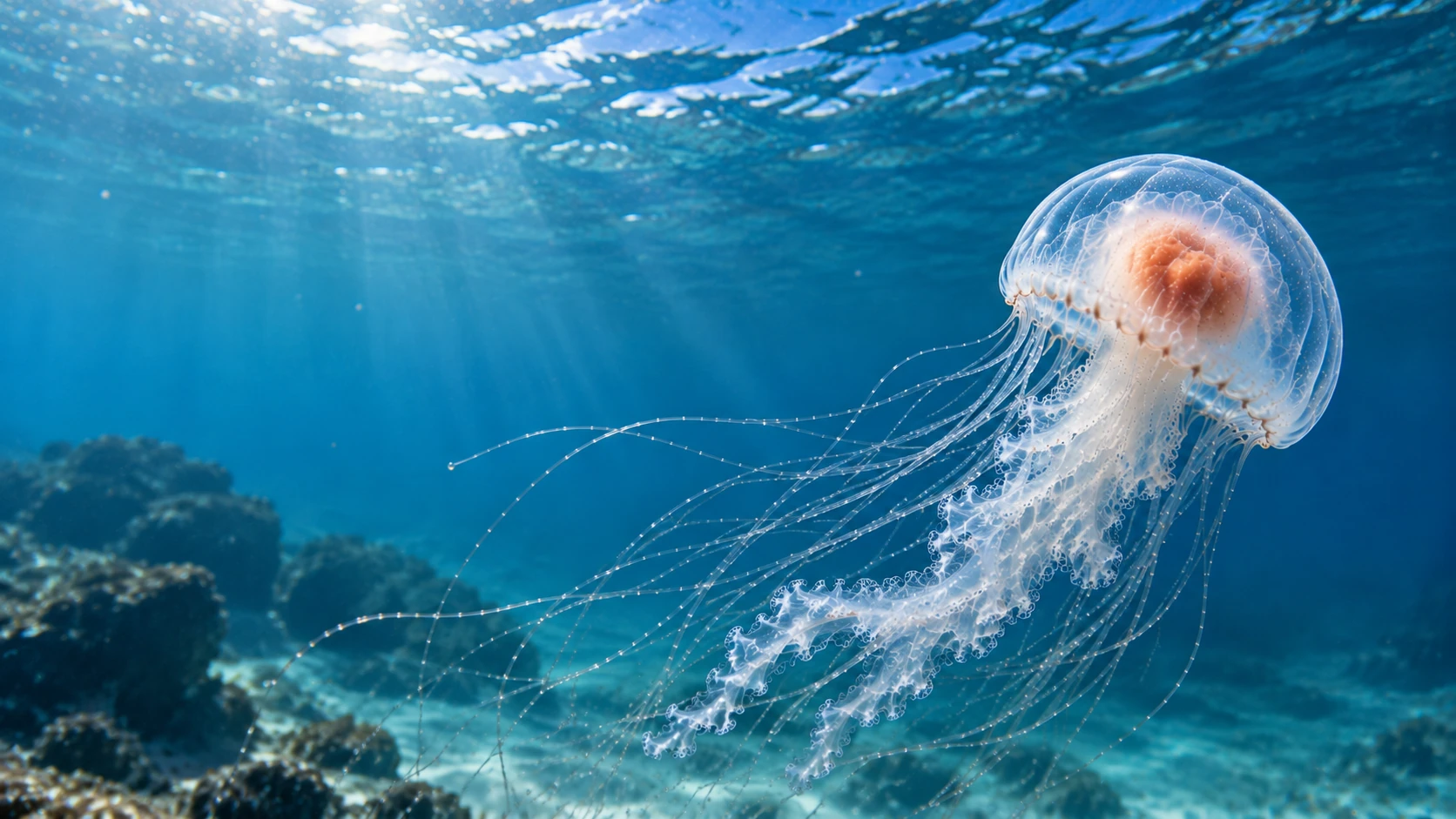
AI-generated editorial illustration. Not a scientific photograph or an exact depiction of Turritopsis dohrnii.
Turritopsis dohrnii is a tiny marine hydrozoan whose swimming medusa can return to a polyp stage and generate a new colony. That extraordinary developmental reversal explains its nickname, the immortal jellyfish. It is a demonstrated biological ability, not a guarantee of endless survival, and it has not supplied a treatment that reverses human aging.
The fascination is justified. Most familiar stories about aging move in one direction: an animal develops, reproduces and eventually declines. This jellyfish can take a different developmental route. Understanding that route requires looking beyond the beautiful floating bell to an attached colony, an intermediate mass of tissue and the experiments that make an otherwise elusive transformation visible.
A remarkable animal only millimetres wide
The adult bell is approximately 4.5 millimetres across, according to the Natural History Museum. A transparent body surrounds a conspicuous reddish digestive structure; tentacles capture small prey. It belongs to Hydrozoa within Cnidaria, the group that also includes corals and sea anemones. This is an animal with organized tissues, feeding structures and a nervous system, despite its miniature scale.
Its two main forms occupy different habitats. The medusa swims in the water column; polyps attach to surfaces and form colonies. The Smithsonian Environmental Research Center’s species account records rocky Mediterranean habitats and occurrences farther afield, including Panama. Its original geographic range is uncertain. Shipping can transport tiny marine organisms, but a global distribution does not prove that rejuvenation occurs continuously wherever they are found.
Discovery: an old species, a newer biological surprise
The species name dates to Weismann’s description in 1883. Its capacity to reverse development became a separate research story much later. A landmark 1996 Biological Bulletin paper by Stefano Piraino, Ferdinando Boero, Brigitte Aeschbach and Volker Schmid described medusae returning to colonial hydroids, including after sexual maturity. The historical title used Turritopsis nutricula, reflecting the taxonomy then applied to the studied animals.
That naming history still causes confusion. On 19 January 2026, Miglietta and colleagues in Zootaxa distinguished true T. nutricula from related lineages using material collected near its North Carolina type locality and mitochondrial DNA. Their tested animals did not show the reversal capacity associated with T. dohrnii. Older titles therefore need context: the two scientific names are not interchangeable labels for every jellyfish in the genus.
The usual journey: planula, polyp and medusa
In the normal Turritopsis cycle, fertilization produces a planula, a small larva that eventually settles and develops into a polyp. The polyp grows on a surface, extending a colony through connected structures. It can reproduce asexually, budding off medusae. Those free-swimming animals mature and produce eggs or sperm, beginning another sexual generation. The American Museum of Natural History explains this alternation between attached and swimming stages.
A polyp is not simply a baby version of a floating bell. It has a different body organization and way of living. Likewise, a colony is not one oversized medusa: it contains connected feeding units. These distinctions make the reversal striking. The animal is reconstructing a developmental form with different tissues and functions, rather than merely growing a replacement tentacle or pausing the aging of an otherwise unchanged body.
PRESDA DATA GRAPHICS
Two routes through a jellyfish life cycle
Normal development
- Fertilization and planula larva
- Attached polyp colony
- Medusae bud from the colony
- Medusae produce gametes; fertilization starts the next cycle
Observed reversal
- Living medusa under suitable conditions
- Cyst-like tissue stage
- Stolon and new polyps
- Polyps can later produce medusae
Conceptual sequence, not a time scale. Reversal does not pass through an egg. Laboratory observation does not establish its frequency in the wild or guarantee survival.
What happens when the life cycle reverses?
A reversing medusa loses its familiar swimming form, contracts and passes through a cyst-like stage. A stolon, a spreading attachment structure, subsequently develops and produces polyps. New medusae can later bud from the colony. Morphological research published in Tissue and Cell in 2003 documented changing body forms and cellular degeneration and apoptosis during this transformation. Reversal involves tissue remodeling, not preservation of every adult structure intact.
It is important to follow the arrow correctly. Medusa-to-polyp reversal bypasses the normal route through fertilization and a planula; it does not recreate the original egg. Nor does a dead jellyfish resurrect. Living tissue must remain capable of reorganizing. A photograph of a contracting animal, by itself, cannot establish whether it will produce a viable colony, whether that colony will bud medusae or whether the next generation will complete another reversal.
Cells changing identity
Transdifferentiation means that a differentiated cell changes into another specialized identity. Cellular reprogramming is a broader term for resetting aspects of cell state and gene activity. The 1996 experiments provided evidence for unusual transformation potential in differentiated tissues. It is reasonable to describe transdifferentiation as part of this animal’s biology; it is premature to pretend researchers have already traced the fate of every cell through every stage.
Matsumoto, Piraino and Miglietta’s 2019 transcriptome study compared gene activity in medusae, cysts and polyps. Matsumoto and Miglietta’s 2021 expression-profiling study further investigated candidate networks involved in reversal. A transcriptome records RNA activity, helping identify processes worth testing. It cannot, on its own, show that one particular adult cell became a particular polyp cell or prove which gene is indispensable.
Stress can trigger reversal, but success is not guaranteed
Experiments have induced reversal using injury, food deprivation, temperature changes and other treatments. These are biological challenges, not a prescription for keeping jellyfish healthy. The response depends on the animals, their developmental stage, the treatment and the endpoint observed. An intervention that promotes cyst formation under one set of conditions may also kill animals or fail to yield fully developed polyps under another.
A 2025 study by Juliana Giraldo-Meneses and Maria Pia Miglietta tested 102 newborn medusae under heat, reduced salinity, wounding and a starvation control. It reported that 22% failed to form cysts across the treatments. That is a result for a defined laboratory experiment and an intermediate endpoint, not a species-wide death rate. It directly cautions against claiming that every threatened medusa inevitably rejuvenates.
Laboratory observation is not an infinite life in the ocean
The strongest evidence comes from animals researchers can observe through successive stages in culture. Maintaining cultures allows tissue changes, gene activity and timing to be compared. A wild animal offers a harder problem: it is tiny, moves with water and can vanish from an observer’s view. Finding medusae and polyps in the same region does not establish that one tracked individual transformed between them.
Natural occurrence and laboratory capacity are therefore separate claims. Research demonstrates that the route is biologically possible; it does not measure how often wild animals use it successfully. Demonstrating indefinite survival would require more than a series of successful reversals. There is no verified centuries-old individual whose continuous history supplies that proof. The popular promise of living forever goes beyond what any finite observation can establish.
What the genome studies actually found
On 29 August 2022, Maria Pascual-Torner and colleagues at the University of Oviedo published a PNAS study comparing T. dohrnii with T. rubra. They identified candidate differences in genes associated with DNA replication and repair, telomere maintenance, oxidative processes and cellular communication. Expression patterns also implicated reprogramming-related pathways. The findings proposed mechanisms to investigate; they did not identify a single switch that conclusively explains immortality.
An independent resource followed. Yoshinori Hasegawa and colleagues’ DNA Research paper, published online in December 2022 and in the February 2023 issue, assembled a genome using long and short sequencing reads. Genetic material came from about 1,500 young medusae originating from one clone. The study expanded the tools available for examining development, illustrating how much painstaking breeding and sample preparation a tiny animal can require.
DNA repair is essential cellular maintenance, while telomeres are chromosome-end structures whose biology contributes to genome stability. Neither phrase translates into a simple longevity guarantee. A gene’s presence, extra copies or altered expression can suggest a role without demonstrating its effect on an entire organism. Comparing genomes helps generate hypotheses; manipulating candidates and observing consequences is needed to test the causal explanation.
A published scientific debate matters
In a 2023 PNAS letter, marine biologist Maria Pia Miglietta challenged aspects of the comparison, species identification and experimental interpretation. Pascual-Torner and Víctor Quesada replied, defending their conclusions and methods. A subsequent correction added species-identification sequence information. It was an addition of documentation, not an announcement that the entire study had been retracted.
For readers, the lesson is methodological rather than personal. A relative described as non-rejuvenating in one experiment should not automatically become a permanent, universal contrast. Different species, maturity stages and observation windows can change what is measured. The existence of a debate does not erase observed reversal in T. dohrnii. It does mean that specific genomic explanations deserve scrutiny and should remain hypotheses until stronger functional evidence supports them.
Other jellyfish make the comparison more interesting
There is no single ordinary jellyfish life cycle shared without variation by every species. Hydrozoans and the larger true jellyfish have different developmental details, and some cnidarians can regress or regenerate in ways unlike T. dohrnii. The scientifically useful comparison is specific: what species, what life stage, what treatment and what outcome? Simply dividing every jellyfish into immortal and mortal boxes loses that information.
A 2024 Nature Communications study generated genomic resources for T. rubra and Aurelia coerulea and examined T. rubra’s reverse development with single-cell analyses. It associated the cyst stage with diapause-related activity, suggesting a survival strategy linked to a resting state. This was not proof that T. rubra lives forever. It reinforces the need to distinguish reversal, prolonged dormancy and demonstrated repeated rejuvenation.
PRESDA DATA GRAPHICS
Species matter: compare the evidence
Scroll horizontally to read the full comparison.
| Species / group | Documented evidence | Limit |
|---|---|---|
| Turritopsis dohrnii | Medusa-to-polyp reversal, including mature animals in foundational experiments | Not unlimited survival; outcomes depend on conditions |
| Turritopsis nutricula | Identified North Carolina animals did not reverse in a 2026 study | Do not equate modern species identification with every historical use of this name |
| Turritopsis rubra | Reversal, cysts and subsequent polyp development studied in 2024 | Does not prove indefinite post-reproductive rejuvenation |
| Other jellyfish | Different life cycles and regenerative capacities | Neither universal reversal nor universal absence of plasticity is established |
The 2024 study also compared Aurelia coerulea. This table compares observations, not lifespans or a ranking of immortality.
Sources: 1996 · Zootaxa, 2026 · Nature Communications, 2024
The 2026 research: RNA clues, not a cure
On 24 August 2026, Chunhui Ai, Lisheng He and Yong Wang published a Marine Biotechnology study analyzing 82 RNA-sequencing samples. They identified candidate long non-coding RNAs associated with reverse development and gene activity relevant to repair, differentiation and cell death. Such RNAs are not translated into proteins, but can participate in regulation. The research adds possible connections to a complex developmental network.
The authors describe correlations and candidates, distinctions worth retaining outside the journal. Two RNA signals rising together do not establish that one causes the other, or that either controls rejuvenation. A useful next step is to test candidate functions while tracking actual developmental outcomes. No drug, supplement or human procedure emerges from this analysis. The result is a research resource, not a clinical breakthrough.
PRESDA DATA GRAPHICS
Research milestones, not an immortality countdown
- 1996Foundational reversal experiments; historical T. nutricula name
- 2019 / 2021Transcriptome and gene-expression studies
- 2022 / 2023Comparative genomes, followed by a critique, reply and identification correction
- 2024T. rubra and Aurelia research on genomes and diapause
- 2025102 newborn medusae tested under multiple stressors; 22% did not form cysts
- 24 August 202682 RNA-sequencing samples used to study long noncoding RNA associations
Publication milestones. Cyst formation is an intermediate endpoint; expression correlations are not functional proof or a human treatment.
Sources: 1996 · 2019 · 2021 · PNAS, 2022 · 2023 · 2024 · 2025 · 2026
Why an immortal jellyfish can still die
Biological immortality here describes a potential escape from an otherwise one-way developmental trajectory. It does not mean immunity to predation, infection or destructive environmental conditions. If essential living tissue is consumed or damaged beyond repair, reversal cannot save it. The animal must still feed, occupy a suitable environment and survive the transitions between forms. A remarkable survival option remains subject to ordinary ecological hazards.
This also changes the question of personal continuity. A medusa that becomes a colonial polyp and buds multiple medusae is not maintaining one unchanged adult body. Genetic continuity, developmental continuity and the everyday idea of one individual’s age are different concepts. Researchers can study repeated rejuvenation without settling every philosophical question about identity. An infinite lifespan should not be assigned simply because those concepts are difficult to separate.
Could this help human longevity research?
The relevant hope is better understanding of repair and cellular plasticity. Scientists can ask how living tissue changes identity, coordinates reconstruction and survives radical remodeling. A 2025 review in Revista Española de Geriatría y Gerontología discusses possible connections with aging research. It is a review of biological possibilities, not a human trial showing age reversal, and should be read in that category.
Humans have very different organs, developmental constraints and disease risks. Reprogramming cells indiscriminately would not preserve their essential functions; uncontrolled proliferation is also a concern in medical translation. Any application needs its own causal evidence, controlled delivery and safety testing. The jellyfish suggests questions rather than a treatment timetable. It neither demonstrates that an adult human can return to childhood nor justifies commercial promises of rejuvenation.
What remains unknown, and why it is worth studying
Researchers still need better cell-by-cell accounts of reversal, functional tests of candidate genes and comparisons across securely identified populations. They also need to understand why some animals fail under conditions that others survive, and how repeated transformations affect later reproduction. Ecological observation would help establish how this capacity contributes to survival outside culture. These are substantial scientific questions even without the prospect of a longevity product.
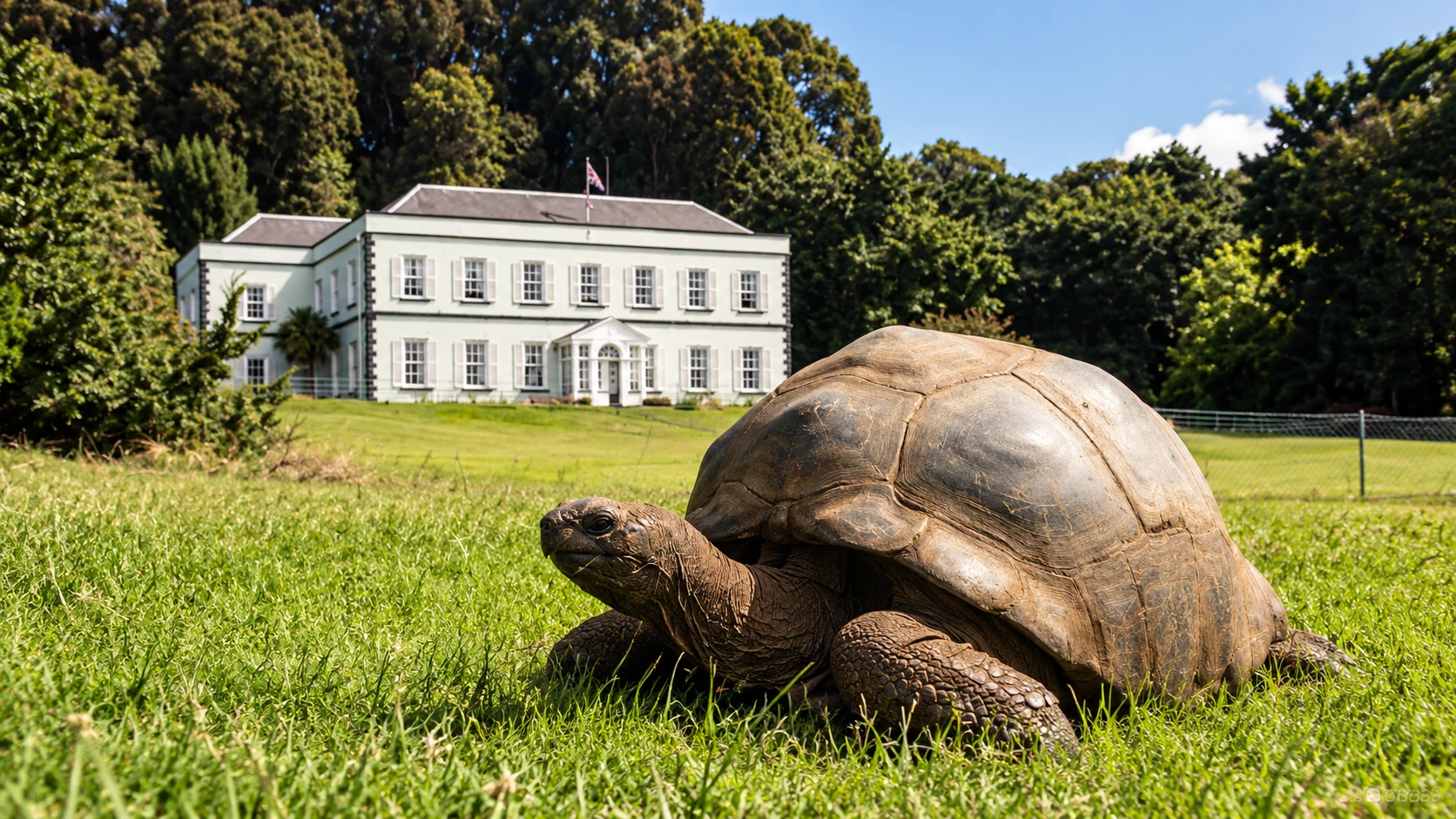
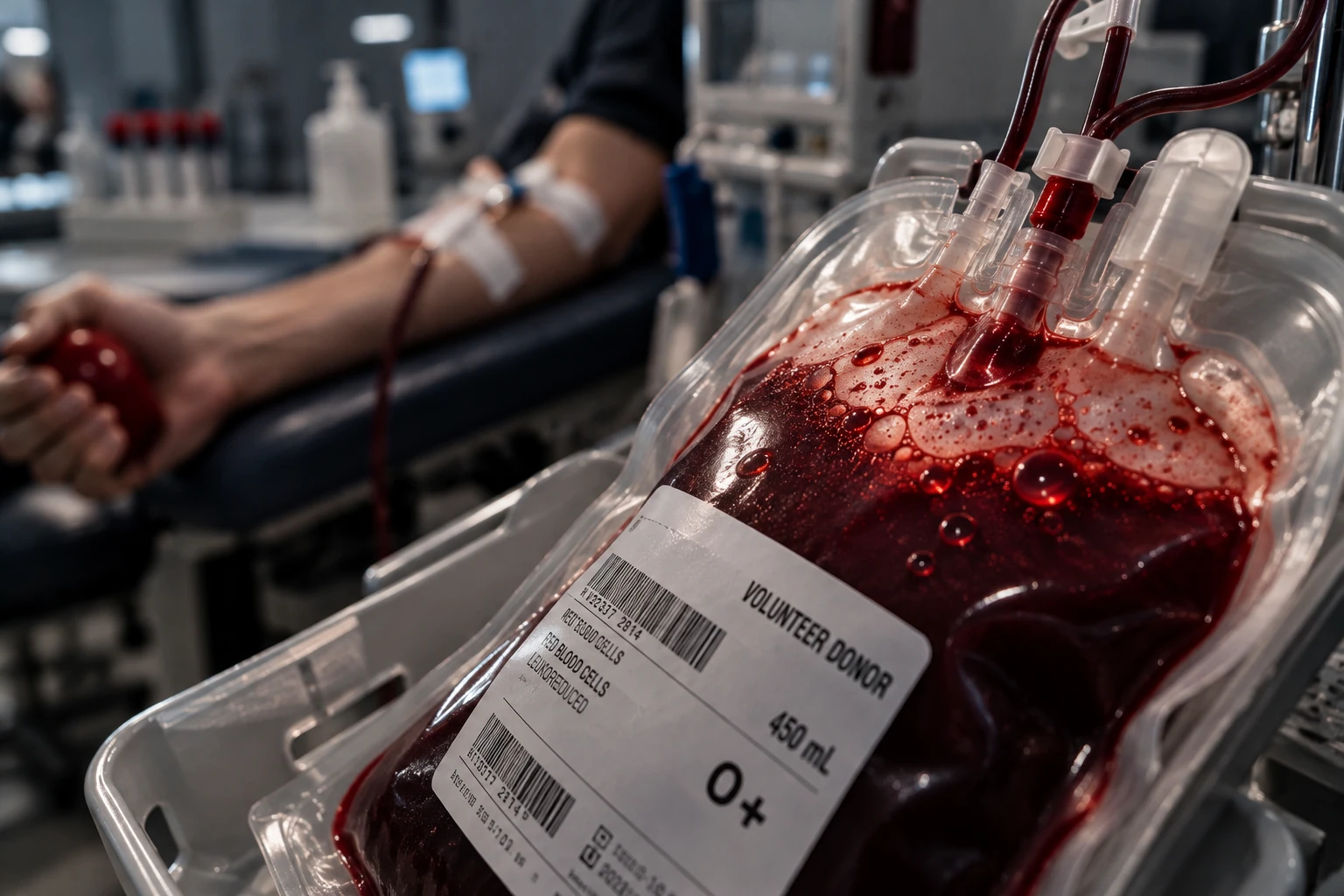
PRESDA’s features on Jonathan the giant tortoise and laboratory-grown blood explore different aspects of longevity and cell biology. A very long lifespan, tissue regeneration and life-cycle reversal are distinct achievements. Comparing them is useful precisely because they should not be collapsed into a single claim that all forms of aging can already be defeated.
The immortal jellyfish’s greatest lesson is that development can be more flexible than our familiar animal lives suggest. Its future is not written solely in the swimming form we recognize. Yet the wonder survives accurate limits: a tiny living organism can reorganize into another stage, while remaining vulnerable and scientifically incompletely understood. That is a profound discovery about life, without needing a promise of eternity.
Image disclosure: the hero is an AI-generated editorial illustration of a jellyfish in sunlit blue water. It is not an authentic scientific photograph, an exact anatomical depiction of Turritopsis dohrnii or a visual record of life-cycle reversal.
FAQ
Frequently Asked Questions
Is the immortal jellyfish really immortal?
The nickname describes its capacity to reverse development and potentially repeat its life cycle. It does not mean an individual cannot die, or that scientists have measured an infinite lifespan.
How does Turritopsis dohrnii become young again?
Under some conditions a medusa contracts into a cyst-like stage, produces a stolon and develops polyps. Those polyps can later bud new medusae. It does not turn back into a fertilized egg.
How big is Turritopsis dohrnii?
Its adult bell is approximately 4.5 millimetres across, according to the Natural History Museum. Size varies with development; the article’s AI hero is an illustration, not a size reference.
Does every stressed jellyfish successfully reverse?
No. Experimental success depends on conditions and the endpoint measured. A 2025 study of 102 newborn medusae reported that 22% failed to form cysts across its treatments. Cyst formation alone is not completion of the entire renewed cycle.
Can humans use jellyfish biology to reverse aging?
No human age-reversal treatment is demonstrated by these jellyfish studies. They provide hypotheses about cellular plasticity and repair, which require separate functional experiments and medical safety evaluation.
Has unlimited rejuvenation been observed in the wild?
Controlled laboratory studies demonstrate reversal. They do not establish how often individual animals complete repeated cycles in nature or prove that a wild individual lives indefinitely.
PRESDA Dispatch
Stay Informed. Stay Aware.
A sharp briefing across AI, gaming, sport, business, world affairs, paparazzi, and lifestyle.