CAN SCIENTISTS CREATE ARTIFICIAL BLOOD?
What lab-grown red cells and artificial oxygen carriers can do, what RESTORE and Japanese trials have shown, and why donated blood remains essential.
Scientists can grow human red blood cells outside the body and build particles that carry oxygen. What they have not established is a fully functional manufactured replacement for all of human blood. The most useful question in October 2026 is therefore not whether artificial blood exists, but which function a product replaces, what has been tested in people and what remains experimental.
This investigation separates three things: biological red cells made in culture, non-cellular oxygen carriers and complete blood. Evidence was checked through October 10, 2026. Trial registration, permission to conduct a study and completion of follow-up do not equal proven clinical benefit or routine regulatory approval. In particular, the reviewed sources do not yet establish final comparative RESTORE results or patient efficacy for Japan’s NMU-HbV.
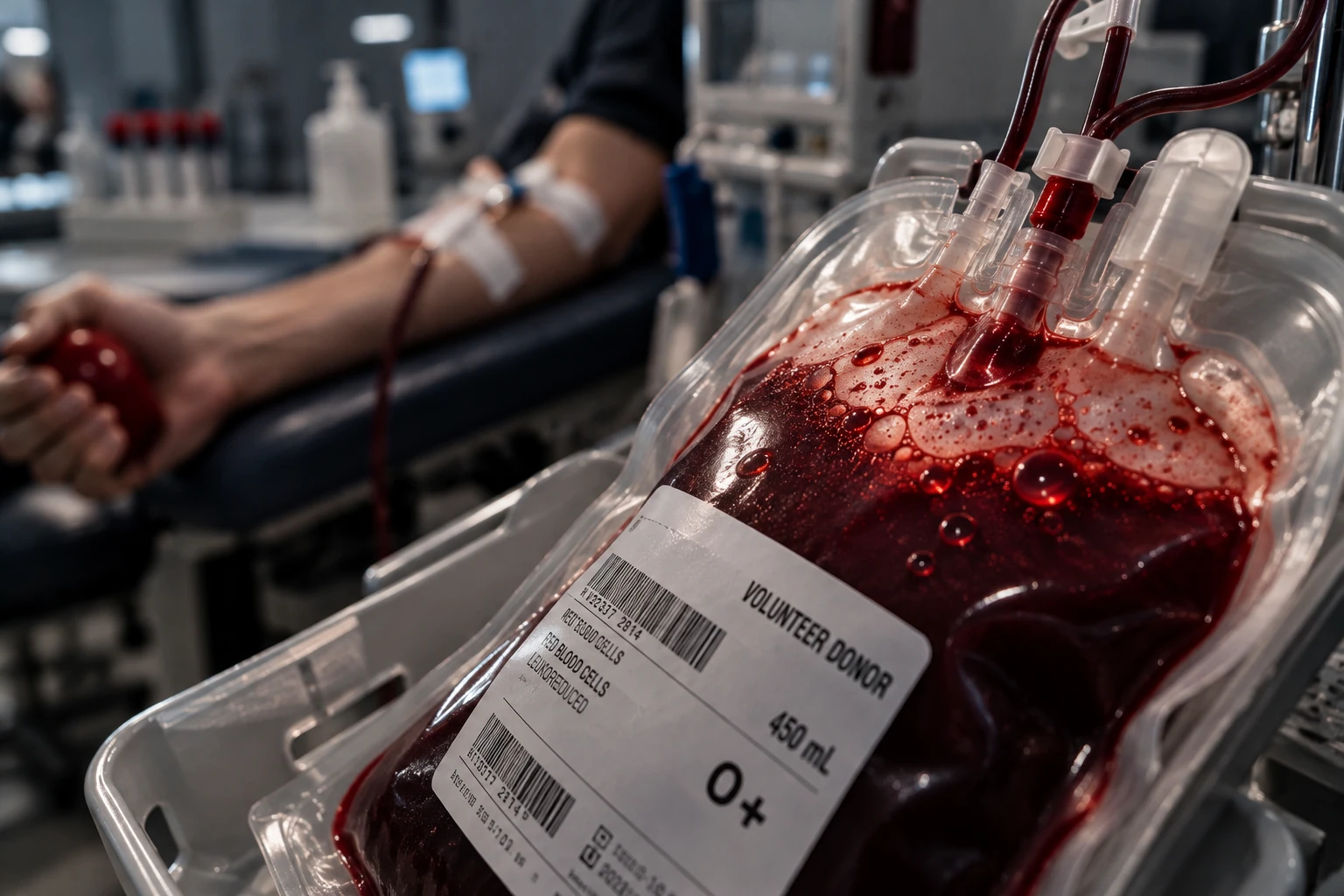
Illustration note: the donation-bag hero is an AI-generated editorial illustration, not a photograph of a RESTORE participant, Japanese trial or approved artificial-blood product. The depicted bag and label are not evidence of a real transfusion, dose or universal compatibility.
Blood is a system, not just a red liquid
NIH’s explanation of blood components distinguishes oxygen-carrying red cells, immune white cells, platelets that help stop bleeding and the liquid plasma. Hemoglobin inside red cells binds oxygen for delivery to tissues. Plasma contains proteins and other substances; clotting relies on more than oxygen transport. Reproducing one of these functions does not reproduce the entire system.
The clinical need is real: compatible donated red cells can be difficult to obtain for people with rare blood-group combinations or antibodies from previous transfusions. Emergencies can occur far from a blood bank. A storable oxygen carrier might buy time until blood arrives; cultured cells might supply unusually difficult matches. These are different problems, so the best product for one would not necessarily solve the other.
How a laboratory grows a red blood cell
RESTORE uses CD34-positive stem/progenitor cells isolated from adult donor blood. Researchers expand these cells and guide them through red-cell development with controlled nutrients and signals. They then obtain young red cells, called reticulocytes, and remove unwanted cells and material. The intended transfusion product is a biological cell, not a synthetic chemical and not a stem-cell transplant. Culturing cells does not automatically remove their blood-group markers.
A 2011 Blood study provided an early human proof of principle by reinfusing cultured cells into the person whose stem cells had supplied them. That autologous experiment should not be erased by later world-first headlines. RESTORE asks a different question: a controlled comparison of donor-derived cultured cells and standard cells in other, compatible volunteers. An early feasibility experiment is not evidence of a mass-market replacement.
The BEL-A work published in Nature Communications in 2017 demonstrated a continuously expandable adult erythroid cell line that can produce functional young red cells. Such lines, and research using induced pluripotent stem cells, offer possible routes beyond repeatedly collecting starting cells. However, expansion, maturation, removal of residual nucleated cells and quality control remain distinct challenges. A laboratory cell line is not itself a licensed transfusion product.
RESTORE: what the UK trial has actually established
NHS Blood and Transplant describes RESTORE as a phase I randomised, single-blind crossover trial, led by Cedric Ghevaert and Rebecca Cardigan with UK academic and clinical partners. Healthy recipients receive cultured red cells and standard red cells from the same donor at separate visits. The official ISRCTN42886452 record specifies safety, cell survival and recovery measurements. The comparison is designed to test the hypothesis that a uniformly young cell population lasts longer.
The November 2022 launch report described mini-transfusions of around 5–10 mL and said the first two recipients had no reported untoward effects. Those were initial observations, not the final safety analysis or proof of improved survival. Healthy-volunteer mini-doses also cannot establish that full therapeutic doses benefit patients with sickle cell disease, thalassemia or severe bleeding.
NIHR BioResource reported on February 11, 2026 that the final batch had been produced and given to volunteers. NHSBT’s current translational-projects page says follow-up is complete and results are expected in 2026 or 2027. As of this review, that is a delivery and follow-up milestone, not a published finding that cultured cells last longer. No final effect size or successful therapeutic outcome is invented here.
Japan’s hemoglobin vesicles are a different technology
The Japanese programme associated with Nara Medical University and collaborating institutions packages purified human hemoglobin inside lipid capsules called hemoglobin vesicles, or HbVs. The product NMU-HbV mimics an oxygen-carrying role without being a living red cell. Its human hemoglobin starting material also means it should not be called entirely synthetic or inherently independent of donated material. The capsule is intended to isolate hemoglobin from direct interactions that have troubled older carriers.
The first human study, published in Blood Advances in 2022, investigated doses up to 100 mL in healthy volunteers. Infusion reactions and fever occurred; one infusion was stopped after a rash. Reported abnormalities resolved, and the small pharmacokinetic analysis found a circulation half-life of roughly eight hours. That is preliminary safety and clearance evidence, not a demonstrated survival benefit in people suffering hemorrhagic shock. Nor should an eight-hour estimate from that dose be treated as the duration of every future formulation.
The January 22, 2026 BMJ Open paper is a phase Ib protocol, not a results paper. It proposes 16 healthy adults in four cohorts: two 100 mL cohorts with different infusion rates, then 200 mL and 400 mL cohorts. Safety and pharmacokinetics are the endpoints. The 400 mL figure is a planned study dose, not an established effective dose, an approved blood unit or confirmation that all participants received it.
The official Japanese registry entry jRCT2051240249 is listed as not recruiting when checked on October 10. That status does not disclose final efficacy results. The protocol’s planned end in June 2026 is a schedule, not proof of a completed, successful study. Later registry changes and eventual results must be assessed separately. Animal hemorrhage experiments cannot be substituted for patient outcomes.
PRESDA Data Graphics
Evidence checked October 10, 2026
Dose volumes refer to different products and study designs. They cannot be compared as measures of benefit or clinical readiness.
UK: RESTORE
- Phase I, randomised crossover in healthy volunteers.
- 2022 launch report: mini-transfusions around 5–10 mL.
- Final batch administered by the February 2026 update; follow-up complete.
- NHSBT expects results in 2026 or 2027. Longer cell survival is not yet established by final results.
Japan: NMU-HbV
- Phase Ib open-label dose-escalation protocol, published January 2026.
- Target: 16 healthy volunteers. Planned cohorts: 100, 100, 200 and 400 mL.
- Official registry: not recruiting when checked October 10.
- Planned doses and registry status do not establish efficacy in bleeding patients or routine approval.
Oxygen carriers: hemoglobin versus synthetic chemistry
FDA researchers describe hemoglobin-based oxygen carriers as modified or engineered hemoglobin products. Outside a protective red cell, hemoglobin can undergo harmful oxidation and affect blood vessels. Earlier products raised concerns including high blood pressure and cardiovascular complications. Lipid encapsulation and other designs aim to reduce those problems, but a plausible design is not proof of safety. Different carriers must be judged individually rather than declared safe or unsafe as one interchangeable class.
A 2026 scoping review of perfluorocarbon research covers another route: fluorinated compounds that dissolve gases, delivered in emulsions. They do not use hemoglobin to bind oxygen. Their performance depends on oxygen conditions, formulation and clearance, with much of the translational evidence coming from animal or laboratory studies. PFCs, hemoglobin vesicles and cultured red cells should not be described as the same material merely because all appear under the label artificial blood.
How the approaches compare with donated blood
Standard donated red-cell components have an established clinical role. Cultured cells seek to reproduce that component, while oxygen carriers seek a temporary function. None of the experimental approaches below supplies a complete combination of red cells, platelets, plasma clotting proteins and immune cells. The comparison separates demonstrated human testing from research ambitions; it does not rank the products by efficacy using incomparable trials.
PRESDA Data Graphics
Evidence checked October 10, 2026
An oxygen carrier is not whole blood. Status is specific to the product and indication; these rows are not an efficacy ranking. Scroll horizontally on small screens.
| Approach | Material and intended function | Compatibility | Evidence and clinical status |
|---|---|---|---|
| Donated red-cell componentSource | Biological cells; established oxygen transport | Donor–recipient matching and testing | Established clinical use; not the same as whole blood |
| Cultured red cells / RESTORESource | Biological young red cells grown from donor stem cells | Blood-group markers retained; matched recipients | Phase I mini-dose study; follow-up complete, final comparative results awaited |
| Hemoglobin vesicles / NMU-HbVSource | Human hemoglobin inside lipid capsules; oxygen-carrier aim | No ordinary red-cell ABO surface; reactions still possible | Phase Ib healthy-volunteer study; protocol is not an efficacy result |
| Cell-free modified hemoglobin / HBOCsSource | Chemically modified or engineered hemoglobin | No ordinary red-cell surface; product-specific safety | HBOC-201 has an expanded-access record; not FDA marketing approval |
| Perfluorocarbon emulsionsSource | Fluorinated compounds dissolve oxygen | Not biological red cells; formulation risks remain | Product-specific research; much current evidence is preclinical |
Blood groups and the limits of universal blood
NHS Blood Donation explains why O negative red cells are important in emergencies. The term universal red-cell donor is not a statement that a whole blood bag or every component is universally interchangeable. ABO and RhD are not the only clinically relevant markers. RESTORE’s registry requires compatibility testing; selected donors with rare profiles could be valuable precisely because manufactured red cells retain biological identities.
An acellular capsule does not carry a normal red-cell surface with ABO antigens, which makes broad compatibility an attractive aim. But avoiding that particular mismatch does not prevent reactions to capsule ingredients or eliminate every immune and physiological risk. Genetically changing cultured cells’ antigen expression is another research direction, not evidence that RESTORE has already created a universally compatible product. Matching, screening and clinical monitoring remain essential to the studies.
Where a successful product could help
Rare-group patients and people needing repeated transfusions are plausible early beneficiaries of cultured red cells. If longer survival is demonstrated, fewer transfusions might reduce the burden of visits and cumulative iron loading. That chain of benefit is conditional; RESTORE has not yet proved it in those patients. Red-cell availability also matters in some cancer care, where treatment or disease can impair blood production.
For emergency care and surgery, a shelf-stable oxygen carrier could potentially support oxygen delivery when compatible red cells are unavailable. It would still not stop the source of bleeding or supply all clotting components. Claims about easy storage, long shelf life and universal use must be verified for the specific finished product and setting. A deployment advantage in a remote area is a research goal until appropriate safety, efficacy and logistics are established.
The manufacturing problem: quality before volume
Freire and colleagues’ January 2026 Scientific Reports study showed that changing lipid supplementation altered cultured reticulocyte yield and characteristics. Cells grown with the tested plasma source had cholesterol-related deficits; cholesterol supplementation rescued many defects. This was laboratory evidence about a particular culture system, not a clinical RESTORE result. It illustrates why counting cells is insufficient: deformability, membrane integrity and function matter.
Commercial manufacturing would require reproducible batches, suitable growth media, sterile closed processing, purification, testing, storage and distribution. Moving from a mini-dose to therapeutic quantities can increase resource needs and reduce the proportion of usable cells. Cell lines may ease sourcing, but do not automatically solve maturation or purification. The reviewed trial reports do not establish a validated commercial per-unit price for RESTORE cells or NMU-HbV, so cost targets are not presented as audited production costs.
Safety, approval and exceptional access
Cultured-cell studies must assess survival, hemolysis, immune responses and contamination control. Oxygen-carrier trials also need to assess vascular effects, oxidation, reactions and how the product is cleared. Small healthy-volunteer studies cannot reliably detect uncommon harms or establish safety during repeated dosing in critically ill patients. Trial authorisation allows research under specified conditions; it does not authorise unrestricted routine transfusion.
Regulatory status is product- and country-specific. ClinicalTrials.gov documents HBOC-201 (Hemopure) under an expanded-access study, while FDA explains that expanded access concerns investigational products. Exceptional access is not marketing approval. The FDA approved-products list is a separate regulatory reference. The reviewed RESTORE and NMU-HbV records do not establish routine approval for those products or a complete artificial replacement for human blood.
Realistic next steps, without a promised launch date
RESTORE’s next visible milestone is publication of comparative safety and survival results. Japan’s phase Ib programme needs dose-escalation results before claims about efficacy in emergency patients. Useful results would guide further patient studies, manufacturing validation and regulatory review. A projected trial-end date is not a hospital availability date, and neither programme provides a verified date when donations can stop.
Beyond transfusion support, researchers explore cultured red cells as delivery vehicles and oxygen carriers for targeted medical applications. These should be labelled by their actual stage, often preclinical, and assessed for the intended use. An organ-preservation application, a laboratory disease model and an intravenous treatment for bleeding are different indications; success in one cannot establish effectiveness in the others.
Could artificial blood replace donations?
The realistic near-term prospect is complementing donations for selected needs. RESTORE begins with donor-derived cells, and Japan’s vesicles use purified human hemoglobin. Even a successful oxygen carrier would not remove demand for platelets, plasma or other donor products. NHSBT’s stated expectation is limited initial use for people with complex transfusion needs, with donors remaining essential for the foreseeable future.
The scientific achievement is substantial: researchers can manufacture biological oxygen-carrying cells and test engineered carriers in humans. The remaining clinical task is equally substantial: show benefit at useful doses with acceptable risks and reliable supply. For context on evidence and treatment progress, read PRESDA’s 50 years of cancer research and human genetic similarities and differences. Neither a vivid laboratory image nor a promising trial protocol can replace clinical results.
FAQ
Frequently Asked Questions
Have scientists created a complete replacement for human blood?
No complete manufactured replacement is established by the reviewed evidence. Cultured red cells and oxygen carriers replace or aim to replace specific functions.
Are the final RESTORE results available?
The reviewed NHSBT update says follow-up is complete and results are expected in 2026 or 2027. Final comparative results were not established as of October 10, 2026.
Is Japan’s artificial blood approved for routine use?
The reviewed NMU-HbV records describe an experimental phase Ib safety study, not routine marketing approval or proven patient efficacy.
Are lab-grown red cells automatically universal?
No. They retain blood-group characteristics and RESTORE requires compatibility testing.
Will this make blood donation unnecessary?
Not in the foreseeable future. The technologies target selected functions and needs, and some also start with donor-derived material.
PRESDA Dispatch
Stay Informed. Stay Aware.
A sharp briefing across AI, gaming, sport, business, world affairs, paparazzi, and lifestyle.