HUMANS AND APES: WHY DO WE SHARE 98% OF OUR DNA?
What 98–99% human and ape DNA similarity measures, why estimates vary, and what chromosome 2 and gene regulation reveal about our shared ancestry.
A chimpanzee’s face can feel familiar before a single genome is examined. The resemblance has a deeper explanation: humans, chimpanzees and bonobos inherited much of their biology from common ancestors. The famous claim that we share 98–99% of our DNA captures part of that relationship. It does not mean that two complete genomes are identical except for a neatly defined remaining percentage.
The essential qualifier is alignment. NHGRI’s account of the 2005 comparison described directly comparable human and chimpanzee sequences as almost 99% identical. Its broader calculation, including insertions and deletions, was 96%. Those are different summaries of a historical comparison, not competing measurements of one universal quantity.
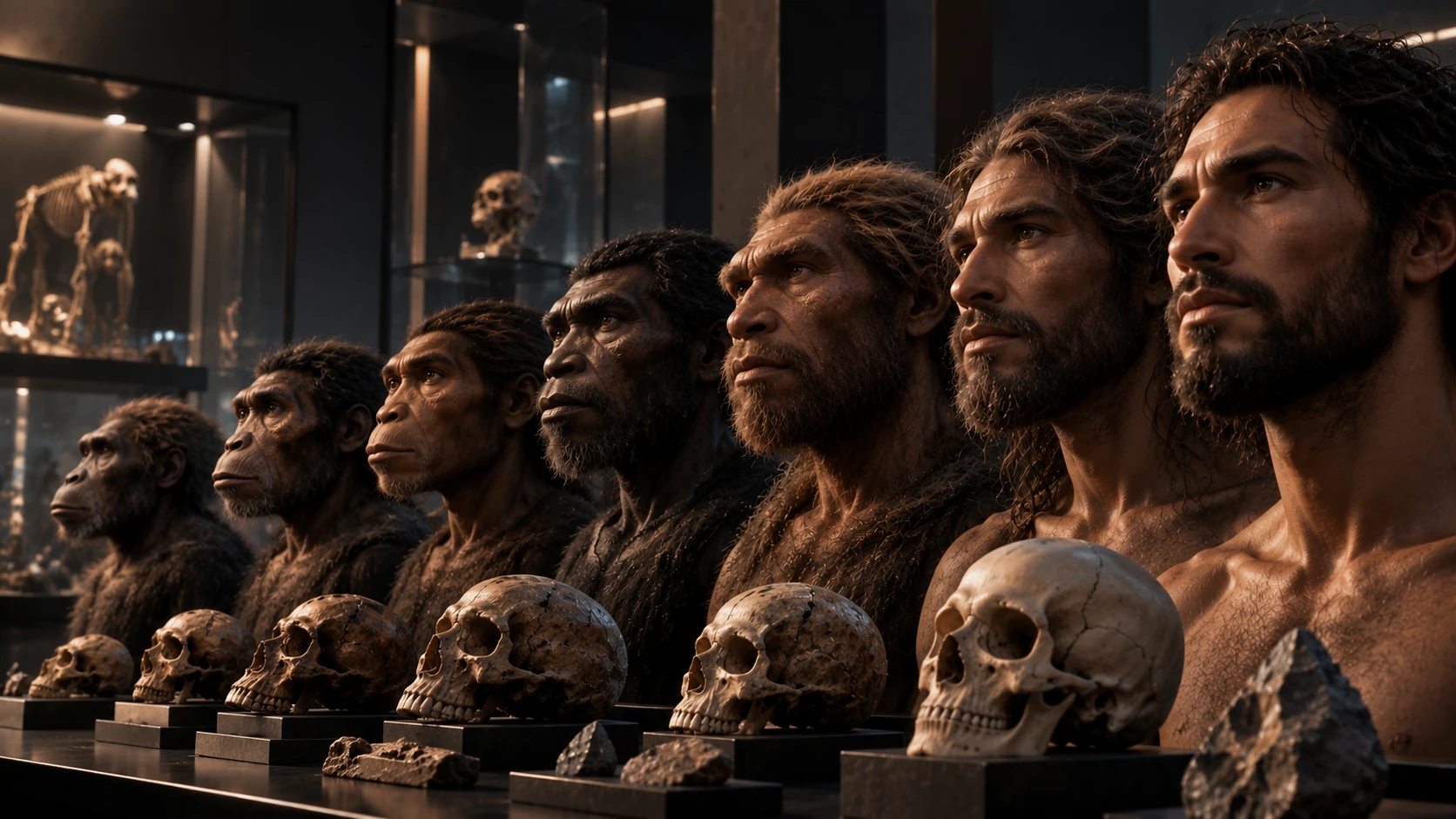
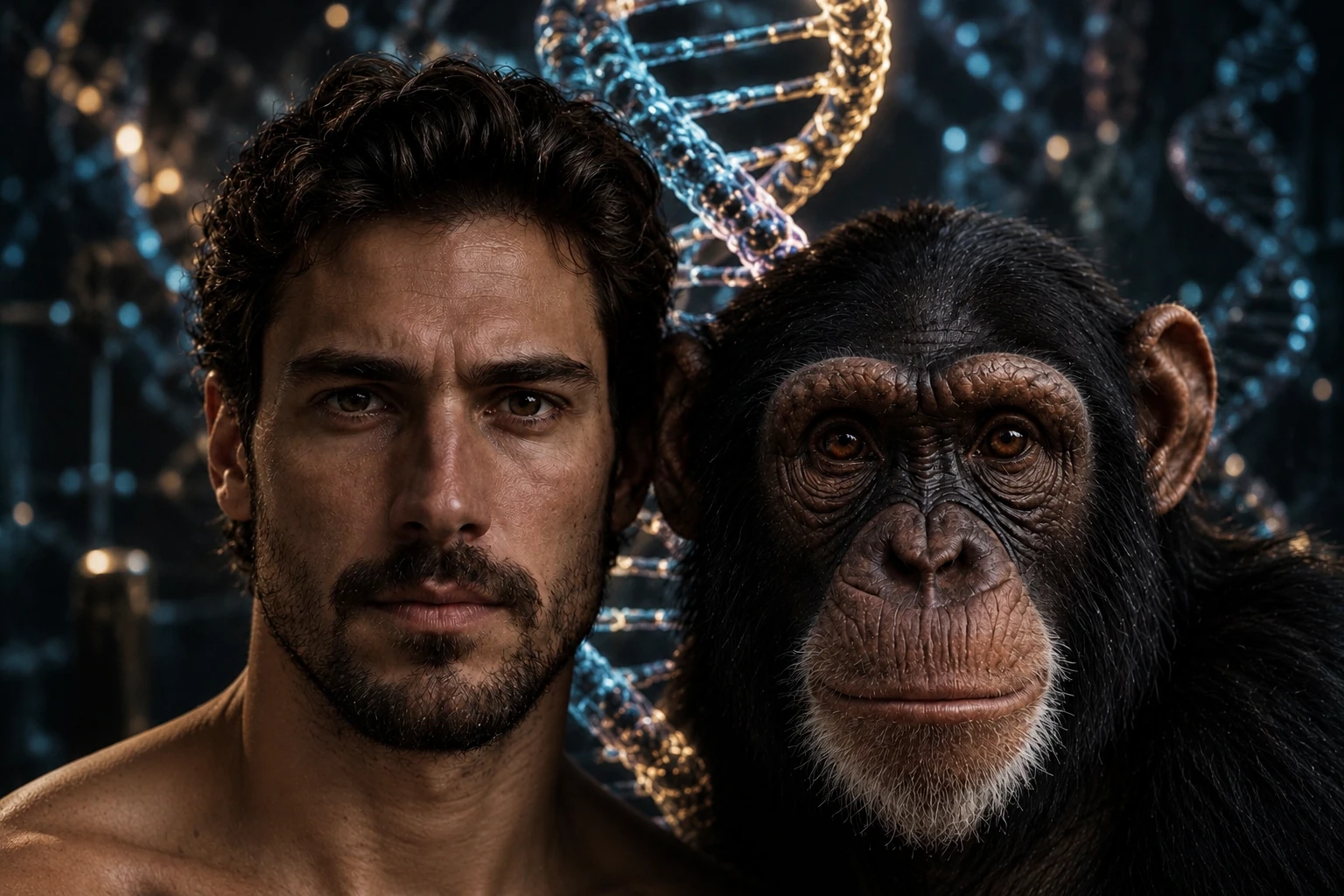
Illustration: the hero is an AI-generated conceptual image of a human, a chimpanzee and a DNA motif. It is not a photograph of a genetic experiment, an identified research participant or an ancestral individual.
What does 98–99% actually measure?
DNA is a sequence written in four chemical bases, conventionally abbreviated A, C, G and T. Sequencing reads their order. Comparing genomes then requires finding corresponding stretches inherited from the same ancestral regions. In a matched stretch, researchers can count positions where one base differs. That is one useful definition of sequence identity. NHGRI explains the sequencing process.
But evolution also adds or removes stretches, duplicates genes, reverses segments and changes repetitive DNA. A base-by-base comparison of alignable regions cannot summarize all those events. Results depend on the reference genomes, which regions are included, alignment rules and treatment of gaps. The original chimpanzee genome paper compared draft assemblies, not two perfect inventories of every sequence in every member of either species.
In 2025, complete ape genome assemblies published in Nature opened difficult repetitive and structurally complex regions to much better analysis. The study covered chimpanzees, bonobos, gorillas, two orangutan species and the siamang. It separates single-nucleotide differences from structural and alignment-gap divergence. A region that is difficult to align is not automatically unrelated DNA. Improved assemblies refine the comparison; they do not erase the evidence for common ancestry.
Selected published comparisons, not a ranking of whole-genome identity. The two 2005 figures use different treatments of gaps; the 2012 figures use single-copy autosomal regions.
Human / chimpanzee
Almost 99%: directly comparable DNA, NHGRI 2005
Human / chimpanzee
96%: historical calculation including insertions and deletions, NHGRI 2005
Human / bonobo
98.7%: corresponding single-copy autosomal regions, Nature 2012
Chimpanzee / bonobo
99.6%: the same region category, Nature 2012
Sources: NHGRI 2005; Nature 2012, single-copy autosomal comparison
PRESDA Data Graphics
Chimpanzees, bonobos, gorillas and orangutans
Chimpanzees and bonobos, the two living species of Pan, are equally our closest living relatives in the species tree. The 2012 bonobo genome study found 98.7% identity to human DNA and 99.6% to chimpanzee DNA in corresponding single-copy autosomal regions. Those values have a stated denominator. They are not percentages of personality, intelligence or total biological similarity, and should not be mixed uncritically with estimates from other methods.
Gorillas branched off earlier than the human–Pan split; orangutans belong to an earlier-diverging great ape lineage. That overall tree can coexist with different histories for individual DNA segments. The gorilla genome study found that some regions group a gorilla sequence more closely with a human or chimpanzee sequence. This reflects ancestral variation retained across successive splits, called incomplete lineage sorting. It does not make gorillas our closest living relatives overall.
Schematic species relationships. Branch lengths do not represent time. Orangutans and gorillas include multiple living species; all tips represent living lineages.
Orangutans
Earlier-diverging great ape branch
Gorillas
Branch before the human–Pan common ancestor
Humans
Sister lineage to Pan
Chimpanzees + bonobos
Two species of Pan; equally close living relatives of humans
Sources: Smithsonian, Genetics; Nature 2012, gorilla genome
PRESDA Data Graphics
A common ancestor, not a modern chimpanzee
The Smithsonian’s genetic overview places the human–chimpanzee common ancestor approximately 8–6 million years ago. The interval is an estimate, not a dated meeting between two individuals. Fossils and genetic models constrain the history in different ways. Both descendant lineages continued evolving. A modern chimpanzee is therefore a relative, not an unchanged portrait of our ancestor. The 2025 complete-genome study’s model estimated a human–chimpanzee split of 5.5–6.3 million years ago. Different mutation-rate assumptions, models and sampled regions help explain why estimates vary. The broader 6–8-million-year framing should not be treated as an exact date. 2025 genomic model.
Evolution is a branching history, not a ladder with humans at its inevitable summit. Chimpanzees and bonobos separated from one another later, approximately two million years ago in the bonobo study’s reconstruction. Gorillas and orangutans also have their own evolutionary histories. “Why are there still apes?” is answered by the same principle that allows related species to coexist: one surviving branch need not replace another.
Chromosome 2: a visible signature of ancestry
Humans normally have 46 chromosomes, while other living great apes have 48. Human chromosome 2 corresponds to two ancestral chromosomes that fused. A 1991 molecular study identified opposing telomeric repeat sequences inside the chromosome, where an ancient junction would be expected. Later analysis of the fusion region reinforced the correspondence with ancestral chromosome ends. One centromere remained active; the other was inactivated.
The fusion is evidence of descent with modification, not proof that one rearrangement created human language or intelligence. Chromosome number does not measure complexity. Nor does the evidence establish a precise fusion date simply from the estimated human–Pan split. The important point is the agreement between chromosome structure and the broader family tree.
Conceptual diagram, not to scale. Two ancestral chromosomes fused; this is not a depiction of modern chimpanzee chromosomes physically becoming human.
Two ancestral chromosomes
Each originally had ends and a centromere
Internal fusion junction
Opposing remnants of telomeric repeats
Human chromosome 2
One active centromere and an inactivated ancestral centromere
Sources: PNAS 1991, fusion junction; Genome Research 2002, fusion structure
PRESDA Data Graphics
Shared biology, different development
Shared ancestry helps explain the same basic arrangement of organs and limbs, and conserved cellular machinery for growth, metabolism and DNA maintenance. Many corresponding genes participate in similar biological processes. Yet a gene list is not a blueprint that develops independently of context. Comparative genomics studies conserved sequences and their functions, including regulatory regions that influence when and where genes are used.
Changes to protein sequences, gene dosage, regulatory switches and developmental timing can matter without replacing most of the genome. A 2019 study of brain organoids compared human, chimpanzee and macaque development at single-cell resolution, identifying differences in maturation and gene regulation. Organoids are laboratory models of aspects of development. They do not reproduce an entire brain, a culture or a capacity for language.
A Science experiment in 2020 showed that expression of the human-specific gene ARHGAP11B increased neocortical size and folding in fetal marmosets. This is evidence for a developmental mechanism in an experimental setting, not a demonstration that a gene makes an animal human or confers human intelligence. Brain evolution involves interacting changes; language and cognition cannot be reduced to a single DNA percentage or one molecular switch.
From genetic change to Homo sapiens
Mutations supply variation; their fate depends on more than usefulness. Natural selection can favor heritable variants that affect reproductive success in a particular environment. Genetic drift also changes variant frequencies through chance, especially in small populations. Migration and demographic history matter too. It is therefore incorrect to assume that every difference between a human and a chimpanzee was selected because it helped produce modern human abilities.
The emergence of Homo sapiens is much more recent than the human–Pan split. The Jebel Irhoud fossils combine a relatively modern facial form with a more elongated braincase; associated heated flints were dated to about 315,000 years ago, with uncertainty of ±34,000 years. They help document early sapiens evolution, not the six-million-year-old common ancestor. Read our Jebel Irhoud feature for the discovery’s context.
Genomes reconstruct relationships and changes in inherited sequences; fossils record bodies in particular places and periods. Neither is a complete history on its own. Early hominin classification, the identity of the human–Pan last common ancestor and many behavioral transitions remain unresolved. Our Human Family Tree follows the later branches without turning human evolution into a straight line.
Selected milestones, not equal-duration intervals. Divergence estimates are approximate; fossil dating has its own uncertainty.
About 8–6 million years ago
Human and Pan ancestral lineages diverge
About 2 million years ago
Chimpanzee and bonobo lineages diverge: 2012 genomic estimate
315,000 ±34,000 years ago
Heated flints associated with Jebel Irhoud early Homo sapiens fossils
2005 → 2025
Draft chimpanzee comparison to complete ape genome assemblies
Sources: Smithsonian; Nature 2012; Nature 2017, fossil dating; Nature 2025
PRESDA Data Graphics
What the percentage cannot tell us
“Humans are not apes” confuses an everyday word with biological classification: humans belong within the great apes. “The remaining 1–2% explains everything human” mistakes a comparison statistic for a causal explanation. “Chimpanzees stopped evolving” mistakes a living relative for a fossil. And “more similar DNA means identical minds” overlooks development, bodily organization, learning and environment. Each claim asks a percentage to answer a question it was not designed to measure.
Our place in nature is neither erased by the similarities nor fully explained by the differences. Genetic evidence puts humans inside an old, branching family of primates. It also gives researchers precise questions to investigate: which changes affect development, which reflect demographic history, and how do they interact? The strongest conclusion is not that humans are “98% chimpanzee.” It is that shared ancestry leaves measurable traces, and that those traces require careful interpretation.
FAQ
Frequently Asked Questions
Do humans share 98–99% of their whole genome with chimpanzees?
The familiar figure describes selected aligned DNA comparisons. Whole-genome comparisons depend on how insertions, deletions, structural variation and difficult-to-align regions are counted.
Did humans evolve from modern chimpanzees?
No. Humans and chimpanzees descend from shared ancestors; both lineages continued evolving.
Are chimpanzees or bonobos closer to humans?
Both are equally our closest living relatives in the species tree, although individual DNA segments can have different histories.
What is the evidence for chromosome 2 fusion?
Corresponding ancestral chromosomes, internal opposing telomeric repeats and the remnant of an inactivated centromere support an ancient fusion.
Does one gene explain human intelligence?
No. Gene regulation, developmental timing, protein changes and environment interact. Experimental effects on brain development are not demonstrations of human intelligence.
PRESDA Dispatch
Stay Informed. Stay Aware.
A sharp briefing across AI, gaming, sport, business, world affairs, paparazzi, and lifestyle.