THE 773,000-YEAR-OLD FOSSILS RESHAPING THE HUMAN STORY
Jaws, teeth and a magnetic clock at Thomas Quarry I illuminate early Homo ancestry, without proving a single birthplace for modern humans.
Beneath the modern city of Casablanca, a quarry preserves a much older coast. Its cave sediments hold pieces of jaws, teeth and a spine from hominins who lived long before the earliest known members of our species. The remains are fragmentary. Their importance comes from the rare combination of anatomy and a geological clock that places them close to a crucial chapter in human evolution.
The fossils from the Grotte à Hominidés at Thomas Quarry I are dated to roughly 773,000 years ago. A study published in Nature on January 7, 2026 argues that they illuminate African populations near the ancestry shared by later Homo lineages. They are not identified as Homo sapiens, and the research does not establish Casablanca, or Morocco, as the single birthplace of modern humans. Hublin et al. (2026): original Thomas Quarry study
A DISCOVERY BUILT OVER DECADES
Thomas Quarry I lies in southwestern Casablanca, within the Oulad Hamida Formation. This is a landscape shaped by ancient shorelines, dunes, changing sea levels and sediment-filled cavities. The name Grotte à Hominidés refers to the fossil-bearing cave, not to every archaeological layer in the quarry. An older locality in the same complex preserves Acheulean stone tools dating to around 1.3 million years ago. Those tools and the 773,000-year-old fossils are different chronological records. Max Planck: research team and findings
A partial adult lower jaw was found in 1969 after quarrying had disturbed part of the cave. Systematic excavations between 1994 and 2015 recovered additional remains with much better recorded positions in the deposits. The 2026 publication is therefore an analysis and dating advance arising from sustained fieldwork, not a claim that every fossil was unearthed that January. Hublin et al. (2026): original Thomas Quarry study
That distinction matters. A bone without a reliable find position can still inform anatomy, but its age and association with other objects require additional justification. Controlled excavation preserves the relationships between finds and sediments. The French Ministry of Culture presents the Casablanca work as a continuing investigation of a particularly rich prehistoric landscape. French Ministry of Culture: Casablanca prehistory
WHAT THE FOSSILS ACTUALLY INCLUDE
The assemblage includes a nearly complete adult mandible, another adult half-mandible, a fragmentary child mandible, isolated teeth and vertebrae. The child was estimated to have died at no more than about 18 months. Eight vertebrae were found close beneath the nearly complete adult jaw; their proximity and small size suggest that they belonged to the same individual. That association is an inference, not a complete articulated skeleton. Hublin et al. (2026): original Thomas Quarry study
The recovered material offers several anatomical windows, but no full skull that would establish brain size or allow an exact facial reconstruction. Jaws and teeth are valuable precisely because their shapes can be compared with other fossils. They do not reveal an individual's language, thoughts, social identity or appearance in life.
A previously studied piece of thighbone bears carnivore damage. Together with animal remains and other traces, it supports the interpretation that the cave served as a carnivore den. The femur's exact position within two possible sedimentary units is less certain than that of the best-contextualized jaws. Gnawing can indicate consumption or scavenging; it does not by itself reconstruct a hunt or a person's final moments. Hublin et al. (2026): original Thomas Quarry study Max Planck: research team and findings
THE MAGNETIC CLOCK IN THE SEDIMENT
The central dating evidence comes from magnetostratigraphy. Magnetic minerals in sediments can preserve the direction of Earth's magnetic field at deposition. Researchers compare sequences of reversed and normal polarity with an independently established geological timescale. At Thomas Quarry I, the fossil-bearing deposits record the Matuyama–Brunhes transition, the most recent major polarity reversal. Max Planck: research team and findings
The original paper reports adding 119 new magnetic samples to 62 previously studied samples. The detailed sequence places the hominin-bearing layers near the transition's nominal age of 773,000 ± 4,000 years. This is an age framework for the deposits and their fossil assemblage. It is not a measurement of the exact year each individual died, and the magnetic transition itself took thousands of years. Hublin et al. (2026): original Thomas Quarry study
Dating is stronger when different observations fit together. Here, the geological sequence and comparisons with fossil animals support the magnetic interpretation. Earlier electron-spin-resonance and uranium-series estimates for teeth were younger. The authors explain why high uranium concentrations can lead to underestimation at this site and treat those results as minimum ages. The study reconciles methods rather than pretending that every laboratory measurement gave the same answer. Hublin et al. (2026): original Thomas Quarry study
READING ANATOMY WITHOUT INVENTING AN ANCESTOR
The team used micro-CT imaging, anatomical comparisons and three-dimensional shape analysis. Teeth can preserve an informative internal boundary between enamel and dentine even when their outer surfaces are worn. Researchers examine that structure alongside jaw proportions and other features. This is a comparative assessment of a suite of traits, not a classification based on one striking resemblance. Max Planck: research team and findings
The result is a mosaic. Some features retain older Homo patterns, while others resemble characteristics seen later in African and Eurasian populations. Antonio Rosas's accompanying Nature commentary places the discovery within the continuing problem of identifying common ancestry. A fossil can be close to an ancestral population without being demonstrably the direct ancestor of everyone who followed. Antonio Rosas: Nature scientific commentary
WHY THE SPECIES LABEL REMAINS OPEN
In their discussion, Hublin and colleagues suggest that the Thomas Quarry hominins probably represent an evolved North African form of Homo erectus in its broad sense. Their combination of features is distinct from the Spanish Homo antecessor material. The paper does not announce a newly named species, nor does it classify these individuals as modern humans. Hublin et al. (2026): original Thomas Quarry study
Species names for fragmentary Middle Pleistocene Homo remain contentious. In particular, Homo heidelbergensis has been used for fossils that may not form one coherent evolutionary group. This is why it is more accurate here to describe early Homo hominins and their proposed relationships than to impose a definitive label that the evidence has not settled. Antonio Rosas: Nature scientific commentary
SAPIENS, NEANDERTHALS AND DENISOVANS
The relevant question concerns populations near the divergence of the lineage leading to Homo sapiens and the lineage that later divided into Neanderthals and Denisovans. Genetic research has estimated the earlier split at roughly 765,000–550,000 years ago. Such estimates depend on models and mutation-rate assumptions. The Casablanca dating sits close to the older end of this context, rather than proving that a split happened at one exact moment. Posth et al. (2017): archaic genetic divergence
Homo antecessor from Atapuerca provides a useful comparison, not a missing rung on a guaranteed ladder. A 2020 study of ancient enamel proteins placed that Spanish population as a close sister lineage to later humans, Neanderthals and Denisovans. Anatomical similarities across regions therefore need interpretation: shared inheritance, retained older traits and independent change can all complicate a simple family tree. Welker et al. (2020): Homo antecessor proteins
The Casablanca study does not report an ancient genome from these individuals. Genetic findings from other populations inform the broader framework, while the quarry fossils are positioned principally through anatomy and chronology. No confirmed DNA pedigree joins a particular Thomas Quarry individual to Jebel Irhoud or to a living person. Hublin et al. (2026): original Thomas Quarry study
CASABLANCA IS NOT JEBEL IRHOUD
Jebel Irhoud is a separate Moroccan site and a separate discovery. Its fossils, interpreted as early Homo sapiens, were associated with heated flints dated to approximately 315,000 ± 34,000 years in research published in 2017. Their faces and teeth show important similarities to our species, while aspects of the braincase retained a more ancient shape. Read the fuller story in PRESDA's Jebel Irhoud feature. Richter et al. (2017): Jebel Irhoud dating Hublin et al. (2017): Jebel Irhoud anatomy
Approximate ages before present. Ordered evidence, not a direct ancestral chain or a scale of equal durations.
About 1.3 million years
Thomas Quarry I: older tool-bearing locality
Acheulean archaeology. Not the age of the hominin assemblage discussed here.
773,000 ± 4,000 years
Thomas Quarry I: Grotte à Hominidés
Early Homo fossils. Magnetostratigraphy anchors the deposits near a magnetic reversal.
315,000 ± 34,000 years
Jebel Irhoud: separate site
Early Homo sapiens. Thermoluminescence dating of associated heated flints.
Scientific sources: Hublin et al. (2026), Richter et al. (2017)
PRESDA Data Graphics
Using the central estimates, Thomas Quarry is about 458,000 years older. This subtraction is a useful orientation, not an exact interval free of dating uncertainty. Casablanca helps investigate a much earlier stage of Homo diversification. Jebel Irhoud helps investigate the emergence of our own species. Finding both in present-day Morocco does not make them the same population or establish a direct ancestral chain.
NORTH AFRICA RETURNS TO THE CENTRE OF THE QUESTION
The significance of North Africa is not that it replaces every other African region in the story. It adds evidence from a period and place that were poorly represented. The Sahara was not an unchanging wall throughout prehistory: shifting climates could open ecological connections. The researchers interpret the Casablanca animal assemblage as evidence of connections with other African regions, not of one permanently isolated population. Max Planck: research team and findings
Broader research also challenges the idea that Homo sapiens emerged from a single, neatly bounded founding group. Scerri and colleagues outlined the possibility of subdivided African populations connected intermittently over time. Ragsdale and colleagues later developed a genetic model involving a weakly structured ancestral stem. These are research frameworks with assumptions and competing interpretations, not maps locating a single birthplace. Scerri et al. (2018): African population structure Ragsdale et al. (2023): structured African ancestry
The work also highlights how knowledge is made. Moroccan and French field research, INSAP, geological expertise and international laboratories contributed different parts of the evidence. The preservation of a site, careful recording and long-term institutional cooperation can be as consequential as a spectacular object. Without that context, a jaw would be a far less precise witness to the past. French Ministry of Culture: Casablanca prehistory Max Planck: research team and findings
WHAT CHANGES, AND WHAT DOES NOT
The strongest contribution is a well-dated North African fossil assemblage relevant to a sparsely documented evolutionary interval. The authors interpret its anatomy as evidence for an African lineage close to the roots of later Homo diversification. That makes the material an important test for origin models, especially claims assigning our deeper ancestry primarily to Eurasia. Hublin et al. (2026): original Thomas Quarry study Antonio Rosas: Nature scientific commentary
It does not prove that these individuals were the last common ancestors themselves. It does not make them Homo sapiens, demonstrate a migration route across Gibraltar, or reveal the moment human consciousness began. A shared anatomical trait does not establish a boat journey; a secure date does not establish a complete genealogical relationship. Such claims would require evidence beyond the current assemblage.
Established observations
Jaws, teeth and vertebrae; a sedimentary age framework near 773,000 years.
Researchers’ interpretation
An African population close to the roots of later Homo lineages.
Not established
A direct ancestor, definitive species assignment, or a single birthplace of modern humans.
Scientific sources: Hublin et al. (2026)
PRESDA Data Graphics
Nor can ancient fossils be assigned modern nationality or used as biological certificates for contemporary identities. Casablanca is the present-day location of the research. The populations whose bones survived lived in a world with different landscapes and no modern political borders. The discovery belongs to the shared investigation of human origins.
THE QUESTIONS STILL WAITING IN THE ROCK
More fossils with comparable anatomical parts could test how widespread this combination of features was. Better regional sequences could clarify whether it persisted, changed or belonged to several populations. Additional molecular evidence, if recoverable, could help distinguish relationships that anatomy alone cannot settle. The 2020 protein work shows what such techniques can sometimes achieve elsewhere; it does not guarantee usable molecules at Thomas Quarry. Welker et al. (2020): Homo antecessor proteins
The unfinished nature of the story is its scientific strength. These remains narrow the distance between geological time and the people who occupied it without closing every evolutionary argument. Beneath Casablanca, an ancient coastline has supplied a rare reference point. What comes next is not a proclamation of where humanity began, but a more demanding comparison of evidence across Africa and beyond.
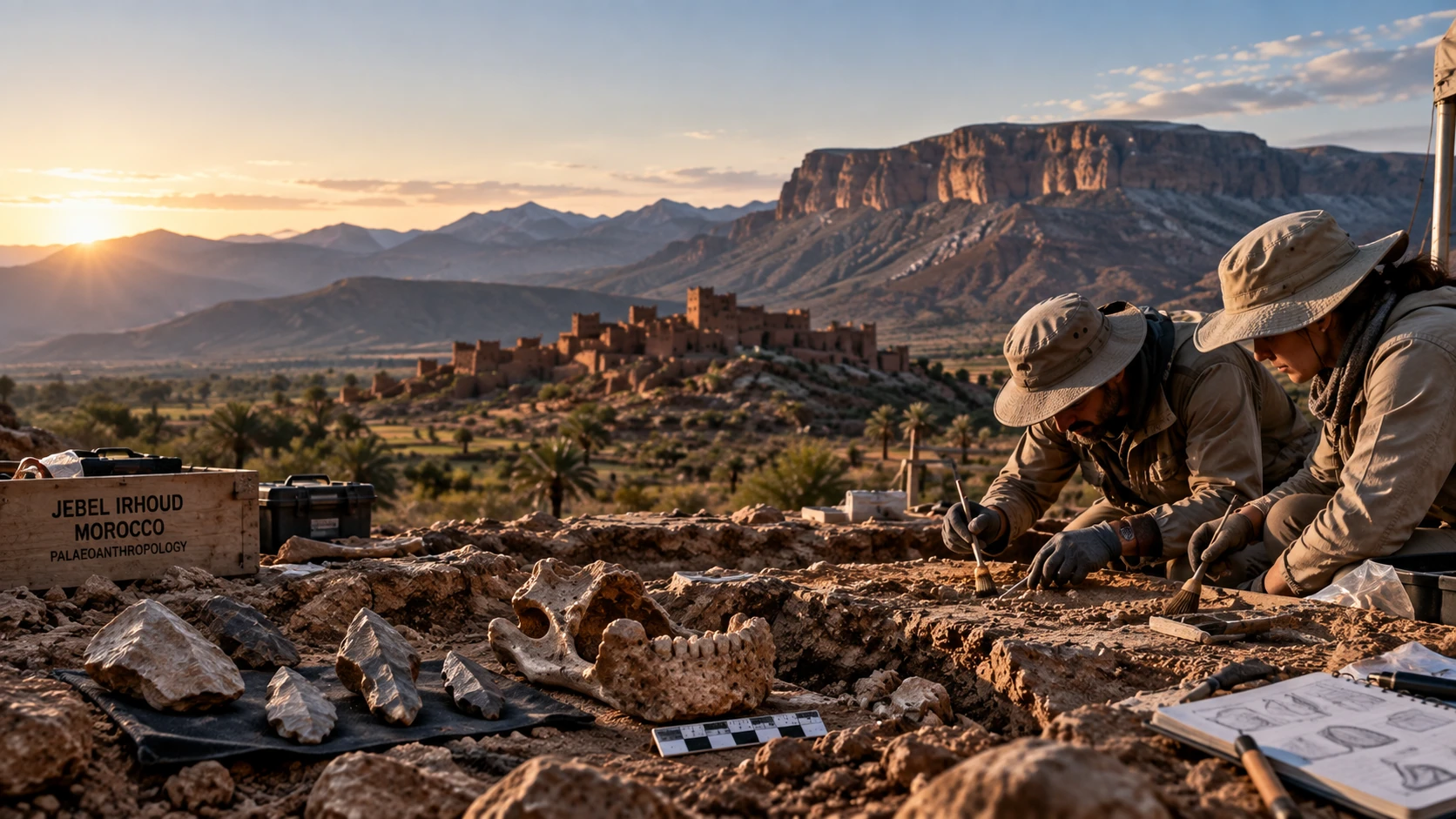
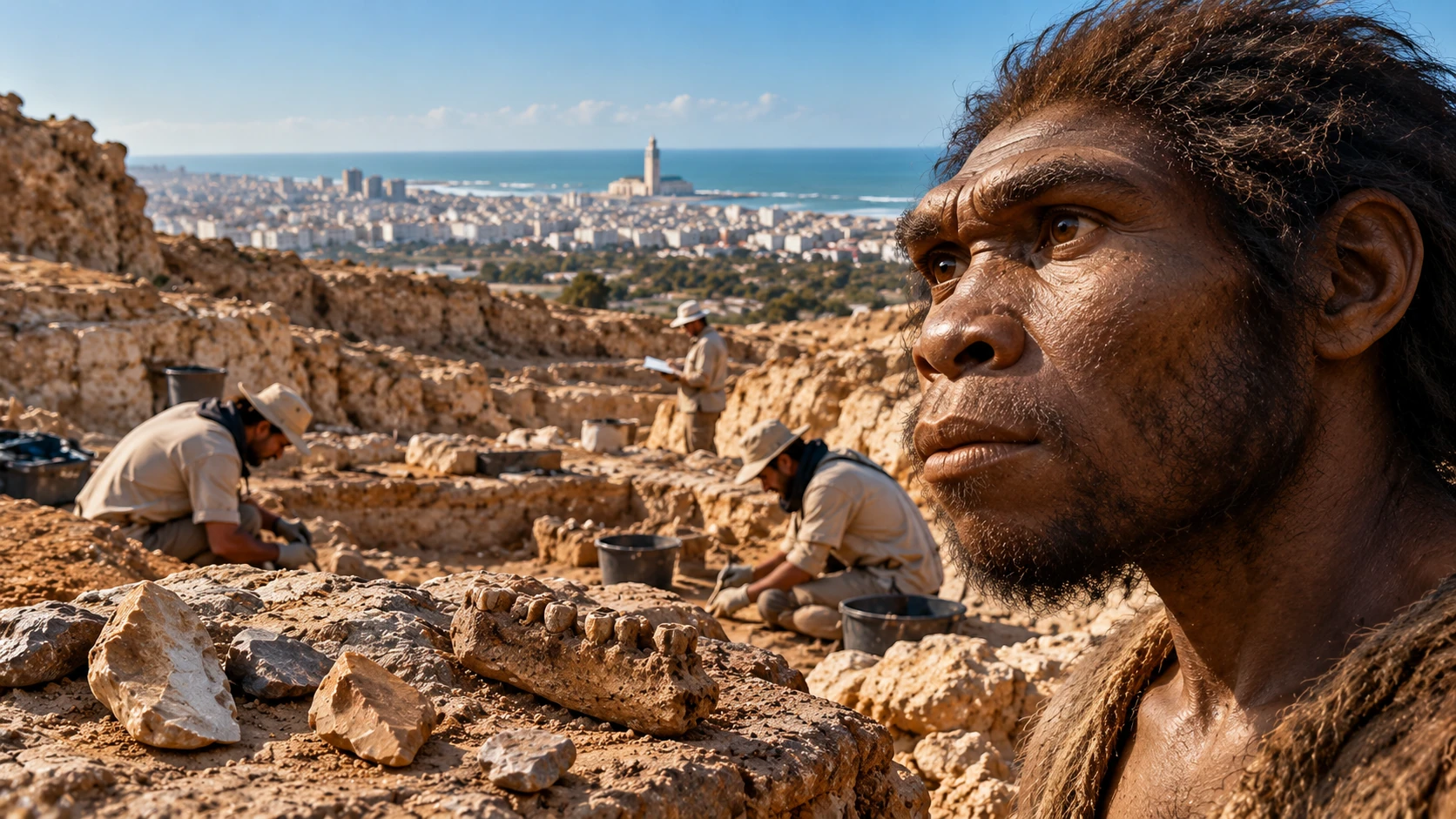
The hero is an AI-generated artistic reconstruction. The hominin face, excavation scene, skyline and visible bones are conceptual elements, not photographs of the site, an exact reconstruction of an individual or an inventory of the documented finds.
FAQ
Frequently Asked Questions
Are the Casablanca fossils Homo sapiens?
The study does not identify them as Homo sapiens. It suggests an evolved North African form of Homo erectus in the broad sense, with a debated position near later Homo ancestry.
How were they dated?
Magnetostratigraphy places their deposits near the Matuyama–Brunhes reversal, at a nominal age of about 773,000 ± 4,000 years, supported by geological and faunal evidence.
Are they the Jebel Irhoud fossils?
No. Jebel Irhoud is a separate site with early Homo sapiens remains associated with a central dating estimate of 315,000 years. Neither discovery proves a single modern-human birthplace.
PRESDA Dispatch
Stay Informed. Stay Aware.
A sharp briefing across AI, gaming, sport, business, world affairs, paparazzi, and lifestyle.