THE OCTOPUS MIND: AN INTELLIGENCE UNLIKE ANY OTHER ON EARTH
How octopuses learn, sense with their arms and change their skin. The science of distributed intelligence, tool use, memory and possible conscious experience.
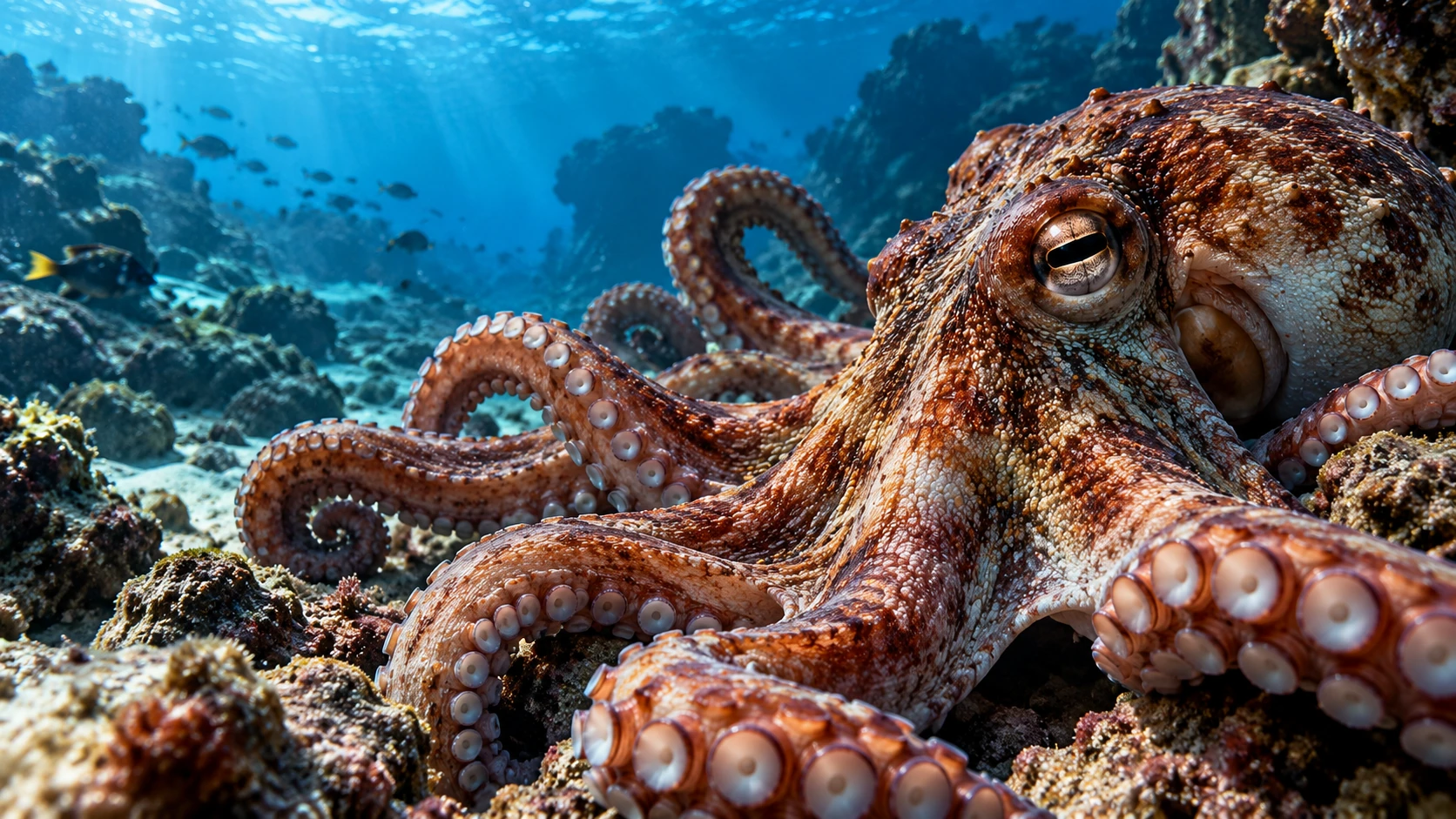
An arm disappears into a crack in the reef. Its suckers encounter a surface, detect chemicals and adjust their grip. Elsewhere, another arm explores, while the animal’s eyes survey the water. The remarkable thing is not simply that an octopus can do several things at once. Much of the neural work takes place outside its central brain. Distributed control · 2022 Chemotactile sensing · Cell, 2020
Octopus intelligence is not a miniature version of ours. It is a capacity for flexible behaviour built around a soft body, eight highly sensitive arms and a nervous system with a striking division of labour. Experiments demonstrate learning and adaptable manipulation. They do not establish human-like reasoning, nor tell us exactly what being an octopus feels like. The hero image is an editorial illustration. Learning and memory · Biological Bulletin, 2006 Sentience assessment · Biological Reviews, 2026
ONE ANIMAL, A DISTRIBUTED NERVOUS SYSTEM
The familiar figure of roughly 500 million neurons comes from estimates for the common octopus, Octopus vulgaris, not a census of every octopus species. A 2022 review reports approximately 170 million in the central brain including the optic lobes, and 350 million in the peripheral arm system. These rounded estimates explain the often-quoted total of about half a billion. Neuron number alone is not an intelligence score. Distributed control · 2022
The central brain integrates information and helps select behaviour; large optic lobes process vision. Axial nerve cords and associated circuitry in the arms handle substantial sensory and motor processing locally. Signals still travel between arms and brain. Distributed control means that the centre need not specify every sucker movement, not that each arm is a separate animal. Distributed control · 2022
Approximate estimates for Octopus vulgaris, summarised in a 2022 review. Not a count for every species or a measure of intelligence.
The central estimate includes about 130 million in the optic lobes and 40 million elsewhere in the central brain. These rounded values total about 520 million, often described as roughly 500 million. Bars share a zero baseline and a 350-million maximum.
Accessible data table
| Region | Approximate neurons (millions) |
|---|---|
| Central brain, including optic lobes | 170 |
| Peripheral arm system | 350 |
Source: Sivitilli, Smith & Gire (2022), neuroanatomical organisation
Biological Reviews (2026), II.2
PRESDA Data Graphics
MYTH VS FACT: DOES AN OCTOPUS HAVE NINE BRAINS?
“Nine brains” is a memorable shorthand, but an inaccurate anatomical description if taken literally. There is a central brain and extensive neural circuitry running through eight arms. The arm nerve cords are not eight miniature copies of the central brain. Local responsiveness and coordination do not demonstrate eight independent minds. The scientifically useful question is how the whole system combines local processing with central control. Distributed control · 2022
EIGHT ARMS THAT SENSE AS THEY MOVE
Suckers do more than attach. Research on the California two-spot octopus identified specialised cells and receptors for mechanical and chemical signals. Contact can reveal compounds that dissolve poorly in seawater, making touch a route to chemical information about concealed food or unsuitable objects. The popular phrase “taste by touch” describes this sensory combination, not a claim that octopuses experience human flavours. Chemotactile sensing · Cell, 2020
An arm can bend, shorten and stiffen without fixed joints. That freedom creates an enormous control problem. Local sensory feedback helps shape action as the animal encounters its surroundings. Yet vision matters too: in a 2011 three-choice maze experiment, common octopuses learned to guide one arm towards a visually marked compartment. Peripheral control and central information can work together. Visual arm maze · Current Biology, 2011
WHAT MAZES, PUZZLES AND CONTAINERS ACTUALLY SHOW
Laboratory work documents habituation, visual and tactile discrimination, associative learning and spatial learning. Habituation means reducing a response to a repeated, harmless stimulus. Associative learning connects a cue or action with an outcome. These are testable abilities, more informative than declaring the animal a genius. Research on the vertical-lobe system also offers a way to investigate neural mechanisms of learning and memory in a brain organised very differently from a mammal’s. Learning and memory · Biological Bulletin, 2006
In a 2016 study, seven common octopuses faced a food-containing L-shaped apparatus that had to be manipulated through an opening. The task progressed through increasingly demanding arrangements, including changes of orientation. Animals adapted their actions rather than simply repeating one pull. This is evidence of flexible problem-solving under those experimental conditions, not proof that an octopus understands geometry as a person does. Puzzle experiment · PLOS ONE, 2016
Opening containers belongs in this same careful frame. In that study, animals were first trained to open the food container. Practice, reward, prior experience and the object’s design all matter. An impressive manipulation does not by itself establish insight, foresight or a general-purpose capacity to solve any puzzle. Small samples also require caution when extending results to other species or wild populations. Puzzle experiment · PLOS ONE, 2016
A BODY THAT CAN CHANGE ITS APPEARANCE
Camouflage links perception to an extraordinary motor system. Neural commands control muscles around pigment-containing chromatophores, changing visible patterns; reflective structures contribute optical effects. Muscular papillae can alter the skin’s texture. Colour, contrast, posture and surface relief help an animal disappear against its surroundings or become conspicuous. This is biological control of skin, not conscious painting demonstrated by an experiment. Camouflage control · Current Biology, 2023
Nor is every display a disguise. Field research on Octopus tetricus documented body patterns and postures associated with conflicts between individuals. Dark displays were associated with more aggressive behaviour. Such findings support a signalling role in particular interactions. They do not establish a language, and they caution against treating all octopuses as socially identical or every colour change as an emotion we can read. Social signals · Current Biology, 2016
HUNTING, SHELTERS AND TOOLS
A flexible body allows an octopus to probe crevices and reach prey beyond the access of a rigid body. Hunting can also involve other species. A 2024 field study examined groups of day octopuses, Octopus cyanea, and fish. Different participants influenced where the group explored and how it moved; group composition affected hunting outcomes. Coordinated activity is observable. Calling it friendship or assuming a shared plan would add claims the evidence does not require. Octopus and fish hunting · Nature Ecology & Evolution, 2024
Tool use has a particularly clear example. Researchers reported veined octopuses, Amphioctopus marginatus, collecting and carrying coconut-shell halves, then assembling them as shelter. Transporting an object for later protection distinguishes this behaviour from simply hiding in a shelter already present. It is documented defensive tool use in that species, not evidence that all octopuses manufacture tools or imagine future events in a human way. Coconut tools · Current Biology, 2009
EXPLORATION WITHOUT HUMAN LABELS
Individuals do not all respond alike to a new object or situation. A recent common-octopus study identified behavioural dimensions labelled alertness, exploration and boldness. Here, “personality” is a research term for patterns of individual behavioural variation, not a full human character. Exploration can look like curiosity, but the feeling behind it is harder to test. Hunger, experience, stress and experimental context must be considered before interpreting a response. Individual differences · Behaviour, 2024
IS THERE SOMETHING IT FEELS LIKE TO BE AN OCTOPUS?
Learning and consciousness are different questions. Sentience usually means the capacity for felt experiences, including unpleasant and pleasant states. It does not require language or reflection about oneself. Scientists cannot obtain an octopus’s verbal report, so they assess converging behavioural and neural evidence rather than relying on resemblance to a human face. Sentience assessment · Biological Reviews, 2026
A 2021 experiment found that octopuses avoided a place associated with an acetic-acid injection and, when injured, preferred a place associated with local anaesthetic relief. Neural recordings added evidence of persistent injury-related activity. The combination supports an affective pain interpretation beyond an immediate withdrawal reflex. It remains an inference about experience, not a direct measurement of what pain feels like to that animal. Pain experiment · iScience, 2021
A 2026 review assessed strong evidence of sentience in octopuses across multiple criteria. Its conclusion deserves more weight than either casual claims that they are just reflex machines or assertions that their inner lives are fully understood. Conscious self-awareness, the unity of experience across a distributed system and the range of possible feelings remain open questions. Sentience assessment · Biological Reviews, 2026
ANOTHER EVOLUTIONARY ROUTE TO COMPLEXITY
Octopuses are molluscs, on the protostome branch of animal evolution. Humans are vertebrates on the deuterostome branch. Their separation lies deep in early animal history, hundreds of millions of years before either modern group existed. The elaborate brains of living cephalopods and vertebrates developed along different paths. Octopuses are not ancestors of humans, nor an intermediate step towards a mammalian brain. Evolution of nervous systems · 2023
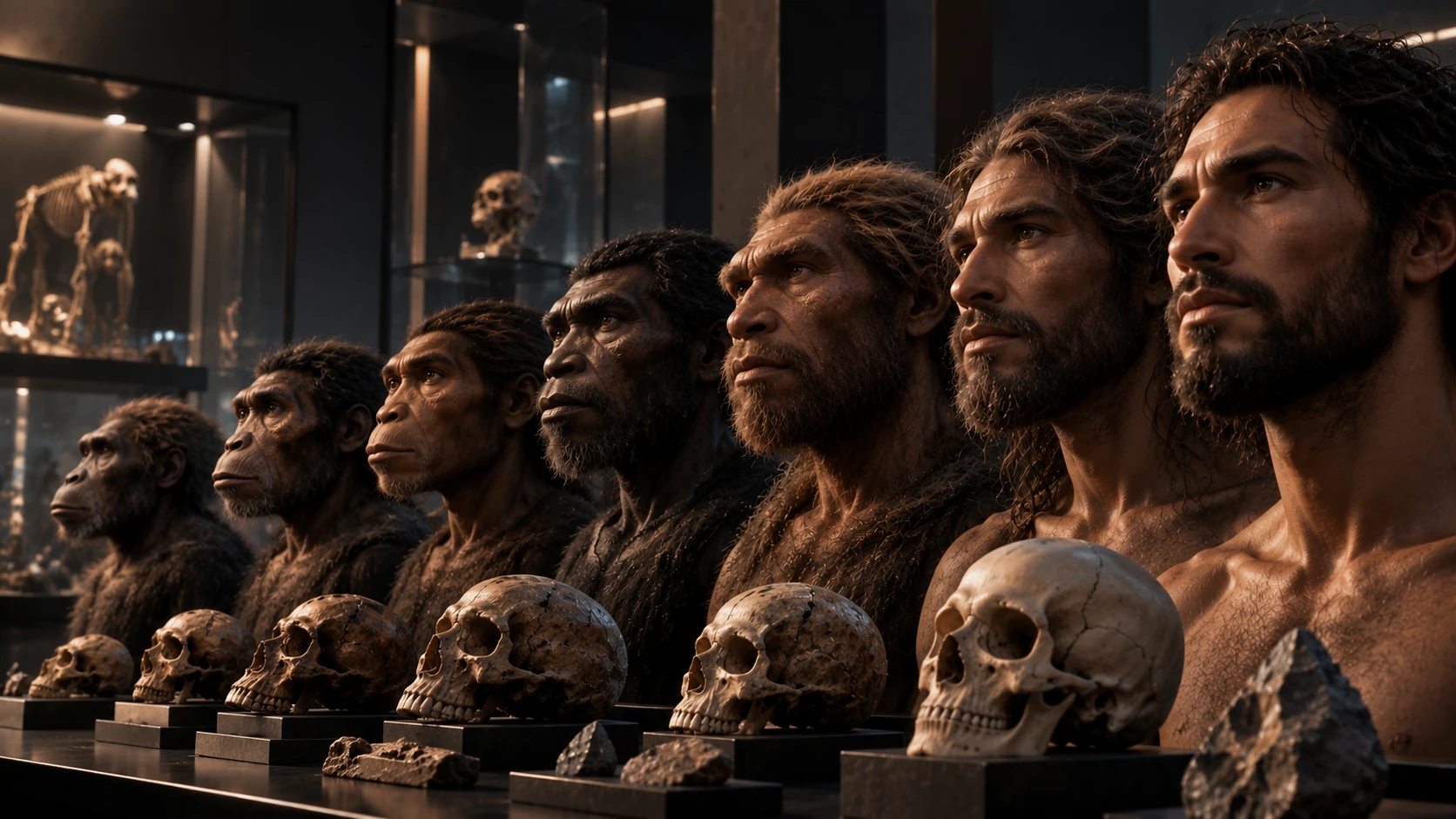
The octopus genome reinforces both difference and continuity. The 2015 genome study found expansions of gene families associated with neural development, alongside a broadly shared animal genetic toolkit. Complexity did not require an entirely alien biology. For the human side of this much later evolutionary story, see PRESDA’s human family tree. Octopus genome · Nature, 2015
Researchers investigate how predation, active hunting, sensory demands and loss or reduction of the ancestral protective shell favoured flexible behaviour. These are evolutionary explanations to test, not a single demonstrated reason intelligence appeared. A soft-bodied hunter faces very different problems from a primate navigating a social group. Evolution of nervous systems · 2023
A SOPHISTICATED MIND, OFTEN A SHORT LIFE
The common octopus typically lives around one to two years. That is striking beside long-lived vertebrates used in cognition research, but it is not a rule for every octopus. A deep-sea female Graneledone boreopacifica was observed brooding for 53 months, longer than the entire usual lifespan of many shallow-water species. Cephalopod biology · Annual Reviews, 2020 Deep-sea brooding · PLOS ONE, 2014
Many octopuses reproduce once and then enter a decline. Research links maternal behavioural changes and death to multiple signalling pathways in the optic glands, endocrine organs distinct from the visual optic lobes. Sophisticated learning therefore does not imply a long childhood or decades of accumulated experience. How life history shapes cognition remains an important comparative question. Maternal signalling · Journal of Experimental Biology, 2018
THE QUESTIONS THAT REMAIN
Which memories are stored where? How does the central brain coordinate changing local information from eight arms? How far do abilities demonstrated in a few laboratory species extend across octopus diversity? Even sleep presents a challenge: a 2023 study documented active sleep with changing skin patterns and wake-like neural activity. That does not demonstrate that octopuses dream as humans do. Octopus sleep · Nature, 2023
The octopus matters because it widens the scientific question. Intelligence need not be organised around a vertebrate skeleton or a mammalian cortex. Understanding it requires experiments suited to this animal’s body and senses, with uncertainty left visible. The strongest story is already remarkable: evolution produced flexible behaviour through a very different arrangement of brain, arms and skin. Explore more evidence-led features in PRESDA Science.
FAQ
Frequently Asked Questions
Does an octopus really have nine brains?
No. It has a central brain and extensive neural circuitry in its eight arms. Distributed processing is not evidence of nine independent minds.
How many neurons does an octopus have?
Common-octopus estimates are often summarised as about 500 million across the nervous system. Counts vary by anatomical definition and should not be applied to every species.
Can octopuses use tools?
Veined octopuses have been documented transporting coconut-shell halves and assembling them as protective shelters.
Are octopuses conscious?
Research supports sentience, including evidence consistent with pain experience. The exact nature of their subjective experience remains unknown.
PRESDA Dispatch
Stay Informed. Stay Aware.
A sharp briefing across AI, gaming, sport, business, world affairs, paparazzi, and lifestyle.