SCIENTISTS GROW EDIBLE POTATOES IN SIMULATED MOON SOIL
Oregon State researchers grow potatoes in amended lunar-soil simulants. The November 2026 paper, nutritional findings and limits before lunar farming.
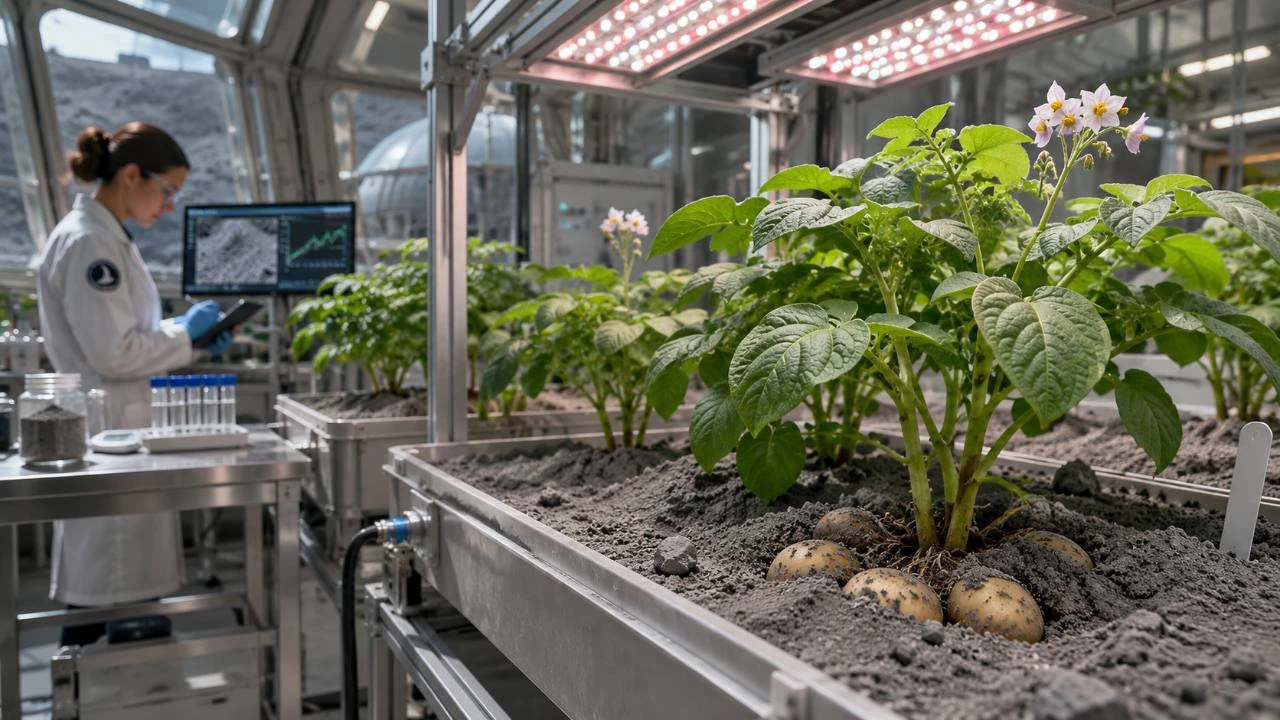
Supplied editorial illustration of a lunar-style greenhouse. The reported experiments took place on Earth; this is not a research photograph.
Scientists at Oregon State University have grown potatoes in simulated lunar soil and found that the harvested tubers retained broadly comparable nutritional profiles to potatoes grown in an Earth-soil control. The study, published in npj Microgravity on November 19, 2026, is encouraging for future space agriculture. It was conducted in a greenhouse on Earth, using supplemented simulants, not on the Moon or in untouched lunar material. Handy and colleagues: potato growth and molecular responses, npj Microgravity, November 19, 2026
That qualification makes the result more interesting, rather than less. The researchers did not simply ask whether a plant could stay alive in unusual dirt. They examined growth, harvestable tubers, molecular stress and food composition. The challenge for a future lunar farm is to produce useful food reliably, not merely a photograph of green leaves.
| Research element | Verified meaning |
|---|---|
| First mixture experiment | LMS-1E with 0%, 15% or 30% vermicompost by volume, plus fertilizer. |
| Five-simulant comparison | 5% vermicompost; tubers formed but yields remained below the Earth control. |
| Food composition | Broadly comparable profiles, with some metal elevations requiring monitoring. |
| Lunar application | A research prospect, not a demonstrated farm on the Moon. |
What did the researchers actually grow?
The team used Modoc, an early-maturing potato variety with red skin and white flesh. Mini-tubers were planted in controlled greenhouse experiments, with Adkins-series sandy soil from Oregon providing a terrestrial reference. The wider comparison covered five lunar regolith simulants representing different mare and highland materials. Handy and colleagues: potato growth and molecular responses, npj Microgravity, November 19, 2026
Regolith is the loose surface material covering rock. A simulant is an Earth-made material designed to reproduce selected characteristics of it. Such mixtures are research tools: they let scientists compare treatments without consuming scarce lunar samples, but they cannot reproduce every property or the full history of material exposed on the Moon.
The compost, and the fertilizer, matter
In the first experiment, researchers compared LMS-1E simulant with 0%, 15% and 30% vermicompost by volume. The corresponding simulant shares were 100%, 85% and 70%. Vermicompost is organic material processed by earthworms. The experiment used it as an amendment, not as evidence that worms had been cultivated on the Moon. Handy and colleagues: potato growth and molecular responses, npj Microgravity, November 19, 2026
The methods also specify supplemental slow-release fertilizer. That is a crucial detail: the result was not achieved with lunar-style minerals and water alone. Adding nutrients helped the team investigate substrate stress without confusing it with straightforward nutrient deficiency. A headline that omits all the inputs would misdescribe the experiment.
What improved, and what remained difficult?
Pure LMS-1E sharply restricted growth, including roots and biomass. At 30% vermicompost, plant biomass and morphology approached the terrestrial control. This result belongs to that particular mixture experiment; it is not proof that adding the same proportion solves every possible lunar substrate or every crop-production problem. Handy and colleagues: potato growth and molecular responses, npj Microgravity, November 19, 2026
The second experiment compared five simulants with 5% vermicompost by volume. Plants completed their life cycle and produced tubers, but canopy size and tuber yield remained below the Earth-soil control. That combination is important: producing a harvest and producing an equally productive crop are different achievements.
Differences between the mixtures also mattered. The researchers analysed leaves’ gene-expression patterns and found distinct stress responses across substrates. There was no single uniform reaction to all lunar-style materials. A future growing system would need to account for the actual material being used, rather than assume that all regolith is agriculturally interchangeable.
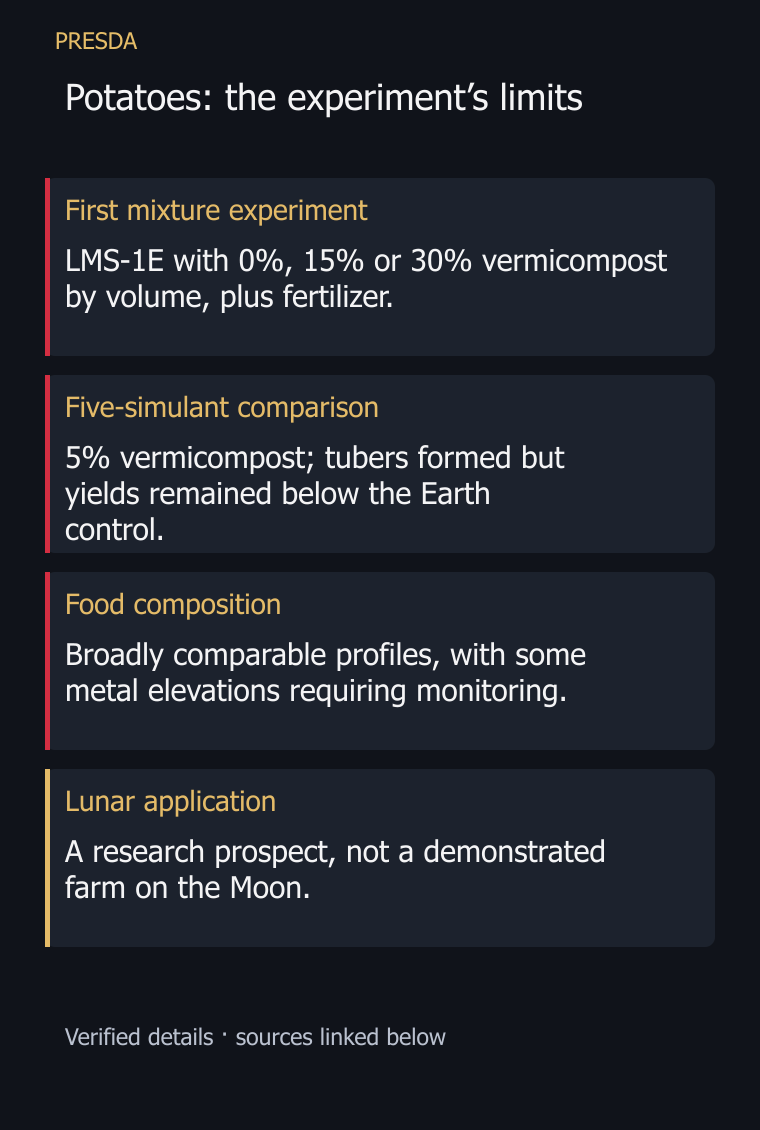
What the November 19 study establishes. Source: Handy and colleagues, npj Microgravity. These are Earth greenhouse experiments.
What does “edible” mean in this study?
The promising finding is that tuber metabolite profiles changed relatively little despite the plants’ stress. The researchers also examined the potato glycoalkaloids solanine and chaconine and did not find statistically significant increases in their principal comparisons. Growing under stress did not automatically translate into a strongly altered tuber composition. Handy and colleagues: potato growth and molecular responses, npj Microgravity, November 19, 2026
That is not a blanket food-safety certificate. Copper, zinc and aluminium were modestly elevated in some treatments, and the paper calls for continued monitoring and further verification. The study does not report a human feeding trial or establish the safety of every possible harvest over a lifetime of consumption.
Nutrition and yield are separate questions
A nutritionally promising tuber can come from a plant with poor yield. Conversely, a large harvest would not eliminate the need to test composition. The team’s approach matters because it considers both sides: how much food is produced and what is in the food. Those questions must remain separate when interpreting a successful experiment.
The distinction also prevents an attractive but misleading shortcut. The paper supports further development of potato cultivation in amended simulants. It does not show that astronauts can scoop up raw lunar dust, add a seed potato and obtain an unrestricted food supply without a carefully managed growing system.
Why potatoes are a useful crop to investigate
Potatoes offer a harvestable storage organ beneath the plant, making them a practical subject for research that follows an entire crop cycle. This study started with mini-tubers, not just seeds germinating for a short demonstration. Its measurements reached the part of the plant that would actually become food.
Oregon State had already highlighted the NASA-supported research in May 2026, while NASA’s project record describes work on potato growth, physiology and nutrition in lunar simulant media. The November paper supplies the detailed experimental account. These dates distinguish earlier public discussion of a project from publication of the peer-reviewed results. Oregon State: NASA-supported lunar potato research, May 12, 2026 NASA Task Book: potato growth and lunar simulant project
For future missions, the attraction is not simply novelty. Producing some food where people live could reduce dependence on supplies from Earth. But the accounting has to include the mass and energy needed for the entire system, including amendments and nutrients. This experiment does not provide a complete lunar farm’s transport or power budget.
How this differs from the 2022 Moon-soil experiment
NASA reported in 2022 that University of Florida researchers grew Arabidopsis thaliana in actual Apollo regolith samples on Earth. Those small research plants grew less robustly than the controls. That was a different species, a different experiment and genuine returned material, not this potato study. NASA: 2022 Arabidopsis experiment in actual Apollo regolith
Both results help ask better questions, but they should not be merged into a claim that potatoes have already been grown in Apollo soil or on the lunar surface. The 2026 paper itself warns that simulants have limitations and that responses to genuine lunar material can differ.
PRESDA’s account of the evidence from the Apollo missions provides context for why returned samples are scientifically valuable. They are a limited research resource, while simulants allow more extensive testing of controlled comparisons and potential remedies.
What a lunar farm would still need
An Earth greenhouse supplies conditions that the lunar environment does not supply naturally. A future habitat would have to manage pressure, temperature, water, light and protection for both people and crops. Growing a tuber in a greenhouse substrate is therefore one component of a much larger engineering problem.
The study also leaves questions about repeated harvests, changing substrate chemistry and the sustainability of the inputs. A working life-support system would need to maintain performance over time, rather than succeed in one batch. Consistent food quality would require continued testing as materials are reused and management practices change.
The next useful evidence
Larger trials, repeated crop cycles, carefully characterised materials and detailed analysis of edible tissue would strengthen the evidence. Experiments involving actual lunar material would answer a different question again. None of those next steps should be reported as complete simply because the first findings are promising.
The broader exploration context can be followed in PRESDA’s report on NASA’s planned return to the Moon. A mission schedule is distinct from a validated agricultural capability. The potato results are a research advance toward that capability, not an announcement that a lunar farm is ready to feed a crew.
A useful advance with clear boundaries
The strongest conclusion is specific: potatoes can complete their life cycle and produce nutritionally promising tubers in amended lunar regolith simulants under the conditions tested. Organic amendments helped, additional fertilizer was used, and important growth and safety questions remain.
The achievement deserves attention precisely because those boundaries are measurable. It moves the discussion from whether a plant can emerge to how a food crop performs. The road from a greenhouse in Oregon to dependable harvests on the Moon remains long, but this experiment supplies evidence for choosing the next steps.
FAQ
Frequently Asked Questions
Were these potatoes grown on the Moon?
No. The work was conducted in an Oregon State greenhouse on Earth using lunar regolith simulants.
Did the plants grow in pure simulated Moon soil?
Unamended LMS-1E severely restricted growth. Successful cultivation involved organic amendments, and the methods also specify supplemental fertilizer.
Why does the headline call the potatoes edible?
The paper reports nutritionally acceptable tubers and broadly comparable composition. It also identifies metal elevations and the need for further monitoring, rather than certifying every future harvest as safe.
What does the 30% figure describe?
Vermicompost by volume in the first LMS-1E mixture experiment. The separate comparison of five simulants used 5% vermicompost.
Does the finding mean a lunar farm is ready?
No. Habitat engineering, repeated harvests, inputs, yield and continuing food-quality monitoring still need to be addressed.
PRESDA Dispatch
Stay Informed. Stay Aware.
A sharp briefing across AI, gaming, sport, business, world affairs, paparazzi, and lifestyle.